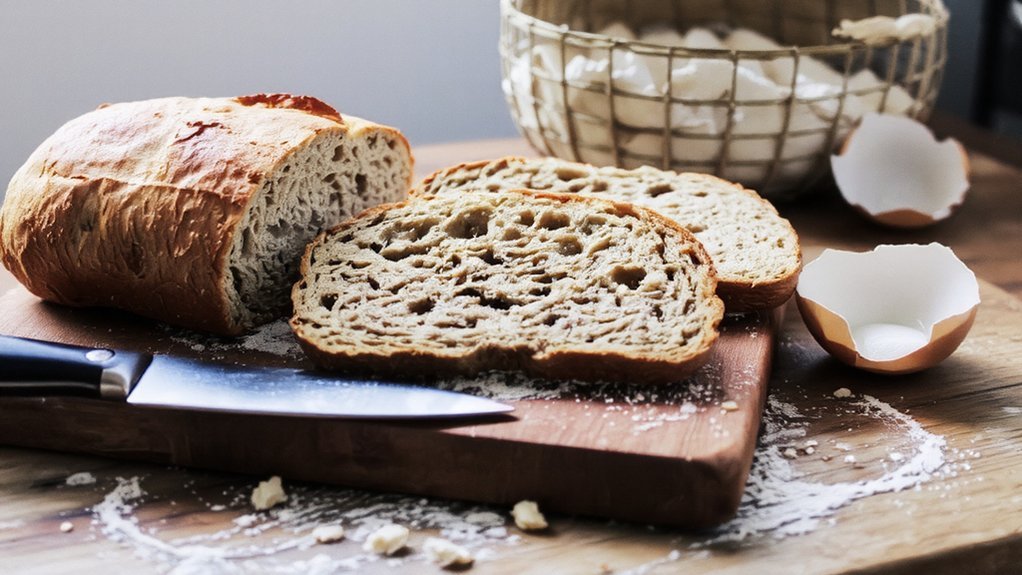

Key Takeaways
- Insufficient kneading prevents adequate gluten development, trapping less gas and creating a compact loaf structure.
- Over-proofing causes gluten breakdown; use the poke test to ensure dough slowly springs back, not stays indented.
- Water temperature below 75°F or above 120°F inhibits yeast activation; aim for 75–85°F for proper fermentation.
- Rough handling during shaping compacts gas bubbles; use gentle, deliberate movements to preserve internal air pockets.
- Oven temperature fluctuations or inaccurate calibration prevent proper oven spring; verify true temperature with an independent thermometer.
Insufficient Kneading
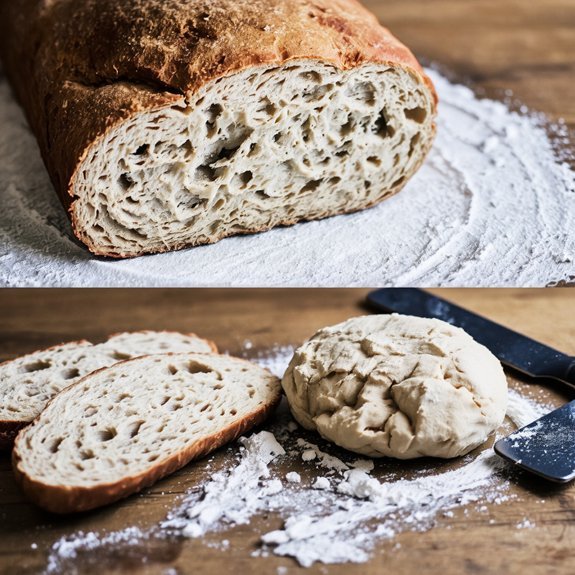
Skipping or rushing the kneading process is one of the most common culprits behind dense bread.
When you don’t knead adequately, you’ll fail to develop the gluten network that traps gas and creates an open crumb structure.
Inadequate kneading prevents gluten network development, which traps gas and creates the open crumb structure your bread needs.
You need sufficient gluten development to achieve the proper dough elasticity.
Here’s how to verify you’ve kneaded enough: perform the windowpane test.
Stretch a small dough piece between your fingers.
If it forms a thin, translucent membrane without tearing, you’ve developed gluten correctly.
If it tears immediately, keep kneading.
Most dough requires 8-10 minutes of hand kneading or 5-6 minutes with a stand mixer.
Don’t shortcut this step.
Underkneaded dough won’t rise properly and’ll produce a tight, compact loaf instead of the light, airy texture you’re after.
Improper Yeast Activation
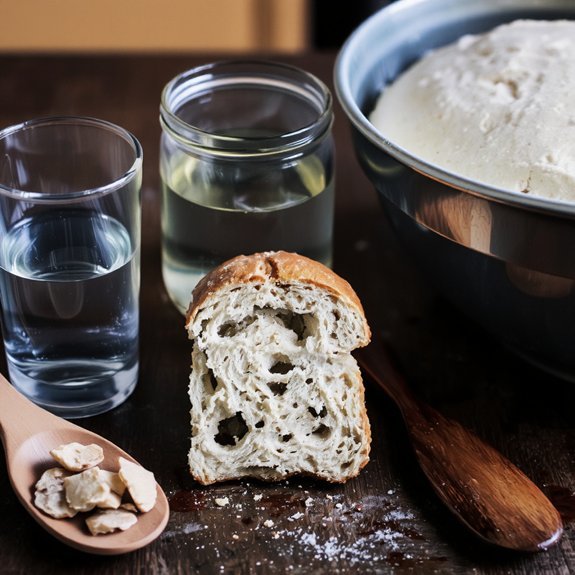
Beyond gluten development, yeast activation plays an equally important role in achieving proper bread rise and texture. You can’t simply mix yeast into your dough and expect ideal fermentation. Different yeast strains require specific conditions to activate properly.
Your activation medium—typically warm water between 105-110°F—must be precisely controlled. If you’re using water that’s too cold, you’ll inhibit yeast metabolism. Conversely, water exceeding 120°F kills yeast cells entirely.
You’ll also want to verify your yeast’s freshness; expired cultures won’t generate sufficient gas production. When you activate yeast correctly in the right medium before mixing it into your dough, you enable robust CO2 production.
This fermentation process creates the air pockets that give bread its open crumb structure and light texture. Skipping proper yeast activation results in dense, heavy bread.
Over-Proofing Your Dough
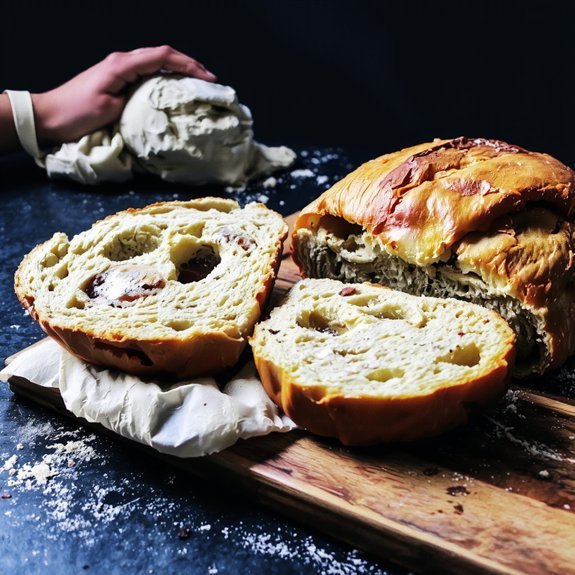
You’ll recognize over-proofed dough by its collapsed structure, sticky texture, and inability to hold shape when scored.
To prevent this, you’ll need to time your bulk fermentation precisely—typically 4-6 hours at room temperature, though variables like flour type and ambient temperature demand adjustment.
The poke test method gives you immediate feedback: when you press your fingertip into the dough, it should slowly spring back halfway; if the indentation stays, you’ve over-proofed.
Signs of Over-Proofed Dough
When dough’s fermentation extends too long, it’ll develop telltale characteristics that signal it’s crossed the threshold from properly proofed to compromised.
You’ll notice a Collapsed Crust—the surface appears deflated and wrinkled rather than taut and springy. Press your finger into the dough; it won’t spring back quickly, indicating gluten breakdown and excessive gas loss.
An Alcohol Aroma becomes prominent, signaling overactive yeast consuming sugars.
Your dough may feel sticky and lose structural integrity. You might observe a grayish tint developing on the surface from oxidation.
These indicators tell you fermentation’s gone too far.
Your bread won’t achieve proper oven spring, resulting in dense, gummy crumb structure. Take control: reduce proofing time or lower fermentation temperature to prevent this outcome.
Timing Your Bulk Fermentation
Since fermentation speed varies based on temperature, hydration, and flour type, you’ll need to monitor your dough’s development rather than rely solely on clock time.
Ambient temperature directly controls fermentation pace—warmer environments accelerate it, while cooler conditions slow it down.
To nail your timing:
- Perform the poke test: gently press your dough; it should spring back slowly, not instantly or not at all
- Watch for a 50-75% volume increase during bulk fermentation, indicating ideal flavor development
- Check internal temperature; dough around 75-78°F ferments predictably
You’re chasing that sweet spot between under- and over-fermentation.
Over-proofed dough collapses during shaping and baking, creating dense crumb structure.
Under-proofed dough stays tight and compact.
Master these visual and tactile cues, and you’ll consistently produce open, airy bread regardless of conditions.
The Poke Test Method
How can a simple finger poke reveal whether your dough’s reached its breaking point? The poke test determines if you’ve over-proofed your dough by measuring its resilience.
After sanitary prep—wash your hands thoroughly—gently poke your dough’s surface with one finger.
If the indent springs back quickly, your dough needs more time. A consistent poke that slowly rebounds indicates proper proofing.
However, if the depression remains and doesn’t spring back, you’ve over-proofed it.
Over-proofed dough loses gluten strength, producing dense, gummy bread with poor oven spring. This collapse happens because fermentation weakened the gluten network beyond recovery.
Master this tactile assessment, and you’ll eliminate dense loaves caused by excessive fermentation time. Your dough’s response tells you everything you need to know.
Under-Proofing Your Dough
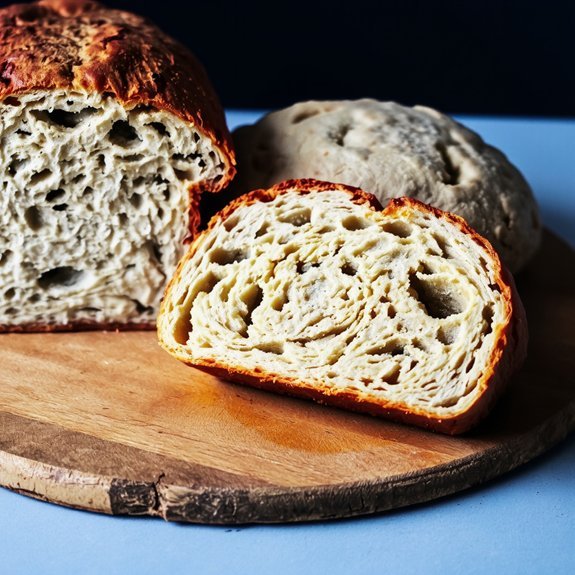
If you’re producing dense bread, under-proofing your dough is likely the culprit.
You’ll notice crumb tightness and compact structure when fermentation time falls short. The dough simply hasn’t developed enough gas pockets to create an open crumb.
Under-proofing causes multiple issues you’ll want to avoid:
- Crumb tightness that makes slicing difficult and reduces eating pleasure
- Flavor underdevelopment because fermentation builds complex tastes through yeast activity
- Poor oven spring since insufficient gas development limits rise potential
You control proofing by monitoring dough temperature, ambient conditions, and rise indicators. Don’t rush this stage. Your dough should roughly double in volume and show slight surface puffiness when ready. Press gently—it should spring back slowly, not immediately.
Master this timing, and you’ll eliminate dense bread permanently.
Using Old or Expired Ingredients
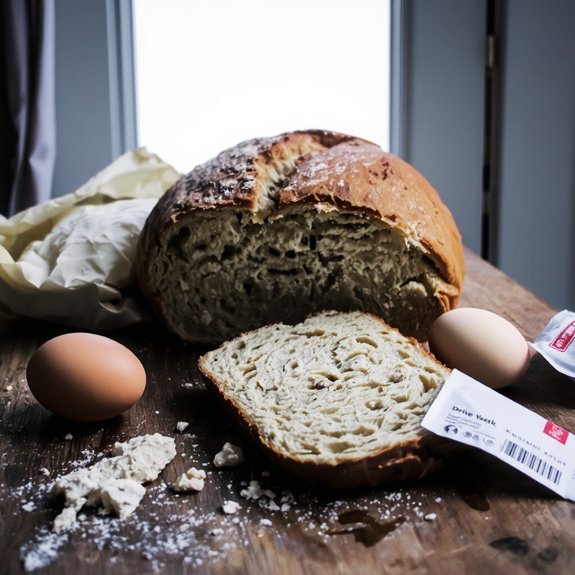
Beyond timing issues, you’ll find that expired ingredients sabotage your bread’s rise and structure just as severely as under-proofing does.
Stale flour loses its gluten-developing capacity and water absorption ability, resulting in dense, crumbly loaves. Old yeast won’t ferment effectively, leaving your dough flat and lifeless. Rancid fats oxidize and break down, compromising gluten networks and trapping fewer air pockets during baking.
Check your ingredient expiration dates ruthlessly—yeast especially degrades rapidly after opening. Store flour in airtight containers away from heat and humidity to prevent staleness. Keep fats refrigerated or frozen to prevent rancidity.
Don’t compromise your bread’s quality by using questionable ingredients. Fresh, viable components guarantee proper fermentation, superior rise, and the open crumb structure you’re after.
Incorrect Water Temperature
Water temperature directly controls yeast activation and dough development, making it one of the most critical variables you’ll manage during mixing.
You need precise control to achieve ideal fermentation and gluten structure.
- Cold water (below 75°F) slows yeast metabolism, resulting in extended rise times and dense crumb structure
- Excessive heat (above 90°F) kills yeast cells, preventing proper leavening and creating heavy bread
- Water hardness and chlorine effects interfere with yeast performance; chlorine inhibits fermentation while mineral content affects gluten development
You’ll want water between 75–85°F for standard recipes.
Account for ambient temperature, flour friction, and friction factor when calculating your ideal water temperature.
Chlorinated tap water requires 24-hour resting periods or filtration to eliminate chemical interference.
Test your water temperature with a reliable thermometer—this single adjustment eliminates dense bread problems you’ve likely encountered.
Not Allowing Enough Rise Time
Because fermentation generates the gas that creates an open crumb structure, insufficient rise time directly produces dense bread. You’re cutting short the yeast’s opportunity to develop flavor and lift your dough properly.
| Factor | Impact | Solution |
|---|---|---|
| Temperature | Slows fermentation | Maintain 75-78°F |
| Humidity Control | Affects rise speed | Monitor at 65-70% |
| Altitude Effects | Reduces pressure | Extend time 10-15% |
You’ll notice that bulk fermentation typically requires 4-6 hours at room temperature. Don’t rush this phase. Insufficient rise time leaves you with compact, gummy bread that lacks the structure you’re seeking. Account for humidity control and altitude effects in your environment—they’re variables you can’t ignore. Give your dough the time it demands, and you’ll achieve the open crumb structure that defines quality bread.
Compacting the Dough During Shaping
When you shape your dough, you’ll compact gas bubbles if you apply excessive pressure with your hands or work surface, which directly reduces the bread’s final volume and creates a dense crumb structure.
You’re degassing the dough through rough handling—aggressive folding, aggressive pressing, or aggressive kneading during the shaping phase releases the carbon dioxide that provides lift in the oven.
To preserve the dough’s gas structure, you’ll need to handle it gently during shaping, using minimal pressure and deliberate movements that maintain rather than destroy the existing air pockets.
Excessive Pressure During Shaping
While you’re shaping your dough, applying too much pressure compacts the gluten network and expels gas that’d otherwise create an open crumb structure.
You need to handle your dough with deliberate restraint to preserve the fermentation work you’ve already done.
- Tool selection matters—use your hands or a bench scraper designed for gentle manipulation rather than aggressive kneading motions
- Develop proper technique—fold dough with controlled movements, allowing surface tension to build naturally without crushing air pockets
- Master scoring technique—apply cuts decisively but shallowly after shaping; deep or rough scoring indicates you’re compensating for poor dough handling
Your goal is creating tension on the dough’s surface while maintaining internal air cells. Practice light, intentional movements. Respect your dough’s structure, and you’ll achieve the open crumb you’re after.
Degassing While Handling Dough
Even with careful handling, you’ll still encounter degassing if you’re not mindful of how pressure collapses gas bubbles during shaping.
When you handle dough roughly, you destroy the fermentation work you’ve invested. Your dough contains countless gas pockets developed during bulk fermentation—these pockets determine your bread’s final crumb structure.
Aggressive handling compacts these bubbles, releasing trapped CO2 and collapsing your loaf’s potential volume.
Practice gentle folding techniques instead. Use minimal pressure when pre-shaping and final shaping. Support the dough with cupped hands rather than pressing down forcefully. Bubble preservation requires restraint; let the dough’s structure guide your movements.
You’re not wrestling the dough—you’re redirecting it. This distinction separates dense, gummy crumbs from open, airy texture.
Your freedom to achieve excellent bread depends on respecting the dough’s delicate gas architecture throughout handling.
Oven Temperature Issues
Because bread’s crumb structure and crust development depend heavily on precise heat, an inaccurate oven temperature is one of the primary culprits behind dense loaves.
You’ll encounter several temperature-related issues:
- Insufficient calibration – Your oven’s displayed temperature may differ substantially from actual internal heat, requiring you to verify true temperature with an independent thermometer.
- Uneven heat distribution – Hot spots create inconsistent baking, forcing you to rotate your loaf midway through baking for uniform browning and rise.
- Temperature fluctuations – Older ovens lack consistent heating cycles, preventing proper oven spring during the critical first minutes of baking.
You’ll achieve superior results by investing in temperature calibration and monitoring techniques.
This autonomy over your baking environment directly determines whether your bread rises properly or remains disappointingly dense.
Frequently Asked Questions
Does the Type of Flour I Use Affect Bread Density?
Yes, your flour choice directly impacts bread density.
You’ll find that high-protein flours like bread flour (12-14% protein) develop stronger gluten networks, yielding lighter, airier loaves.
All-purpose flour’s moderate protein content produces denser results.
Whole wheat flour’s bran content interferes with gluten development, creating denser crumbs.
If you’re chasing freedom from heavy bread, opt for bread flour and sift out excess bran.
Lower protein flours guarantee denser outcomes regardless of technique.
How Does Altitude or Humidity Impact My Bread’s Texture?
Your altitude and humidity directly control your bread’s final texture.
At higher elevations, you’ll experience reduced air pressure, which accelerates yeast activity and causes premature oven spring.
High humidity weakens gluten structure, creating dense crumbs.
You’re free to adjust your fermentation times and hydration levels accordingly.
Lower humidity demands increased water; thinner air requires shorter rise periods.
Monitor these variables to master your dough’s texture independently.
Should I Use Bread Flour Instead of All-Purpose Flour?
Yes, you should switch to bread flour for lighter results.
Bread flour’s higher protein content—typically 12-14% versus all-purpose’s 10-12%—develops stronger gluten networks, reducing density. You’ll gain superior rise and crumb structure.
Consider cost comparison: bread flour runs slightly higher per pound, though availability differences vary by region. Independent bakers often find the investment worthwhile for consistent, superior outcomes. You’re not locked into all-purpose; choose what serves your baking freedom best.
Can I Fix Dense Bread by Adjusting My Recipe?
You can fix dense bread by adjusting your recipe strategically.
Increase hydration to improve gluten development and crumb structure.
Extend your fermentation time—both bulk and final proof—allowing yeast more opportunity to generate gas.
You’re not bound by traditional timelines; experiment with your schedule.
These modifications strengthen your dough’s ability to trap air effectively, yielding a lighter, more open crumb that resists that heavy, compact texture you’re fighting against.
Does the Speed of My Mixer Affect Dough Development?
Yes, your mixer’s speed directly impacts gluten development and dough temperature. You’ve got the freedom to control outcomes by adjusting settings.
Higher speeds accelerate gluten formation but risk overheating your dough—aim for 75-78°F. Slower speeds give you better temperature control and gentler development.
You’ll want to monitor both factors simultaneously. Match your mixer’s speed to your recipe’s requirements and environmental conditions for ideal results.


Leave a Comment