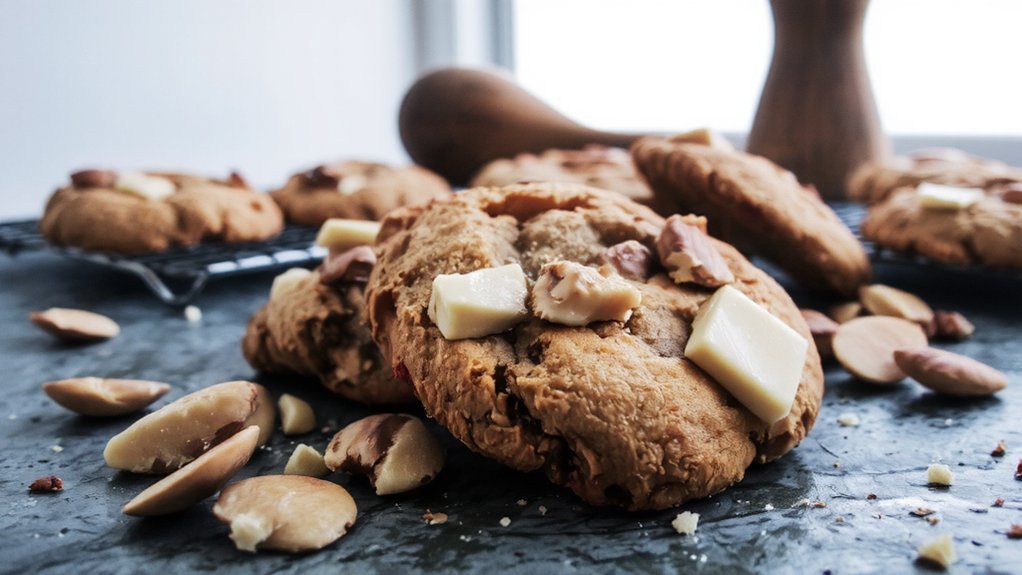

Key Takeaways
- Cream softened butter and sugar 2–3 minutes until pale and fluffy for optimal texture and structure.
- Chill dough at least 2 hours at 40°F to relax gluten and develop deeper flavor complexity.
- Bake at 350°F for 11–13 minutes until edges are golden but centers remain slightly underbaked.
- Rest cookies on baking sheet 2 minutes before transferring to wire racks to prevent collapse.
- Use couverture-grade white chocolate and toast macadamia nuts at 325°F for 8 minutes to enhance flavor.
Ingredients You’ll Need
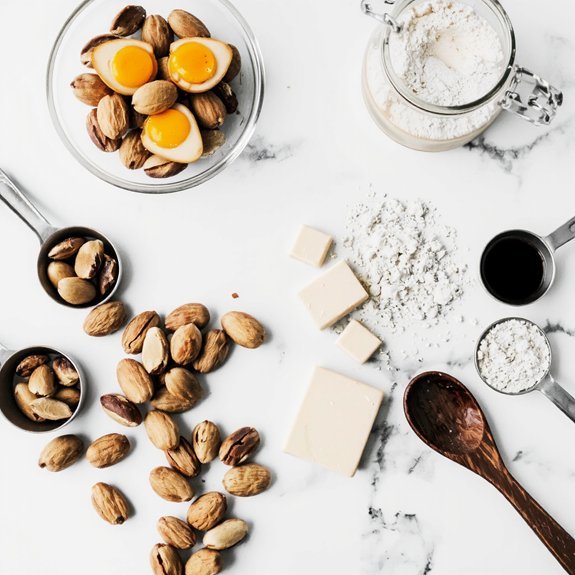
Gather these ingredients before you begin: 2¼ cups all-purpose flour, 1 teaspoon baking soda, 1 teaspoon salt, 1 cup unsalted butter (softened), ¾ cup granulated sugar, ¾ cup packed brown sugar, 2 large eggs, 2 teaspoons vanilla extract, 2 cups white chocolate chips, and 1½ cups macadamia nuts (chopped).
When sourcing tips matter most, you’ll want to select high-quality components from reputable suppliers.
Select high-quality components from reputable suppliers when sourcing ingredients for optimal baking results.
Check allergen labeling carefully, as macadamia nuts and white chocolate may contain traces of other tree nuts or dairy.
You’re responsible for verifying ingredient sourcing aligns with your dietary preferences and restrictions.
Purchase unsalted butter for precise flavor control.
Chopping macadamia nuts yourself guarantees ideal texture and freshness.
Store your white chocolate chips in cool conditions to prevent melting.
Organize all components before mixing to streamline your baking process efficiently.
Why White Chocolate and Macadamia Nuts?
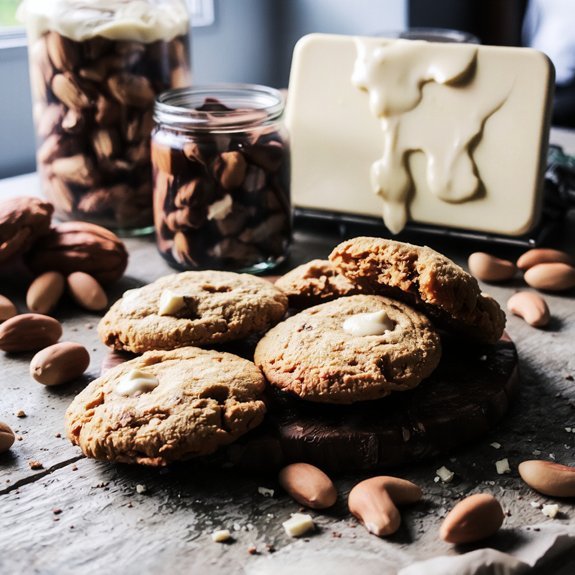
Now that you’ve assembled your premium ingredients, understanding the flavor dynamics of white chocolate and macadamia nuts becomes your foundation for baking success.
White chocolate delivers creamy sweetness with subtle vanilla notes, creating Flavor Harmony that doesn’t overpower your palate.
Macadamia nuts contribute buttery richness and delicate earthiness, complementing the chocolate’s brightness.
The Textural Contrast between soft, melting chocolate and crunchy nuts elevates your cookies beyond ordinary confections.
Macadamias’ superior fat content promotes moisture retention, preventing dry results.
Their mild flavor profile allows white chocolate to shine while providing structural integrity to each bite.
This pairing grants you creative freedom—you’re not bound by aggressive flavor combinations.
Instead, you’re crafting a sophisticated cookie with balanced sweetness and nuanced complexity.
The premium quality of both ingredients justifies your effort, delivering professional-caliber results in your own kitchen.
Preparing Your Ingredients
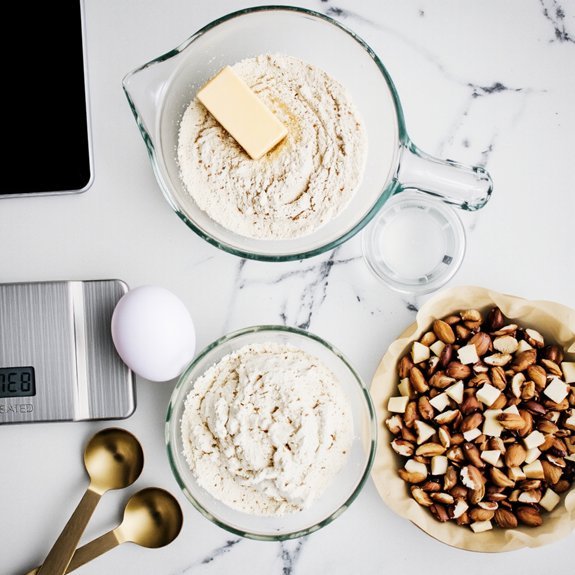
Measuring your dry and wet components separately guarantees precise incorporation and ideal dough development.
Separate dry and wet components for precise incorporation and optimal dough development in every batch.
You’ll want to use a kitchen scale for accuracy—volumetric measuring cups can introduce inconsistencies.
Weigh your flour, sugar, baking soda, and salt in one bowl.
In another, combine softened butter and eggs.
For sourcing tips, select raw macadamia nuts from reputable suppliers offering freshness guarantees.
White chocolate quality matters markedly; choose couverture-grade varieties containing cocoa butter rather than vegetable oil substitutes.
Your measuring techniques should include leveling dry ingredients with a straight edge and bringing cold ingredients to room temperature beforehand.
This methodology delivers consistent results across batches.
Don’t compromise on ingredient quality—superior components yield superior cookies that justify your investment in precision and sourcing excellence.
Mixing the Perfect Dough
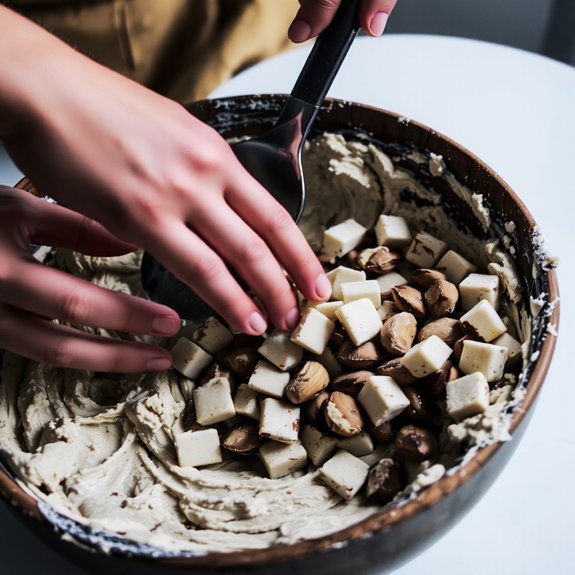
You’ll want to make sure your butter and eggs reach room temperature before you begin, as this facilitates proper emulsification and incorporates air more effectively.
Start by creaming your softened butter with sugar for approximately 2-3 minutes until the mixture becomes pale and fluffy, which aerates the dough and creates the ideal texture.
This foundational step directly impacts your cookies’ final structure, so don’t rush the process.
Ingredient Temperature Matters
Since butter’s plasticity directly influences dough development and cookie texture.
Maintaining proper ingredient temperatures is essential for consistent results.
You’ll achieve ideal dough consistency by following these temperature guidelines:
- Butter conditioning: Bring your butter to 65-68°F for ideal creaming action, ensuring you’re not constrained by cold ingredients that resist proper incorporation.
- Egg tempering: Use room-temperature eggs at 70°F to promote emulsification and prevent dough separation, giving you control over your baking outcome.
- Shipment temperature monitoring: If ordering ingredients, verify thermal labeling on packages to confirm they’ve maintained appropriate temperatures during transit.
You’ll notice that cold ingredients create dense, uneven cookies.
Properly tempered components yield uniform rise and texture.
This precision methodology eliminates guesswork and guarantees repeatable success.
Creaming Butter and Sugar
Combining softened butter with granulated sugar creates the foundation for proper cookie structure through mechanical incorporation of air. You’ll beat these ingredients together for approximately 2-3 minutes until you achieve a light, fluffy consistency with a pale appearance. This creaming process, rooted in baking’s historical origins, aerates your mixture and guarantees even distribution of sugar crystals.
The visual presentation transforms from a dense paste into a voluminous, cloud-like texture. You’re establishing emulsification, which allows subsequent wet and dry ingredients to integrate seamlessly. Temperature precision matters here—butter between 65-70°F yields ideal results without greasing.
This methodology grants you freedom from dense, heavy cookies. Proper creaming produces the tender crumb structure your white chocolate macadamia cookies demand, delivering superior texture and lift throughout your finished product.
Chilling for Best Results
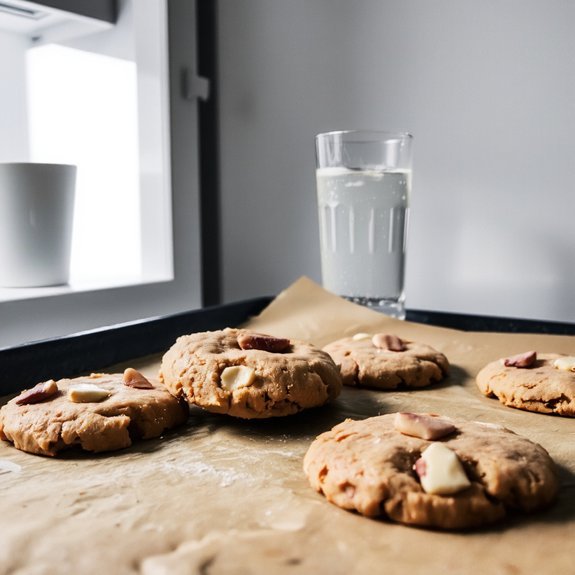
After mixing the dough, refrigerate it for a minimum of 2 hours at 40°F (4°C) to allow the gluten structure to relax and the flavors to develop fully.
This chilling period enables flavor maturation, transforming your cookies into sophisticated treats with complex taste profiles.
You’ll gain several advantages through proper refrigeration:
- Enhanced dough workability—cold dough resists spreading during baking, yielding thicker, chewier cookies
- Superior flavor development—ingredient integration deepens as temperatures stabilize
- Improved texture consistency—controlled gluten relaxation prevents unwanted spread patterns
If you’re pressed for time, freezer alternatives work effectively.
You can freeze dough for up to three months, baking directly from frozen with minimal time adjustments. This flexibility lets you maintain your schedule while preserving baking excellence.
Your commitment to proper methodology guarantees exceptional results.
Shaping and Spacing Your Cookies
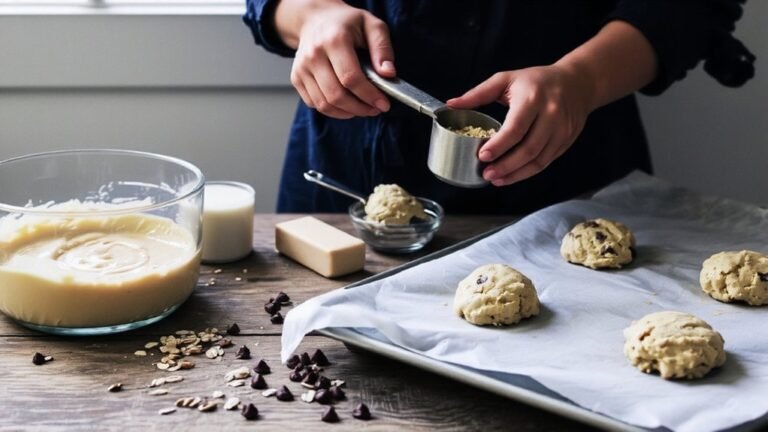
Once your dough’s chilled, you’ll shape each portion into uniform balls weighing approximately 1.5 ounces (42 grams) to guarantee consistent baking times and browning.
Uniform scooping using a standardized cookie scoop provides precision and eliminates guesswork from your process.
Space each ball two inches apart on your parchment-lined baking sheet, allowing adequate room for lateral expansion during baking.
This spacing prevents cookies from merging together, maintaining individual structure and texture.
If you prefer a refined presentation, you can apply stamped patterns to each dough ball using a fork or decorative tool before baking.
Press gently to avoid compressing the dough excessively.
Maintain consistent sizing throughout your batch—this disciplined approach delivers predictable results and professional-quality cookies you’ll control completely.
Baking to Golden Perfection
You’ll bake your cookies at 350°F for 11-13 minutes, monitoring them closely as they shift from pale to light golden brown.
Temperature control matters substantially because even a 25-degree variance can produce undercooked centers or overdone edges, compromising both texture and flavor.
Remove your cookies from the oven when the edges set but the centers still show slight underbaking, as residual heat will continue the cooking process during the cooling phase.
Baking to Golden Perfection
When your oven’s reached 350°F, you’re ready to transfer the dough onto parchment-lined baking sheets, spacing each cookie about two inches apart to allow for proper spread during baking.
Bake for 11-13 minutes until the edges achieve a light golden hue while centers remain slightly underbaked.
This technique guarantees ideal texture—crispy exteriors with chewy interiors.
Monitor these critical factors:
- Internal temperature should reach 165°F for food safety
- Cookie bottoms must display golden-brown coloration without burning
- Centers should yield slightly when pressed, indicating doneness
Remove sheets from heat and allow cookies to cool for two minutes before transferring to wire racks.
This resting period prevents structural collapse.
For presentation techniques and serving pairings, consider arranging cookies on elevated stands or pairing with cold milk for enhanced enjoyment and visual appeal.
Temperature Control Matters
Because oven temperature directly impacts cookie structure and texture, you’ll need to verify your oven’s accuracy with an independent thermometer before baking begins.
Precision heating guarantees your macadamia cookies develop proper browning without burning.
Maintain a consistent 350°F throughout the baking cycle.
You’re establishing thermal comfort for even heat distribution across all cookies simultaneously.
Rotate your baking sheet halfway through the 12-minute cycle to counteract hot spots common in most home ovens.
After baking, immediate server cooling on wire racks prevents carryover cooking that darkens edges excessively.
This rapid temperature reduction halts the cooking process, preserving your desired golden exterior and chewy center.
You’ll gain ideal results by respecting these temperature parameters.
Independence from guesswork means mastery over your baking outcomes—every batch delivers consistent, professional-quality cookies.
Cooling and Storage Tips
After removing the cookies from the oven, let them rest on the baking sheet for 2-3 minutes before transferring them to a wire cooling rack.
They’ll firm up completely within 15-20 minutes.
You’ll maximize your cookies’ shelf life through strategic storage methods:
- Airtight Containers – Store cooled cookies in food-grade airtight containers at room temperature for up to five days, maintaining ideal texture and flavor integrity.
- Portion Freezing – Individually wrap cookies in parchment paper and freeze in labeled containers for up to three months, preserving quality without crystallization.
- Temperature Control – Keep storage areas between 60-70°F, away from direct sunlight and moisture sources that compromise structural integrity.
You’ll maintain peak freshness by implementing these evidence-based techniques, ensuring your white chocolate macadamia cookies deliver consistent quality whenever you choose to enjoy them.
Variations and Flavor Twists
You can elevate your white chocolate macadamia cookies by incorporating tropical fruit infusions—consider adding 1/4 teaspoon of passion fruit extract or finely grated lime zest to your dough for bright, citrus notes.
Alternatively, you’ll achieve deeper complexity with a spiced brown butter twist by browning 2 ounces of butter until nutty, then infusing it with 1/4 teaspoon cardamom and 1/8 teaspoon cayenne pepper before folding it into your wet ingredients.
Each variation requires you to maintain consistent oven temperature and baking time while adjusting other liquid ratios proportionally to preserve the cookie’s structural integrity.
Tropical Fruit Infusions
Incorporating tropical fruits into white chocolate macadamia cookies elevates the flavor profile through strategic ingredient substitution and complementary textural elements.
You’ll craft innovative cookies that reflect current market trends while honoring cultural traditions from Pacific island baking.
Consider these additions:
- Dried pineapple chunks (¼ cup, finely diced) for tartness and moisture retention
- Freeze-dried passion fruit powder (1 teaspoon) for concentrated flavor without excess liquid
- Candied mango pieces (⅓ cup) for chewy texture and natural sweetness
Replace 2 tablespoons of vanilla extract with coconut rum for depth.
Reduce sugar by 1 tablespoon to compensate for fruit sweetness.
Toast macadamia nuts at 325°F for 8 minutes beforehand to amplify their buttery notes.
These modifications yield distinctively flavored cookies that you’ll find both liberation-worthy and technically superior.
Spiced Brown Butter Twist
While tropical infusions bring vibrant, fruity dimensions to white chocolate macadamia cookies, brown butter introduces a deeper, more sophisticated flavor foundation that’ll transform your baseline recipe through controlled heat and spice layering.
You’ll achieve nutty complexity by heating butter to 180-190°F, where milk solids caramelize. This sensory evaluation creates your foundation for introducing complementary spices. Your culinary storytelling intensifies when you add cardamom, cinnamon, or nutmeg—each spice choice reflecting intentional flavor progression.
| Spice | Temperature | Duration | Result |
|---|---|---|---|
| Cardamom | 350°F | 12 min | Floral warmth |
| Cinnamon | 350°F | 13 min | Deep earthiness |
| Nutmeg | 350°F | 11 min | Peppery notes |
| Blend | 350°F | 14 min | Balanced complexity |
You’ll notice how brown butter’s caramelized notes amplify spice potency, demanding precise measurement discipline. This methodology empowers you to craft cookies reflecting your distinct sensory preferences and culinary vision.
Troubleshooting Common Baking Issues
Why do white chocolate macadamia cookies sometimes spread excessively, bake unevenly, or turn out too soft or crispy?
You’ll find solutions by addressing three critical factors:
1. Temperature Control – Verify your oven temperature with an independent thermometer.
Oven hotspots cause uneven browning; rotate your baking sheet halfway through the 10-12 minute bake time.
2. Ingredient Ratios – Make sure you’re using precise measurements.
Excess butter increases spread; insufficient chilling time compromises structure.
3. Altitude Adjustments – At higher elevations, you’ll need to reduce baking soda by 25%.
Increase liquid slightly, and lower your oven temperature by 25°F to compensate for faster moisture evaporation.
You’ll achieve consistent results by monitoring dough temperature (68-70°F), using room-temperature ingredients, and employing reliable equipment.
These methodical adjustments guarantee your cookies turn out perfectly every time.
Frequently Asked Questions
Can I Substitute Macadamia Nuts With Other Nuts in This Recipe?
You can absolutely execute an almond swap in your cookie formulation without compromising structural integrity.
Your pistachio pairing option delivers comparable fat content and textural contrast.
Substitute macadamia nuts at a 1:1 ratio by weight—approximately 1 cup macadamia equals 1 cup chopped almonds or pistachios. Adjust baking duration by 2-3 minutes, as alternative nuts may require slightly accelerated browning. This substitution method preserves your recipe’s emulsification balance while granting you complete control over flavor profiles and ingredient sourcing.
How Long Do White Chocolate Macadamia Cookies Stay Fresh?
Your white chocolate macadamia cookies’ll maintain ideal quality for 5-7 days at room temperature when stored in an airtight container. You’ll extend their fridge lifespan to 10-14 days by refrigerating them in sealed storage.
For maximum preservation, you can freeze batches up to 3 months. Monitor for moisture absorption and texture degradation.
Implement these storage protocols to preserve your cookies’ structural integrity and flavor profile independently.
Can I Freeze the Dough Before Baking?
You can absolutely freeze your dough for maximum flexibility.
Use flash freezing by placing portioned dough balls on a baking sheet for two hours, then transfer them to freezer bags for up to three months.
When you’re ready to bake, you’ve got options: thaw at room temperature for thirty minutes, or bake directly from frozen, adding two to three extra minutes.
This method gives you complete control over your baking schedule.
What Causes My Cookies to Spread Too Much?
Your cookies spread excessively due to warm dough or excess sugar in your formulation.
You’ll want to chill your dough thoroughly—at least two hours—before baking.
Reduce sugar incrementally if you’re using more than recommended; this’ll give you better structural integrity.
Make sure your oven temperature’s accurate using a thermometer.
These adjustments’ll give you the control you’re after, delivering cookies that hold their shape precisely as you intend.
Can I Make This Recipe Without an Electric Mixer?
Yes, you can absolutely make this recipe without an electric mixer. You’ll employ hand creaming techniques to blend your butter and sugars thoroughly—this demands approximately 3-5 minutes of vigorous manual effort.
Use whisk techniques to incorporate your dry ingredients systematically.
While labor-intensive, hand mixing gives you complete control over your dough’s development. You’re liberated from equipment dependency, achieving identical results through traditional methodology and elbow grease commitment.



Leave a Comment