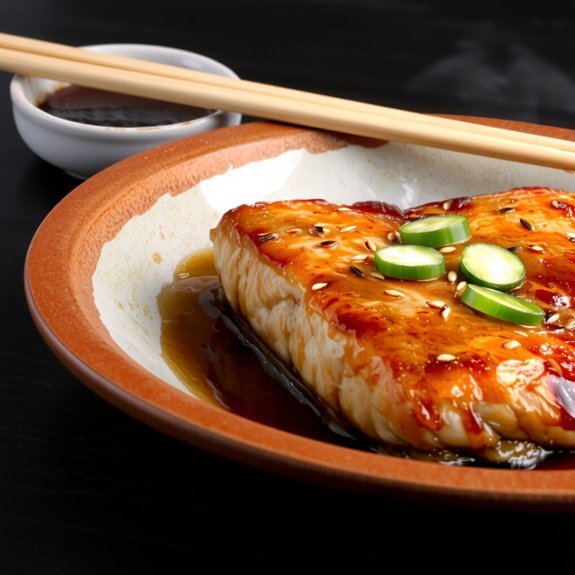

You’ll master a straightforward teriyaki salmon that balances sweet and savory. Make a soy, brown sugar, garlic and ginger marinade and let it penetrate the fillets for 15–30 minutes. You’ll pick pan-sear, bake, or grill and finish with a reduced glaze and sesame garnish — here’s how to get precise timing.
Ingredients and Measurements
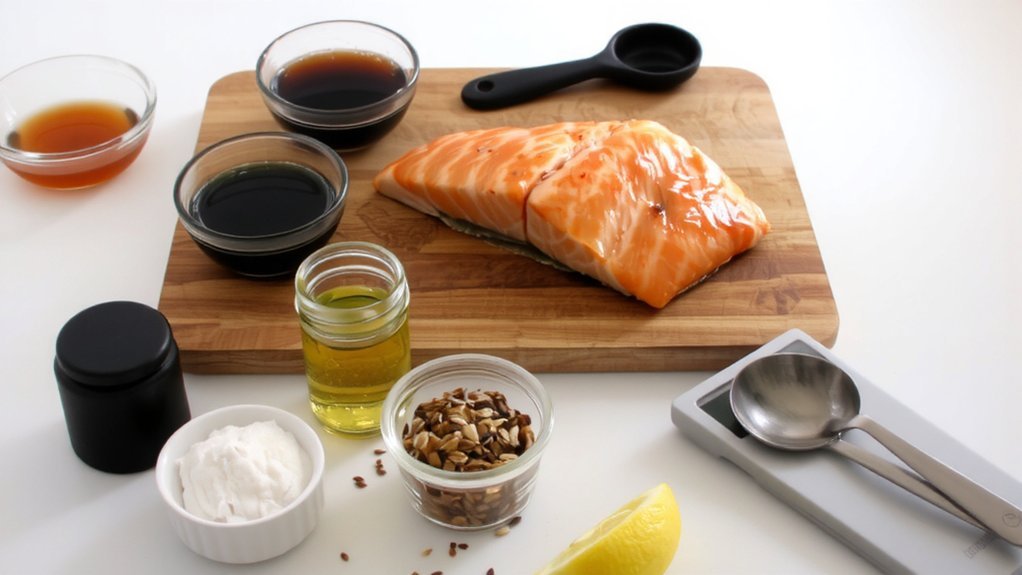
For a standard teriyaki salmon, use 2–3 fillets (total weight typically ¾–3 lb), each about ¾–1″ thick; you can leave the skin on for flavor and crisping. For baking, preheat the oven and bake at 400˚F for 12–16 minutes until the salmon is flaky.
You’ll season fillets simply with salt and black pepper, then optionally coat lightly with cornstarch for searing. Use neutral oil or a knob of unsalted butter for cooking.
Season simply with salt and pepper, dust with cornstarch if searing, and cook in neutral oil or butter.
Garnish scope: toasted sesame seeds and chopped green onions.
Equipment: baking sheet lined with parchment or foil, skillet, grill, or air fryer; have a whisk for any sauce work.
Optional items: sake, mirin, mustard, flour for dusting, maple or brown sugar as sweeteners.
Note nutritional salmon benefits and prefer seasonal ingredients for ideal freshness and flavor.
Measure portions per person at 6–8 oz cooked salmon; adjust for appetite accordingly.
Marinade and Sauce Preparation
For the teriyaki base, combine soy sauce, brown sugar (or honey/maple), minced garlic and grated ginger, optionally adding rice vinegar, sesame oil, mirin or sake for acidity and umami.
Marinate salmon 15–30 minutes at room temperature or refrigerate up to a few hours—turn once—to absorb flavor without over-curing.
Reserve the marinade, boil and simmer to reduce, add cornstarch slurry gradually until a sticky glaze forms, and brush it on near the end or after cooking so you’re not burning the sugars.
For best results, use low sodium soy sauce in the teriyaki base to control saltiness.
Core Sauce Ingredients
One should build a balanced teriyaki base by combining a low-sodium soy sauce or tamari (gluten-free) with a sweetener—brown sugar, honey, or mirin—an acid such as rice vinegar or a splash of sake, fresh grated ginger and minced garlic, and a touch of sesame oil; dilute with water if the soy is too salty and add hoisin for extra depth if desired. Teriyaki is a cooking method that originated in Japan in the 1600s. You’ll select soy sauce varieties based on salt tolerance and gluten needs and choose sweetening agents to control caramelization and viscosity.
Finish with a cornstarch slurry for cling. Use precise measurements and warm gently to dissolve sugars. Reserve some sauce for glazing after cooking immediately.
- Select low-sodium or tamari for base control.
- Balance sweetness and acidity quantitatively.
- Thicken to glossy, coating consistency.
Marinade Timing Tips
Although a short soak of 15–20 minutes will impart adequate teriyaki flavor, you can marinate up to 2–8 hours if you refrigerate the fish and use a sealed container to avoid texture breakdown and excessive saltiness. Also, pat dry the salmon before marinating to improve flavor absorption.
You should pat fillets dry, then apply half the prepared sauce so marinade absorption is efficient; use a ziplock or sealed tray for even contact. At room temperature 15–20 minutes gives reliable penetration for quick cooking; refrigeration is mandatory beyond that.
Longer contact increases flavor intensity but risks protein denaturation and hyper-salinity, so limit to eight hours. Remove chilled salmon 10–15 minutes before cooking for even heat transfer.
Reserve and separately heat any used marinade intended for finishing to eliminate cross-contamination. Follow times to maintain safety and quality.
Thickening and Glazing
When you need a glossy, clingy teriyaki glaze, choose the thickening method that matches your application and heat tolerance.
For quick thickening, use a cornstarch slurry—for best results pre-dissolve it to avoid lumps and remember that cornstarch enhances thickness. You’ll pick reduction for maximum gloss and flavor via controlled simmering, or a cornstarch slurry for rapid viscosity gains; flour works but clouds and alters taste. Remember sauces thicken as they cool; stop short of final sauce consistency and correct with water or soy if over-thickened.
For glazing techniques, layer thin coats, let each set, and finish with a final mop in the last 1–2 minutes to caramelize without burning.
- Reduction concentrates sugars, deepens aromatics, risks scorching.
- Cornstarch slurry thickens quickly; pre-dissolve to avoid lumps.
- Multiple thin layers yield resilient, uniform gloss.
Store cooled sauce airtight; reheat gently to restore pourable texture before glazing or serving.
Preparing and Seasoning the Salmon
You should rinse and pat fillets dry with paper towels, removing scales or residual ice so the surface is dry for searing.
Lightly season both sides with kosher salt and freshly ground black pepper to enhance the salmon before applying marinade or coating.
If you’ll marinate, refrigerate the seasoned fillets and limit marination to 20–30 minutes to avoid breaking down the flesh.
This Baked Teriyaki Salmon is an easy, healthy, gluten-free dish that pairs well with rice, veggies, or quinoa.
Cleaning and Drying
The cleaning and drying phase guarantees hygienic fish and consistent cooking. You start by rinsing the salmon under cold running water to remove surface impurities and excess slime, supporting fish hygiene and preserving salmon freshness. This step removes contaminants and reduces surface bacteria, lowering the risk of foodborne illness.
Use a clean cutting board, a sharp knife and a spoon; remove scales, gills, guts and trim fins and bloodline. Protect surfaces with newspaper or a bag and have a disposal bucket ready.
- Use cold running water and a clean cutting board.
- Scale, gut, remove gills and trim excess parts.
- Pat dry with paper towels, then brief air dry for even cooking.
Drying prevents sogginess, aids browning, preserves texture and ascertains uniform cooking.
Work in a spacious, clean area and keep tools sanitized between tasks regularly.
Salting and Seasoning
After patting the fillets dry, prep salting and seasoning to optimize flavor, texture and browning: apply a moderate amount of salt as a short dry-brine (10–30 minutes) or use a wet brine if preferred—enough to season but not so much it pulls out moisture. Also, pat salmon dry and rub with oil before seasoning to improve browning and adherence of seasonings. You’ll apply salt uniformly; use ½ teaspoon per 4 ounces as guideline to control salt absorption and prevent drying.
| Method | Time | Effect |
|---|---|---|
| Dry-brine | 10–30 minutes | Browning, firm texture |
| Wet brine | 15–30 minutes | Moisture retention |
For seasoning balance, mix 1–1.5 tablespoons spices per pound—pepper, garlic, ginger, oregano; blend evenly. Season just before cooking unless dry-brining; if marinating for teriyaki, salt lightly or reduce soy to maintain seasoning balance. Store mixes airtight up to six months. Let rested fillets retain juices thereafter.
Cooking Methods and Timing
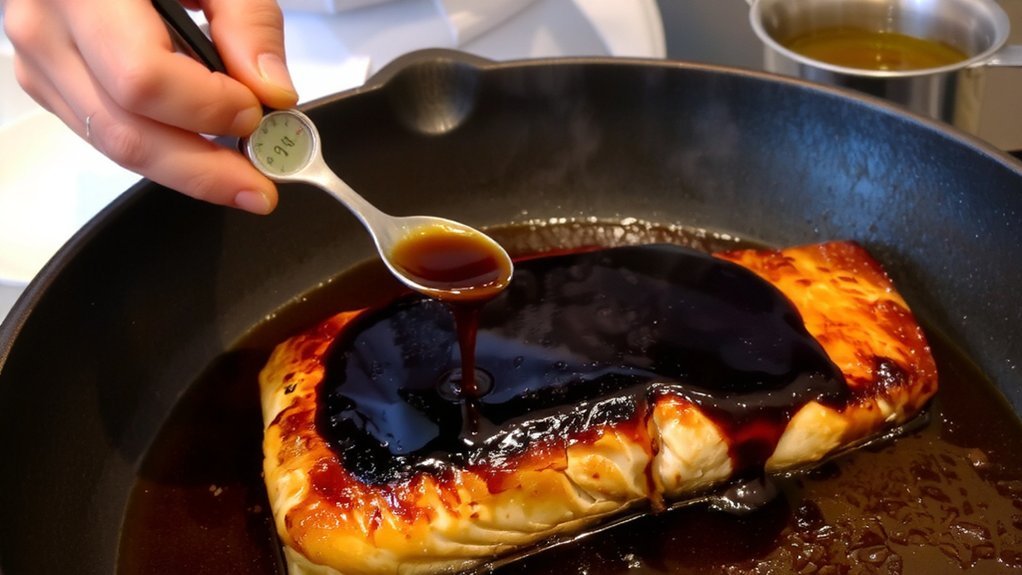
Cooking method dictates heat transfer and time—pan-searing, baking, air-frying, and grilling each demand specific temperatures and durations. For balanced flavor, chefs often prefer light soy sauce.
You’ll apply pan searing techniques to crisp skin: medium heat, oil and butter, 15s initial skin-side press, then flip and finish or steam with sake to 125–130°F.
- Pan-sear: medium heat, 15s skin press, 3–4 min per side, steam 3–5 min with sake.
- Bake: 350–400°F, 6–14 min based on thickness, optional 1–2 min broil, pull near 135°F.
- Air fry / Grill (grilling secrets): 350–400°F air fryer 7–10 min; grill ~400°F 4–5 min per side on oiled grates.
Always verify with an instant-read thermometer; avoid overcooking, pull at target temp and rest 1–2 minutes to preserve moisture.
Monitor thickness and adjust. Control carryover heat, check center, and serve promptly.
Glazing, Garnishes, and Serving Suggestions
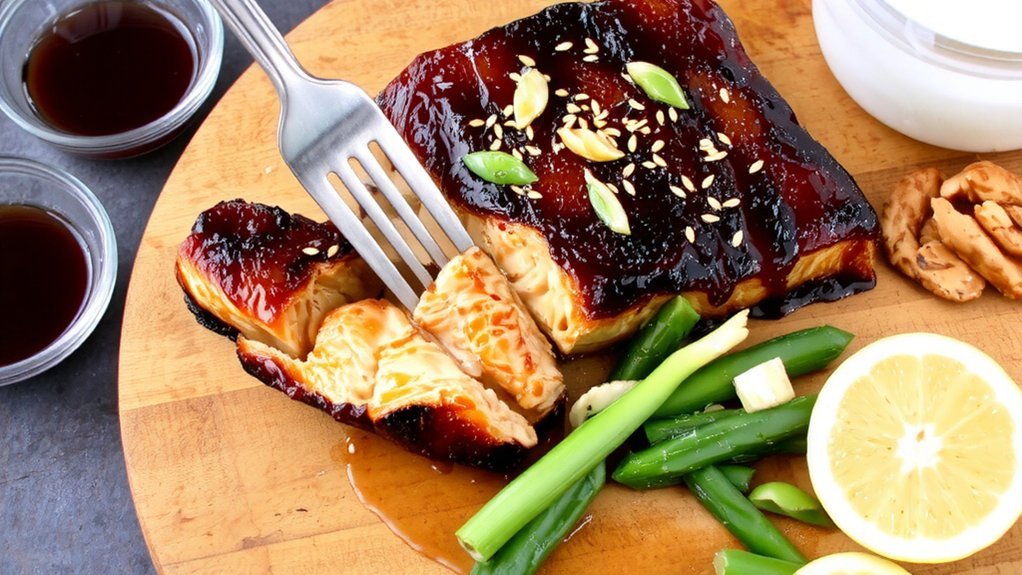
Glaze matters: you’ll reduce teriyaki to concentrate flavor, then bring it to a simmer and if needed whisk in a small slurry of cornstarch or arrowroot to reach a brushable viscosity. Make sure the salmon reaches an internal temperature of 145F to ensure safe doneness. For glaze application, heat to activate sugars, brush during final cook stages and avoid early application to prevent burning. Use soy, rice vinegar, brown sugar, ginger, garlic, sesame oil for balanced chemistry. Garnish choices should contrast texture and acidity: toasted sesame for crunch, sliced green onion for brightness, citrus wedge for cut-through. Serve with neutral starch and simple vegetables to showcase the glaze. Table illustrates presentation cues.
| Element | Purpose |
|---|---|
| Sesame seeds | Texture, visual |
| Green onion | Freshness, color |
Pair with wine.
Tips, Variations, and Storage
How long should you marinate and how should you handle the salmon before and after? Marinate at least 20 to 30 minutes, refrigerate for longer holds, and pat fillets dry so the sauce adheres.
Marinate salmon 20–30 minutes (refrigerate longer), pat dry for better glaze adhesion before cooking.
Flip halfway for even coating; bring refrigerated salmon to room temperature before cooking to guarantee uniform doneness. Use an instant-read thermometer and target 145°F (63°C); rest 1 to 2 minutes to finish cooking.
- Use marinade combinations like soy, hoisin, and brown sugar with ginger and garlic for standard teriyaki.
- For flavor variations, swap brown sugar for maple, add vinegar for acidity, or thicken with cornstarch for a glaze.
- Store raw at or below 40°F (4°C), freeze at 0°F (−18°C), and refrigerate cooked leftovers up to two days in airtight containers.
Leave a Comment