
Key Takeaways
- Combine flour, baking powder, baking soda, salt, and individual spices (cinnamon, cloves, nutmeg, ginger) whisked together until homogeneous.
- Cream softened butter with granulated sugar, then blend eggs, oil, and molasses vigorously for two minutes until slightly emulsified.
- Fold sifted dry ingredients into wet mixture with room-temperature buttermilk or Greek yogurt until smooth and lump-free without overmixing.
- Bake batter in two greased 9-inch round pans lined with parchment at 350°F for 30–35 minutes until toothpick emerges with minimal crumbs.
- Cool cakes 15–20 minutes in pans, then transfer to wire racks for complete cooling before frosting with cream cheese or caramel drizzle.
Ingredients You’ll Need
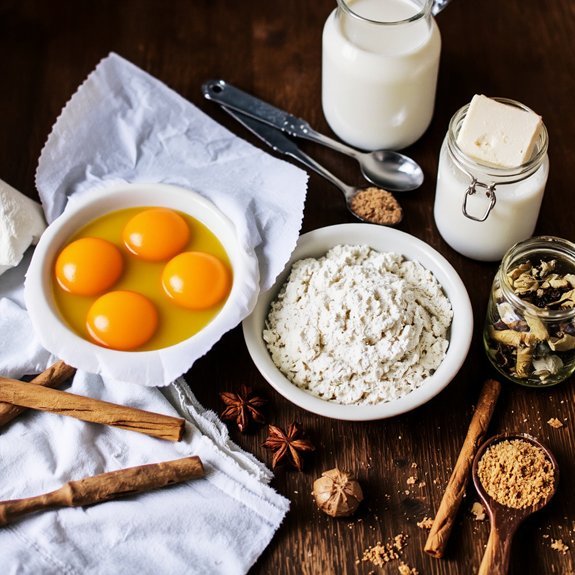
To bake a classic spice cake, you’ll need two cups of all-purpose flour, one and a half teaspoons of baking powder, half a teaspoon of baking soda, one teaspoon of ground cinnamon, half a teaspoon of ground cloves, quarter teaspoon of ground nutmeg, quarter teaspoon of ground ginger, half a teaspoon of salt,
one cup of unsalted butter (softened), one and a half cups of granulated sugar, three large eggs, and one cup of sour cream.
For allergen swaps, you can substitute all-purpose flour with gluten-free alternatives or almond flour.
Replace eggs with appleseed or aquafaba for vegan versions.
Regional variations flourish across cultures.
Middle Eastern bakers incorporate cardamom and rose water, while Latin American versions include chocolate and chili powder.
These modifications let you customize the cake to your preferences without compromising its essential spiced character.
Essential Baking Equipment
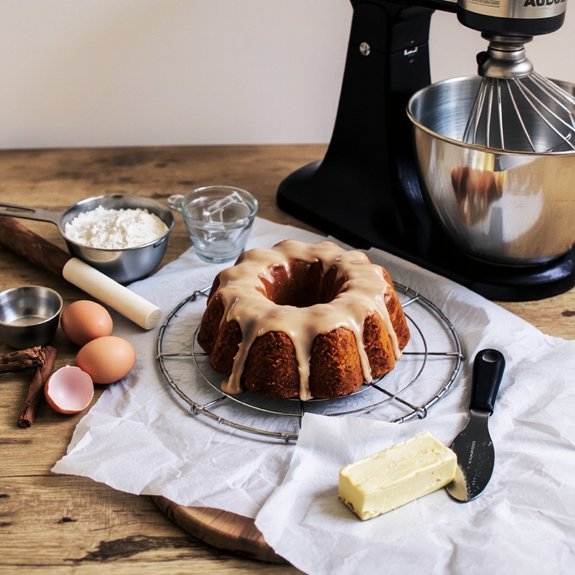
Gathering the right tools will guarantee your spice cake bakes evenly and turns out perfectly textured.
You’ll need two 9-inch round cake pans for ideal baking.
A stand mixer or handheld mixer efficiently combines your dry spices with wet ingredients, ensuring proper aeration.
Measuring cups and spoons deliver accuracy that directly impacts flavor distribution throughout your cake.
A bench scraper efficiently scrapes bowl sides, capturing every bit of batter.
You’ll rely on a pastry brush to apply any glazes or syrups post-baking.
A wire cooling rack allows proper air circulation, preventing moisture buildup underneath.
Don’t overlook parchment paper for pan lining—it eliminates sticking issues.
A reliable oven thermometer confirms accurate baking temperatures.
These essentials give you complete control over your baking process, ensuring consistent, exceptional results every time.
Preparing Your Cake Pans
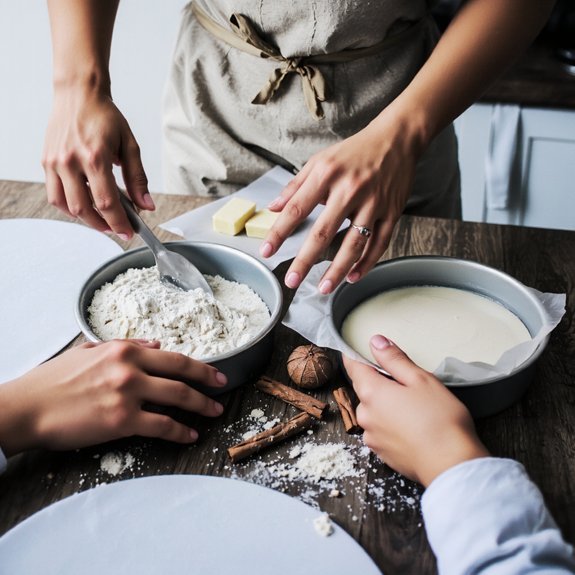
Properly preparing your cake pans guarantees even baking and effortless cake removal.
You’ll want to choose your pan materials carefully—aluminum conducts heat efficiently, while steel offers durability.
Dark pans bake faster than light ones, so adjust your oven temperature accordingly if needed.
For greasing methods, you’ve got options.
Butter provides flavor but can burn; neutral oil won’t.
Apply your chosen grease liberally to all interior surfaces, including corners and seams.
Dust with flour or cocoa powder, tapping out excess—this creates a barrier preventing sticking.
Alternatively, use parchment paper cut to fit your pan’s bottom, then grease around it.
For spice cake specifically, parchment works exceptionally well since sticky spices demand extra release assurance.
Line your pans five to ten minutes before pouring batter.
You’re now ready for confident, successful baking.
Mixing the Dry Ingredients
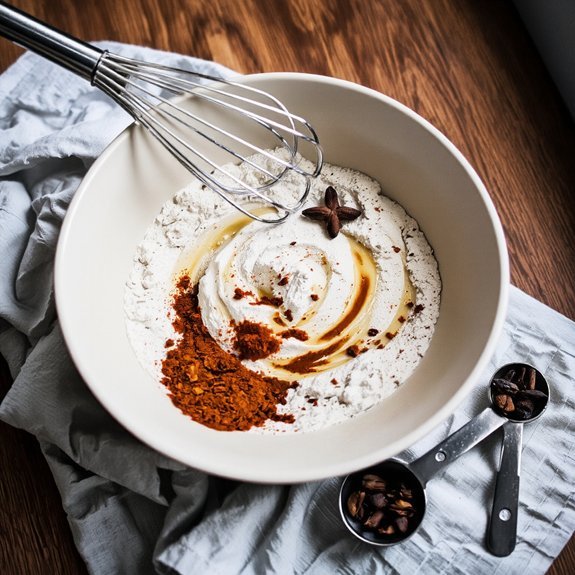
You’ll need to measure your spices with precision, as their concentrated flavors can easily overpower or underwhelm your cake if you’re inexact.
Combine your flour with the appropriate leavening agents—baking soda and baking powder—whisking them together thoroughly to distribute these ingredients evenly throughout your dry mixture.
This pre-mixing step guarantees consistent rise and flavor distribution when you incorporate your wet ingredients.
Measuring Spices Accurately
How do you make sure your spice measurements won’t throw off the cake’s flavor balance?
You’ll master measurement psychology by understanding that slight variations dramatically alter taste profiles.
Use dry measuring spoons, leveling each ingredient flush with the rim—no heaping or tapping.
Sensory calibration matters; smell each spice before measuring to confirm freshness and potency.
Ground spices lose intensity over time, so older stock requires adjustment.
Measure cinnamon, nutmeg, ginger, and cloves separately rather than combining them first, ensuring precision for each component.
This approach gives you complete control over your cake’s final flavor profile.
Keep spices in airtight containers away from heat and light.
Your measurements remain consistent only when your ingredients maintain their integrity.
Precision here translates directly to superior results.
Combining Flour and Leavening
Whisking your dry ingredients together creates a uniform distribution of flour, baking powder, baking soda, and salt—the foundation that determines your cake’s crumb structure and rise.
This process guarantees even particle distribution throughout your batter, preventing pockets of unmixed leavening agents that’d compromise texture.
The acid-base chemistry between baking soda and your spices matters substantially.
Cocoa powder’s acidity activates baking soda, while baking powder handles moisture independently.
Whisk for 20-30 seconds until you’ve achieved complete homogeneity—no streaks of white flour remain visible.
Skip this step, and you’re gambling with inconsistent rising.
You’ll get dense zones alongside airy pockets.
Your spices won’t distribute evenly either, creating unpredictable flavor variations throughout each slice.
Proper dry ingredient combining gives you control over your final product’s structure and taste.
Combining Wet Ingredients
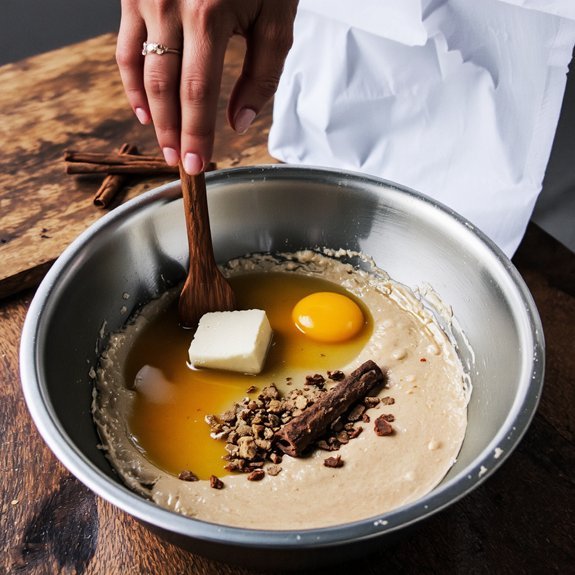
Blending eggs, oil, and molasses together creates the foundation for your spice cake’s moisture and richness.
Whisk these components vigorously for two minutes until you’ve achieved a homogeneous mixture with a slightly emulsified texture.
If you’re exploring vegan replacements, substitute eggs with flax or chia gel—one tablespoon ground flax plus three tablespoons water per egg. Applesauce works equally well for binding.
For your wet ingredients, incorporate room-temperature buttermilk or Greek yogurt next, mixing until fully combined. This addition tenderizes your crumb and balances the molasses’s intensity.
Consider sugar alternatives like coconut sugar or honey if desired, adjusting liquid ratios accordingly since these sweeteners behave differently. Combine all wet components before integrating your previously prepared dry mixture, ensuring no streaks remain.
Creating the Batter
You’ll combine your dry ingredients—flour, baking soda, salt, and spices—in one bowl, then fold them into the wet mixture you’ve prepared.
Watch carefully as you blend these components together; you’re aiming for a batter that’s smooth and lump-free without overmixing, which can toughen the cake.
The proper consistency should fall somewhere between thick and pourable, allowing it to spread evenly across your prepared pan.
Dry Ingredients Mix
The foundation of spice cake’s distinctive flavor and texture relies on properly combining flour, baking soda, baking powder, salt, and the aromatic spices—cinnamon, nutmeg, cloves, and ginger.
You’ll want to whisk these dry ingredients together in a medium bowl, ensuring even distribution. This method prevents clumping and guarantees consistent leavening throughout your batter.
| Ingredient | Measurement |
|---|---|
| All-purpose flour | 2 cups |
| Baking soda | 1 tsp |
| Ground spices | 2 tsp combined |
Consider bulk purchasing your spices for cost efficiency and improved shelf stability. You’ll maintain fresher aromatics while reducing per-unit expenses. Sift your combined dry mixture once more before adding wet ingredients, eliminating any remaining lumps and aerating the flour for superior cake texture and rise.
Wet Ingredients Combine
Once your dry mixture’s been sifted and aerated, gather your wet components—eggs, oil, buttermilk, and vanilla extract—in a separate bowl. Whisk these ingredients vigorously for two minutes, employing an emulsification technique that binds the fat and liquid phases together seamlessly. This process creates a stable, homogeneous mixture with balanced viscosity effects that’ll distribute evenly throughout your batter.
The eggs act as primary emulsifiers, their lecithin content facilitating fat incorporation. The oil contributes richness while buttermilk adds tang and moisture. Vanilla extract rounds out the flavor profile.
Don’t skimp on whisking time—proper emulsification prevents separation and guarantees consistent crumb structure in your final cake. You’ll notice the mixture becoming slightly thicker and paler as air incorporates, indicating successful emulsification. You’re now ready to combine wet and dry components.
Proper Batter Consistency
How do you know when you’ve achieved the right batter consistency?
Your spice cake batter should reach specific viscosity targets for ideal results.
After combining wet and dry ingredients, you’ll perform a texture assessment to verify proper consistency. Here’s what you’re looking for:
- The batter falls slowly from your spoon in thick ribbons, not liquidy streams
- You can smoothly pour it into your pan without it spreading too rapidly
- It holds peaks briefly when you lift your mixer beaters
- The mixture doesn’t clump or appear dry with visible flour pockets
Your batter’s thickness directly impacts cake structure and crumb.
Too thin, and you’ll lose the dense, moist texture spice cakes demand.
Too thick, and you’ll end up with a heavy, compact result.
This balance guarantees your cake bakes evenly with proper rise and moisture retention throughout.
Baking Instructions
Preheat your oven to 350°F (175°C) and prepare two 9-inch round cake pans by greasing them thoroughly and lining the bottoms with parchment paper.
Pour your batter evenly between the prepared pans, filling each about two-thirds full.
Bake for 30-35 minutes until a toothpick inserted into the center emerges with minimal crumbs—your primary doneness indicator.
If you’re baking at higher altitudes above 3,500 feet, increase your oven temperature by 25°F and reduce baking time by 5-8 minutes, since altitude adjustments substantially impact moisture evaporation and rise rates.
Cool the cakes in their pans for 10 minutes, then turn them out onto wire racks.
You’ve now achieved perfectly baked spice cake layers ready for frosting and assembly.
Cooling Your Cake
After you’ve removed your spice cake layers from the oven, you’ll want to let them cool gradually to prevent structural collapse.
Make sure moisture distributes evenly throughout the crumb.
- Place cake pans on wire racks to establish ambient airflow beneath the layers
- Allow 15-20 minutes in-pan cooling before turning cakes onto racks
- Position racks away from direct sunlight and heat sources to avoid condensation prevention issues
- Let layers cool completely (approximately 1-2 hours) before frosting or stacking
Don’t rush this critical phase.
Proper cooling solidifies the crumb structure while preserving the spices’ aromatic compounds.
Inadequate cooling causes moisture loss and compromises your cake’s texture.
Your patience here determines whether you’ll achieve that dense, moist spice cake you’re after.
Frosting and Topping Ideas
You’ll enhance your cooled spice cake with cream cheese frosting, which you can prepare by blending softened cream cheese, butter, powdered sugar, and vanilla extract until smooth.
For added depth, you can drizzle a spiced caramel topping over the frosting, combining butter, brown sugar, heavy cream, and warm spices like cinnamon or nutmeg. These two complementary elements—the tangy richness of cream cheese and the warm sweetness of spiced caramel—will elevate your cake’s flavor profile considerably.
Cream Cheese Frosting Classic
Cream cheese frosting’s tangy richness perfectly complements spice cake’s warm, complex flavors, creating a balanced finish that’s both indulgent and revitalizing.
You’ll craft this classic by combining:
- Eight ounces softened cream cheese for authentic tanginess
- Four ounces unsalted butter at room temperature for smooth consistency
- Two cups powdered sugar for proper sweetness balance
- One teaspoon vanilla extract for depth
Frosting origins trace back to early American baking traditions, where cream cheese became a signature pairing with spiced desserts.
Regional variations emerge across the country—some bakers prefer additional lemon zest for brightness, while others incorporate subtle cinnamon notes echoing the cake itself.
You’ll beat ingredients until fluffy, spreading generously between layers and across the exterior.
This frosting’s stability allows you the freedom to decorate without time pressure, ensuring professional results every time.
Spiced Caramel Drizzle Topping
Drizzling warm spiced caramel across your frosted spice cake introduces a sophisticated layer of butterscotch complexity that cuts through the cream cheese’s richness. You’ll master caramel chemistry by combining butter, brown sugar, and heavy cream at precise temperatures, then infusing it with cinnamon, nutmeg, and sea salt.
| Ingredient | Temperature | Function |
|---|---|---|
| Brown sugar | 350°F | Caramelization base |
| Heavy cream | Room temp | Emulsion stabilizer |
| Sea salt | N/A | Flavor enhancement |
Your serving rituals transform when you drizzle this topping just before plating, allowing it to cascade naturally down the cake’s sides. The contrast between warm caramel and cool frosting creates textural intrigue that elevates your dessert presentation and satisfies those seeking uncompromised indulgence.
Storage and Make-Ahead Tips
Since spice cakes benefit from time for their flavors to meld and intensify, proper storage techniques’ll extend both shelf life and taste development.
You’ll maximize freshness by implementing these strategies:
- Room temperature storage: Keep your cake in an airtight container for up to three days, allowing spices to fully develop.
- Refrigeration: Store wrapped cake for five to seven days; cold temperatures slow moisture loss while preserving structural integrity.
- Portion freezing: Slice your cake and freeze individual pieces in parchment-lined containers, enabling convenient single-serving access without thawing the entire cake.
- Freezer labeling: Mark containers with the baking date and specific ingredients, particularly if you’ve incorporated nuts or dairy, ensuring you track freshness and allergen information.
You’ll maintain ideal texture and flavor through these methods.
Frequently Asked Questions
Can I Substitute All-Purpose Flour With Whole Wheat Flour in This Recipe?
You can substitute all-purpose flour with whole wheat flour, though you’ll notice differences.
Whole wheat creates a denser crumb structure because it contains more bran and absorbs more moisture. You’ll need to adjust flour hydration by increasing your liquid ingredients by 2-3 tablespoons per cup substituted.
This modification maintains your cake’s integrity while delivering earthier flavor notes. Start with a 50/50 blend if you’re hesitant, then experiment with full substitution once you’re comfortable controlling the texture.
How Do I Know When My Spice Cake Is Completely Baked Through?
You’ll know your cake’s fully baked when you insert a toothpick into the center and it emerges clean or with minimal crumbs.
Alternatively, check the internal temperature—you’re looking for 200-210°F at the cake’s core.
Don’t rely solely on appearance; golden-brown edges can mask an underbaked center. These methods guarantee you’ve achieved proper moisture content and structure throughout your spice cake.
What’s the Difference Between Spice Cake and Carrot Cake Recipes?
You’ll notice spice cake emphasizes warm spice profiles—cinnamon, nutmeg, cloves, and ginger—as the dominant flavors.
Carrot cake incorporates these same spices but relegates them to supporting roles while featuring shredded carrots as the star ingredient. Your carrot cake relies on vegetable moisture and natural sweetness, whereas spice cake doesn’t require carrots.
The ingredient origins differ notably: spice cake centers on aromatic compounds; carrot cake balances vegetables with spices for textural complexity and nutritional depth.
Can I Make This Recipe Without Eggs for a Vegan Version?
You’ve got solid options for veganizing your spice cake.
A flax replacement—mixing ground flaxseed with water—creates excellent binding properties that’ll hold your dry ingredients together.
Alternatively, aquafaba binding delivers superior moisture retention and lift.
Use three tablespoons aquafaba or one flax egg per replaced egg.
Both methods preserve your cake’s structural integrity while maintaining the warm spice complexity you’re after.
Choose based on your ingredient availability and desired crumb density.
How Far in Advance Can I Bake This Cake Before Serving?
You’ll maximize your cake’s quality by baking it one day ahead.
For extended storage, implement a freezing strategy—wrap unfrosted layers airtight and freeze up to three months.
Thaw overnight before frosting timing.
Apply frosting no more than four hours before serving to prevent ingredient separation and maintain structural integrity.
This approach gives you complete control over your baking schedule while preserving moisture and spice flavors effectively.


Leave a Comment