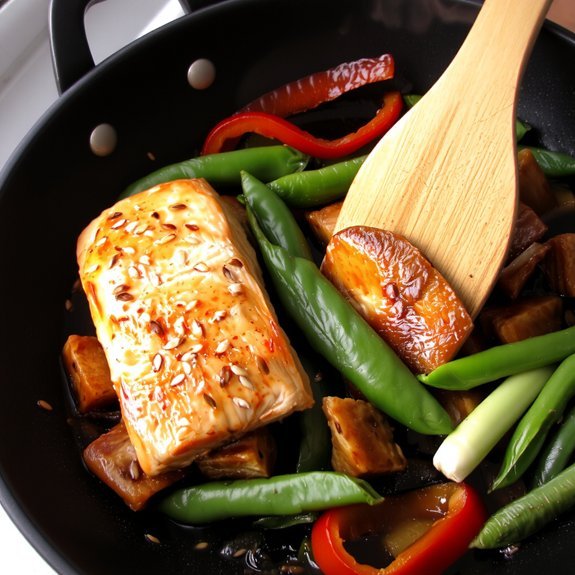

You’ll start by sizing and marinating salmon, then searing it to develop a Maillard crust while keeping the interior tender. You’ll stir-fry vegetables by heat zone, finish with a soy-sesame glaze, and time steps to preserve texture and nutrients. Continue for exact measurements, cooking times, and plating tips…
Ingredients and Measurements
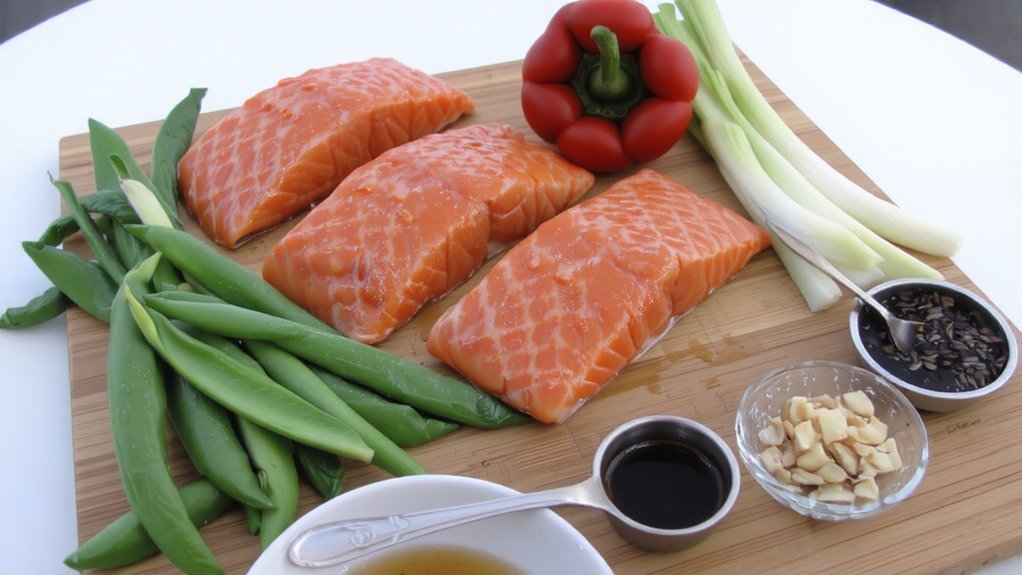
While prepping the stir-fry, gather 1 lb of salmon (skin-on or skinless), 1 each red and yellow bell pepper, 3 cups broccoli florets, matchstick carrots, ½ red onion, and 8 oz sliced mushrooms.
Use ¼ cup soy sauce, 2 tsp sesame oil, 1 tsp rice vinegar, and 1 tbsp brown sugar; add 1 tsp cornstarch to thicken. For aromatics measure 1-in ginger and 2 cloves garlic.
You’ll portion salmon into bite-size pieces to guarantee even cooking. Apply measuring techniques: level spoons, liquid measurements at eye level.
For ingredient substitutions, swap tamari for soy sauce, honey for brown sugar, or avocado oil for peanut oil to adjust smoke point and allergens.
Reserve sesame seeds and scallions for garnish. Taste and adjust sauce before serving immediately. The teriyaki sauce is essential for elevating the overall flavor of the stir-fry.
Equipment and Kitchen Tools
Because heat control and surface properties determine searing and tossing performance, choose cookware accordingly: a seasoned carbon‑steel wok is ideal, a flat‑bottom wok fits electric/induction, and heavy stainless‑steel or cast‑iron skillets or deep sauté pans are acceptable substitutes.
Select cookware for searing and tossing: seasoned carbon‑steel woks, flat bottoms for induction, heavy skillets as backups
Remember to cook over high heat to achieve quick cooking and proper searing.
You’ll equip a thin, long-handled wok spatula and a fish spatula for delicate flips; add long tongs for ingredient separation. Use a mandoline for uniform vegetable gauge, a liquid measuring cup for sauce accuracy, and a steamer insert to pre-tender dense items.
Maintain tools with a wok brush and gentle scrubbers to preserve seasoning. Configure a compact stir-fry station to optimize kitchen organization and speed.
Prioritize stainless or carbon-steel utensils in utensil selection for durability and heat resistance; avoid metal-on-nonstick contact and ventilate the cooking workspace.
Choosing the Right Salmon
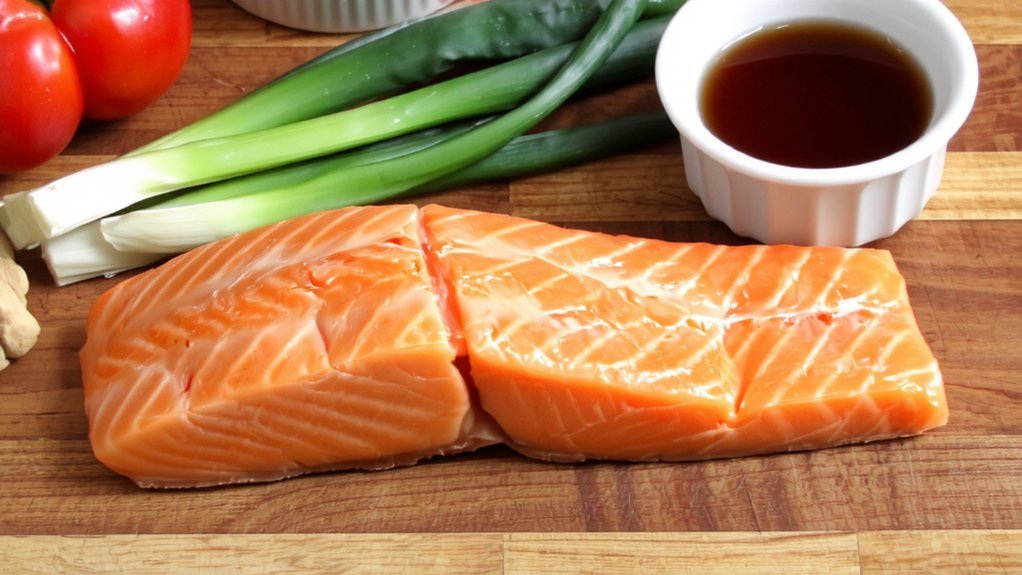
If you want the best balance of flavor and nutrition, prioritize wild‑caught fillets. You’ll evaluate salmon sourcing options by comparing wild‑caught and farm‑raised attributes: wild offers higher omega‑3s and a cleaner flavor; farm‑raised provides consistency and availability. This stir‑fry cooks quickly, taking about 20 minutes from start to finish.
For stir‑fry, choose Atlantic, Sockeye, or King for firm texture and robust fat content. Decide skin on to reduce flaking during high‑heat searing, or remove skin after cooking if you prefer. Both fresh and previously frozen fillets perform well; thaw safely and keep chilled.
Consider regional varieties for subtle flavor differences — use a flavor profile comparison to match intensity to your sauce. Remove pin bones pre‑cook or post‑cook as preferred, and avoid overcooking to retain moisture.
Salmon is protein‑dense, vitamin‑rich, and supports cardiovascular health and brain function.
Prep and Marinating Steps
You’ll select salmon cuts—skinless or skin-on fillets or uniform 1-inch chunks—based on desired texture and cook time.
Mix a measured marinade of soy or tamari, sesame oil, rice vinegar, grated ginger, minced garlic and a sweetener, adding chili paste for heat as needed.
Marinate chunks 30–60 minutes (fillets up to 2 hours, never over 4), keep pieces single-layered and turn once for even coverage. The recipe is designed to be ready in 30 minutes.
Choosing Salmon Cuts
How you choose and prep the cut determines the stir-fry outcome. You’ll select thick, fleshy fillets or steaks from preferred salmon varieties, choosing wild when possible.
Match cut size to high-heat cooking techniques. Remove skin for even cooking; retain for a brief sear if desired. Pat dry, de-bone, and trim thin edges. Use a sharp knife to cut uniform 1-inch cubes. For best flavor and texture, marinate for 10 minutes with a mix of soy sauce, sesame oil, and Japanese BBQ sauce to avoid stringiness.
- Choose thick, uniform fillets or steaks.
- Cut into ~1-inch cubes across the grain.
- Pat dry and remove pin bones; refrigerate until cooking.
- Pre-sear skin-side down briefly if keeping skin for texture.
Avoid heavy or wet marinades before cutting; handle pieces gently to prevent excessive flaking.
Keep cut salmon cold and use clean utensils to prevent contamination. Cook promptly now.
Marinade Ingredients
Marinade components center on a salty umami base—soy sauce or tamari—balanced with 1–2 tsp sesame oil, 1–4 minced garlic cloves, and 1–4 tsp grated ginger; add 1–2 tbsp rice vinegar (or mirin/lime) and a sweetener like honey or brown sugar to round flavors.
You’ll pat salmon dry, then whisk soy, oil, garlic, ginger, vinegar and sweetener into a homogeneous mixture. Adjust salt by diluting with water or low-sodium broth; add 1 tsp cornstarch to thicken when cooking.
For heat and depth, include black pepper, cayenne, garlic chili paste, or onion powder. Use coconut aminos for gluten-free swaps. Save excess marinade to reduce into a finishing sauce.
Apply marinade customization deliberately and employ targeted flavor enhancements to match cuisine profiles. Balance intensity precisely, consistently too. This recipe can be ready in approximately 30 minutes.
Marinating Time Guide
When you marinate salmon for stir-fry, aim for about 30 minutes at room temperature—up to 1 hour only if the marinade’s acidity is moderate—to maximize flavor without softening the flesh. This marinade is also excellent for other flaky fish such as trout or cod, expanding your stir-fry options.
Pat pieces dry, cut uniform bites, remove pin bones, and use a shallow non-reactive dish. Room-temperature marinating accelerates flavor infusion; refrigerate only if exceeding an hour. Avoid marinating frozen fish; thaw fully. Turn pieces once or twice and set a timer. Don’t reuse raw marinade unless boiled.
- Ideal: 30 minutes for balanced marinating techniques and intact texture.
- Up to 60 minutes: moderate acid only; monitor texture.
- Quick: 15–20 minutes yields milder flavor profiles.
- Safety: marinate ≤1 hour at room temp; refrigerate longer sessions.
Cook immediately after marinating. This preserves quality and guarantees even cooking.
Step-by-Step Cooking Instructions
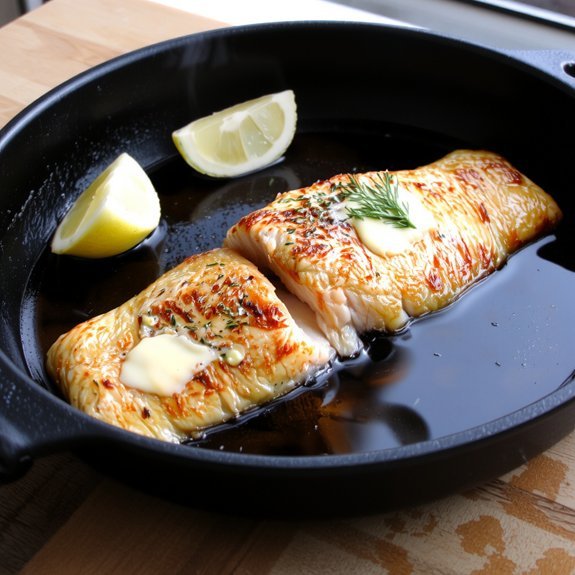
Begin by preparing and cooking components in stages: sear the salmon, set it aside, stir-fry the vegetables, then finish by returning the fish and adding the sauce. For best results, sear the salmon skin-side down for 3 minutes, then flip and cook another 3 minutes so it’s golden and just pink inside. Apply efficient cooking techniques and meal planning so you’ll sequence tasks and premeasure sauce. Cut skinless salmon into 1-inch cubes, pat dry or brief-marinate; heat high-smoke-point oil in a wok over medium-high, arrange pieces single-layer, sear 1–3 minutes per side until golden and just pink inside.
Transfer salmon to a warmed plate. Stir-fry hard vegetables first under high heat 2 minutes, add quick-cook vegetables 2–3 minutes until crisp-tender.
Reduce heat, reintroduce salmon, add sauce, stir gently until it’s coating. Adjust seasoning and serve immediately with rice or noodles.
Store leftovers airtight; consume within three days for safety.
Vegetable Options and Pairings
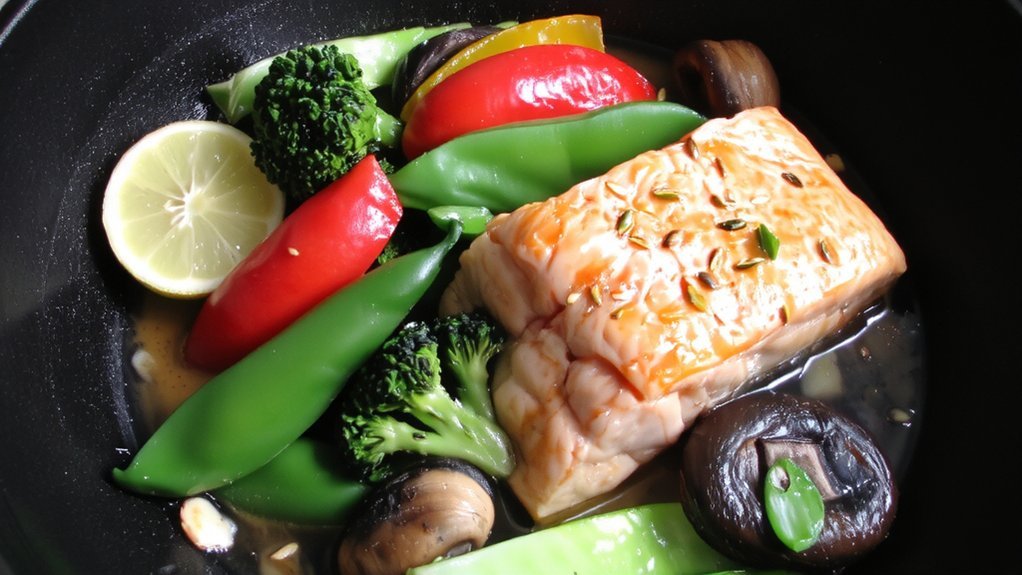
Although salmon’s richness can dominate a stir-fry, choose vegetables that deliberately balance texture and cook time: firm, denser items (carrots, broccoli, bell peppers, green beans) go in first, while delicate greens and sprouts (spinach, bok choy, bean sprouts) are added last. For best results use avocado oil for its high smoke point and healthy fats.
You’ll plan vegetable combinations using color, density, and thermal mass: pair crunchy (peppers, snap peas) with tender (mushrooms, bok choy); include bitter notes (asparagus, broccoli) to cut fat. Use seasonal suggestions to swap squash in summer or parsnips in winter.
Aim for uniform cuts to guarantee synchronized doneness.
- Carrots, broccoli, bell peppers, green beans: baseline firm mix
- Mushrooms, asparagus, snap peas: umami and vitamin density
- Spinach, bok choy, bean sprouts: finish-fast greens
- Zucchini, summer squash, cabbage, edamame: seasonal swaps
Adjust proportions per serving.
Sauce Recipes and Flavor Variations
How do you choose and deploy sauces to match salmon’s richness and your veg mix? Use teriyaki-style, honey-garlic, or spicy sesame as frameworks: each specifies soy/tamari ratios, sweetener, acid, and thickeners for predictable viscosity and gloss.
For teriyaki, follow 2:1 soy to brown sugar, add garlic, ginger, lime; thicken with cornstarch.
For honey-garlic, use tamari, honey, lime, water; add sriracha to taste.
For spicy sesame, include sesame oil, rice vinegar, brown sugar, cornstarch and crushed red pepper.
Employ brief marination (≈15 minutes), deglaze with reserved marinade, and layer sauces during cooking and finishing.
Modify with umami boosters, alternative sweeteners, or gochujang for heat.
These sauce pairings deliver controlled flavor enhancements and consistent coating and gloss and texture retention in pan. Salmon is an excellent source of Omega-3 fatty acids, which support brain and heart health.
Serving Suggestions and Rice Pairings
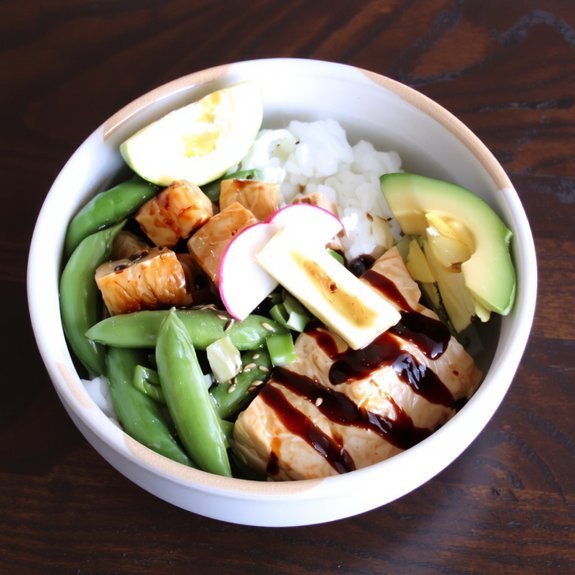
You should pick rice by texture and flavor: white for neutrality, brown for nuttiness and fiber, jasmine/basmati for aroma, sushi rice for stickiness, and cauliflower rice for low-carb needs.
Match sauce intensity to rice—use bold soy- or chili-forward sauces with neutral or sticky rice, and lighter citrus or miso-based sauces with aromatic or whole-grain rice.
Pair with functional sides (steamed greens, quick-pickles, seaweed salad, edamame, miso soup) and finish rice with furikake, sesame, or chili oil for texture.
For best flavor and sustainability, choose wild-caught salmon.
Best Rice Choices
When selecting rice for salmon, consider flavor, texture, nutrition, ease of preparation, and versatility so you can choose a variety that complements the fish without overpowering it; aim for a fluffy or slightly chewy grain (jasmine, basmati, brown, or wild) to provide contrast, balanced carbs and fiber, and straightforward cooking methods that fit your meal style. For richer, creamier preparations consider Arborio rice, known for its creamy risotto consistency.
You’ll evaluate rice varieties, salmon compatibility, glycemic index, and fiber to match dish intent.
Choose jasmine for fluff, basmati for aroma, brown for fiber, wild for earthiness. Use these practical criteria:
- Jasmine: fluffy, mild, quick cook, Asian pairings
- Basmati: aromatic, low-medium glycemic index, Middle Eastern match
- Brown: higher fiber, chewy, balanced nutrition
- Wild: earthy, nutrient-dense, textural contrast
Pick based on tempo of meal, prep time, and health goals.
Sauce and Sides
While choosing a sauce, match its sweetness, acidity, and viscosity to your starch and sides so the coating, mouthfeel, and flavor balance stay consistent.
You’ll select sauce combinations, like teriyaki for sweet-gloss on white rice, soy/tamari with sesame for nutty umami on brown rice, coconut aminos for lower-sodium needs, or chili oil for heat.
Marinate salmon briefly (≈15 minutes), reserve marinade for vegetables, and add sauce at the end to thicken with cornstarch or arrowroot for glaze without overcooking.
For side variations, pick steamed rice, cauliflower rice, quinoa, or noodles to control carbs and texture; add bok choy or other greens for contrast.
Finish with sesame seeds, green onion, furikake, or citrus zest and a chili crunch if desired for plating precision and service.
Nutritional Information and Health Benefits
Although calorie content varies widely (≈170–669 kcal per serving), a salmon stir-fry delivers high-quality protein (≈16–49 g) and omega‑3 fats (total fat ≈10–28 g) while keeping carbohydrates and fiber flexible (≈4–51 g and 3–6 g, respectively) depending on vegetables and sauces. One typical serving provides about 330.2 kcal.
You’ll get clear salmon benefits: vitamin D (~188 IU), potassium (~566 mg), iron (~1.9 mg) and B‑vitamins; it’s among reliable protein sources, supporting muscle repair and metabolic function. Choose portions to match energy needs.
- Anti-inflammatory omega‑3s support cardiovascular health.
- Protein density aids muscle maintenance and satiety.
- Mixed vegetables add fiber, micronutrients, antioxidants.
- Watch sodium from sauces; prefer low‑sodium options.
This profile suits weight management, ketogenic adjustments, and active diets.
You can tailor ingredients to optimize macronutrients and daily micronutrients.
Storage, Reheating, and Leftover Tips
You should store cooked salmon stir-fry in airtight glass or BPA-free containers, refrigerate within 2 hours, and consume within 2–3 days.
For reheating, heat it in a skillet over medium-low and add a splash of sauce or water to restore moisture and guarantee even warming.
If you use a microwave, run it at 50% power in short intervals and avoid repeated reheating cycles to preserve safety and quality.
Also, for best results, Prep ingredients before cooking to make reheating faster and help preserve the texture and flavor.
Storing Cooked Salmon
Timing matters: refrigerate cooked salmon within 2 hours of cooking to limit bacterial growth. When thawing, remember that safest method is refrigerator thawing, which helps prevent bacterial growth. For safe storage, cool to room temperature briefly, pat dry, portion into shallow airtight containers, and label with the cook date.
Keep fridge ≤40°F (4°C) and place containers in the coldest area—back of the bottom shelf—to reduce salmon spoilage risk.
- Use shallow containers for faster cooling.
- Store single servings to minimize exposure.
- Freeze only if you won’t eat within 3–4 days; label freeze date.
- Discard if slimy, discolored, or foul-smelling.
Follow these controls: avoid door storage, prevent cross-contamination, and consume refrigerated leftovers within 3–4 days or freeze promptly.
Vacuum-sealed cooked salmon can extend unopened shelf life, but once opened you must follow standard timelines and label.
Safe Reheating Methods
Proper reheating preserves both safety and texture after you’ve stored cooked salmon, whether refrigerated or frozen. Using low heat is crucial to prevent drying out. You should use reheating techniques like air fryer or oven to balance even heating and moisture retention. Set temperature so internal salmon reaches 145°F (63°C); use low heat and avoid excessive heat. Avoid microwaves unless covered with water to reduce cold spots. Thaw frozen portions fully and let reach room temperature before reheating. Don’t overcrowd trays; allow air circulation. Limit reheats to one. Use a thermometer, monitor, and add broth or oil for moisture retention and to minimize oxidation and odor.
| Method | Temp | Tip |
|---|---|---|
| Air Fryer | 350°F | Add water |
| Oven | 275°F | Cover dish |
| Microwave | medium | Add water, cover |
| Thawing | room temp | Avoid cold centers |
| Thermometer | 145°F | Verify safety |
Leave a Comment