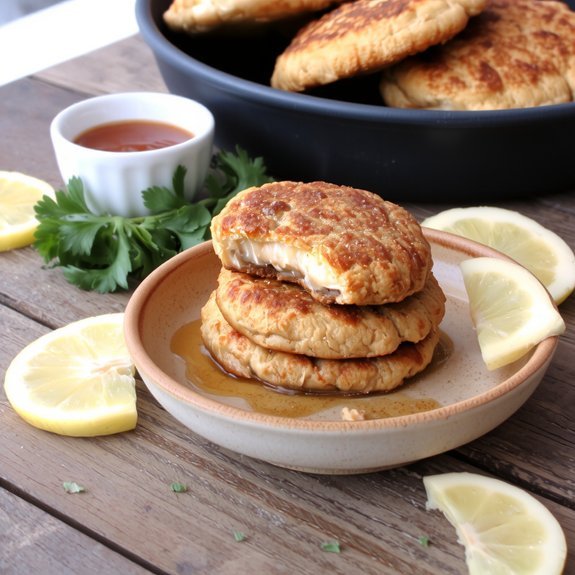

You’ll make salmon patties by combining canned salmon, binder, and seasonings to a precise texture. Measure moisture, adjust crumbs, and portion patties for uniform cook time. You’ll choose pan-fry, bake, or air-fry depending on desired crust and oil usage. Keep the center moist while achieving a crisp exterior—then execute the essential sear that determines success.
Ingredients
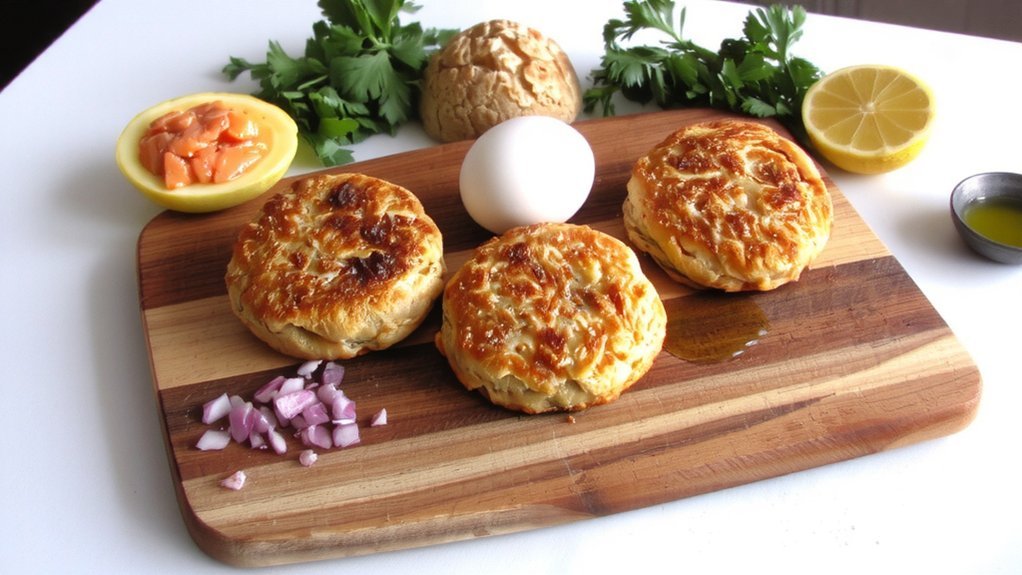
Although canned salmon forms the base, you’ll assemble a short list of components: canned pink or red salmon, eggs (or yolks) as the primary binder, and a dry binder—panko breadcrumbs or crushed crackers—for structure and texture.
Canned pink or red salmon with eggs or yolks and panko or crushed crackers provides structure, texture, and binding
You select Salmon varieties for predictable moisture and flake size; pink or red are standard. Measure eggs to provide protein matrix; use whole eggs for cohesion or yolks when moisture must be limited.
Include diced onion and measured salt, pepper, and optional garlic salt for baseline seasoning. Choose binding agents deliberately: mayonnaise or extra yolk increases adhesion; panko or crushed crackers supply mechanical integrity and crispness.
For cooking, specify oil choice, temperature (medium to medium-high), and 3–5 minute per-side time. Serve recommendations follow in the next section below. They are Great with Homemade Tartar.
Variation Ideas
With the base ingredients assembled, you can systematically modify flavor, texture, binders, serving style, and cooking methods to achieve specific outcomes—add herbs or spices for targeted flavor profiles, swap binders (yolks, mayo, yogurt, avocado, or gluten-free flours) to change moisture and cohesion, incorporate grated vegetables or cooked grains to alter crumb and mouthfeel, and choose pan-frying, oven-baking, or skillet techniques to control crust development and fat content.
For flavor, select herb combinations and targeted spice blends — dill, parsley, cilantro, Old Bay, smoked paprika, or curry — and adjust mustard or acid for brightness.
For texture, vary panko, crushed crackers, grated vegetables, or cooked quinoa; choose mayonnaise, egg yolk, yogurt, or avocado as binder.
Serve as sliders or mains with complementary sauces, or bake to reduce fat.
Canned salmon is convenient and requires no extra cooking.
Preparation Steps
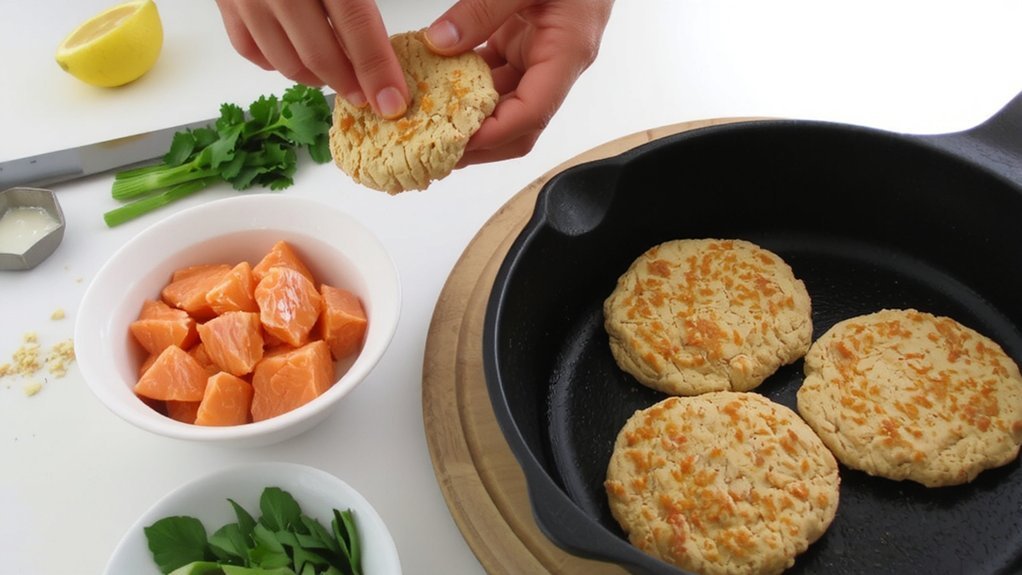
Start by draining the canned salmon thoroughly, removing or crushing any soft bones and skin, and measuring out diced onions, eggs, breadcrumbs (or crackers/panko), and any optional ingredients like lemon juice, mayo, herbs, and seasonings so everything’s ready for quick, efficient mixing. They’re a quick and easy option for busy weeknights.
You’ll focus on salmon selection and ingredient ratios to control moisture and binding. Combine drained salmon, diced onions, measured eggs and breadcrumbs, and seasonings in a large bowl; mix gently to distribute without overworking.
Focus on salmon, control moisture with proper ratios, and gently mix for well-bound patties.
Adjust consistency with extra egg or mayo if mixture won’t hold. Portion and form with consistent measurements for uniform patties.
- Drain and inspect salmon
- Measure binding agents
- Dice onions finely
- Adjust consistency
- Portion for uniform size
Rest briefly to let flavors meld before cooking for best binding results.
Cooking Methods
For pan-frying, you should heat a butter–oil blend in a nonstick or cast-iron skillet to 325–350°F and cook 2–3-inch, 1/3–1/2-inch patties about 3–5 minutes per side until golden, then drain on paper towels. For best flavor, use fresh salmon rather than canned salmon.
Reduce heat if they brown too quickly so residual heat finishes internal cooking without burning.
You can instead bake at 400–425°F for ~20–25 minutes (flip halfway) for a lighter texture, or air-fry at 390–400°F for 10–12 minutes, flipping once, to get crispness with minimal oil.
Pan-Frying Best Practices
When you pan-fry salmon patties, preheat a medium-to-large nonstick or well-seasoned cast-iron skillet over medium-high heat until it’s hot enough to sizzle.
Then add 1–3 tablespoons of a high-smoke-point oil to coat the surface; arrange uniformly sized ½-inch-thick patties in a single layer with space between them.
Fry undisturbed 3–5 minutes per side until golden brown, flip once using a flexible fish spatula, and drain briefly on paper towels to remove excess oil. Canned salmon provides a good source of Omega-3s.
Maintain pan temperature control by adjusting heat so patties brown evenly; reduce to medium if crust darkens too fast.
Use firm yet gentle flipping techniques to turn once with minimal pressure.
Key points:
- Preheat skillet properly
- Use 1–3 tablespoons oil
- Space patties apart
- Flip once confidently
- Drain briefly on paper towels
Baking Vs Air-Frying
Although both oven baking and air-frying will cook salmon patties safely, you’ll choose between lower fat and longer, gentler heat (baking) versus faster cook times and enhanced exterior crispness (air-frying). They’re budget friendly because they’re typically made with canned salmon.
You’ll preheat either appliance to 400°F (200°C). For baking, expect 18–20 minutes for frozen patties, flipping once; baking pros include consistent internal texture and minimal oil.
For air-frying, expect 12–13 minutes, single layer, flip once; benefits are rapid cook time and crisper exterior with precise temperature control.
Consider air frying cons, such as slightly higher surface oil requirement and limited capacity per batch.
Monitor internal temperature to verify safety. Use equal-sized patties, avoid overcrowding, and spray minimal oil for controlled browning and best texture.
Adjust times for fresh patties and calibrate your equipment regularly.
Tips for Perfect Patties
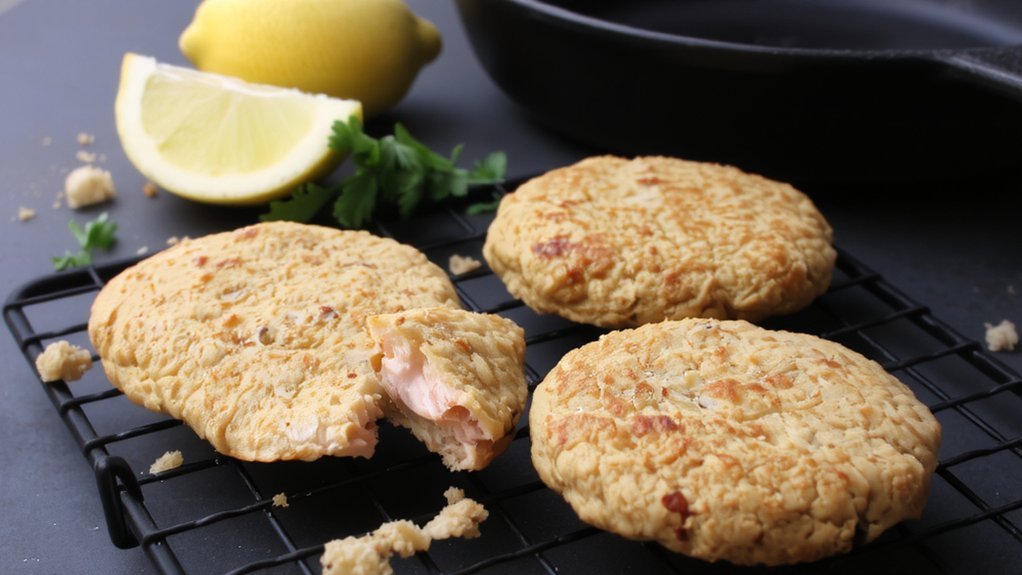
If you want consistent, non‑soggy salmon patties, drain or flake the fish thoroughly, add a measured binder (one beaten egg or 2 Tbsp mayo/Greek yogurt) plus 1/4–1/3 cup dry filler per pound (panko, crushed crackers), and mix in finely diced aromatics and herbs for flavor without excess moisture. Salmon patties became especially popular during the Great Depression when canned salmon was an affordable staple.
Control patty consistency by using the measured binder and filler; aim for slightly sticky, not wet. Shape 3–4 oz patties, 2–3 inches wide and 1/3–1/2 inch thick; chill about 30 minutes.
Cook in oil and butter over medium-low until golden, adjusting heat to avoid burning. Sauté aromatics first for moisture control and improved flavor balance.
Use nonstick or well-oiled cast iron; drain on paper towels.
- Measure binders
- Pre-sauté aromatics
- Uniform chill time
- Moderate heat
- Drain crust
Serving Suggestions and Nutrition
Serve your hot salmon patties on whole-grain buns, over mixed greens, or with lettuce and tomato, and you’ll get classic, nutritious pairings. They are also High protein, which helps support muscle maintenance and satiety.
Add toppings like plain Greek yogurt, salsa, pineapple, or a lemon squeeze to modify flavor and moisture.
Use the nutrition facts to guide portions—typical patties range ~120–495 kcal, 5–31 g fat, 9–48 g protein, and 210–952 mg sodium—so you can tailor sides to dietary targets.
Serving Ideas
When plating salmon patties, you’ll balance texture and nutrition by pairing whole-grain brown rice or mashed potatoes with steamed or roasted vegetables and a vinegar-based slaw; finish with a citrus drizzle or a Greek yogurt–based sauce to cut richness and boost perceived freshness. For best flavor, use 24 ounces of canned salmon when making the patties.
You’ll choose sauces and sides to optimize mouthfeel and contrast; use salmon sauce pairings that include lemony Greek yogurt, tartar, avocado crema, or Newburg, and select vegetable accompaniments offering crispness and fiber.
- Brown rice or mashed potatoes with steamed broccoli
- Vinegar-based coleslaw or cucumber salad for acidity
- Tartar, avocado crema, or Newburg sauce options
- Toasted bun with arugula and tomato
- Steamed spinach, sweet potato fries, or pasta salad
Plate patties on a sauce smear, keep them rested, and offer burger-style options.
Nutrition Facts
A single salmon patty (≈86–100 g) delivers roughly 150–280 kcal and provides a concentrated macronutrient profile: about 20–27 g protein, 11–15 g total fat (≈2.5 g saturated), 16–20 g carbohydrates (≈1 g fiber), and roughly 155 mg cholesterol.
You can use this macronutrient breakdown to plan meals for protein-focused or moderate-fat diets; swapping crumbs for almond meal lowers carbs and increases unsaturated fat.
Expect vitamin D, B12, selenium and potassium to contribute micronutrients. Note sodium varies with seasoning and can reach ~300 mg.
Pan-frying raises caloric density; baking reduces added fat. The omega 3 benefits support cardiovascular and anti-inflammatory effects, enhancing satiety and cognitive support.
Monitor cholesterol and sodium if you manage cardiac risk. Store refrigerated within two hours to preserve safety and nutrients.
Note that a full serving of salmon patties contains 524 calories.
Leave a Comment