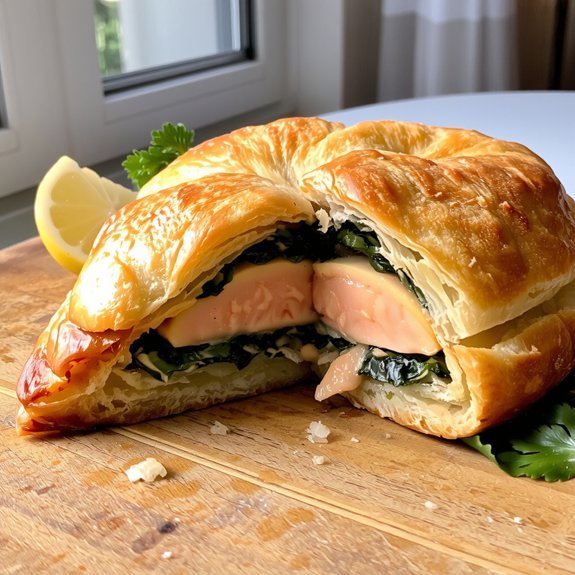

You’ll master Salmon En Croûte with clear steps and practical timing so your pastry stays flaky and the salmon stays moist. You’ll prepare the filling, season and seal the fillets, chill them properly, and bake to a glossy, golden crust. Follow a few precise tips and you’ll understand why the resting step makes all the difference.
Ingredients and Components
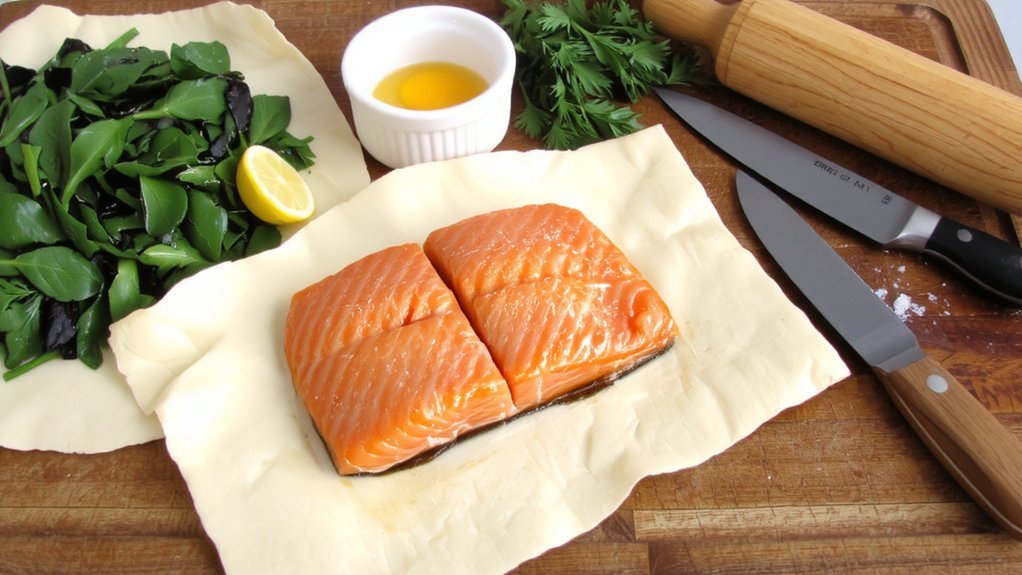
When you assemble Salmon en Croûte, prioritize three tightly defined components: a skinless, boneless salmon fillet (125–150 g per single serving, scaled as needed), a sheet of ready-rolled puff pastry trimmed and egg-washed for a golden seal, and a moist spinach-cheese layer (baby or well-drained frozen spinach blended with cream cheese and aromatics) to cushion the fish.
Choose fresh, high-quality salmon and season lightly; seasoning options include salt, cracked pepper, dill, lemon zest or a touch of horseradish.
Prepare the spinach mixture to be well-drained but creamy for even heat transfer. Select store-bought puff pastry for consistency, noting alternative pastry types if you want butter-rich vs. lighter margarine bases.
Measure portions precisely to guarantee even cooking and neat assembly and present slices precisely plated.
You can prepare Salmon Wellingtons up to 24 hours in advance to save time on the day you serve them.
Equipment and Prep Work
Start by organising a clear workspace and the essential tools so assembly and baking go smoothly: preheat the oven to 375–400°F (190–204°C), line a rimmed baking sheet with parchment, and set a cooling rack on the sheet to keep the pastry crisp.
Organize a clear workspace, preheat oven to 375–400°F, and line a rimmed sheet with parchment and a cooling rack
Then gather essential tools: rimmed baking sheet, cooling rack, skillet, rolling pin, sharp chef’s knife, pastry brush and mixing bowls.
Create a dedicated workspace setup with ample room for rolling, filling and wrapping; keep cling film, measuring spoons and cups, and a small egg-wash bowl within reach.
Use a colander to dry wilted greens and a sturdy spatula for fillings.
Position the oven rack mid-height and verify temperature.
This precise prep prevents soggy pastry and streamlines assembly and improves presentation and service.
This elegant preparation highlights that puff pastry wrapped salmon with creamed spinach is perfect for festive meals.
Preparing the Salmon Fillets
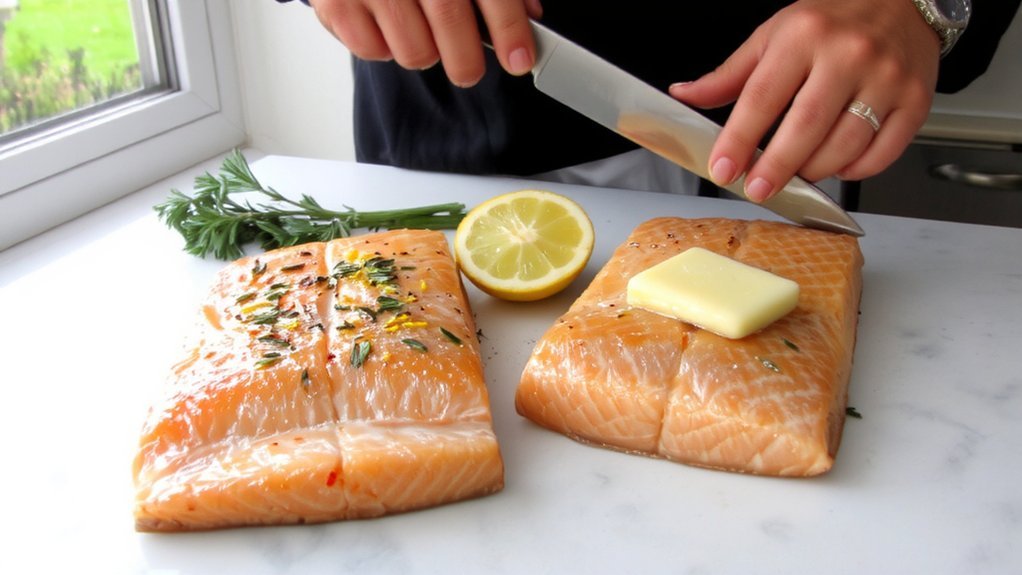
With your workspace and tools in place and the oven at temperature, turn your attention to the salmon: choose boneless fillets of uniform thickness with bright, translucent flesh and a mild, ocean-like scent, and let them sit at room temperature for 20–30 minutes to promote even cooking. Searing then roasting produces a golden crust.
Now focus on Selecting Salmon and Preparing Fillets deliberately. Inspect color and smell; buy from a reliable source. Pat fillets dry with paper towels, especially the skin side, and avoid rinsing.
Season both sides with salt and pepper shortly before cooking to enhance flavor without drawing excess moisture. If skin-on, plan to sear skin-side down for crispiness; if skin-off, aim for a golden crust.
Keep fillets uniform in size and don’t overcrowd the pan so heat distributes evenly.
Making the Filling
Assemble a creamy, well‑drained filling that balances soft cheese, bright herbs, and cooked greens so it holds shape inside the pastry.
You’ll start by wilting spinach or watercress, squeezing out every last drop of moisture; excess liquid will steam the pastry.
Soften cream cheese until smooth, then fold in sautéed shallots or garlic, fresh dill, lemon zest and a touch of juice for acidity.
Use precise filling techniques: beat the cheese for uniform texture, mix greens thoroughly, and season with salt, pepper and a hint of Worcestershire or smoked salt for depth.
Aim for a firm but spreadable consistency; chill the mixture briefly to firm it.
Taste and adjust for clean flavor balance before proceeding.
Reserve any extra for serving or future sandwiches later.
For best results cure the salmon in a salt-and-sugar mixture, weigh it down, and refrigerate for 12–48 hours so the flesh firms up.
Assembling the En Croûte
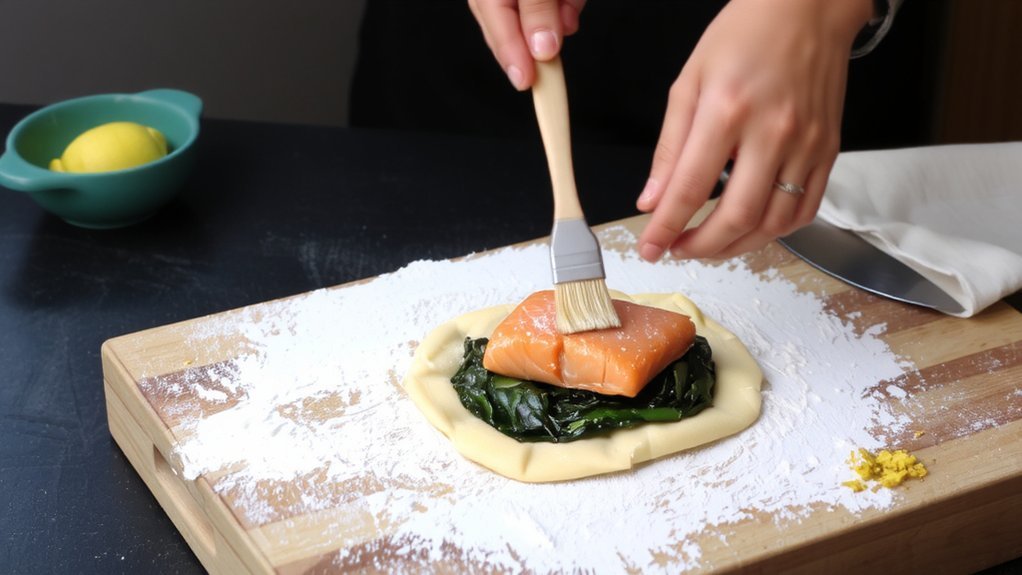
Before you begin sealing, position one rolled pastry sheet on a lined tray and lay the first salmon fillet skin‑side down, patting it dry, then spread a thin, even layer of the chilled cream‑cheese filling (and a strip of prosciutto or leeks if using) so it won’t bulge when enclosed; top with the second fillet (skin‑side up) and press the seam of the two fish together, then drape the second pastry sheet over, trim excess, tuck and overlap the edges, crimp firmly to seal, cut a few small vents, and brush the entire surface and edges with egg wash for color and adhesion before chilling. Also, ensure you preheat oven to 200°C / 400°F before assembling so the pastry bakes evenly.
| Step | Tip |
|---|---|
| Layering | Techniques |
| Seal | Eggwash |
Apply controlled layering techniques and firm pastry sealing for clean, professional presentation visually.
Chilling and Baking Instructions
After sealing the pastry, chill the en croûte for at least 30 minutes (or up to 24 hours covered) to firm the dough and keep the butter cold—this prevents shrinking and yields flakier layers.
Chill the sealed en croûte at least 30 minutes or up to 24 hours to firm the dough and ensure flaky layers.
This preparation is suitable for special occasions.
You’ll keep it wrapped in the fridge to avoid drying; longer chilling duration improves handling and flavor melding.
Preheat the oven fully so the initial blast of high heat (200–220°C / 400–425°F) creates steam and sets the crust. Start hot for 15–20 minutes, then reduce to 160–180°C (320–350°F) to finish cooking the salmon without burning pastry.
Apply egg wash after chilling and score vents to control puffing. Watch for a golden, puffed crust and flaky salmon; adjust times for fillet thickness and oven variation and follow visual cues over timers.
Resting, Slicing, and Serving
After baking, let your Salmon En Croûte rest for about 5–10 minutes so juices redistribute and the pastry firms for clean cuts. Use a probe to check the center and aim for an internal temperature of 50 °C to ensure the salmon is perfectly cooked.
Don’t let it sit longer than 10 minutes to avoid a soggy crust, though you can add a minute or two for larger fillets.
When slicing, use a sharp serrated or chef’s knife, cut roughly 1‑inch portions, and wipe the blade between cuts for neat presentation.
Resting Time
When you remove salmon en croûte from the oven, let it rest about 10 minutes so juices redistribute, the filling sets, and the pastry firms for cleaner slices; tent loosely with foil to retain warmth without trapping steam.
You’ll see the resting importance immediately: residual heat finishes the fish gently, prevents runny filling, and stabilizes layers for presentation.
Temperature contrast between warm interior and slightly cooled pastry preserves texture and maximizes flavor harmony when you serve promptly after resting. Tent loosely; don’t seal tightly or the crust will soften.
Aim for five to fifteen minutes based on fillet thickness; longer resting risks cooling, shorter risks runniness. Serve warm but not piping hot, pair with bright sides or a light sauce to cut richness nicely. Traditionally, puff pastry is used to create an elegant, buttery crust that signals a luxurious dish.
Slicing Tips
If you’ve let the salmon rest until the filling firms and the pastry cools slightly, you’ll get much cleaner slices by using a sharp serrated or thin chef’s knife and a gentle sawing motion. Keep in mind this recipe serves 2-3.
Support the base with one hand, slice portions one to one and a half inches wide, and apply steady pressure to avoid crushing layers.
Wipe the blade between cuts to prevent residue build-up and tearing; if the pastry feels too soft, chill briefly.
Score the top before baking to guide even cuts.
Transfer slices with a flat spatula to a warm platter so pastry stays crisp; garnish with dill, lemon wedges, or pickled cucumber.
Practice disciplined slicing techniques and regular knife maintenance—sharpen blades and clean them—to preserve presentation and texture.
Tips, Variations, and Storage
Because puff pastry must stay very cold to achieve maximum flakiness, chill assembled bundles before baking and seal edges firmly with water or egg wash to prevent leakage and guarantee a crisp, golden finish. Use precise cooking techniques, flavor pairing: par-cook greens, score pastry, and target 145°F internal for salmon. Plan for a 40 minutes total cook time when scheduling the dish.
| Tip | Action |
|---|---|
| Seal edges | Water or egg wash |
| Resting | Let rest 5–10 min |
| Storage | Refrigerate 2 days |
Assemble up to 24 hours ahead or freeze unbaked for 1 month. Reheat at 350°F until 165°F internal; avoid microwaves to keep pastry crisp. Swap fillings—parmesan, chard, leeks, sun-dried tomatoes, or herbs—for clear, reliable variations. Let leftovers cool before refrigerating and discard after two hours at room temperature; use a thermometer when reheating to 165°F precisely.



Leave a Comment