

Key Takeaways
- Metric measurements eliminate volume-packing guesswork by weighing ingredients in grams for consistent, repeatable baking results.
- Imperial cups and ounces introduce measurement variability; small deviations dramatically alter texture, rise, and flavor outcomes.
- Metric’s decimal simplicity enables precise recipe scaling, while imperial unit conversions compound rounding errors and inconsistencies.
- Digital scales supporting metric weights provide exact readings, quality control, and professional baking standards unavailable with imperial cups.
- Imperial system evolved organically from medieval trade practices; metric developed as revolutionary scientific standard adopted globally by professionals.
Understanding the Metric System in Baking

The metric system offers bakers a more precise and consistent approach to measurements than imperial units.
You’ll appreciate the decimal simplicity that grams and milliliters provide—no more wrestling with fractions or confusing conversions.
This straightforward numerical system lets you scale recipes up or down effortlessly, giving you complete control over your baking outcomes.
Global consistency means you’re using the same measurement standard as professional bakers worldwide.
You’re not confined to outdated volume measurements that vary based on how densely you pack ingredients.
Instead, you’re weighing components directly, eliminating guesswork entirely.
The Imperial Measurement System Explained
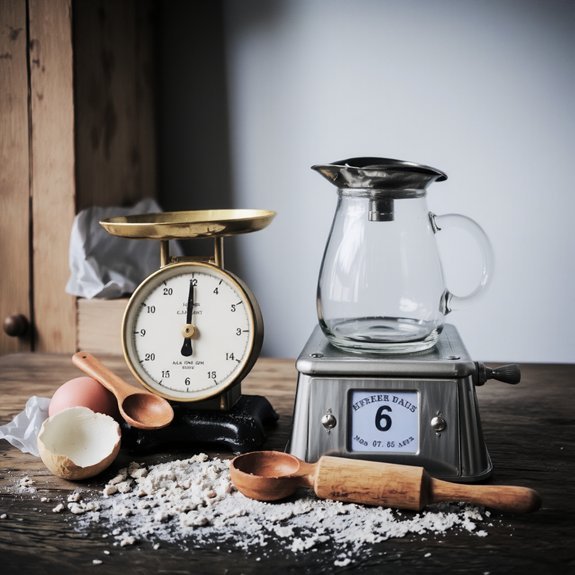
You’ll find that the Imperial system evolved from medieval English measurements, establishing the foundation for modern baking standards still used today in the United States and other Commonwealth nations.
When you bake using Imperial units, you’re working primarily with cups, tablespoons, teaspoons, and ounces—each with specific volume and weight equivalents that differ from their metric counterparts.
Understanding how to convert between Imperial and metric measurements guarantees you can follow any recipe accurately, regardless of which system it employs.
Historical Origins and Development
Originating in medieval England, imperial measurements developed from practical needs rather than scientific standardization, establishing systems that’d persist for centuries and eventually spread throughout British colonies and beyond.
Guild Traditions shaped these early standards, as craftspeople and merchants required consistent measurements for trade and commerce. You’ll find that imperial units evolved organically through everyday market transactions rather than deliberate governmental decree.
Colonial Exchange accelerated this system’s expansion when British traders introduced imperial measurements to their colonies, creating a unified commercial language across vast territories. This decentralized development meant you experienced regional variations that persisted even as standardization efforts increased.
Unlike the metric system’s revolutionary approach, imperial measurements grew incrementally from practical experience, reflecting the preferences of those who used them daily in their trades and businesses.
Common Imperial Units Used
Several imperial units form the foundation of traditional baking measurements that you’ll encounter in British and American recipes.
You’ll rely on these core units:
- Cups (c) – volumetric measure for dry and wet ingredients
- Tablespoons (tbsp) – abbreviation meanings essential for precision in smaller quantities
- Teaspoons (tsp) – the smallest common measure for leavening agents and extracts
- Ounces (oz) – weight-based measurements, especially for chocolate and butter
- Pounds (lb) – larger quantities typically listed on package listings for flour and sugar
Understanding these abbreviation meanings prevents costly measurement errors.
You’ll notice package listings frequently reference cups or ounces rather than grams.
This system demands your attention because slight variations compound quickly in baking’s precise chemistry.
Master these units, and you’ll decode virtually any traditional recipe with confidence.
Imperial Conversion and Equivalents
Because baking demands precision, converting between imperial units—and eventually to metric—requires understanding the fixed relationships that govern this system.
You’ll find that 16 tablespoons equal one cup, and 3 teaspoons make one tablespoon.
These standardized conversions guarantee consistency across recipes.
When you’re shopping, labeling practices often display both imperial and metric measurements, giving you flexibility in your choice.
However, marketing claims on packaging sometimes obscure actual serving sizes or weight conversions, so verify the fine print.
Understanding these equivalents empowers you to work independently between measurement systems without relying on conversion charts.
You’re not locked into one approach—you can confidently select recipes and ingredients regardless of which system they use, maintaining complete control over your baking outcomes.
Accuracy and Consistency: Why Precision Matters

When you’re baking, small measurement deviations can dramatically alter your final product’s texture, rise, and flavor.
Precision isn’t optional—it’s fundamental to reproducible results.
Metric measurements give you superior accuracy:
- Grams eliminate volume inconsistencies from packing variations
- Digital scales provide exact readings without guesswork
- Ratios remain stable across batch sizes
- Temperature conversions align perfectly with metric standards
- Quality Control becomes measurable and documentable
You’ll develop Sensory Training by consistently using precise measurements, recognizing how slight variations affect outcomes.
This builds your intuition and confidence in the kitchen.
Imperial conversions introduce compounding errors through rounding and estimation.
When you demand control over your baking results, metric precision delivers.
You’re not constrained by approximations—you’re empowered by accuracy.
This systematic approach transforms baking from trial-and-error into reliable, repeatable success.
Common Conversion Challenges
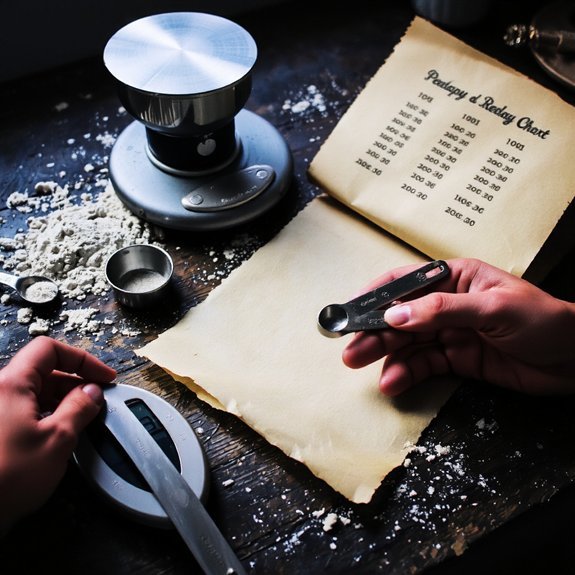
Even with metric precision at your disposal, converting between systems creates practical obstacles that can undermine your baking success. Cup variability poses a significant problem—a cup isn’t standardized across all measuring tools, leading to inconsistent ingredient quantities. You might grab different cups and receive different volumes, compromising your recipe’s integrity.
Rounding errors compound this issue. When you convert imperial measurements to metric, you’ll often encounter decimals that demand rounding. A recipe calling for 2.5 ounces becomes approximately 71 grams, but that slight adjustment accumulates across multiple ingredients. These small mathematical compromises alter ratios and affect texture, rise, and flavor.
You’re forced to choose between convenience and accuracy. Converting on-the-fly introduces human error, while pre-converted recipes sometimes contradict each other. Master one system thoroughly rather than constantly switching between them.
How to Convert Between Metric and Imperial Measurements

To convert accurately, you’ll need reliable conversion factors and a systematic approach.
Accurate conversions demand reliable conversion factors paired with a systematic, methodical approach.
Master these essential techniques:
- Use established conversion ratios (1 oz = 28.35g, 1 cup = 240ml)
- Round strategically for practical baking results without sacrificing precision
- Invest in digital scales for gram-based measurements—they’re your most accurate option
- Leverage software solutions like conversion apps and recipe calculators to eliminate guesswork
- Attend educational workshops that teach metric fundamentals specific to baking chemistry
You’ll find that converting imperial to metric isn’t arbitrary—it’s about understanding ingredient ratios.
Don’t just plug numbers into formulas; grasp why conversions matter for your results. Digital scales remove interpretation from the equation, giving you consistent outcomes batch after batch. Whether you’re scaling recipes or adapting international cookbooks, these tools and strategies guarantee your conversions remain precise and reliable.
Best Practices for Measuring Dry Ingredients
Why do so many bakers struggle with dry ingredient consistency?
You’ll master this by adopting precise techniques that eliminate guesswork.
First, you’ve got to invest in quality scales—digital ones give you the accuracy that cups can’t deliver.
Weight measurements in grams or ounces remove variables that plague volume-based approaches.
For flour storage, you’re controlling moisture content by using airtight containers in cool, dry environments.
This prevents clumping and density shifts that ruin recipes.
You’ll maintain tool maintenance rigorously.
Clean your measuring equipment immediately after use, ensuring no residual moisture or flour buildup skews future measurements.
Spoon-and-level techniques work reasonably well when scales aren’t available, but they’re inherently inconsistent.
You’re better served switching to metric weights entirely.
This freedom from measurement ambiguity transforms your baking reliability.
Liquid Measurements: Key Differences and Techniques
Liquids demand a fundamentally different approach than solids, and you’ll find that volume measurements become far more reliable here than they were with flour and sugar.
When measuring liquids, you’re working with precision that directly impacts your results.
Here’s what you need to master:
- Meniscus reading: Position your eye level with the container’s mark, reading the lowest point of the liquid curve
- Viscosity effects: Thick liquids like honey flow differently than water, requiring adjusted measuring techniques
- Container choice: Use liquid measuring cups with spouts for accuracy and control
- Temperature considerations: Cold liquids contract; hot liquids expand slightly
- Pouring technique: Pour slowly near your target measurement to avoid overshooting
Metric measurements (milliliters) eliminate ambiguity entirely, offering superior consistency for your baking freedom.
Frequently Asked Questions
Can I Mix Metric and Imperial Measurements in a Single Recipe?
You shouldn’t mix metric and imperial measurements in a single recipe.
Doing so creates conversion pitfalls that compromise measurement accuracy, leading to inconsistent results.
You’ll face calculation errors when scaling ingredients, affecting texture, rise, and flavor.
Stick with one system throughout.
Convert your entire recipe beforehand using reliable conversion charts.
This approach gives you consistent, predictable outcomes and full control over your baking success.
Your results depend on this discipline.
Which Measurement System Is Better for Professional Bakeries and Why?
You’ll find that metric measurements dominate professional bakeries because they deliver superior production consistency and streamline regulatory compliance.
You’re working with precise decimal increments that eliminate rounding errors inherent in imperial fractions.
You’ll appreciate how metric scales directly to larger batches without calculation headaches.
You’ve got the freedom to maintain standardized formulas across multiple locations, ensuring your products stay uniformly excellent.
You’re also meeting international food safety standards more easily with metric documentation.
Do Metric and Imperial Measurements Produce Different Baking Results Consistently?
You’ll find that metric and imperial measurements don’t consistently produce different results if you’re precise with conversions.
However, ingredient density variations mean you’ll encounter discrepancies when rounding imperial measurements.
Metric’s decimal-based system eliminates rounding errors in baking chemistry, giving you tighter control.
You’re not constrained by approximations—you’ll achieve reproducible results through metric’s accuracy.
Imperial’s fractions introduce tolerance that compounds across batches, compromising your consistency and freedom to scale recipes reliably.
What Kitchen Tools Accurately Measure Both Metric and Imperial Units?
You’ll find Digital Scales your most reliable option—they’ve got dual-unit displays showing grams and ounces simultaneously.
Convertible Cups offer another practical solution, featuring metric and imperial markings on the same vessel.
Neither tool forces you into measurement compromises.
You’re free to choose your preferred system without conversion math.
Combine both tools for maximum flexibility, ensuring you’re not locked into one standardized approach that doesn’t match your independence.
How Do Altitude and Temperature Affect Metric Versus Imperial Baking Measurements?
You’ll find altitude corrections aren’t unit-dependent—they affect both metric and imperial equally.
High elevations require you to reduce leavening agents and increase liquid regardless of your measurement system.
Temperature scaling works identically too. You’re adjusting ratios based on environmental conditions, not measurement type.
Whether you’re using grams or ounces, you’ll modify recipes the same way. Your freedom to choose units doesn’t change how you compensate for atmospheric pressure or heat fluctuations.
Leave a Comment