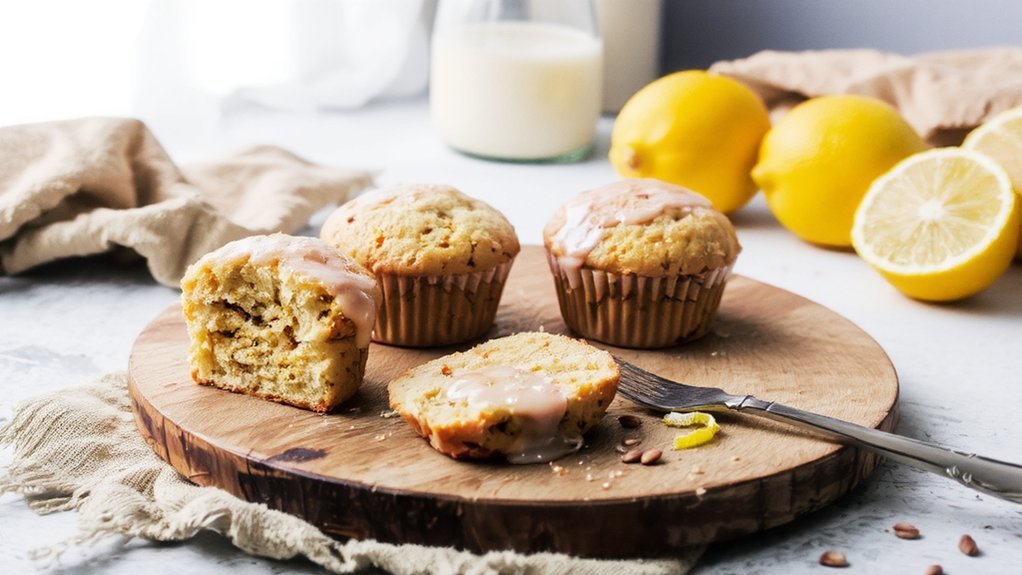

Key Takeaways
- Combine 2 cups flour, 1 tbsp baking powder, ½ tsp salt, and 2 tbsp poppy seeds; whisk dry ingredients for uniform leavening distribution.
- Mix 3 eggs, ¾ cup sugar, ½ cup oil, 1 cup yogurt, lemon zest, and juice; fold wet into dry with minimal strokes.
- Fill muffin cups three-quarters full; bake at 375°F for 18–22 minutes until golden-brown and toothpick exits clean.
- Use oil instead of butter for tender crumb; substitute yogurt with buttermilk or sour cream to enhance moisture retention.
- Store in airtight container at room temperature for 2–3 days, refrigerate up to one week, or freeze individually for three months.
Ingredients You’ll Need
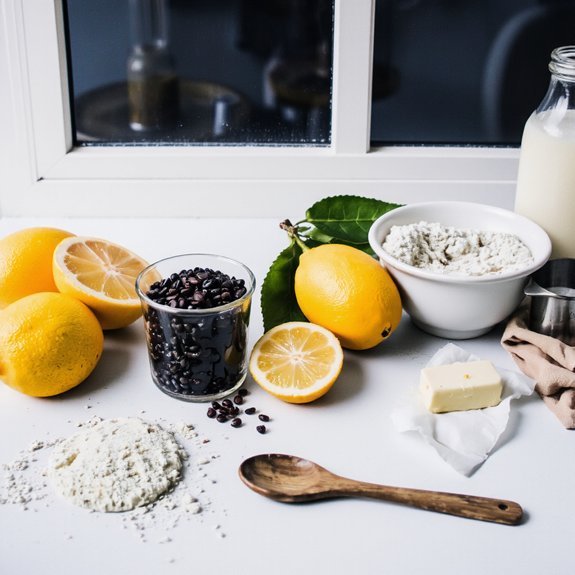
You’ll need just a handful of dry ingredients to build your muffin base: 2 cups all-purpose flour, 1 tablespoon baking powder, ½ teaspoon salt, and 2 tablespoons poppy seeds.
These shelf staples form your foundation.
For the wet mixture, gather 3 large eggs, ¾ cup granulated sugar, ½ cup vegetable oil, and 1 cup plain yogurt.
You’ll want fresh seasonal produce: 3 lemons for zest and juice.
The zest contributes aromatic oils while the juice provides acidic balance, activating your leavening agents.
This ingredient hierarchy guarantees proper emulsification and rise.
The yogurt replaces buttermilk, offering flexibility for your kitchen preferences.
You’re looking at roughly fifteen minutes of assembly time before baking.
These measurements yield twelve standard muffins with ideal crumb structure and moisture retention.
Why Poppy Seeds Matter
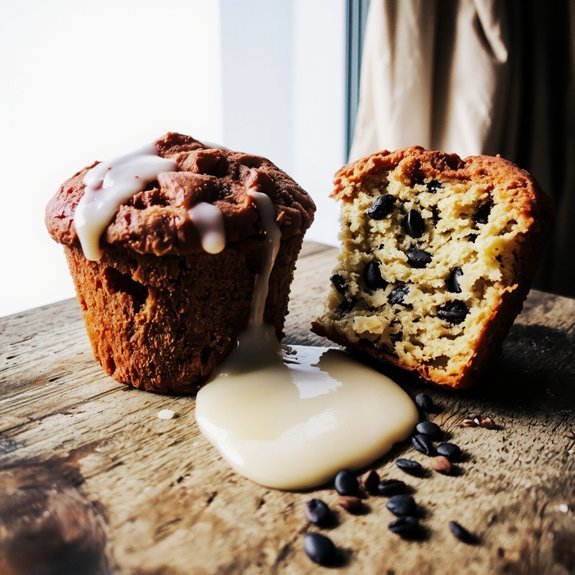
You’ll incorporate poppy seeds into your muffin batter for their nutritional density—they’re rich in calcium, magnesium, and fiber that enhance the nutritional profile of your finished product.
These tiny seeds deliver a distinctive nutty, slightly sweet flavor that complements your lemon zest and creates textural contrast throughout the crumb.
The poppy seeds’ oil content activates their aromatic compounds during baking, intensifying their contribution to the overall flavor complexity of your muffins.
Nutritional Benefits of Poppy
Poppy seeds pack substantial micronutrients that elevate the nutritional profile of lemon poppy seed muffins beyond basic carbohydrates.
You’ll gain meaningful nutritional advantages by incorporating these tiny seeds into your baking:
- Calcium Content: You absorb approximately 1,438 mg of calcium per 100g of poppy seeds, strengthening your skeletal system and supporting metabolic function.
- Magnesium Benefits: You receive roughly 347 mg of magnesium per 100g, enhancing muscle relaxation and energy production.
- Manganese Density: You access 8.7 mg per 100g, facilitating bone development and antioxidant defense.
- Phosphorus Levels: You obtain 870 mg per 100g, working synergistically with calcium for enhanced mineral bioavailability.
These nutrient concentrations mean you’re maximizing your dietary intake while enjoying delicious muffins that support your wellness independence.
Flavor Enhancement in Baking
While poppy seeds contribute negligible flavor independently, they’re essential textural and flavor-anchoring agents that amplify citrus notes and create subtle complexity in baked goods. You’ll discover that their mild, nutty undertones establish an ideal aroma pairing with lemon’s volatile compounds, intensifying perceived brightness without overpowering your palate.
The seeds’ structural composition delivers critical textural contrast against muffin crumb, engaging your teeth and prolonging sensory engagement.
Their hydrophobic properties absorb moisture selectively, allowing lemon zest oils to distribute evenly throughout the batter.
You’re not simply adding decoration—you’re engineering flavor synergy.
Approximately 1–2 tablespoons per dozen muffins maintains proper ingredient hierarchy, preventing seeds from dominating while ensuring they fulfill their dual function: anchoring citrus volatiles and providing mechanically distinct elements that elevate your finished product’s complexity and mouthfeel substantially.
Step-by-Step Baking Instructions
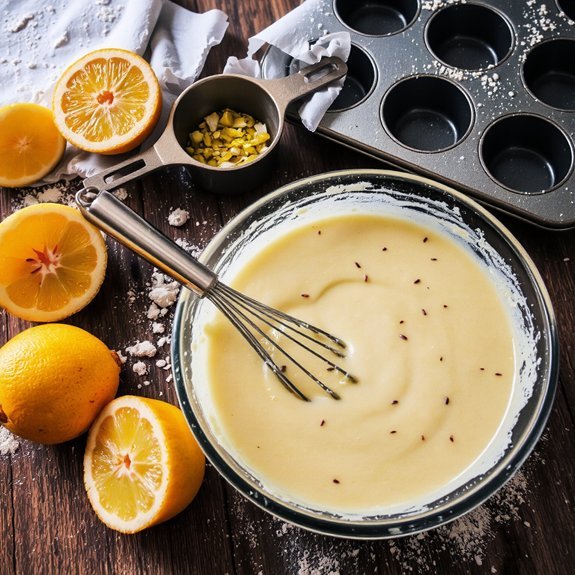
Preheat your oven to 375°F (190°C) and prepare a standard 12-cup muffin tin by inserting paper liners or lightly coating each cavity with nonstick spray.
Proper oven calibration guarantees consistent results across batches.
Proper oven calibration guarantees consistent results across all your baking batches.
- Whisk together dry ingredients—flour, baking powder, salt, and poppy seeds—in a medium bowl to distribute leavening agents uniformly.
- Combine wet ingredients separately: melted butter, eggs, sour cream, lemon juice, and zest, whisking until fully emulsified.
- Fold wet mixture into dry ingredients using minimal strokes to prevent gluten development and maintain tender crumb structure.
- Divide batter evenly among cups, filling each three-quarters full for ideal rise without overflow.
Bake 18-22 minutes, checking at timing checkpoints to prevent over-baking.
Muffins are done when a toothpick inserted in the center emerges clean and tops achieve light golden-brown coloring.
Tips for the Moistest Muffins
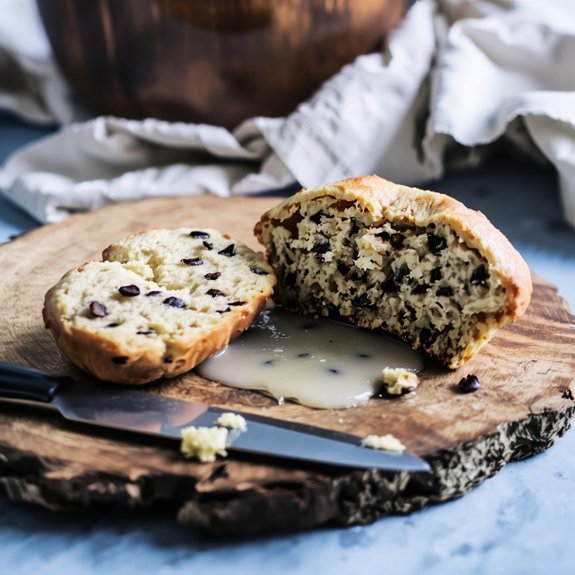
You’ll achieve ideal moisture by substituting buttermilk or sour cream for regular milk, as their acidic content tenderizes the crumb structure.
Refrain from overmixing your batter beyond the point of ingredient incorporation, which develops gluten and produces a dense, dry texture.
Incorporate oil rather than butter into your dry ingredients, since oil coats flour particles more effectively and creates a more tender crumb than solid fat.
Use Buttermilk or Sour Cream
Substituting all-purpose flour’s liquid component with buttermilk or sour cream dramatically improves muffin moisture retention and crumb structure.
You’ll achieve superior results by leveraging these acidic dairy products’ chemical properties.
- Acidity levels: The lactic acid in buttermilk and sour cream reacts with baking soda, creating lift and tender crumbs you can’t replicate with regular milk
- Texture comparison: Sour cream yields denser, more luxurious muffins; buttermilk produces lighter, airier results
- Hydration balance: Replace milk 1:1 with buttermilk or reduce sour cream by 25% due to higher fat content
- Emulsification: These dairy options stabilize your batter, preventing separation and ensuring consistent moisture distribution
You’ll notice immediate improvements in your muffins’ shelf life and eating quality.
The tangy undertone complements lemon’s brightness perfectly, elevating your final product’s complexity and appeal.
Don’t Overmix the Batter
While buttermilk and sour cream establish your batter’s foundation, how you combine these ingredients matters just as much as what you’re mixing.
Overmixing activates gluten development, which transforms your muffins into dense, tough hockey pucks instead of tender crumbs.
You’ll want to fold your dry ingredients into your wet mixture using minimal strokes—just until combined.
This approach limits gluten formation while preserving air incorporation, the critical factor for lift and moisture retention.
Use a rubber spatula, not an electric mixer, for this final stage.
Stop when you still see streaks of flour; a few lumps won’t hurt you.
This restraint yields that coveted tender crumb structure that makes lemon poppy seed muffins genuinely moist and delicious.
Add Oil Instead of Butter
Because butter solidifies as muffins cool, it can trap moisture and create a dense crumb structure.
Neutral oil—canola, vegetable, or light olive oil—distributes evenly throughout the batter and remains liquid, promoting superior moisture retention and tender crumb.
You’ll achieve ideal results by choosing oils with these characteristics:
- High smoke point (400°F+) ensuring stability during mixing and baking
- Neutral flavor that doesn’t compete with lemon and poppy seed notes
- Emulsion stability that maintains consistent fat distribution throughout the batter
- Clean texture without residual flavors affecting your final product
Replace butter at a 3:4 ratio—use three-quarters cup oil for every cup of butter.
This adjustment accounts for butter’s water content, yielding muffins with superior moistness and crumb tenderness.
You’re free from dense, dry results.
Flavor Variations to Try
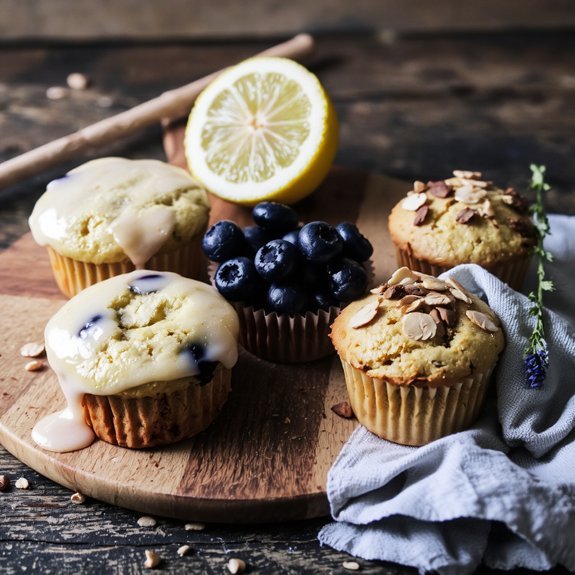
Once you’ve mastered the classic lemon poppy seed formula, you can easily manipulate the base recipe’s citrus-to-fat ratio and incorporate complementary botanicals to create distinct flavor profiles.
You’ll find seasonal themes work brilliantly—try adding fresh blueberries and lavender in summer, or cranberry and orange zest in autumn.
Global inspirations open endless possibilities: incorporate cardamom and pistachios for Middle Eastern notes, or matcha powder for Japanese-influenced depth.
Adjust your liquid ratios when adding wet ingredients like yogurt or buttermilk.
You can substitute 25% of the lemon juice with bergamot or lime without compromising structure.
Increase poppy seeds to 3 tablespoons when introducing Earl Grey tea steeping into your wet ingredients.
These modifications maintain your recipe’s chemical integrity while delivering personalized flavor experiences.
You’re not just baking—you’re innovating.
Storage and Shelf Life
Proper storage extends your muffins’ shelf life substantially by controlling moisture migration and oxidation.
Proper storage extends muffin shelf life by controlling moisture migration and oxidation.
You’ve got flexibility in how you preserve these treats based on your consumption timeline.
- Room temperature storage: Keep muffins in airtight container recommendations for 2-3 days maximum
- Refrigeration: Store in sealed containers at 40°F for up to one week, though crumb structure may compact slightly
- Freezer longevity: Wrap individually in parchment, then place in freezer bags for three months without quality degradation
- Thawing protocol: Remove from freezer and unwrap at room temperature for 30-45 minutes before serving
This approach preserves your lemon poppy seed muffins’ moisture content and flavor integrity.
Choose your storage method based on when you’ll consume them—don’t sacrifice quality by overthinking the process.
Serving Suggestions
While lemon poppy seed muffins shine on their own, you’ll elevate their appeal by pairing them strategically with complementary beverages and accompaniments. Tea pairings amplify citrus notes—select Earl Grey or chamomile for ideal flavor synergy. You’re free to customize garnish options using candied lemon slices, poppy seed dust, or a light glaze to enhance visual presentation and textural contrast.
| Beverage | Flavor Profile | Intensity |
|---|---|---|
| Earl Grey Tea | Bergamot-forward | Medium |
| Chamomile Tea | Floral, delicate | Light |
| Espresso | Bold, roasted | Strong |
Strategic garnishing transforms presentation without compromising nutritional composition. Apply garnishes immediately post-baking for firm adhesion. Consider your audience’s preferences when selecting accompaniments, whether you prefer minimal decoration or elaborate embellishment.
Frequently Asked Questions
Can I Substitute Poppy Seeds With Another Ingredient if I Don’t Have Any?
You can absolutely swap poppy seeds for alternatives. Chia seeds deliver comparable texture and nutritional density at a 1:1 ratio, though they’ll absorb more moisture—reduce your liquid by 2 tablespoons per cup.
Toasted sesame seeds provide nutty complexity and crunch; use half the quantity since they’re more assertive. Both substitutions maintain structural integrity while liberating you from ingredient constraints. Your muffin’s crumb structure remains intact with either option.
Why Do Poppy Seeds Sometimes Have a Bitter or Metallic Taste?
You
Are Poppy Seeds Safe to Consume Regularly for Health-Conscious Bakers?
You’ll find poppy seeds safe for regular consumption when you source them responsibly.
Reputable suppliers conduct opioid testing to verify trace alkaloid levels stay negligible.
However, you shouldn’t consume excessive quantities during pregnancy concerns—moderation’s your best approach.
Choose seeds with documented quality control and transparent sourcing.
You’re free to enjoy lemon poppy seed muffins routinely by maintaining standard portion sizes and verifying your supplier’s testing protocols meet established safety thresholds.
Can I Make This Recipe Without Eggs for a Vegan Version?
You’ll absolutely create vegan muffins by substituting eggs with flax eggs—combine 1 tablespoon ground flaxseed with 3 tablespoons water per egg, letting it sit 15 minutes.
Alternatively, you can use aquafaba substitute at 3 tablespoons per egg for superior binding and moisture retention.
Both options deliver comparable rise and crumb structure.
Flax eggs provide earthier notes; aquafaba maintains your recipe’s original flavor profile.
You’re free to choose based on your dietary preferences and desired textural outcomes.
What Causes Poppy Seeds to Sink to the Bottom of Muffins?
Poppy seeds sink because you’re not employing proper mixing technique. Their small seed size creates density that gravitates downward in batter.
You’ll prevent settling by coating seeds in flour before folding them in last, or by using thicker batter consistency. Alternatively, reserve seeds for topping your muffins pre-bake.
Your freedom to achieve even distribution depends on strategic ingredient sequencing and methodical incorporation timing.
Leave a Comment