

Key Takeaways
- Reduce liquid content by 1/4 cup per cup when substituting honey, maple syrup, or agave nectar.
- Lower oven temperature by 25°F when using honey or coconut sugar to prevent excessive browning.
- Replace 1 cup granulated sugar with 3/4 cup coconut sugar for similar sweetness and moisture retention.
- Use erythritol as a 1:1 replacement for sugar with minimal texture or browning adjustments needed.
- Combine high-intensity sweeteners like stevia or monk fruit with bulking agents to replicate sugar’s structural role.
Understanding Sugar’s Role in Baking

Since sugar serves multiple functions beyond sweetness in baking, you’ll need to understand its properties before you can effectively substitute it.
Sugar affects texture, moisture retention, and browning through the Maillard reaction.
You’ll discover that sugar’s leavening interaction with baking soda creates carbon dioxide, enabling rise in your baked goods.
Additionally, sugar’s preservative effect extends shelf life by reducing water activity, which inhibits microbial growth.
When you’re substituting sugar, you’re managing these mechanical and chemical properties simultaneously.
Different sweeteners behave differently—some won’t provide equivalent browning, others won’t interact with leavening agents identically, and some lack comparable preservative capabilities.
Understanding these distinctions empowers you to make informed substitutions that maintain your recipe’s structural integrity and desired outcomes rather than relying on guesswork or failed experiments.
Honey as a Sugar Substitute

Because honey contains approximately 17% water compared to sugar’s negligible moisture content, you’ll need to adjust your recipe’s liquid ratios when substituting it directly.
Honey’s 17% water content requires reducing other liquids by one-quarter cup per cup used in baking recipes.
Reduce other liquids by one-quarter cup per cup of honey used.
You’re also working with a sweetener roughly 25% sweeter than sugar, demanding proportional reduction.
Consider these essential factors:
- Floral varieties (clover, wildflower, acacia) impart distinct flavor profiles affecting final taste
- Allergy concerns necessitate clear labeling and customer disclosure
- Browning occurs more rapidly; lower oven temperatures by 25°F
- Honey’s hygroscopic nature keeps baked goods moist longer
- Fermentation risk increases in yeast-based applications due to moisture content
Honey works best in dense cakes, muffins, and cookies where its properties enhance texture without compromising structural integrity.
Maple Syrup and Other Liquid Sweeteners

Like honey, maple syrup introduces substantial moisture and pronounced sweetness to your formulations, but it’ll demand different adjustments than its floral counterpart.
You’ll reduce liquid content by approximately 25% when substituting maple syrup for sugar, as its water content affects dough consistency.
Regional varieties offer distinct flavor profiles—Grade A delivers mild sweetness, while Grade B provides robust, molasses-like notes that enhance baked goods.
You’ll find sustainable sourcing increasingly important; verify certifications ensuring responsible harvesting practices.
Agave nectar and brown rice syrup present additional options.
Agave yields neutral flavor with lower glycemic impact, though it requires similar liquid reduction.
Brown rice syrup carries subtle caramel notes but demands careful measurement due to its thinner consistency.
Each liquid sweetener necessitates precise formulation adjustments, so you’ll experiment methodically to achieve ideal results.
Stevia and Monk Fruit Sweeteners

You’ll find that stevia and monk fruit offer zero-calorie sweetening alternatives without the blood sugar impact of traditional sugar.
When you substitute these sweeteners, you’ll need to adjust your conversion ratios carefully—typically using one-third to one-half the amount of stevia compared to sugar, while monk fruit generally requires similar volume adjustments depending on the product’s concentration.
Both options present distinct taste profiles that you should test in your recipes, as stevia can carry a slight aftertaste while monk fruit delivers a cleaner sweetness more closely resembling sugar.
Natural Zero-Calorie Options
Where can bakers find sweetening solutions that deliver zero calories without the metabolic impact of sugar?
You’ll discover powerful alternatives that grant you complete control over your baking outcomes.
- Stevia extracts provide 200-300 times the sweetness of sugar with minimal aftertaste when properly refined
- Monk fruit sweeteners contain mogrosides, delivering intense sweetness without glycemic response
- Allulose benefits include superior browning, texture replication, and bulk comparable to conventional sugar
- Miraculin applications offer flavor-modifying properties that enhance perceived sweetness without adding calories
- Blended formulations combine these options to optimize taste profiles and functional performance
You’re not constrained by traditional baking limitations.
These zero-calorie options let you craft indulgent products while maintaining nutritional integrity.
You’ll achieve consistent results by understanding each sweetener’s unique properties and adjusting your recipes accordingly.
Taste and Conversion Ratios
While stevia and monk fruit deliver comparable sweetness levels, they require markedly different conversion ratios and produce distinct flavor profiles that’ll impact your final product.
Stevia typically demands a 1:1 replacement ratio but often leaves a bitter aftertaste requiring taste calibration adjustments.
Monk fruit sweetener, conversely, usually substitutes at a 1:1 ratio with minimal residual flavors, offering superior sweetness perception for most applications.
You’ll find stevia works best in beverages and dark recipes where its slight metallic notes won’t dominate. Monk fruit excels in delicate baked goods where clean sweetness matters.
Since both contain additives like erythritol for volume, you’ll need to account for these when adjusting liquid ratios. Start with smaller quantities, taste-test, then modify accordingly to achieve your desired flavor balance without compromising structural integrity.
Sugar Alcohols: Erythritol and Xylitol
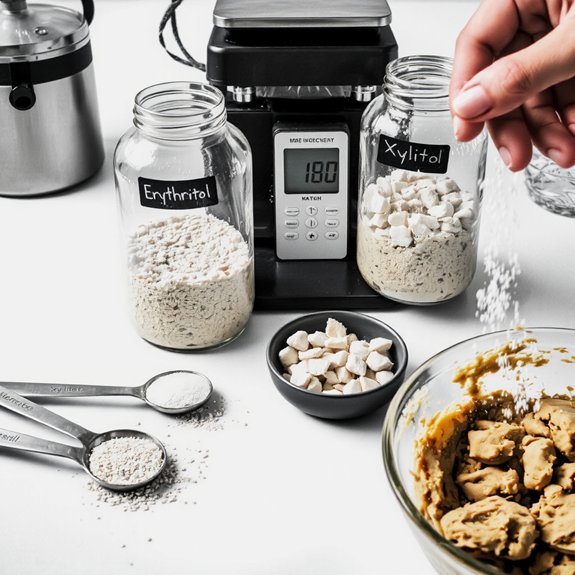
Sugar alcohols like erythritol and xylitol have become increasingly popular substitutes for traditional sugar in baking applications. You’ll find these compounds offer distinct advantages through their unique molecular structures and industrial production methods.
Key characteristics you should know:
- Both contain fewer calories than sucrose while maintaining sweetening power
- Erythritol provides superior heat stability during baking processes
- Xylitol delivers a cooling sensation that affects mouthfeel perception
- Their molecular structures resist caramelization at standard temperatures
- Industrial production yields consistent quality for reliable baking results
You’ll appreciate that these sugar alcohols don’t spike blood glucose levels, giving you control over your dietary choices.
However, they require careful conversion ratios—typically 1:1 replacement works for erythritol, while xylitol needs slight adjustments.
Understanding their distinct properties helps you achieve your desired baking outcomes without compromising texture or flavor development.
Coconut Sugar and Date Paste
You’ll find that coconut sugar offers a lower glycemic index than refined sugar while retaining similar moisture content, making it a viable one-to-one substitute in most baking applications.
Date paste, which you can prepare by blending soaked dates with minimal water, provides natural sweetness along with fiber and minerals that enhance nutritional profiles.
When you implement either substitute, you’ll need to adjust liquid ratios slightly—use 3/4 cup of coconut sugar or date paste for every cup of refined sugar your recipe calls for.
Coconut Sugar Nutritional Benefits
Nutritional superiority distinguishes coconut sugar from refined white sugar, making it a compelling alternative for health-conscious bakers. You’ll appreciate coconut sugar’s lower glycemic index, which prevents rapid blood sugar spikes that restrict your dietary freedom.
Its antioxidant profile surpasses conventional sugar, delivering polyphenols and flavonoids that combat oxidative stress. The mineral content includes potassium, magnesium, zinc, and iron—nutrients your body demands for peak function.
- Lower glycemic index (35 vs. 68 for white sugar)
- Rich antioxidant compounds protecting cellular health
- Essential minerals supporting metabolic processes
- Reduced insulin response promoting stable energy
- Natural trace nutrients absent in refined alternatives
You’re investing in nutritional integrity when substituting coconut sugar in your baking projects. This choice empowers you to enjoy delicious baked goods without compromising your health objectives or sacrificing the nutritional density your body requires.
Date Paste Preparation Methods
While coconut sugar delivers impressive nutritional benefits, combining it with date paste creates an even more potent sweetening solution for your baking endeavors.
You’ll find that mastering date paste preparation requires understanding two critical approaches:
| Method | Process |
|---|---|
| Soaking Techniques | Hydrate pitted dates in hot water for 15-20 minutes until softened |
| Blending | Pulse soaked dates with reserved liquid until smooth consistency |
| Storage Methods | Transfer paste to airtight containers; refrigerate up to two weeks |
| Ratio Application | Use one part paste to replace one part granulated sugar |
| Quality Control | Maintain uniform texture without lumps or separation |
You’ll gain control over sweetness intensity and moisture content by preparing your own paste. This method eliminates commercial additives, giving you complete autonomy over your baking ingredients. The resulting paste integrates seamlessly with coconut sugar, enhancing both flavor complexity and nutritional value while maintaining your desired texture in finished products.
Substitution Ratios and Conversions
Since coconut sugar and date paste possess distinct moisture profiles and sweetening potencies, precise ratios determine successful substitutions in your recipes.
You’ll achieve ideal results through metric standardization and calibration techniques tailored to each sweetener’s unique properties.
For coconut sugar substitution:
- Replace 1 cup granulated sugar with 3/4 cup coconut sugar
- Reduce liquid content by 1/4 cup per cup of coconut sugar used
- Adjust baking temperature down 25°F to prevent over-browning
- Account for coconut sugar’s mineral content affecting flavor profiles
- Employ weight-based measurements for precision calibration
Date paste demands different handling.
You’ll substitute 1 cup sugar with 1 1/3 cups date paste, accounting for its inherent moisture.
Reduce other liquids proportionally.
These calibration techniques help you maintain structural integrity and desired texture throughout your baked goods.
Adjusting Recipes for Different Sweeteners
Each sweetener behaves differently in baking due to variations in sweetness intensity, moisture content, and chemical composition, requiring you to adjust recipes accordingly.
Sweeteners vary in intensity, moisture, and chemical makeup, demanding recipe adjustments for successful baking outcomes.
When substituting, you’ll need to take into account equipment adjustments—some sweeteners demand modified mixing times or temperatures to activate properly. Honey and agave, for instance, require reduced liquid in your formulation, while stevia demands careful measurement due to its concentrated potency.
Cost comparisons reveal significant savings opportunities. Bulk sugar substitutes often provide better value than specialty options, though effectiveness varies.
You’re free to experiment with various sweeteners to discover your preferred balance of flavor, texture, and economics. Understanding each sweetener’s hydroscopic properties guarantees you’ll achieve consistent results while maintaining your recipe’s structural integrity and final product quality.
How Sweeteners Affect Browning and Texture
Controlling browning and texture requires understanding how different sweeteners interact with heat and moisture during baking.
You’ll find that sweetener choice dramatically impacts your final product’s characteristics.
- Maillard reactions intensify with granulated sugar but diminish with sugar alcohols, affecting crust color and flavor development
- Honey and molasses promote deeper browning due to higher moisture content and reactive compounds
- Stevia and aspartame don’t participate in browning reactions, yielding paler baked goods
- Moisture retention varies markedly—liquid sweeteners create softer crumbs while dry alternatives produce crispier textures
- Artificial sweeteners may require texture adjustments since they don’t provide sugar’s structural properties
- Oven Calibration: Verify your oven’s temperature accuracy using an independent thermometer; substitutes may require adjusted baking times
- Doneness Indicators: Monitor color development, firmness, and internal temperature rather than relying solely on visual cues
- Texture Assessment: Evaluate crumb structure, moisture retention, and mouthfeel against your control batch
- Flavor Profile: Taste for off-flavors, bitterness, or unexpected aftertastes common with certain sweeteners
- Volume and Rise: Compare final product dimensions; some substitutes affect leavening and expansion differently
You’ll need to experiment with substitution ratios and oven temperatures to achieve your desired results.
Understanding these chemical interactions empowers you to make confident, informed baking decisions without compromising quality.
Combining Multiple Sweeteners for Best Results
When you blend multiple sweeteners, you’ll capitalize on each one’s strengths while offsetting individual limitations.
Flavor layering through strategic combinations allows you to achieve complexity that single sweeteners can’t deliver.
For instance, pairing honey with stevia masks stevia’s metallic aftertaste while reducing overall sweetness intensity.
Cost optimization becomes another advantage when you strategically mix sweeteners.
You’re not locked into expensive alternatives; instead, you’ll combine modest amounts of premium sweeteners with budget-friendly options.
This approach maintains quality without breaking your budget.
Consider your specific baking application when selecting combinations.
Honey with brown sugar enhances moisture retention in cakes, while combining maple syrup with monk fruit provides balanced sweetness without excessive browning.
You’ll achieve superior results by treating sweetener blending as precision chemistry rather than guesswork.
Testing and Troubleshooting Your Baked Goods
How’ll you know if your sugar substitutes are working as intended?
Test your results systematically by evaluating key performance metrics.
Document your observations meticulously.
You’ll identify which substitutes perform most effectively for specific applications.
Adjust ratios incrementally based on results, maintaining control over your baking outcomes and ensuring consistent quality across batches.
Frequently Asked Questions
Are Sugar Substitutes Safe for Children and Pregnant Women to Consume in Baked Goods?
You’ll find that most FDA-approved sugar substitutes are generally recognized as safe for children and pregnant women in baked goods.
However, you should review individual sweetener profiles, as some exhibit placental transfer properties.
During breastfeeding exposure, certain substitutes appear in breast milk at minimal levels.
You’re encouraged to consult your healthcare provider about specific sweeteners before consumption, particularly during pregnancy and lactation, ensuring you make informed choices aligned with your family’s health priorities.
Which Sweeteners Work Best for Diabetic-Friendly or Low-Glycemic Baking Recipes?
You’ll find erythritol blends work exceptionally well for low-glycemic baking, delivering minimal blood sugar impact while maintaining structure.
You can experiment with stevia ratios—typically 1 teaspoon replaces 1 cup sugar, though you’ll need to adjust based on your recipe’s requirements.
You’re free to combine these sweeteners for ideal taste and texture.
You’ll also want to explore monk fruit and allulose as complementary options that won’t compromise your diabetic-friendly goals.
Can I Use Sugar Substitutes in Yeast-Based Breads and Do They Affect Fermentation?
You can use sugar substitutes in yeast breads, but they’ll substantially impact fermentation. Yeast requires actual sugar for food and CO2 production.
Sugar substitutes like stevia or erythritol won’t ferment, limiting your dough’s rise. This compromises crumb texture and creates dense loaves.
You’re better off combining a small amount of real sugar with substitutes to maintain adequate fermentation while reducing overall sweetness. This approach preserves both rise and structure.
How Do Artificial Sweeteners Compare Nutritionally to Natural Sugar Substitutes?
You’ll find artificial sweeteners and natural substitutes differ substantially in nutrient profiles and antioxidant levels.
Artificial options like aspartame contain virtually no nutrients or antioxidants, offering only sweetness.
Natural alternatives—stevia, honey, maple syrup—retain diverse micronutrients and beneficial compounds.
You’re trading pure sweetening power for nutritional density when choosing natural substitutes.
Your choice determines whether you’re optimizing for zero calories or maximizing health-promoting compounds in your baked goods.
Which Sweeteners Are Most Cost-Effective When Substituting Sugar in Large Batch Baking?
You’ll find bulk sourcing of high-fructose corn syrup and dextrose offers substantial cost savings for large-batch operations.
Conduct thorough supplier comparison across multiple vendors to identify competitive pricing structures.
Aspartame and sucralose provide efficient per-unit economics when purchased in industrial quantities.
You’re maximizing your operational autonomy by negotiating volume discounts directly with distributors, bypassing retail markup constraints entirely.


Leave a Comment