

Key Takeaways
- Fruit purees like applesauce or mashed banana replace eggs at 1:4 cup ratio, creating denser, moister baked goods.
- Aquafaba whips into stiff peaks and replaces one egg using 3 tablespoons, ideal for meringues and mousses.
- Ground flax or chia seeds mixed with water form gels for binding; use 1 tablespoon seeds plus 3 tablespoons water per egg.
- Commercial egg replacers offer consistency and shelf stability; mix one tablespoon with three tablespoons water per egg replacement.
- Reduce added sugar by ¼ cup when using sweet purees and adjust liquid content based on puree consistency for optimal results.
Understanding the Role of Eggs in Baking
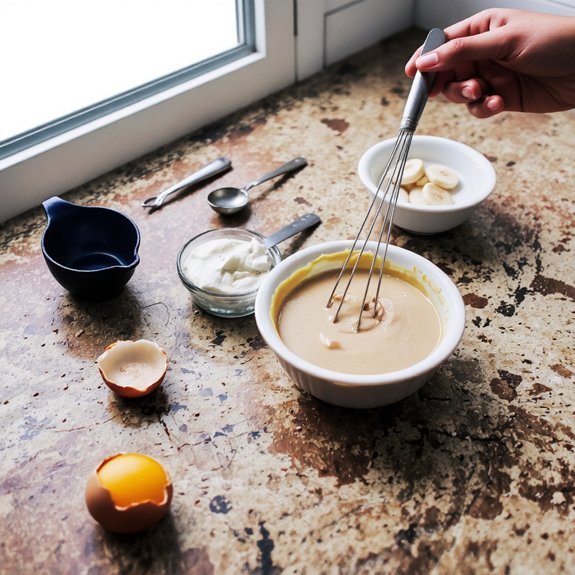
Before you can effectively substitute eggs, you’ll need to understand what they actually do in your recipes. Eggs serve multiple critical functions that directly impact your baked goods’ texture and structure.
The protein structure in eggs coagulates when heated, creating a network that traps moisture and provides structural support. This binding capability stabilizes your batters and doughs, preventing them from collapsing during baking.
The emulsification role of eggs is equally important. Egg yolks contain lecithin, a natural emulsifier that allows incompatible ingredients—fats and liquids—to blend seamlessly. This prevents separation and produces smooth, consistent batters.
Additionally, eggs contribute leavening through air incorporation during beating. They also add richness and moisture to finished products.
Understanding these distinct functions guarantees you’ll choose appropriate substitutes that replicate the specific roles eggs play in your particular recipe.
2. Applesauce and Fruit Purees
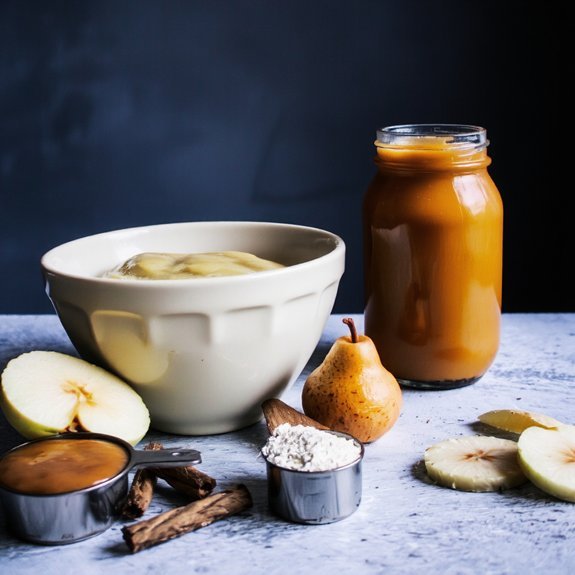
Since applesauce and fruit purees provide moisture and binding without contributing significant leavening or emulsification, they work best in recipes that don’t rely heavily on eggs for structure.
You’ll substitute one egg with ¼ cup of applesauce or puree in brownies, quick breads, and muffins.
The advantage? You control your ingredients completely.
However, you’ll need seasoning adjustments since fruit purees add sweetness—reduce sugar by ¼ cup per substituted egg.
Unsweetened varieties give you maximum flexibility.
For storage methods, keep opened applesauce refrigerated for up to two weeks or freeze in ice cube trays for convenient portioning.
Homemade purees should be refrigerated for five days or frozen for three months.
Your baked goods will be denser and moister than egg-based versions, making them ideal for dense cake applications.
3. Flax Seeds and Chia Seeds
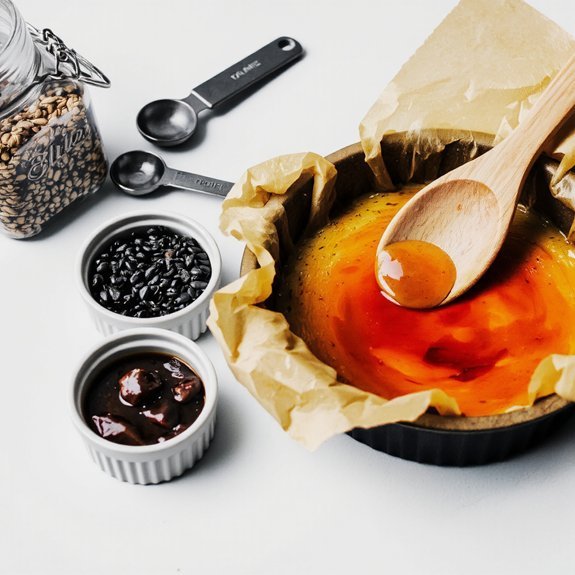
Flax seeds and chia seeds offer a different mechanism for egg replacement than fruit purees—they create binding through their mucilaginous properties rather than moisture alone.
You’ll maximize results by grinding seeds finely and hydrating them before use.
Here’s how to optimize your substitution:
- Mix 1 tablespoon ground flax or chia with 3 tablespoons water; let sit 15 minutes until gel forms
- Use this ratio for each egg your recipe requires
- Store ground seeds in airtight containers away from heat to preserve their nutritional profiles
- Consider chia’s superior absorption capacity—it absorbs roughly three times its weight in liquid
Their nutritional profiles provide omega-3 fatty acids and fiber, enhancing your baked goods’ health benefits.
Storage tips include refrigerating ground seeds for extended shelf life.
This method works best in dense recipes like brownies and quick breads where binding matters most.
4. Aquafaba: The Chickpea Liquid Solution
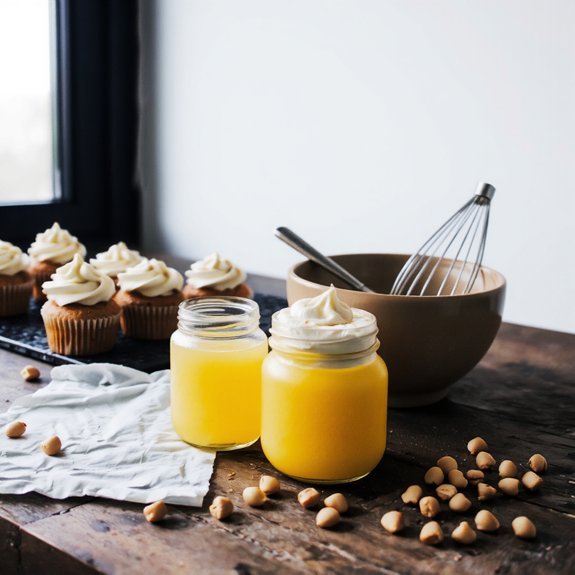
You can whip aquafaba into stiff peaks similar to egg whites because its proteins and starches create a stable foam structure when aerated.
To replace eggs in your recipes, you’ll use a 3:1 ratio—three tablespoons of aquafaba equals one whole egg, though you may need to adjust based on whether you’re substituting for binding, leavening, or moisture.
This precise conversion allows you to achieve consistent results across different baking applications, from meringues to mousses.
Whipping and Foam Formation
What makes aquafaba—the viscous liquid drained from canned or cooked chickpeas—such an effective egg replacer for whipping?
You’ll discover that aquafaba’s starches and proteins create structural integrity when you whip it into foam.
Here’s what happens during the whipping process:
- Protein denaturation occurs as mechanical action unfolds protein molecules, stabilizing air bubbles
- Surface tension reduces at the air-water interface, allowing foam expansion
- Starches absorb water, thickening the mixture and maintaining bubble structure
- Air incorporation creates a stable foam comparable to egg whites
You’ll achieve stiff peaks within 3-5 minutes using an electric mixer.
Three tablespoons of aquafaba equals one egg white.
This foam works excellently in meringues, mousses, and angel food cakes, giving you complete control over your baking without animal products.
Ratio Conversions for Recipes
Now that you’ve mastered aquafaba’s foaming properties, understanding precise ratio conversions becomes necessary for adapting recipes successfully. You’ll use weight conversions and scaling formulas to translate aquafaba measurements across different batches.
| Egg Function | Traditional Amount | Aquafaba Equivalent | Weight (grams) |
|---|---|---|---|
| Binder | 1 egg | 3 tablespoons | 45 |
| Leavening | 1 egg | 2 tablespoons whipped | 30 |
| Moisture | 1 egg | 3 tablespoons | 45 |
| Structure | 1 egg | 4 tablespoons whipped | 60 |
You’ll calculate your recipe’s total egg content, then multiply by the appropriate aquafaba ratio. For scaling formulas, divide your desired batch size by the original recipe yield, then apply that factor to aquafaba measurements. You’re now equipped to confidently convert any egg-containing recipe into an aquafaba-based alternative without compromising texture or rise.
5. Mashed Bananas and Other Fruit Options
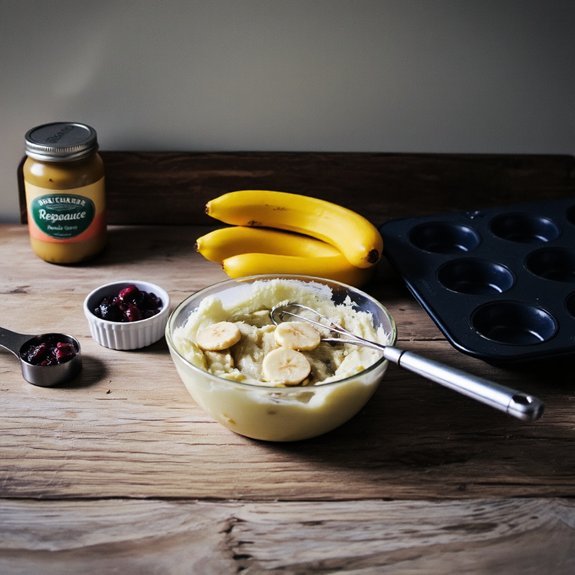
You can harness mashed bananas‘ natural binding properties and moisture content to replace eggs in your baked goods, though you’ll need to adjust your ratios—typically using 1/4 cup of puree per egg while reducing other liquids by 3 tablespoons.
When selecting fruits, you’ll find that applesauce, pumpkin puree, and avocado offer similar functional benefits, each with distinct moisture levels and flavor profiles that you must match to your specific recipe. To optimize results, you should match the fruit’s water content to your batter’s requirements, as denser purees like pumpkin require different liquid adjustments than thinner options like applesauce.
Banana’s Binding and Moisture
Because mashed bananas contain both binding starches and natural moisture, they’re effective egg replacers in baking applications where you’ll benefit from added tenderness and density.
You’ll need to understand ripeness indicators and starch conversion to optimize results.
- Ripeness timing: Use fully ripe bananas with brown spotting; they’ve undergone ideal starch conversion to simple sugars, enhancing binding capacity and sweetness.
- Ratio accuracy: Replace one egg with ¼ cup mashed banana, adjusting liquid content in your recipe accordingly.
- Starch functionality: The resistant starches provide structural support while retaining moisture throughout baking, preventing dryness.
- Texture outcomes: Expect denser crumb structure and increased moisture retention compared to traditional egg-based baked goods.
This substitution works best in quick breads, muffins, and brownies where you’re seeking freedom from conventional binding agents.
Fruit Puree Ratios Guide
Fruit purees function as effective egg replacers when you maintain precise ratios that account for their varying water content and binding properties.
For applesauce or banana puree, substitute one egg with ¼ cup puree.
Pumpkin requires ⅓ cup per egg due to its density.
You’ll need to reduce other liquids in your recipe by 25% to prevent excess moisture that compromises structure.
Flavor balancing becomes critical—banana imparts sweetness, while applesauce offers neutrality.
Consider your recipe’s profile when selecting purees.
Texture optimization depends on puree consistency; thicker options provide superior binding.
Prune puree delivers remarkable density for dense cakes.
You’re not just replacing eggs; you’re engineering moisture and binding dynamics.
Test ratios in small batches first, adjusting liquid content until you achieve your desired crumb structure and rise.
Best Fruits for Baking
Once you’ve mastered the ratios for common purees, selecting the right fruit becomes your next strategic decision.
You’ll want to assess how each fruit impacts texture, moisture, and flavor stability in your final product.
The best fruits for egg substitution include:
- Mashed bananas—contribute density and natural sweetness; ideal for dense cakes
- Applesauce—provides moisture without overpowering flavors; works across most applications
- Dried fruits rehydrated into paste—offer concentrated flavor and superior binding properties
- Citrus zest combined with fruit purees—enhances complexity while reducing moisture content
You’re not locked into conventional choices.
Experiment with combinations that align with your recipe’s flavor profile.
Darker fruits like prunes deliver richer results, while lighter options maintain delicate tastes.
Your freedom to innovate means testing variables systematically.
Track which substitutions yield your preferred crumb structure and rise, then scale accordingly for consistent, reliable baking outcomes.
6. Commercial Egg Replacers and Starches
For bakers seeking consistency and shelf stability, commercial egg replacers offer a scientifically formulated alternative that you’ll find particularly useful in vegan baking or for allergen-free applications. These products typically combine starches, leavening agents, and binding compounds to mimic eggs’ functional properties.
When comparing ingredients, you’ll notice commercial replacers provide precise ratios—usually one tablespoon mixed with three tablespoons water equals one egg. This standardization guarantees reproducible results across batches.
Starches like potato or tapioca serve as binding agents, while xanthan gum enhances structure without compromising texture.
You’ll appreciate their extended shelf stability; unopened packages remain viable for years. Once opened, store them in cool, dry conditions.
Though pricier than alternatives like applesauce or aquafaba, commercial replacers deliver reliability when you demand consistent baking outcomes without compromise.
7. Troubleshooting Common Egg Substitution Issues
Even with reliable commercial replacers at your disposal, you’ll encounter specific challenges that demand targeted solutions.
Your baking outcomes depend on understanding how substitutes behave under heat and moisture conditions.
Common issues you’ll face:
- Density problems – Replacers often produce denser crumbs; adjust liquid ratios downward by 10-15% to compensate
- Oven calibration – Your oven’s actual temperature may deviate from settings, affecting rise and browning rates with egg-free batches
- Flavor masking – Substitute aftertastes require stronger vanilla or spice notes to neutralize unwanted notes
- Moisture retention – Some replacers absorb excess liquid; reduce binding agents proportionally
You’ll need to experiment systematically with your specific oven and ingredient brands.
Document temperature variations and moisture adjustments.
This methodical approach gives you control over consistent results, freeing you from guesswork and failed batches.
Frequently Asked Questions
Can I Mix Different Egg Substitutes Together in a Single Recipe?
Yes, you can mix different egg substitutes together, though you’ll want to take into account flavor compatibility and leavening synergy.
Combining applesauce with baking soda works well for structure, while aquafaba mixed with cornstarch enhances moisture.
You’re free to experiment with proportions, but keep total volume consistent with original egg amounts.
Test your ratios carefully—some combinations interact unpredictably during baking, affecting rise and texture substantially.
Do Egg Substitutes Affect the Shelf Life or Storage of Baked Goods?
Yes, egg substitutes substantially impact your baked goods’ shelf life. You’ll find that applesauce and mashed bananas increase moisture retention, which accelerates mold growth compared to traditional eggs.
Flax and chia eggs don’t extend longevity either. Commercial replacers offer better stability.
Store substituted baked goods in airtight containers and refrigerate within two days to prevent spoilage. Your freedom to choose substitutes comes with understanding these storage trade-offs require vigilance.
Are Egg Substitutes Suitable for All Types of Baking Recipes?
No, you can’t use egg substitutes uniformly across all baking recipes. You’ll find that texture compatibility and rise performance vary considerably depending on your recipe type.
Delicate cakes and meringues demand specific substitutes for proper structure, while dense recipes like brownies offer you more flexibility. You’re responsible for matching the substitute’s binding, leavening, and moisture properties to your recipe’s requirements for ideal results.
How Do Egg Substitutes Impact the Nutritional Content of Baked Goods?
You’ll find that egg substitutes noticeably alter your baked goods’ nutritional profiles.
Most alternatives reduce protein content substantially—whole eggs deliver roughly 6 grams per unit, while plant-based substitutes provide minimal protein.
Calorie comparison reveals applesauce and banana-based options cut calories dramatically, though they increase sugar content.
Flax and chia seeds maintain better protein levels but add fat.
You’re fundamentally trading one nutritional attribute for another, so you’ll want analyzing labels carefully before choosing your substitute.
Can I Use Egg Substitutes in Recipes Requiring Whipped or Beaten Eggs?
You can’t reliably replicate traditional foam mechanics with most egg substitutes. Aquafaba (chickpea liquid) performs best, achieving similar whip timings and structural stability as egg whites—approximately 3 minutes to stiff peaks.
However, you’ll sacrifice some volume and stability compared to actual eggs. Alternatives like flax or chia eggs won’t develop proper foam, limiting their use in angel food cakes or soufflés.
Choose aquafaba when foam structure’s non-negotiable.




Leave a Comment