
Key Takeaways
- Organize equipment by frequency of use—daily essentials at eye level, weekly items in secondary storage, occasional tools on higher shelves.
- Install vertical dividers, under-shelf racks, and drawer organizers to maximize cabinet space and improve accessibility for mixing bowls and tools.
- Store delicate items like thermometers and piping tips in padded wraps within airtight containers with silica packs for protection.
- Use color coding and strategic labeling by function to quickly locate specific tools and reduce search time during baking tasks.
- Implement seasonal rotation to keep prime storage real estate available for frequently used equipment while storing holiday molds separately.
Assess Your Baking Equipment Inventory

Before you organize your baking equipment storage, you’ll need to conduct a thorough inventory of what you own.
Before organizing your baking equipment storage, conduct a thorough inventory of everything you own to clarify your true storage needs.
Start by listing every item—mixers, measuring cups, baking pans, and specialty tools.
Evaluate each piece using a condition checklist, noting functionality, wear, and damage.
Categorize equipment by frequency of use: daily, weekly, or occasional.
Determine your replacement timeline for worn items.
Identify broken equipment that requires repair or disposal.
Document which items you actually use versus those taking up valuable space.
This assessment prevents unnecessary clutter and clarifies your true storage needs.
Create a spreadsheet tracking item condition, age, and priority level.
This systematic approach enables you to make informed decisions about what deserves prime storage real estate.
You’ll gain clarity on your actual baking arsenal and optimize your storage strategy accordingly.
Organize by Frequency of Use
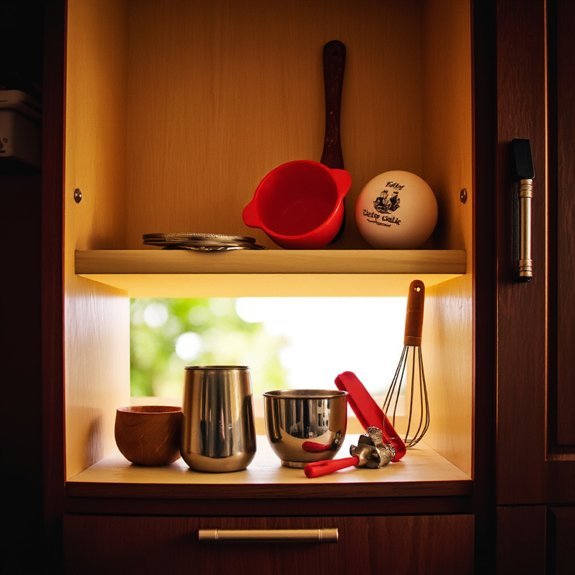
Once you’ve inventoried your baking equipment, you’ll organize your storage system by categorizing items based on usage frequency.
Place daily essentials—mixing bowls, measuring cups, and spatulas—in your most accessible locations.
Reserve secondary storage for weekly-use items like specialty pans and pastry tools.
Implement task batching by grouping related equipment together.
Store all decorating supplies in one zone, all measuring tools in another.
This approach streamlines your workflow and eliminates wasted motion.
Consider seasonal rotation for occasional equipment.
Holiday-specific molds, springform pans, and themed decorating tools belong in less-accessible storage during off-seasons.
Rotate them forward when needed, maximizing your prime storage real estate.
This frequency-based organization system gives you complete control over your baking space while maintaining efficiency.
Maximize Cabinet and Drawer Space

Your cabinet and drawer organization directly impacts how efficiently you’ll access your baking tools.
Smart cabinet and drawer organization is the foundation of an efficient baking workspace.
Install vertical dividers in drawers to separate items like baking sheets, cooling racks, and cutting boards.
This prevents cluttering and lets you grab what you need without shuffling through stacks.
Use under shelf racks to double your usable space without sacrificing cabinet real estate.
Stack mixing bowls, measuring cups, and smaller equipment on these racks to keep your shelves uncluttered.
Implement drawer organizers with compartments for measuring spoons, piping tips, and specialty tools.
Group similar items together so you’ll locate them instantly.
Store frequently used equipment at eye level and within arm’s reach.
Reserve higher shelves for occasional-use items.
This strategic arrangement maximizes accessibility while keeping your baking station clutter-free and functional.
Protect Delicate and Specialty Tools

Safeguarding delicate equipment requires deliberate storage strategies that prevent damage and extend tool longevity.
You’ll want to invest in padded wraps for fragile items like thermometers, piping tips, and specialty molds.
These protective layers absorb impact and prevent scratches during storage and retrieval.
Store moisture-sensitive tools in airtight containers with silica packs to eliminate humidity damage.
Replace silica packs regularly to maintain ideal dryness levels.
You should designate a dedicated shelf or drawer for delicate equipment, keeping it separate from heavier tools that risk crushing or denting.
Consider vertical storage solutions for flat items like cake decorating stencils and templates.
Label all containers clearly so you locate specific tools without excessive searching or handling.
This systematic approach preserves your investment and maintains equipment functionality.
Create an Accessible System for Quick Access

While protecting your equipment matters, organizing it for quick retrieval guarantees you’ll actually use your tools when you need them.
Implement a strategic labeling scheme that identifies each item’s purpose and location.
You’ll eliminate wasted time searching through drawers and cabinets.
Adopt color coding to categorize equipment by function: one color for mixing tools, another for measuring devices, and a third for specialty items.
This visual system lets you grab what you need instinctively.
Store frequently used items at eye level and within arm’s reach.
Reserve higher or lower shelves for occasional-use equipment.
Position your most essential tools—measuring spoons, whisks, spatulas—in the most accessible spots.
This streamlined approach maximizes your baking efficiency and keeps your workflow uninterrupted.
You maintain complete control over your space and your creative process.
Frequently Asked Questions
How Often Should I Clean and Inspect My Baking Equipment Before Storage?
You’ll want to establish a routine schedule that includes cleaning and inspecting your equipment before every storage session.
Don’t wait—implement a prestorage checklist you can customize based on your specific needs.
You’re free to adjust frequency depending on usage intensity, but monthly inspections work well for most home bakers.
You’ll maintain ideal equipment performance and extend longevity by staying consistent with this disciplined approach.
What Temperature and Humidity Levels Are Ideal for Storing Baking Tools?
You’ll want to maintain 50-70% relative humidity and temperatures between 60-75°F for ideal baking tool storage. Keep your monitoring tools handy to track these conditions consistently.
You’re free to make seasonal adjustments as needed—tighter controls during humid summers prevent rust, while winter’s dryness requires less intervention.
Store equipment away from direct sunlight and temperature fluctuations. Proper environmental control guarantees your tools remain reliable and ready whenever you choose to bake.
Should I Store Baking Equipment Separately From Other Kitchen Items?
You’ll benefit from implementing a zoning strategy that separates baking equipment from general kitchen items.
This tool grouping approach maximizes your storage efficiency and gives you immediate access to what you need.
Dedicate specific cabinets or drawers exclusively to baking supplies—mixers, measuring tools, and specialty pans.
You’ll eliminate clutter, streamline your workflow, and maintain better organization.
This systematic separation empowers you to work independently without searching through unnecessary items.
How Can I Prevent Rust and Damage During Long-Term Storage Periods?
You’ll prevent rust and damage by applying protective coatings to metal surfaces before storage.
Use rust converters on any existing oxidation to neutralize it chemically.
Store equipment in climate-controlled, dry environments away from moisture.
Wrap items individually in acid-free paper or cloth.
You’re free to choose silica gel packets for humidity control.
This systematic approach protects your investment and maintains functionality throughout extended storage periods without restriction.
What’s the Best Way to Store Non-Stick Pans to Maintain Their Coating?
You’ll maintain your non-stick coating by storing pans with protective liners between each piece, preventing friction damage. Install hanging hooks on your storage wall or cabinet interior—this vertical approach eliminates stacking pressure that degrades the non-stick surface.
Keep pans in a cool, dry environment away from humidity. You’ll maximize coating longevity by avoiding direct contact with other cookware, ensuring you preserve your investment’s performance and durability.
Leave a Comment