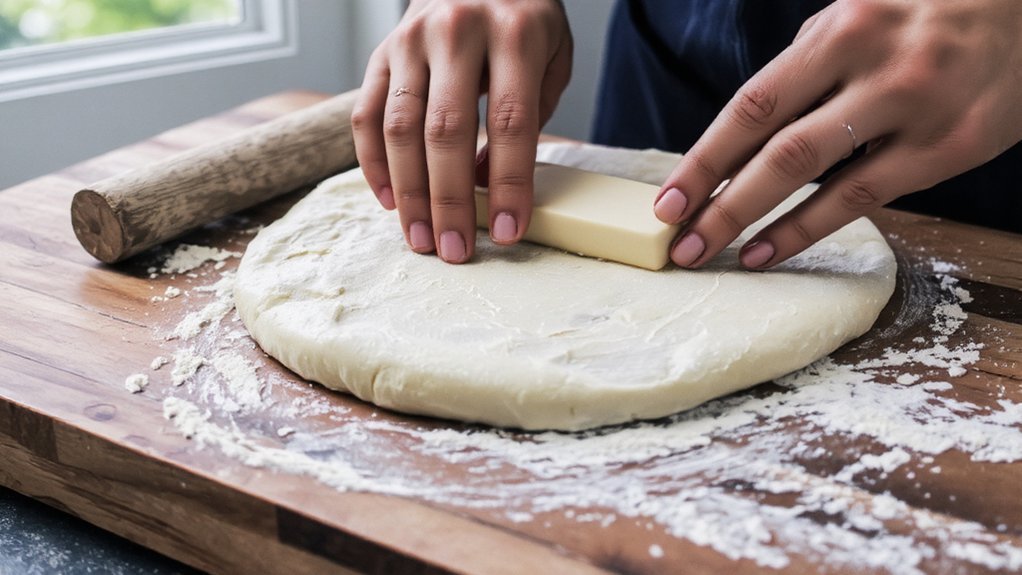

Key Takeaways
- Fold butter into dough repeatedly to create alternating sheets that puff separately during baking for flaky texture.
- Use bread flour (12–14% protein) and European-style butter (≥86% butterfat) at precise temperatures for optimal lamination.
- Maintain dough at 60–65°F during lamination and butter at 65–68°F to prevent premature softening or cracking.
- Rest dough 20–30 minutes in refrigeration between each fold to relax gluten and firm butter layers.
- Execute consistent folds with even pressure, tracking layers meticulously; six folds create approximately 4,096 distinct layers.
Understanding Lamination Basics
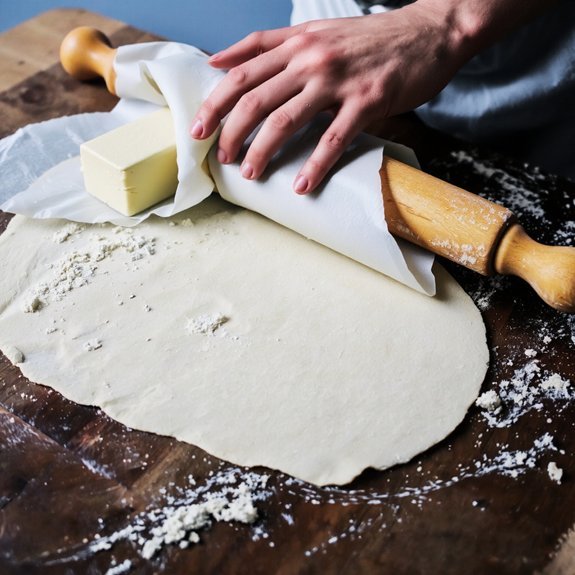
Have you ever wondered why croissants possess those delicate, shattering layers?
You’re witnessing lamination theory in action.
This technique involves folding butter into dough repeatedly, creating alternating sheets that separate during baking.
Folding butter into dough repeatedly creates alternating sheets that separate beautifully during baking, transforming your pastry.
Layer science explains this phenomenon: steam generated between butter and dough layers causes them to puff independently, producing those coveted flaky textures.
You’ll discover that precision matters tremendously.
Maintaining proper dough temperature prevents butter from melting prematurely, while controlled folding guarantees even layer distribution.
Each fold doubles your layer count exponentially—three folds yield twenty-seven layers, fundamentally transforming your dough’s structure.
Understanding these principles gives you freedom to master croissants, danishes, and puff pastry confidently.
You’re not simply following recipes; you’re controlling the physics that determines your pastry’s success.
Preparing Your Dough and Butter
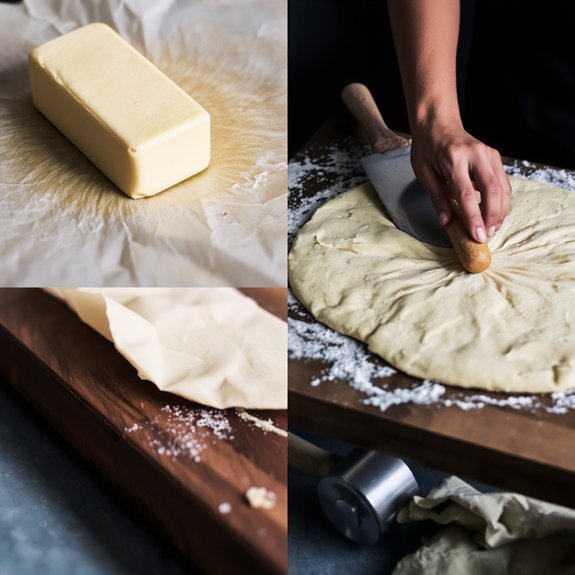
Since lamination depends entirely on temperature control and proper ingredient preparation, you’ll need to establish precise conditions before you begin folding.
Your flour selection determines gluten development and dough strength. Choose bread flour with 12-14% protein content for ideal elasticity. Butter quality is equally critical—use European-style butter containing 86% butterfat minimum for superior lamination.
| Component | Temperature | Timing |
|---|---|---|
| Dough base | 75°F | 30 minutes rest |
| Butter block | 65-68°F | Tempered |
| Work surface | 68°F | Pre-chilled |
| Folding environment | 65-70°F | Controlled |
| Final proofing | 40°F | Overnight |
Keep your dough and butter within precise temperature ranges. Your butter must remain pliable yet firm—too soft and it’ll smear; too cold and it’ll crack. Allow your dough adequate resting periods between folds to prevent gluten breakdown and maintain lamination integrity throughout the process.
Mastering the Folding Technique
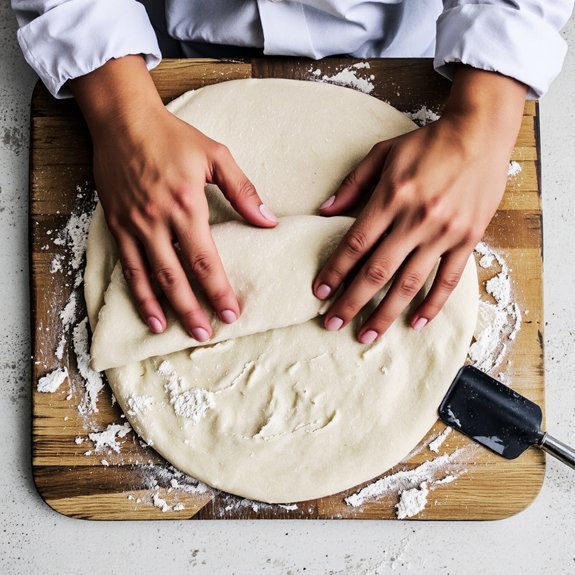
With your dough and butter properly prepared and tempered, you’re ready to execute the folding technique that’ll create the signature layers of laminated pastry.
Position your dough on a floured surface with hand positioning that grants you complete control—thumbs beneath, fingers splayed across the top.
Roll to even thickness, then deposit your butter block centrally.
Fold the dough’s edges over the butter, sealing it completely.
Execute your first fold by bringing one end toward the center, then folding it over itself.
Rotate ninety degrees and repeat.
Track your layer counting meticulously; each fold doubles your layers exponentially.
After six folds, you’ll achieve approximately 4,096 distinct layers.
Maintain consistent pressure and temperature throughout—this discipline guarantees superior lamination and ideal pastry performance.
Managing Temperature and Timing
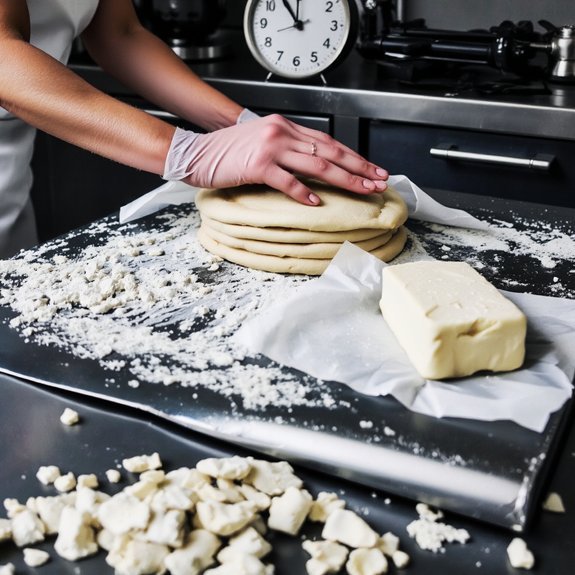
You’ll maintain your dough’s integrity by keeping it consistently cold throughout the lamination process—temperatures between 60-65°F prevent butter from softening prematurely and compromising your layers.
Your resting periods between folds are critical; you’ll need 20-30 minutes of refrigeration after each turn to allow the dough to relax and the butter to firm up before the next fold. Timing these intervals precisely guarantees you’ll achieve the maximum number of distinct, crispy layers without overworking the gluten structure.
Cold Dough Maintenance Essentials
The laminated dough’s structural integrity depends entirely on maintaining consistent cold temperatures throughout the production process.
You’ll preserve your dough’s shelf life by storing it between 32-40°F, ensuring butter layers remain distinct and don’t merge into the dough mass.
Keep your work surface chilled—use marble slabs or refrigerated marble sheets to prevent premature softening during folding sessions.
Practice rigorous tool sanitation by cleaning all scrapers, bench knives, and rolling pins with cold water immediately after use.
Residual dough attracts warmth and compromises your lamination work.
Monitor your dough’s temperature constantly using an instant-read thermometer.
Your dough should never exceed 70°F between folds.
Properly maintained cold dough yields superior croissants and Danish pastries with crisp, flaky layers that justify your meticulous attention to thermal control.
Resting Period Best Practices
Because laminated dough requires time for gluten relaxation and butter stabilization between folds, strategic resting periods directly determine your final product’s texture and rise.
You’ll maintain ideal control by resting dough at 38-40°F for 30-45 minutes between each fold cycle. This temperature range prevents butter from softening while allowing gluten to relax sufficiently.
You should implement batch labeling with fold numbers and timestamps to track your dough’s progress accurately. Schedule coordination guarantees you’re not constrained by rigid timelines—you can adjust resting intervals based on your kitchen’s conditions and your production demands.
Cold overnight rests (12-16 hours) at 35-38°F develop superior flavor complexity and structural integrity.
You’ll achieve consistent lamination only through disciplined temperature management and precise timing documentation. These practices grant you flexibility while maintaining the technical precision laminated dough demands.
Common Mistakes and How to Avoid Them
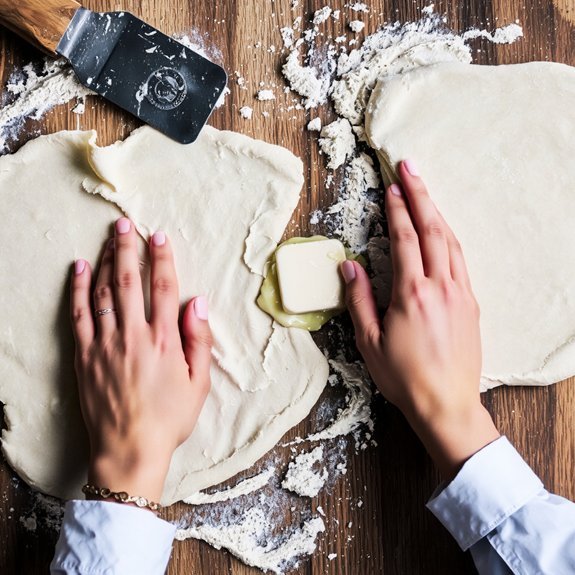
You’ll encounter three critical pitfalls when laminating dough: uneven butter distribution creates inconsistent layers and compromises flakiness, temperature fluctuations cause butter to soften unevenly or become too firm, and overworking the dough develops gluten excessively, resulting in tough, dense pastries instead of the desired tender crumb.
Mastering control over these variables requires you to maintain precise temperature conditions, distribute butter uniformly during each fold, and handle your dough with deliberate restraint throughout the lamination process.
Your attention to these fundamentals directly determines whether you’ll achieve the characteristic crispy, shattered layers that define quality laminated products.
Uneven Butter Distribution
When laminating dough, inconsistent butter placement undermines the entire process, creating thick and thin layers that won’t rise uniformly or develop the desired flaky texture.
You’ll compromise both structure and consumer perception if distribution remains uneven.
To prevent this, use a diagnostic checklist: verify your butter’s temperature matches your dough, confirm even pressure when rolling, and maintain consistent thickness throughout each fold.
Cold butter resists spreading; warm butter pools unevenly. You’re aiming for precise, deliberate placement—not approximation.
Roll systematically from center outward, applying uniform pressure.
Monitor lamination progress after each fold. You’ll notice imperfections immediately when you inspect cross-sections. Correct inconsistencies before advancing; compounding errors through successive folds guarantees failure.
Precision here determines whether you’ll achieve those distinct, separated layers that define exceptional laminated dough.
Temperature Control Issues
While even butter distribution demands mechanical precision, temperature management determines whether your lamination effort succeeds or fails entirely.
You’ll encounter two primary challenges: seasonal fluctuations and oven hotspots.
Seasonal fluctuations directly impact your dough’s consistency.
During warmer months, butter softens prematurely, collapsing your layers.
Winter temperatures slow fermentation unpredictably.
You’ll need to adjust your workspace temperature—ideally maintaining 65-70°F throughout the process.
Oven hotspots create uneven baking, causing some sections to brown excessively while others underbake.
You’re responsible for rotating your laminated pastries halfway through baking and preheating thoroughly.
Master these variables by monitoring ambient conditions, controlling your environment actively, and testing your oven’s temperature distribution with an oven thermometer.
These adjustments guarantee consistent, perfectly laminated results regardless of external conditions.
Overworking The Dough
Because laminated dough’s structure depends on maintaining distinct butter-dough layers, excessive manipulation during folding and shaping destroys the very foundation you’ve carefully built.
You’ll notice the consequences immediately: dough tearing compromises your layers’ integrity, while excessive kneading increases crumb tightness, resulting in dense, heavy pastries.
Resist the urge to overwork your dough beyond what the recipe specifies. Handle it with deliberate, controlled movements—fold precisely, then step back. When shaping, you’re not conditioning bread dough; you’re preserving lamination’s delicate geometry.
Your freedom in the kitchen demands discipline here. Trust your technique rather than force. If dough resists shaping, rest it briefly instead of pushing harder. This restraint yields superior croissants, Danish pastries, and puff pastry with distinct, crispy layers that justify your effort.
Tips for Perfect Results Every Time
Achieving consistent, professional-quality laminated dough requires strict attention to temperature control and timing throughout the lamination process.
Consistent, professional laminated dough demands meticulous temperature control and precise timing throughout the entire lamination process.
You’ll maximize your results by maintaining butter at 65-68°F and dough between 75-78°F, preventing uneven layers and separation.
You must work quickly during folding sessions, chilling between each turn to prevent the dough from becoming too warm.
Rest periods are non-negotiable—they allow gluten relaxation and butter integration.
You’ll want to invest in a quality bench scraper and scale for precise measurements.
Keep your work surface cool; marble or stainless steel outperforms wood.
Document your lamination batches, noting temperature fluctuations and resting times.
This data helps you refine technique and achieve reproducible results.
Finally, you’ll elevate your final products through thoughtful flavor variations and serving presentation, transforming basic laminated dough into distinctive, market-ready items.
Frequently Asked Questions
Can I Freeze Laminated Dough, and if So, for How Long?
You can freeze laminated dough for up to three months without compromising quality. Wrap it tightly in plastic wrap and aluminum foil to prevent freezer burn.
When you’re ready to use it, you’ve got two thawing methods: thaw overnight in your refrigerator for ideal results, or thaw at room temperature for four to six hours. Cold thawing maintains your dough’s integrity and lamination structure better than rapid methods.
What Type of Flour Works Best for Laminating Croissants and Danish Pastries?
You’ll want bread flour with 12-14% protein content for ideal lamination results.
This higher protein develops strong gluten networks that’ll hold your butter layers intact without tearing.
Consider flour blends combining bread flour with a small percentage of all-purpose flour to achieve flexibility alongside structure.
You’re free to experiment with regional varieties—French T55 or European equivalents offer excellent performance.
Don’t settle for cake flour; you’ll sacrifice the structural integrity your croissants and Danish pastries demand.
How Do I Fix Dough That Has Become Too Warm During Folding?
You’ve got to act fast when your dough warms up.
Immediately place it between parchment sheets and refrigerate for 15-20 minutes.
Implement strategic rest intervals throughout your folding process—chill after every two folds.
Use chill techniques like working in a cool environment and chilling your rolling pin.
These methods prevent butter from breaking through the dough layers, maintaining those essential laminations you’ve worked to establish.
Can I Use Margarine or Oil Instead of Butter for Lamination?
You can substitute margarine or oil, though you’ll encounter significant texture tradeoffs.
Margarine won’t laminate as effectively—you’ll sacrifice the crisp, flaky layers butter creates.
Oil spreads unevenly, preventing proper layer formation.
Both options deliver flavor differences too; you’ll lose butter’s rich, distinctive taste.
For ideal results maintaining lamination integrity, you’re better served sticking with quality butter.
It’s your choice, but butter delivers superior performance.
What Equipment Do Professional Bakers Use to Streamline the Lamination Process?
You’ll streamline your lamination process with a dough sheeter, which you can adjust to precise thickness settings, eliminating manual rolling inconsistencies.
You’ll also want a laminating table—a temperature-controlled work surface that keeps your dough at ideal conditions, preventing butter from melting prematurely.
These tools grant you control over production speed and consistency, letting you maximize output while maintaining the quality lamination demands.


Leave a Comment