

Key Takeaways
- Soften 8 oz cream cheese and 4 tbsp butter to 65–70°F, then beat together until pale and fluffy.
- Add 2 cups sifted powdered sugar in three additions at low speed, beating 30–45 seconds between each.
- Incorporate vanilla extract and salt at low speed, then finish at medium-high for 1–2 minutes.
- Test consistency by piping a dollop onto parchment and refrigerating 15 minutes to verify proper holding.
- Store in airtight containers at 40°F for two weeks or freeze portions in ice cube trays.
Ingredients You’ll Need
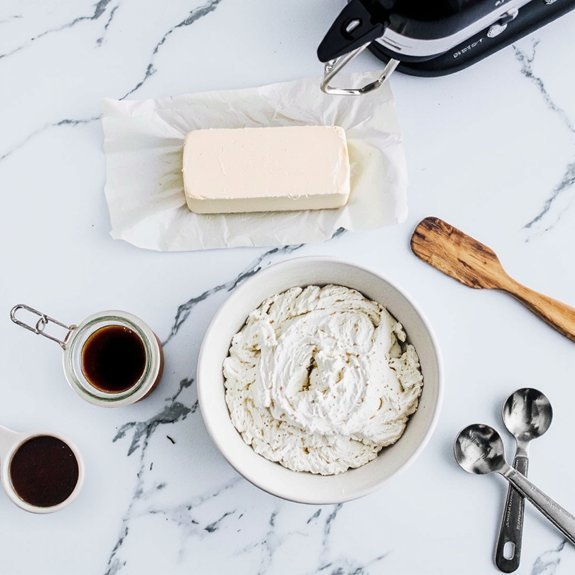
You’ll need just five essential components to create this frosting:
8 ounces of softened cream cheese (room temperature), 4 tablespoons of unsalted butter (softened), 2 cups of powdered sugar, 1 teaspoon of vanilla extract, and a pinch of salt.
For ingredient sourcing, select full-fat cream cheese from reputable dairy suppliers to guarantee ideal emulsification and tang.
Your butter must reach room temperature to facilitate proper incorporation without lumps.
Powdered sugar—also called confectioners’ sugar—prevents grittiness through its fine particulate structure.
Vanilla extract contributes aromatic complexity and depth.
Dietary alternatives exist for those with restrictions.
Substitute dairy-free cream cheese and vegan butter for lactose-intolerant or plant-based applications. These alternatives maintain structural integrity while preserving flavor profiles.
Monk fruit sweetener or erythritol replaces powdered sugar for keto-compliant versions, though adjustments to ratios may be necessary.
You’re empowered to customize this frosting according to your nutritional preferences without compromising quality.
Preparing Your Ingredients
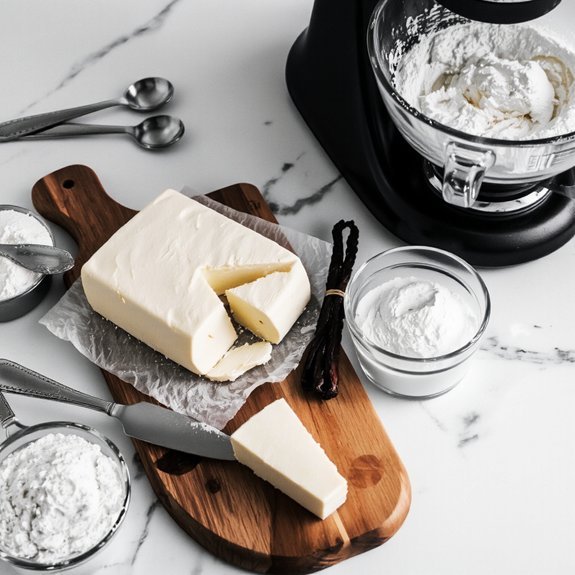
Before you begin mixing, it’s essential that all components reach their ideal temperatures and states.
Remove your cream cheese and butter from refrigeration 30-45 minutes beforehand, allowing them to achieve 65-68°F for best emulsification.
Remove cream cheese and butter 30-45 minutes ahead, targeting 65-68°F for optimal emulsification and smooth integration.
This temperature range prevents lumping and guarantees smooth integration.
Establish your mise en place by arranging all ingredients within arm’s reach: softened cream cheese, unsalted butter, powdered sugar, vanilla extract, and salt.
Sift your powdered sugar through a fine-mesh strainer to eliminate lumps that resist dissolution.
For storage tips, keep unused frosting in an airtight container at 40°F for up to two weeks.
You can freeze portions in ice cube trays for convenient future use.
Bring frozen frosting to room temperature before application for proper consistency and spreadability.
Mixing and Beating Techniques

Combining your softened cream cheese and butter requires a stand mixer fitted with a paddle attachment, operating at medium speed for 2-3 minutes until the mixture achieves a pale, fluffy consistency.
Tool selection matters markedly—a stand mixer prevents overworking, which causes graininess and separation.
Once combined, reduce your speed variation to low and gradually incorporate powdered sugar in three additions. This controlled approach prevents sugar clouds and guarantees even distribution. After each addition, beat for 30-45 seconds until fully incorporated.
Add vanilla extract and salt at low speed. Finally, increase to medium-high for 1-2 minutes, whipping in air for ideal texture. Don’t exceed this duration—overbeating breaks down the emulsion, compromising your frosting’s spreadability and structural integrity. Your technique directly determines the final product’s quality.
Achieving the Perfect Consistency

The frosting’s final texture depends on balancing cream cheese, butter, and powdered sugar ratios—typically a 1:1 cream cheese-to-butter ratio with 2-3 cups powdered sugar per 8 oz cream cheese, adjusted incrementally based on your desired firmness.
You’ll perform texture evaluation by lifting your mixer beads to observe the frosting’s consistency and flow characteristics.
For stability testing, you should pipe a small dollop onto parchment paper and refrigerate it for fifteen minutes to verify it holds its shape without slumping or cracking.
You can add more powdered sugar for firmer consistency or incorporate heavy cream in half-teaspoon increments for looser applications.
Temperature control proves critical—ensure all components reach room temperature before combining.
This methodology grants you complete control over achieving your exact frosting specifications.
Common Mistakes to Avoid
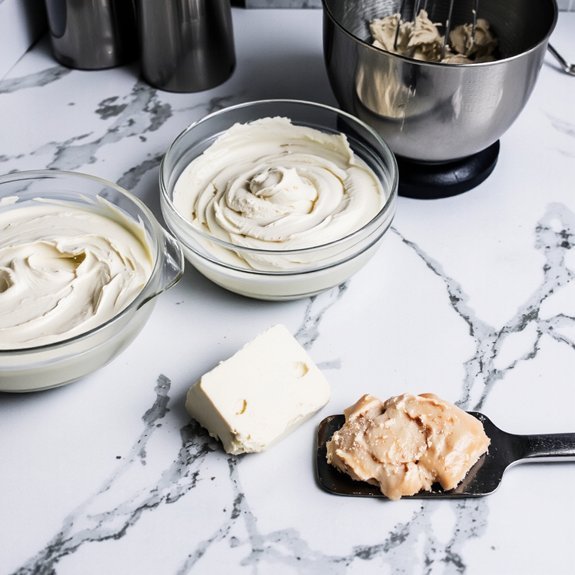
Even though you’ve mastered consistency ratios, you’ll still sabotage your frosting if you don’t account for temperature variables—cream cheese and butter must reach 65-70°F before mixing, or you’ll create a separated, greasy mixture that won’t incorporate powdered sugar evenly.
Cream cheese and butter must reach 65-70°F before mixing, or you’ll create separated, greasy frosting that won’t incorporate powdered sugar evenly.
Overmixing introduces excess air, resulting in a fluffy texture that collapses during decorating disasters.
Don’t skimp on quality ingredients; low-fat cream cheese compromises structure and tang.
Storage mishaps frequently occur when you refrigerate frosting in sealed containers without proper airtight sealing, allowing moisture absorption that degrades texture.
Never freeze frosting with unstabilized formulations.
Neglecting to sift powdered sugar creates lumps that resist blending, producing gritty results.
Additionally, adding liquid extracts without reducing other wet components throws off your ratios irreversibly.
Respect measurements religiously—frosting demands precision.
Frequently Asked Questions
How Long Can Cream Cheese Frosting Be Stored in the Refrigerator or Freezer?
You’ll find refrigerator limits extend to 7-10 days when you store cream cheese frosting in an airtight container at 40°F or below. For freezer longevity, you can preserve it up to 3 months at 0°F, though the emulsion may separate slightly upon thawing.
Use parchment paper between layers if freezing frosted items. Thaw gradually in your refrigerator for best texture restoration.
This storage flexibility gives you freedom to prepare ahead without compromising your frosting’s structural integrity.
Can I Make Cream Cheese Frosting Without an Electric Mixer by Hand?
You can absolutely make cream cheese frosting by hand using proper whisk techniques. Make sure your cream cheese and butter reach room temperature—around 65-70°F—for ideal blending.
Vigorously whisk together softened ingredients until you’ve achieved a smooth, homogeneous consistency. Gradually incorporate powdered sugar while whisking continuously to prevent lumps.
You’ll need elbow grease and persistence, but hand-whisking gives you complete control over your frosting’s texture and density without depending on machinery.
What’s the Best Way to Transport a Cake Frosted With Cream Cheese Frosting?
You’ll want to keep your cream cheese frosting cake stable by positioning it low in your vehicle’s center, away from heat sources.
Choose an insulated, flat-bottomed container with secure lid placement.
Maintain temperatures between 65-70°F during transport.
You’ve got the freedom to skip traditional cake boxes—use food-grade plastic containers with proper ventilation.
Secure everything with non-slip matting to prevent shifting and frosting damage during your journey.
Does Cream Cheese Frosting Work Well for Piping Decorative Designs on Cakes?
You’ll find cream cheese frosting’s piping suitability depends on your texture adjustments. It’s softer than buttercream, so you’ve got to chill it thoroughly—aim for 65-70°F consistency.
Whip in less cream cheese and boost your butter ratio for improved stability. Use stabilized formulations with cornstarch or gelatin.
You’re free to pipe intricate designs when you’ve nailed the ingredient proportions. Temperature control remains your critical variable for decorative success.
How Can I Fix Frosting That Has Curdled or Separated During Mixing?
You can salvage curdled frosting by adjusting liquid ratios—slowly incorporate room-temperature cream cheese or a small amount of milk.
For emulsifier addition, whisk in egg white or lecithin to restore stability.
Temperature control matters: make sure all ingredients hit 68-70°F before mixing.
If separation persists, add one tablespoon of cornstarch per cup of frosting.
Beat on low speed for two minutes, then medium for three.
You’ll reclaim smooth, pipeable consistency.





Leave a Comment