

Key Takeaways
- Double dry goods by weight or volume; reduce liquids by 10–15% to maintain proper consistency and texture.
- Increase spices, baking soda, and baking powder to 1.5× instead of 2× to prevent over-seasoning and off-flavors.
- Use equipment with double capacity: larger bowls, mixers rated for 8+ quarts, and appropriately sized cookware.
- Extend baking time by 25–50% and rotate pans halfway through to ensure even cooking and browning.
- Taste seasonings incrementally in small quarter-teaspoon additions and document adjustments to refine future batches.
Understanding Which Ingredients Scale Easily
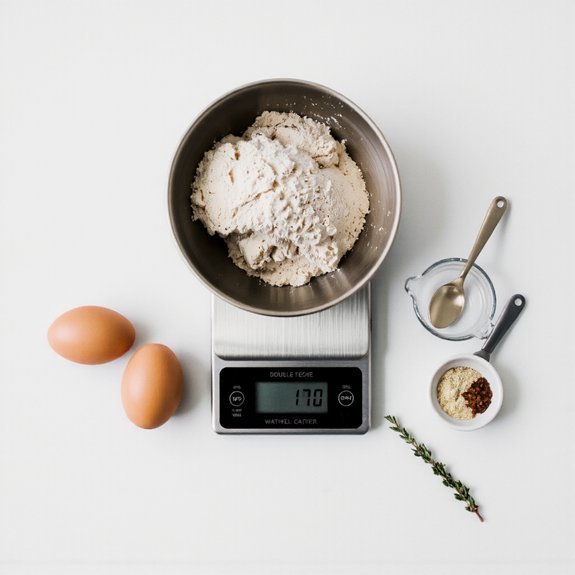
Most ingredients don’t scale proportionally in recipes.
You’ll find that dry goods like flour and sugar double seamlessly since they’re measured by weight or volume consistently.
However, seasonings, leavening agents, and liquids require restraint—doubling them often produces unpalatable results.
Seasonings, leavening agents, and liquids demand restraint when doubling recipes—excess often yields unpalatable results.
You’ve got freedom in choosing which ingredients to scale directly.
Salt, spices, and baking powder don’t follow linear scaling; instead, increase them by 1.5 times rather than doubling.
This prevents overpowering your dish.
Consider packaging sizes when purchasing ingredients for doubled recipes.
Buying in bulk eliminates waste while maintaining cost efficiency.
Liquids like vanilla extract and acidic components need careful adjustment—they concentrate their flavors intensely.
Understanding these distinctions lets you confidently double recipes without compromising taste or texture.
How to Handle Seasonings and Spices
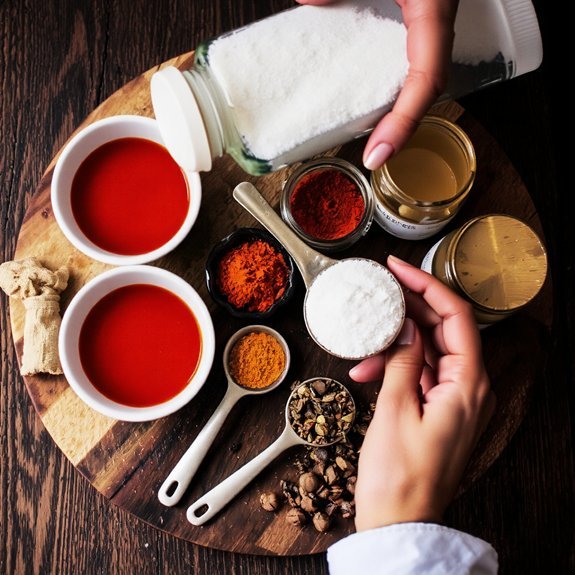
When you double a recipe, you shouldn’t automatically double your seasonings and spices—they’re far more concentrated than other ingredients and won’t scale proportionally.
Instead, you’ll want to start with half the doubled amount, then taste your dish and incrementally add more until you’ve reached your desired flavor profile.
This approach prevents you from over-seasoning and gives you control over the final result, since spice potency varies by brand, age, and storage conditions.
Start With Half Amounts
Because seasonings and spices concentrate during cooking, you’ll want to start with half the original amount when doubling a recipe, then adjust to taste.
This strategic approach to portion forecasting prevents over-seasoning before you’ve established the ideal flavor profile.
Spices release volatile compounds during heating, intensifying their potency.
When you double ingredients, cooking time often remains constant, allowing flavors to concentrate further.
By using 1.5 times the original spice quantity instead of doubling it, you maintain balance while preserving your dish’s integrity.
Your pantry management strategy should reflect this principle.
Taste as you cook, incrementally adding more seasoning until you achieve desired results.
This method grants you complete control over your final product, ensuring you’re not locked into predetermined ratios that don’t serve your palate or dietary preferences.
Taste and Adjust Gradually
Once you’ve added your initial half-measure of spices, you’ll need to taste methodically and adjust in small increments rather than making large additions that’ll overshoot your target flavor.
Flavor mapping—systematically identifying each taste component—prevents overseeding. Your sensory training improves through deliberate tasting:
- Taste after each small addition, waiting 30 seconds for flavors to register fully on your palate
- Add spices in quarter-teaspoon increments, not half-teaspoon jumps
- Document what you add; this data guides future recipes
- Neutralize your palate between tastings using water or plain bread
This scientific approach respects your autonomy as a cook.
You’re not bound by rigid recipes—you’re making informed decisions based on direct sensory feedback.
Control the seasoning’s intensity yourself, achieving precisely the flavor profile you want without waste or disappointment.
Adjusting Leavening Agents Properly

How do you know whether you can simply double your leavening agents? You can’t—that’s the short answer. Doubling baking soda or powder disrupts your recipe’s acid balance and enzyme activation, creating bitter flavors and dense textures. Instead, you’ll increase them by only 1.5 times, letting chemistry work properly.
| Agent | Original | Doubled | Adjustment | Reason |
|---|---|---|---|---|
| Baking Soda | 1 tsp | 2 tsp | 1.5 tsp | Excess causes metallic taste |
| Baking Powder | 2 tsp | 4 tsp | 3 tsp | Over-leavening creates tunneling |
| Yeast | 1 pkg | 2 pkg | 1.5 pkg | Prevents over-fermentation |
| Cream of Tartar | 0.5 tsp | 1 tsp | 0.75 tsp | Maintains acid ratios |
| Vinegar | 1 tbsp | 2 tbsp | 1.5 tbsp | Controls rise timing |
This measured approach preserves your recipe’s integrity.
Scaling Liquids and Wet Ingredients
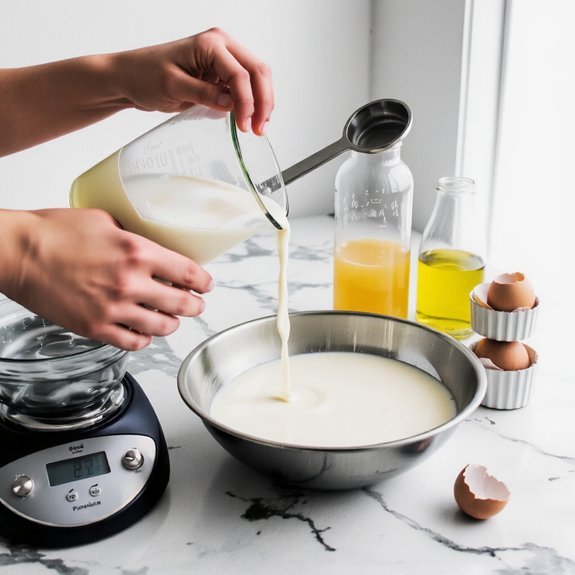
Unlike leavening agents, you’ll double your liquids and wet ingredients proportionally.
Unlike leavening agents, double your liquids and wet ingredients proportionally to maintain consistency.
You’ll need to account for evaporation rates that shift with larger batch sizes.
- Increase all liquids by exactly 2x—water, milk, oil, and eggs—maintaining precise ratios for consistency.
- Monitor viscosity changes during mixing; doubled batches generate more friction and heat, altering your batter’s thickness unpredictably.
- Watch emulsification stability closely with doubled fats and eggs; larger volumes risk breaking if you’re not methodical during incorporation.
- Reduce liquid slightly (by 10-15%) if your recipe relies on evaporation for final texture—larger surface areas expose more moisture to heat.
You’re commanding the chemistry here. Respect the science, trust your measurements, and you’ll nail your doubled recipe every time.
Tips for Doubling Baked Goods

When you’re doubling baked goods, you’ll need to adjust leavening agents carefully because they don’t always scale proportionally—too much baking soda or powder can create an off-flavor and uneven rise.
You’ll also face practical constraints with oven space; baking multiple pans simultaneously can create hot spots and uneven heat distribution, requiring you to rotate pans and potentially extend baking times.
Finally, you must modify your liquid ratios thoughtfully since doubled batches can absorb moisture differently, and increasing all liquids by exactly double sometimes produces a batter that’s too wet for proper structure.
Adjusting Leavening Agents Carefully
Because leavening agents work through chemical reactions rather than simple proportional scaling, you can’t simply double the amount of baking powder or baking soda when doubling a recipe.
You’ll need strategic adjustment to maintain proper rise and texture.
- Increase baking soda by 25-50% rather than 100%—excess creates metallic flavors and interferes with acid interactions
- Boost baking powder by only 50%; doubling it produces excessive CO2 and causes peaked, cracked surfaces
- Account for acid interactions carefully; more batter means less surface area for acid-base reactions per unit volume
- Consider alternative leaveners like yeast or egg whites for recipes requiring dramatic scaling
This measured approach gives you control over your baked goods’ structure without compromising flavor or texture.
Managing Oven Space Issues
Your standard home oven typically accommodates one standard batch on a single rack, so doubling a recipe demands strategic placement to prevent uneven baking.
You’ll need to master rack arrangement to achieve consistent results.
Position one baking sheet on the lower-middle rack and another on the upper-middle rack, ensuring at least two inches of clearance between them.
This spacing allows hot air circulation, preventing browning disparities.
Consider batch scheduling if your oven’s dimensions won’t safely accommodate two pans simultaneously.
Bake the first batch completely, remove it, then bake the second.
Though time-consuming, this method guarantees uniform results without compromising quality.
Rotate pans halfway through baking when using dual racks.
This compensates for hot spots inherent in most ovens, ensuring even heat distribution across both batches.
Modifying Liquid Ratios Properly
Once you’ve solved your oven placement challenges, you’ll encounter a subtler problem: liquid ratios don’t always double predictably in baked goods.
When you’re doubling recipes, you’re altering the viscosity balance and emulsion stability of your batter or dough.
Here’s what you need to know:
- Reduce liquids by 10-15% when doubling to maintain proper consistency and prevent dense results
- Add eggs gradually, checking texture after each addition, since they act as both liquid and binder
- Monitor fat distribution carefully; doubling butter or oil can destabilize emulsions and compromise rise
- Adjust leavening agents incrementally rather than doubling them outright, as excess can cause collapse
Trust your instincts over blind doubling.
You’re in control.
Make small adjustments, test batches, and refine your approach until you achieve the results you want.
Cooking Time and Temperature Adjustments
When you’re doubling a recipe, you’ll discover that cooking time and temperature don’t scale proportionally with ingredient quantities.
A doubled batch possesses greater thermal mass, requiring longer heat penetration to reach the center.
Don’t simply multiply cooking time by two—instead, increase it by 25-50%, then monitor progress closely.
Increase cooking time by 25-50% when doubling recipes, then monitor closely for optimal results.
Temperature typically stays constant; you’re not adjusting heat intensity, just duration.
Account for carryover cooking, where residual heat continues cooking food after removal from the heat source.
This effect intensifies with larger portions.
You’ll gain freedom from guesswork by using a meat thermometer or doneness tests.
Check your doubled recipe at the original time, then continue cooking incrementally.
This scientific approach guarantees even cooking throughout without overdrying exterior edges or undercooking centers.
Equipment Considerations for Larger Batches
Doubling a recipe often means you’ll need larger cookware to accommodate the increased volume without compromising cooking performance.
When you’re scaling up, you’ll face real constraints that demand practical solutions.
- Pot and pan sizes – You’ll need cookware with roughly double the capacity; an 8-quart Dutch oven replaces your standard 4-quart vessel
- Mixer capacity – Your stand mixer may struggle; opt for a commercial-grade model handling 8+ quarts
- Oven space – Multiple baking sheets require adequate rack positioning and air circulation
- Power requirements – Larger mixers demand higher wattage; verify your kitchen’s electrical infrastructure supports additional load
You’re not constrained by old rules.
Choose equipment matching your actual batch sizes.
This independence in kitchen planning guarantees efficiency and consistent results without unnecessary limitations.
Common Mistakes to Avoid When Doubling Recipes
Even with the right equipment in place, you’ll encounter pitfalls that proper technique can prevent. The most critical errors involve scaling ingredients inconsistently and neglecting chemical balance adjustments.
| Mistake | Problem | Solution |
|---|---|---|
| Label confusion | Misidentifying ingredients causes batch failure | Use clear, dated labels on all containers |
| Doubling leavening agents | Creates excessive rise and unpleasant texture | Scale by 1.5x instead of 2x for baking soda/powder |
| Ignoring portion packaging | Oversized containers affect cooking times | Maintain original vessel ratios or adjust heat accordingly |
You’ll also risk undermixing when attempting larger volumes—increased mass demands longer blending times. Portion packaging matters substantially; cramming doubled recipes into standard containers disrupts heat distribution. Salt and spices require restraint; their potency concentrates at double volume. Season conservatively, tasting as you go. These adjustments preserve recipe integrity while maintaining your cooking independence.
Frequently Asked Questions
Can I Double a Recipe That Uses Expensive or Hard-To-Find Ingredients?
You can absolutely double recipes with expensive ingredients. Conduct a thorough cost analysis first—doubling might reveal bulk purchasing savings that offset expenses.
Consider ingredient substitutes that maintain chemical integrity without compromising results. Research scientifically equivalent alternatives: you’re not limited to original components.
Calculate precise measurements meticulously; scaling ratios guarantees consistent outcomes. Your culinary freedom isn’t restricted by ingredient scarcity or cost—strategic substitution and informed choices liberate you to experiment boldly.
How Do I Adjust Recipes That Rely on Visual Cues Like “Until Golden Brown”?
You’ll rely on thermometer guidance rather than visual benchmarks when doubling recipes.
Golden brown typically means 350-375°F for baked goods.
Use an instant-read thermometer to verify doneness independently of color changes.
Doubled batches may cook unevenly, so rotate pans halfway through.
Trust temperature readings over appearance—they’re objective, repeatable, and won’t steer you wrong regardless of your pan’s size or oven’s quirks.
What Should I Do if My Kitchen Doesn’t Have Larger Mixing Bowls?
You can use batch mixing to handle doubled recipes without larger bowls.
Mix ingredients in two separate batches using your standard bowls, then combine them strategically.
Improvised containers work too—clean stockpots, Dutch ovens, or food-grade buckets accommodate doubled quantities.
You’re not bound by traditional equipment; just make sure your vessels are clean, heat-safe if needed, and large enough to prevent overflow during mixing.
Are There Recipes That Simply Cannot Be Doubled Successfully?
Yes, you’ll encounter recipes that don’t cooperate when doubled.
Baked goods face leavening limits—doubling baking powder or yeast often creates excessive rise and off-flavors. Emulsion failures plague sauces like hollandaise or mayonnaise; their delicate balance destabilizes at larger volumes. Spice-heavy dishes become overwhelmingly intense.
You’re better off making two separate batches of temperamental recipes rather than forcing problematic chemistry. Trust your instincts when science pushes back.
How Do I Scale Down a Doubled Recipe if It Turns Out Wrong?
You’ll need flavor rebalancing and portion recovery techniques.
Start by halving ingredient quantities systematically—don’t just guess. Taste as you adjust, reducing seasonings and spices first since they’re potent. For liquids, decrease gradually to prevent over-thinning. Document your corrections; you’re effectively reverse-engineering the recipe. This scientific approach gives you control over your kitchen’s outcomes, letting you salvage mistakes without waste or compromise.
Leave a Comment