

Key Takeaways
- Calculate the scaling factor by dividing your desired yield by the original recipe yield.
- Multiply each ingredient quantity by the scaling factor to maintain consistent flavor and texture.
- Scale seasonings sub-linearly: use 75% salt, 50–75% spices, and 90% acid for balance.
- Increase cooking time by 25–40% for doubled recipes; heat penetrates larger volumes more slowly.
- Test scaled recipes in small batches first, documenting texture, flavor, and doneness before full production.
Understanding Conversion Ratios
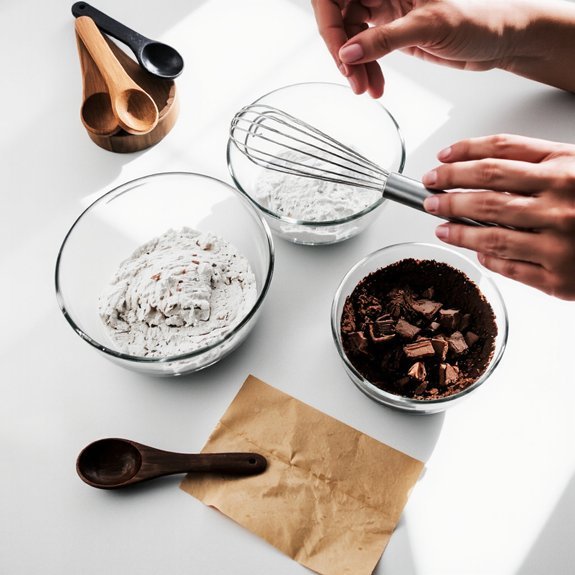
When you’re scaling a recipe up or down, you’ll need to establish a conversion ratio—the mathematical relationship between your original yield and your desired yield.
Establish a conversion ratio by dividing your desired yield by the original yield—the mathematical foundation for accurate recipe scaling.
This ratio theory forms the foundation of accurate scaling, allowing you to adjust ingredient quantities proportionally without compromising results.
You’ll calculate your ratio by dividing your desired yield by the original yield. For example, if you’re doubling a recipe, your conversion ratio is 2:1.
This dimensional analysis approach applies uniformly across all ingredients, ensuring consistent flavor profiles and textures.
Master this fundamental technique, and you’re liberated from recipe constraints. You’ll confidently scale any formula—whether you’re feeding two or twenty.
Understanding conversion ratios eliminates guesswork, transforming you from a recipe follower into a skilled, independent cook who controls portion sizes and ingredient quantities precisely.
Calculating Your Scaling Factor
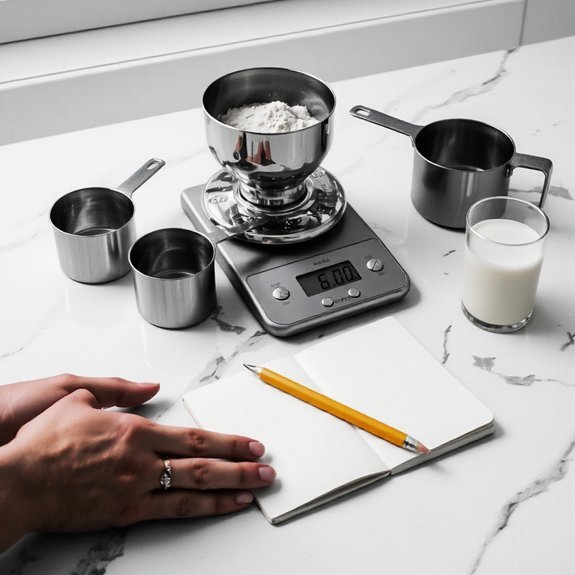
Now that you’ve determined your conversion ratio, you’ll translate it into a scaling factor—a decimal or whole number you’ll multiply by each ingredient quantity.
Your scaling factor derives directly from batch math. Here’s how you’ll calculate it:
- Divide your desired yield by your recipe’s original yield
- Round to two decimal places for practical portion estimation
- Apply this multiplier to every ingredient measurement
For example, if you’re halving a recipe yielding 24 servings down to 12, your scaling factor is 0.5. Multiply each ingredient by 0.5.
This systematic approach guarantees consistent results across any batch size.
You’re not guessing—you’re using precise calculations to maintain flavor balance and texture integrity.
Your freedom to adapt recipes without compromising quality depends on this mathematical foundation.
Adjusting Dry Ingredients

Once you’ve calculated your scaling factor, you’ll apply it to your dry ingredients—flour, sugar, salt, baking powder, and similar components that measure by volume or weight.
| Ingredient | Scaling Method |
|---|---|
| Flour | Multiply weight; use sifting technique before measuring |
| Sugar | Scale by weight for accuracy |
| Baking powder/soda | Multiply volume precisely |
| Salt | Scale by weight or volume |
You’re not locked into one approach. Weigh dry ingredients whenever possible—it’s your most reliable option. If you’re measuring by volume, account for packing methods. Loosely packed flour differs substantially from compressed flour. Your sifting technique matters: sift before measuring for consistency across batches. Scale each ingredient independently rather than scaling the entire mixture. This precision gives you control over your final product’s texture and rise.
Modifying Wet Ingredients

When you’re scaling wet ingredients, you’ll need to adjust liquid volumes proportionally to maintain your recipe’s balance and consistency. You can convert common wet measurements—cups, tablespoons, teaspoons, and milliliters—using standard equivalencies, though you’ll want to account for how ingredient density affects exact ratios.
Precision matters here because wet ingredients directly impact texture and hydration, so you’ll benefit from using a kitchen scale to measure by weight whenever possible rather than relying solely on volume conversions.
Scaling Liquids and Ratios
Liquids don’t scale as predictably as dry ingredients, so you’ll need to adjust your approach based on the recipe type and cooking method.
When you’re modifying wet ingredients, understand how scaling affects your final dish.
Consider these critical factors:
- Emulsion stability – Sauces and dressings may break when you alter ratios; adjust oil and acid proportions gradually to maintain proper emulsification
- Viscosity changes – Reducing liquids concentrates flavors and thickens consistency; scaling up may require less liquid than proportional math suggests
- Cooking time variance – Larger batches need extended reduction periods; smaller portions cook faster, affecting liquid evaporation rates
You’ve got the freedom to experiment, but prioritize maintaining the ingredient balance that drives your recipe’s success.
Test small batches before committing to full-scale conversions.
Converting Common Wet Measurements
How do you convert wet measurements accurately without compromising your recipe’s balance?
You’ll need reliable measuring tools and an understanding of regional units that vary globally.
Cups, milliliters, fluid ounces, and liters each dominate different culinary traditions.
The U.S. cup differs from metric cups, creating conversion challenges. You’re not locked into one system—choose what works for your kitchen.
Use precise measuring tools like graduated cylinders or calibrated spoons for accuracy.
When converting, remember that one U.S. cup equals approximately 237 milliliters, while metric cups measure 250 milliliters.
Document your conversions for consistency across batches. This flexibility allows you to adapt recipes freely while maintaining proper ingredient ratios and achieving reliable results every time.
Managing Leavening Agents
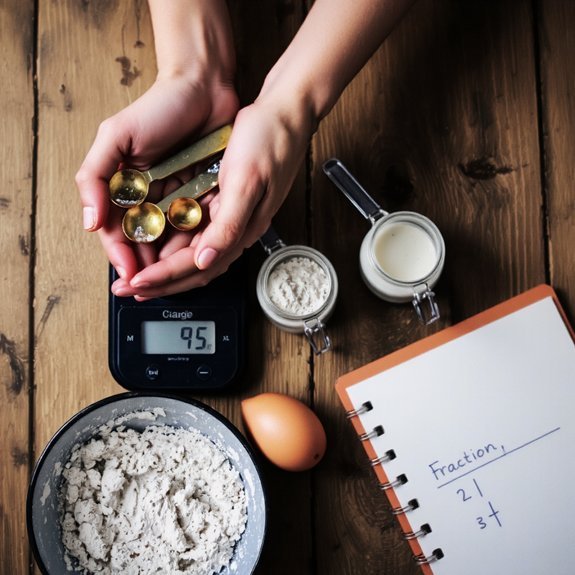
Because leavening agents directly determine your recipe’s rise and crumb structure, you’ll need to adjust them proportionally when converting batch sizes.
You’re not simply scaling numbers—you’re maintaining precise chemical balance for ideal results.
When adjusting leavening agents:
- Calculate proportional increases or decreases based on your conversion ratio, ensuring yeast activation remains consistent with temperature and timing conditions
- Account for ingredient interaction changes; doubled recipes may require slightly less leavening than pure multiplication suggests
- Follow storage guidelines meticulously—expired baking powder or soda undermines your scaled recipe entirely
Scale baking soda and powder exactly as your conversion ratio dictates.
For yeast, monitor fermentation time carefully since larger batches generate different temperature dynamics.
Your precision here determines whether your converted recipe succeeds or fails.
Seasoning and Flavor Adjustments
Unlike leavening agents that operate through chemistry, seasonings and flavorings demand restraint during scaling—they don’t always follow linear conversion ratios. You’ll discover that salt, spices, and acids intensify differently based on recipe volume.
| Ingredient | Scaling Rule |
|---|---|
| Salt | Scale to 75% of ratio |
| Spices | Scale to 50-75% of ratio |
| Acid (lemon, vinegar) | Scale to 90% initially |
| Vanilla extract | Scale at 100% |
| Hot peppers | Scale to 50% of ratio |
When doubling recipes, you’re not merely multiplying—you’re recalibrating. Start conservatively with spices, then adjust. This approach to flavor layering lets you maintain control. Similarly, acid balancing requires tasting as you scale; adding vinegar or citrus in smaller increments prevents overwhelming the dish. You’ve got the freedom to customize intensity while respecting the original formula’s integrity.
Cooking Time and Temperature Considerations
While flavor adjustments rely on tasting and restraint, cooking time and temperature won’t accommodate the same trial-and-error approach—they’re governed by thermal dynamics that shift with recipe volume.
You’ll need to account for:
- Mass and heat penetration – Larger batches require extended cooking times since heat travels slower through increased volume
- Oven hotspots – Doubled recipes demand strategic pan placement and rotation to prevent uneven browning across distributed cookware
- Carryover cooking – Remove proteins earlier than scaled calculations suggest; residual heat’ll continue cooking as internal temperature rises
Don’t assume linear scaling applies uniformly. A recipe doubled in size might need 25–40% more time, not exactly double.
You’ve got the freedom to adjust oven temperature down slightly for larger volumes, preventing exterior burning while interiors finish properly.
Testing and Troubleshooting Your Scaled Recipe
Your scaled recipe’s success hinges on systematic testing before you commit to serving it.
Start with small batch trials to identify potential issues without wasting ingredients.
Measure every component precisely, verifying your conversions against the original recipe.
Check equipment calibration—your scaled oven temperature, mixer speed, and timing must match the original’s performance.
Document results meticulously: texture, flavor balance, doneness level, and yield accuracy.
If results diverge from expectations, isolate variables systematically.
Did leavening agents scale proportionally?
Did cooking times adjust adequately for pan size?
Examine liquid ratios, as they’re sensitive to scaling.
Make singular adjustments between trials, establishing cause-and-effect relationships.
You’ll quickly pinpoint correction factors specific to your scaled version, ensuring consistent, reliable outcomes every time.
Frequently Asked Questions
How Do I Scale Recipes That Use Unusual Measurements Like Pinches or Dashes?
You’ll convert pinches and dashes by understanding pinch definitions first—a pinch equals roughly 1/16 teaspoon, while a dash measures about 1/8 teaspoon.
For dash conversions, multiply your scaling factor by these baseline measurements.
When you’re doubling or halving recipes, you’re applying the same ratio to these unconventional units.
Don’t guess—calculate precisely using these standards so you’ve got complete control over your ingredient ratios and final results.
Can I Convert a Recipe Designed for One Cooking Method to Another Method?
You can convert recipes between cooking methods, but you’ll need to account for technique substitutions and browning reactions.
Oven-roasting differs fundamentally from pan-searing regarding heat distribution and Maillard development.
You’re free to experiment, yet you must adjust temperatures, timing, and liquid ratios accordingly.
Understand that each method produces distinct flavor profiles through different browning intensities.
Measure ingredients precisely and monitor your results carefully to master cross-method conversions.
What Equipment Adjustments Are Necessary When Scaling Recipes up or Down Significantly?
When you’re scaling recipes dramatically, you’ll need to reassess your Pan Size to guarantee even heat distribution and proper cooking times.
Larger batches demand proportionally bigger pans; smaller ones require downsized equipment.
Your Mixer Capacity becomes critical too—overstuffed mixers won’t blend ingredients uniformly.
Recalibrate oven temperatures and cooking durations accordingly.
You’re not just multiplying ingredients; you’re redesigning the entire cooking process for ideal results and ingredient integration.
How Do Ingredient Quality and Freshness Affect Scaled Recipe Results Differently?
When you’re scaling recipes, you’ll find that ingredient quality and freshness create disproportionate effects on your results.
Fresh ingredients maintain their flavor intensity better across larger batches, while stale components amplify texture variation problems.
You’ve got freedom to adjust ratios based on your stock’s freshness—older spices need boosting, while fresh herbs require reduction.
Quality degradation compounds exponentially when scaling up, demanding your precise attention to sourcing and measurement adjustments.
Should I Scale Nutrition Information Proportionally When Changing Recipe Serving Sizes?
Yes, you’ll scale nutrition info proportionally when you adjust serving sizes. However, watch for portion rounding—slight measurement adjustments can shift calorie density meaningfully.
You’ve got the freedom to recalculate based on your actual ingredient weights rather than generic estimates. This ingredient-focused approach gives you precise control over nutritional data, ensuring your scaled recipes deliver accurate macros and micros without relying on approximations that undermine your dietary autonomy.


Leave a Comment