

Key Takeaways
- Prepare zucchini by shredding medium-sized specimens, then squeeze out excess moisture using paper towels and kitchen towels.
- Mix dry ingredients (flour, baking soda, salt, cinnamon) by sifting, then combine wet ingredients (eggs, oil, sugar, vanilla) separately.
- Gently fold wet mixture into dry ingredients using 15–20 strokes maximum, then add shredded zucchini last to prevent dense muffins.
- Bake at 350°F for 18–22 minutes in preheated oven on middle rack, filling cups two-thirds to three-quarters full.
- Test doneness using toothpick (few moist crumbs), golden-brown top appearance, and internal temperature of 205–210°F before cooling in pan.
Gathering Your Ingredients
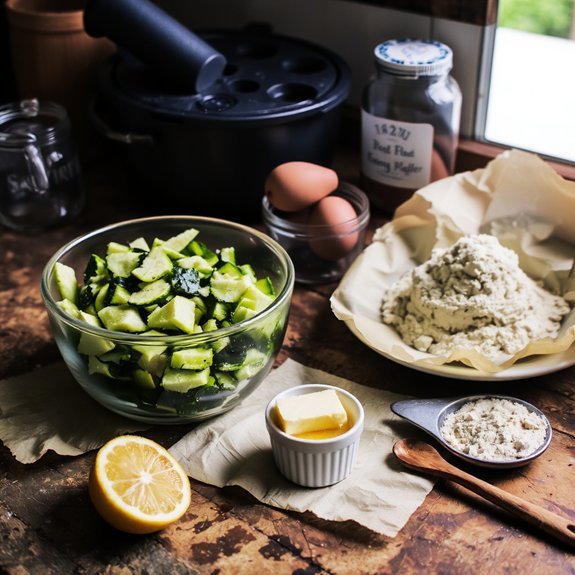
You’ll need two cups of all-purpose flour, one teaspoon of baking soda, half a teaspoon of salt, and one teaspoon of cinnamon to build your dry base.
Add two cups of shredded zucchini, three-quarters cup of sugar, and two eggs to create your wet mixture.
For budget shopping, buy zucchini during peak summer season when prices drop substantially.
You’ll also need one-third cup of neutral oil and one teaspoon of vanilla extract.
Seasonal substitutions work well here—swap cinnamon for nutmeg or cardamom depending on what you’ve got.
Consider adding walnuts or chocolate chips for texture and sustained energy.
This ingredient list delivers fiber-rich muffins packed with vegetables.
You’re controlling exactly what goes into your batter, eliminating processed additives and unnecessary sugars found in commercial versions.
Preparing Your Zucchini
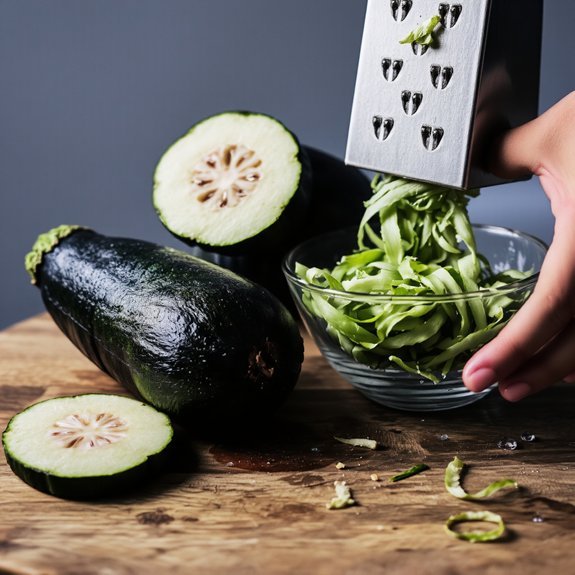
With your ingredients assembled, preparing the zucchini properly guarantees your muffins achieve the ideal texture and moisture balance.
Proper zucchini preparation guarantees your muffins achieve ideal texture and moisture balance with every batch.
When choosing zucchini, select medium-sized specimens—about 8 inches long—for best water content and flavor. Larger zucchini tend toward woodiness and excess moisture.
Your shredding techniques matter markedly:
- Wash zucchini thoroughly under cool running water
- Use a box grater’s medium holes for consistent shreds
- Spread shredded zucchini on paper towels for 10 minutes
- Gently squeeze out excess moisture using clean kitchen towels
This moisture removal prevents soggy muffins while preserving nutritional value.
You’ll retain essential vitamins and minerals while achieving superior crumb structure. Don’t over-squeeze—you’re removing water, not nutrients.
Properly prepared zucchini delivers that perfect balance between tender crumb and structural integrity your muffins demand.
Essential Equipment and Tools

What separates a mediocre muffin from an exceptional one often comes down to having the right tools at hand.
You’ll want a standard muffin tin—cast iron or steel both work, though steel heats more evenly.
Grab mixing bowls in varying sizes and a whisk for incorporating ingredients without overworking your batter.
A box grater or food processor shreds zucchini efficiently, saving you time and effort.
For budget options, basic metal tools won’t break your bank while delivering professional results.
Material comparisons matter: silicone spatulas prevent scratching, while metal whisks create smoother batters.
Measuring cups and spoons provide precise ratios—critical for consistent texture and moisture.
You’re investing in reliability.
Quality equipment won’t fail mid-bake, giving you freedom to focus on flavor and nutrition rather than troubleshooting kitchen disasters.
Mixing the Dry Ingredients

Combining your dry ingredients—1¾ cups all-purpose flour, ¾ teaspoon baking soda, ½ teaspoon salt, and 1½ teaspoons cinnamon—creates the structural foundation for your muffins’ crumb.
Combining dry ingredients creates the structural foundation for your muffins’ perfect crumb texture.
Proper preparation guarantees uniform texture and balanced flavor throughout.
1) Sift flour and baking soda together to eliminate lumps and incorporate air, enhancing your muffins’ rise
2) Add salt to strengthen gluten development, improving structural integrity
3) Distribute cinnamon evenly through the mixture for consistent spice distribution without concentrated pockets
4) Whisk all components for 30 seconds, to achieve complete homogeneity
These sifting benefits reduce density while promoting even browning.
Spice distribution becomes critical when you’re maximizing nutritional value—cinnamon offers antioxidants and blood-sugar regulation.
You’ll achieve professional-quality results by respecting these measurements.
Don’t skip this foundational step; it directly impacts your final product’s success.
Combining the Wet Ingredients
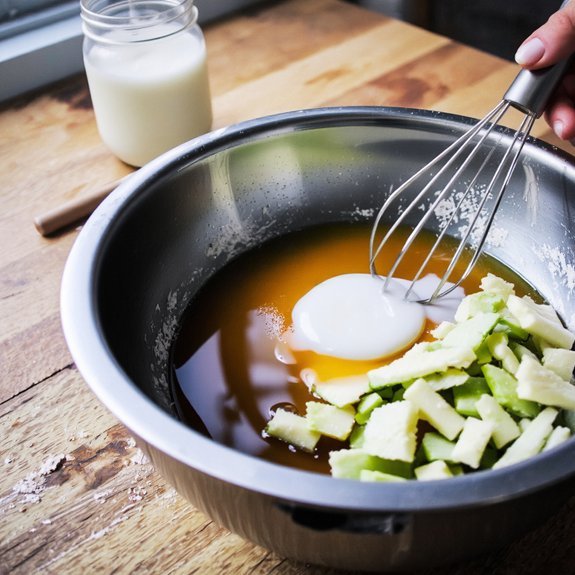
Whisking together your wet ingredients—2 eggs, ⅓ cup vegetable oil, 1 cup sugar, and 1 teaspoon vanilla extract—creates the moisture and binding foundation your muffins need. Start by beating eggs with sugar, then add oil in a steady stream while whisking. This whisking order emulsifies the mixture, distributing fats evenly for tender crumb structure.
| Ingredient | Benefit |
|---|---|
| Eggs | Protein structure, binding |
| Vegetable oil | Moisture retention, tenderness |
| Sugar | Sweetness, browning reaction |
| Vanilla extract | Flavor depth, complexity |
Once your wet mixture reaches pale yellow consistency, you’re ready for the folding technique. Gently incorporate shredded zucchini using a spatula, rotating the bowl as you fold. This preserves air pockets you’ve created, preventing dense muffins. Avoid overmixing—your freedom to achieve perfect texture depends on respecting this essential step. You’re now ready to combine with your dry ingredients.
Bringing It All Together
Because you’ve carefully prepared both your wet and dry components, the final mixing stage requires restraint rather than vigor.
Your workflow overview demands precise timing coordination to lock in nutrients and texture.
- Gently fold wet ingredients into dry components using 15-20 strokes maximum
- Stop mixing immediately when streaks of flour disappear—overmixing destroys fiber structure
- Add shredded zucchini last, distributing evenly without crushing the batter
- Fill muffin cups to three-quarters capacity for ideal rise and moisture retention
This approach preserves the zucchini’s nutritional density while preventing dense, rubbery results.
Your independence from traditional heavy-handed techniques yields superior muffins.
Distribute batter efficiently, respecting both ingredient integrity and your baking freedom.
You’re now ready for the oven.
Filling Your Muffin Cups
With your batter ready and muffin tin prepared, you’ll want to distribute it strategically for consistent results. Fill each cup to about two-thirds capacity—this gives your muffins room to rise without overflowing. You’ve got freedom in your liner alternatives; choose parchment papers, silicone cups, or go traditional with paper liners based on your preference.
Use an ice cream scoop for uniform portions, ensuring consistent bake times and professional-looking results. Proper fill levels matter: underfilled muffins bake too quickly and dry out, while overfilled ones create messy overflow and undercooked centers.
Distribute any remaining batter evenly across cups rather than loading a few heavily. This approach maximizes your batch’s nutritional consistency and presentation quality. Don’t skip this step—strategic filling determines whether you’ll enjoy perfectly golden, moist muffins or disappointing results.
Baking Time and Temperature
You’ll bake your zucchini muffins at 350°F for 18-22 minutes, ensuring they’re heated through without drying out the nutrient-rich vegetables.
Insert a toothpick into the center of a muffin—it should emerge with just a few moist crumbs, indicating you’ve preserved the beneficial fiber and moisture content.
This precise timing prevents overbaking, which can destroy heat-sensitive vitamins while maintaining the muffins’ dense, satisfying texture.
Optimal Temperature Settings
Once you’ve prepared your batter, setting your oven to 350°F guarantees even heat distribution that’ll cook your muffins through without over-browning the tops.
You’ll want to verify your oven’s accuracy before baking:
- Check oven calibration using an independent thermometer to catch temperature discrepancies
- Invest in a reliable thermometer for precise heat monitoring throughout baking
- Position your rack in the middle to achieve uniform air circulation
- Preheat for 15 minutes to stabilize internal temperatures
Temperature precision matters because zucchini muffins contain moisture that requires steady, moderate heat.
Higher temperatures risk burnt exteriors with raw centers.
At 350°F, your muffins bake for approximately 22-25 minutes, creating a nutrient-rich, tender crumb.
You control your baking outcome through deliberate temperature management—no guesswork required.
Duration Guidelines for Muffins
Because zucchini muffins rely on precise timing to develop their tender crumb while preserving nutritional integrity, you’ll monitor two critical factors: the 22-25 minute bake window at 350°F and the visual cues that signal doneness.
You’ll master batch pacing by staggering your prep scheduling, allowing consistent results across multiple batches.
Insert a toothpick into the center—it should emerge clean or with minimal crumbs, never wet batter.
The tops’ll turn golden brown, and edges’ll pull slightly from the pan’s sides.
Don’t overbake; excess time dries out your muffins and diminishes the vegetables’ nutrient density.
Remove them promptly when ready.
Cool them for five minutes in the pan before transferring to a wire rack, ensuring ideal texture and moisture retention throughout your batch.
Testing for Perfect Doneness
While the 22-25 minute window provides your baseline, mastering the specific indicators of doneness guarantees you’ll extract muffins at their nutritional peak rather than relying solely on elapsed time.
- Toothpick Check: Insert a toothpick into the center; it should emerge with minimal crumbs clinging to it, not wet batter.
- Crumb Texture: Your muffin tops should display a golden-brown exterior with a slightly springy feel when gently pressed.
- Internal Temperature: Use an instant-read thermometer to verify 205-210°F at the core—this helps maintain proper moisture retention and nutrient preservation.
- Visual Cues: Look for slightly recessed centers and edges that’ve pulled back from your muffin tin.
You’re liberated from guessing games.
These markers work together, empowering you to bake with confidence and consistency.
Testing for Doneness
How’ll you know when your zucchini muffins have baked through? Use the toothpick test—insert one into the center of a muffin. You’re looking for moist crumbs clinging to it, not wet batter. That crumb texture indicates perfectly baked muffins with ideal moisture retention and nutritional integrity.
| Test Method | Result |
|---|---|
| Toothpick insertion | Moist crumbs, no batter |
| Top appearance | Golden-brown surface |
| Internal temperature | 205-210°F (96-99°C) |
| Bounce-back test | Springs back when touched |
| Cooling time | 5 minutes in pan |
Don’t overbake—that dries out your muffins and diminishes their nutrient profile. Remove them when you’ve got that perfect balance between structure and moisture. Your freedom to create the ideal breakfast awaits.
Storage and Serving Tips
Storing your cooled zucchini muffins properly locks in their nutritional benefits and keeps them fresh for days.
You’ve got flexibility in how you preserve your baked goods.
- Room temperature storage works for two days in an airtight container
- Refrigerate muffins up to five days for extended freshness
- Freezer storage extends shelf life to three months when wrapped individually
- Thaw frozen muffins at room temperature for one hour before serving
For serving suggestions, pair your muffins with Greek yogurt for added protein, or serve alongside fresh berries to boost antioxidants.
Dust with cinnamon for enhanced flavor without extra calories.
You’re in control—enjoy them plain, toasted, or reimagined as a nutritious breakfast component.
These muffins adapt to your lifestyle, delivering wholesome nutrition on your terms.
Frequently Asked Questions
Can I Substitute All-Purpose Flour With Whole Wheat Flour in Zucchini Muffins?
Yes, you can substitute all-purpose flour with whole wheat flour, though you’ll notice texture differences. Use a 1:1 ratio initially, but whole wheat absorbs more moisture, so you’ll likely need to add extra liquid—an additional tablespoon or two.
This swap boosts fiber and nutrients while delivering denser, earthier muffins. For ideal results, consider using 75% whole wheat and 25% all-purpose flour. This balanced approach maintains moisture while maximizing nutritional benefits without sacrificing your muffins’ quality.
What Causes Zucchini Muffins to Be Dry, and How Do I Prevent It?
You’ll prevent dry muffins by avoiding overmixed batter—fold ingredients gently until just combined. Don’t overbaked muffins; remove them at 18-20 minutes when a toothpick shows slight moisture.
Use precise measurements; too much flour absorbs moisture. Add extra zucchini or applesauce for hydration.
Include healthy fats like Greek yogurt or coconut oil. You’ve got the freedom to experiment, but these techniques guarantee moist, nutrient-dense results you’ll enjoy.
Can I Freeze Zucchini Muffin Batter Before Baking for Later Use?
You can absolutely freeze your zucchini muffin batter for up to three months’ storage duration.
Pour your measured batter into muffin liners within a freezer-safe container.
Expect minor texture changes upon thawing—the zucchini’s moisture content may slightly increase density.
Simply thaw at room temperature for thirty minutes, then bake as directed.
This approach gives you total control over your baking schedule while maintaining nutritional integrity and fresh-baked quality whenever you want them.
How Do I Make Zucchini Muffins Without Eggs for Vegan Baking?
You’ll substitute eggs using a flax egg—mix one tablespoon ground flaxseed with three tablespoons water per egg, letting it sit five minutes. Alternatively, use applesauce binder at a 1:1 ratio for moisture and binding power.
These plant-based swaps deliver comparable structure while boosting fiber content. Your vegan muffins’ll rise beautifully with these nutrient-dense alternatives, giving you complete freedom from animal products without sacrificing texture or flavor.
Why Are My Zucchini Muffins Sinking in the Middle While Baking?
Your zucchini muffins sink because you’re likely overmixing your batter, which deflates the leavening agents.
You’ll also want to verify your oven temperature—use an oven thermometer to make sure it’s accurate.
Overmixing develops gluten, causing structural collapse mid-bake.
Mix until ingredients just combine.
Keep your oven at a steady 350°F for ideal rise.
These adjustments deliver nutrient-dense muffins with perfect crumb structure, giving you complete baking freedom.




Leave a Comment