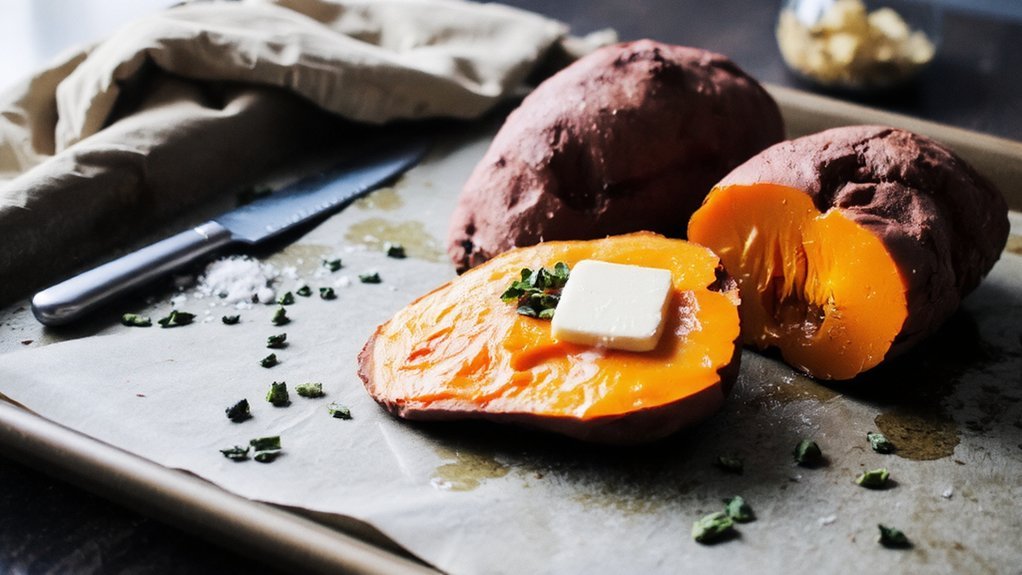

Key Takeaways
- Choose firm, medium-sized sweet potatoes with tight, waxy skin and rinse thoroughly before patting dry completely.
- Pierce each potato multiple times with a fork to prevent steam buildup and potential oven ruptures during baking.
- Bake at 400°F for 45–60 minutes, rotating midway; adjust temperature based on potato size for even cooking.
- Test doneness using a probe thermometer inserted into the thickest section, targeting an internal temperature of 205–210°F.
- Enhance flavor with herb-infused oils, spices like cinnamon, or toppings such as Greek yogurt and pecans.
Selecting Quality Sweet Potatoes
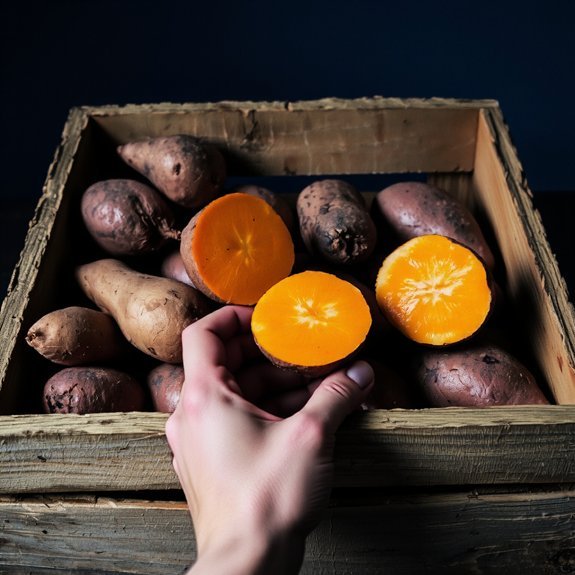
Before you bake sweet potatoes, you’ll want to choose specimens that are firm, unblemished, and medium-sized for even cooking.
Look for varietal characteristics that match your preferences: orange-fleshed types offer higher beta-carotene content, while purple varieties provide anthocyanins, powerful antioxidants.
Examine appearance indicators carefully—avoid potatoes with soft spots, sprouting, or wrinkled skin, which signal deterioration and nutrient loss.
The skin should feel tight and waxy, indicating freshness.
Medium-sized potatoes cook uniformly, delivering consistent texture and nutrient availability.
Store them in cool, dark conditions before baking to preserve their nutritional profile.
Your selection determines the final product’s quality, nutritional density, and cooking success.
Make each choice count.
Preparing Your Sweet Potatoes
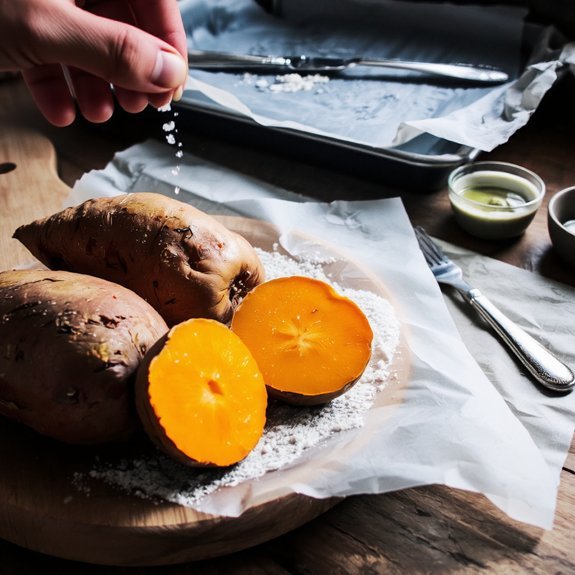
Once you’ve selected your sweet potatoes, you’ll want to rinse them thoroughly under cool running water to remove soil and surface debris that can harbor bacteria and pesticides.
Rinse sweet potatoes thoroughly under cool running water to eliminate soil, debris, bacteria, and pesticide residue.
Before baking, gather your equipment checklist:
- Sharp knife for safe, efficient cutting
- Cutting board with secure grip
- Fork for piercing skin
- Paper towels for drying
- Baking sheet lined with foil
Pat potatoes dry completely with paper towels to prevent excess moisture during baking.
Practice proper knife safety by using a stable cutting board and keeping your fingers curled away from the blade.
Pierce each potato multiple times with a fork—this prevents steam buildup and explosive ruptures inside your oven.
You’re now ready to bake.
These preparation steps guarantee ideal texture, nutrient retention, and your complete control over the cooking process.
Seasoning and Flavoring Options
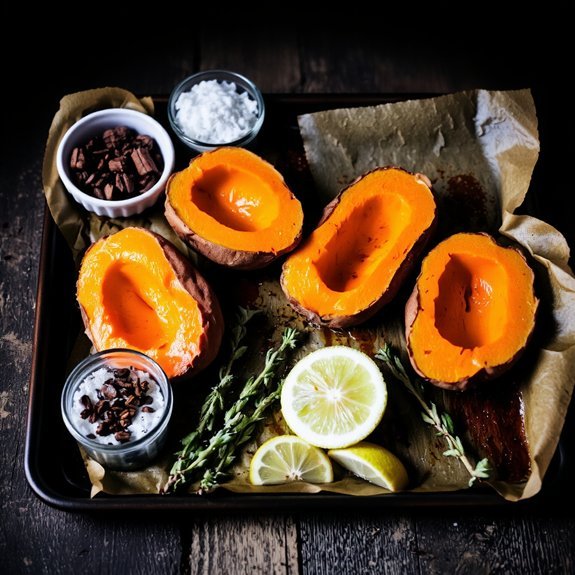
After you’ve pierced your sweet potatoes and they’re ready for the oven, you’ll want to think about how you’ll enhance their natural sweetness and earthy flavor profile.
You’ve got complete control over your baking experience—don’t settle for plain spuds.
Consider herb infused oils featuring rosemary, thyme, or sage to add complexity without excess calories. Brush them directly onto your potatoes before baking for maximum flavor penetration.
Sweet savory glazes offer another dimension. Combine balsamic vinegar with cinnamon and a touch of maple syrup, or try miso with ginger for umami depth.
For health-conscious seasoning, skip heavy butter and opt for nutritional yeast, smoked paprika, or cumin. These choices deliver robust flavor while respecting your dietary freedom and nutritional goals.
Baking Temperature and Time
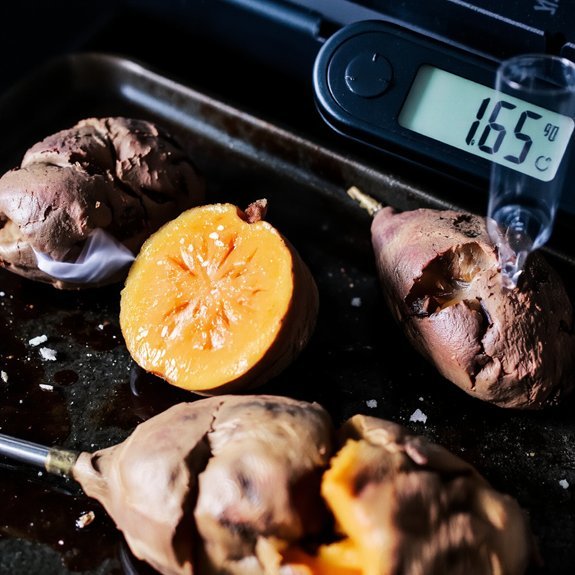
You’ll want to set your oven to 375-400°F for ideal nutrient retention and even cooking throughout the sweet potato.
Most medium-sized potatoes’ll reach tender doneness in 45-60 minutes, though you can check by piercing the flesh with a fork for softness.
Adjust your baking time upward for larger potatoes and downward for smaller ones, as size directly impacts how heat penetrates the dense interior.
Ideal Oven Temperature Range
Because sweet potatoes’ starches convert to sugars at precise heat levels, baking at 400°F (204°C) delivers ideal results within 45-60 minutes, depending on size.
You’ll achieve excellent caramelization and nutrient retention by maintaining consistent oven calibration:
- 400°F (204°C) – Standard temperature for medium potatoes; produces creamy interiors
- 375°F (190°C) – Lower setting for energy efficiency without sacrificing quality
- 425°F (218°C) – Higher heat for smaller potatoes; reduces baking time to 35-40 minutes
- Check calibration – Use an oven thermometer to verify accuracy
- Rotate midway – Promotes even cooking and prevents hot spots
You’re free to adjust within this range based on your oven’s characteristics.
Smaller potatoes need higher temperatures for faster cooking; larger ones benefit from moderate heat.
This precision maximizes nutrient bioavailability while delivering that sought-after tender texture.
Determining Doneness by Time
Once your oven maintains the correct temperature, timing becomes your primary indicator of doneness.
You’ll want to bake medium sweet potatoes for 45-60 minutes at 400°F, while larger specimens need 60-75 minutes.
Smaller potatoes cook faster, around 35-45 minutes.
For efficient batch coordination, arrange similarly-sized potatoes together so they finish simultaneously. This approach streamlines your meal timing and prevents some from overcooking while others remain undercooked.
You can pierce the thickest potato with a fork to verify tenderness—it should slide through effortlessly. The skin may wrinkle slightly, indicating the starches have converted to digestible sugars, enhancing nutritional bioavailability.
Don’t rely solely on appearance; always confirm internal softness. This method gives you complete control over your cooking schedule, ensuring perfectly baked sweet potatoes every time.
Adjusting Heat for Size
While the standard 400°F temperature works well for medium potatoes, adjusting both heat and duration based on your sweet potato’s size guarantees even cooking throughout.
Proper heat transfer depends on your potato’s dimensions, affecting cooking uniformity across the flesh.
Consider these adjustments:
- Small potatoes (under 6 oz): Bake at 425°F for 35-40 minutes
- Medium potatoes (6-10 oz): Bake at 400°F for 45-60 minutes
- Large potatoes (over 10 oz): Reduce to 375°F for 60-75 minutes
- Extra-large potatoes: Pierce multiple times and extend to 90 minutes at 375°F
- Uneven sizes: Arrange smaller ones toward oven edges for uniform results
Higher temperatures accelerate exterior cooking, risking burnt skin before the interior softens.
Lower temperatures with extended time promote thorough heat penetration.
You’ll achieve nutrient-rich, perfectly cooked sweet potatoes by respecting size variations.
Testing for Doneness
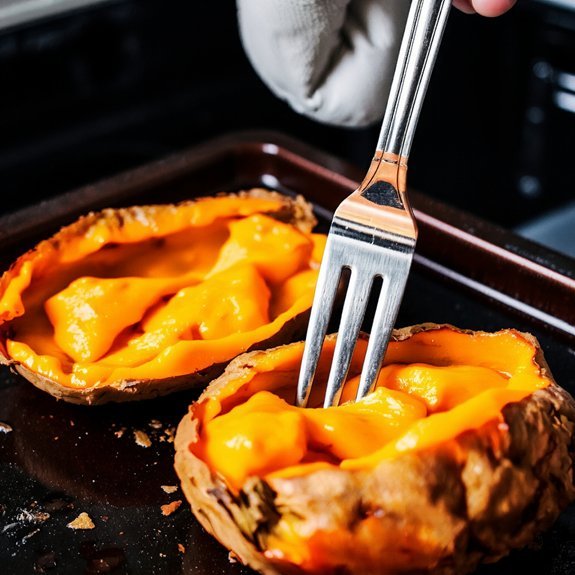
You’ll know your sweet potatoes are done when you can easily pierce the flesh with a fork, indicating the starches have converted to digestible sugars and the texture has softened throughout.
For precision, insert an instant-read thermometer into the thickest potato—you’re aiming for an internal temperature of 205-212°F, which guarantees ideal nutrient availability and creamy consistency. Either method confirms that the potatoes have reached peak tenderness while retaining their natural nutritional profile.
Fork Piercing Method
Testing sweet potatoes for doneness with a fork reveals whether the flesh has softened sufficiently to break down starches into digestible sugars.
You’ll want to use consistent piercing patterns to evaluate doneness accurately:
- Insert your fork into the thickest part of the potato
- Press gently—fully cooked flesh yields without resistance
- Check multiple spots for uniform softness
- Resistance indicates incomplete cooking; continue baking
- Tool alternatives include skewers, sharp knives, or toothpicks
The fork method gives you immediate feedback on the potato’s interior texture.
When the tines glide through easily, starches have converted to simple sugars, maximizing nutritional bioavailability and digestibility. This straightforward technique requires no special equipment, letting you maintain complete control over your cooking process without dependency on gadgets or timers.
Internal Temperature Check
How’s your confidence in the fork method alone?
Consider taking control with a meat thermometer for absolute certainty.
You’ll want to verify your sweet potato’s internal temperature reaches 205-210°F, the threshold where starches fully break down and nutrients become maximally bioavailable.
Invest in a quality probe thermometer and prioritize probe calibration before each use—insert the stem into the thickest section without touching the skin.
This precision measurement eliminates guesswork and confirms you’re meeting established safety thresholds for food quality.
Your independence from unreliable visual cues means perfect results every time.
The thermometer confirms your sweet potato’s ready when that target temperature appears on the display.
This straightforward approach guarantees tender flesh and maximum nutritional value without compromise.
Serving Suggestions
Once your sweet potatoes have cooled slightly, they’re ready to pair with complementary toppings that enhance their natural sweetness and nutritional profile.
You’ve got freedom in your choices.
Consider these garnish ideas and side pairings:
- Cinnamon and nutmeg: Sprinkle warming spices that complement the potato’s inherent sweetness
- Greek yogurt: Add protein and probiotics while reducing added sugars
- Pecans or walnuts: Provide healthy fats and textural contrast
- Black beans: Create complete proteins when combined with the sweet potato’s amino acids
- Lime juice and cilantro: Balance richness with bright, acidic freshness
You can mix and match based on your nutritional goals.
Layer your preferred toppings strategically to maximize both flavor complexity and nutrient density.
This approach transforms your baked sweet potato into a nutrient-dense meal supporting your wellness objectives.
Storing and Reheating Leftovers
Proper storage extends your sweet potatoes’ shelf life while preserving their nutritional integrity and texture.
Proper storage extends shelf life while preserving the nutritional integrity and texture of your sweet potatoes.
You’ll want to refrigerate cooked sweet potatoes in airtight containers for up to five days—your storage duration depends on how quickly you’ll consume them.
For extended preservation, you’ve got freezing tips worth following: cool your potatoes completely, portion them into freezer-safe containers, and label with the date.
They’ll maintain quality for three months frozen.
When reheating, you’ve got freedom in your methods.
Microwave individual portions for quick results, or reheat in a 350°F oven for superior texture restoration.
Add minimal water or coconut oil to prevent drying.
Thawed potatoes reheat faster than frozen ones.
This approach preserves the nutritional density you’ve worked to create through proper baking.
Frequently Asked Questions
Can I Bake Sweet Potatoes in a Microwave Instead of a Traditional Oven?
Yes, you can absolutely use the microwave technique for sweet potatoes—it’s faster and gives you freedom from waiting. Pierce your potato several times, place it on a microwave-safe plate, and cook on high for 5-10 minutes, depending on size.
This method actually preserves more nutrient retention compared to traditional ovens since the cooking time’s shorter. You’ll get tender, ingredient-focused results while maintaining control over your cooking process and saving energy.
What’s the Difference Between Sweet Potatoes and Yams for Baking Purposes?
You’ll find sweet potatoes deliver a creamier texture comparison and earthier, subtly sweet flavor profiles when baked.
True yams, conversely, aren’t widely available in US markets—what you’re calling yams are typically starchy sweet potato varieties.
For baking, you’ve got freedom choosing either; sweet potatoes offer superior nutritional density with beta-carotene and fiber.
Both roast beautifully, though authentic yams require slightly longer cooking times due to their denser composition.
Do I Need to Poke Holes in Sweet Potatoes Before Baking Them?
Yes, you’ll want to poke several holes in your sweet potatoes before baking.
This practice allows steam to escape gradually, preventing your potatoes from bursting in the oven.
Additionally, controlled steam escape enhances the caramelization impact of the natural sugars on the interior flesh, creating that desirable sweet, complex flavor.
You’re free to skip this step, though you’ll risk messy results and less ideal texture development in your final product.
How Long Can I Safely Store Baked Sweet Potatoes in the Refrigerator?
You can safely refrigerate baked sweet potatoes for 3-5 days in an airtight container.
Follow this refrigeration timeline to maintain ideal nutritional value and prevent bacterial growth.
Check for spoilage indicators like mold, off-odors, or slimy texture before consuming.
Store them at 40°F or below.
You’re free to meal prep confidently when you recognize these warning signs early, ensuring you maximize your health-conscious eating without compromising food safety.
Can I Wrap Sweet Potatoes in Foil While Baking, or Should I Leave Them Unwrapped?
You’ll achieve superior results leaving sweet potatoes unwrapped. Unwrapped baking creates crisp skin and concentrated flavor from caramelized natural sugars.
The direct oven heat draws out moisture while intensifying nutrient bioavailability. Foil-wrapped potatoes steam instead, yielding soft skin and diluted taste.
You’re free to choose your method, but unwrapped baking delivers ideal texture and nutritional value. Pierce skin beforehand to prevent bursting and guarantee even cooking throughout.
Leave a Comment