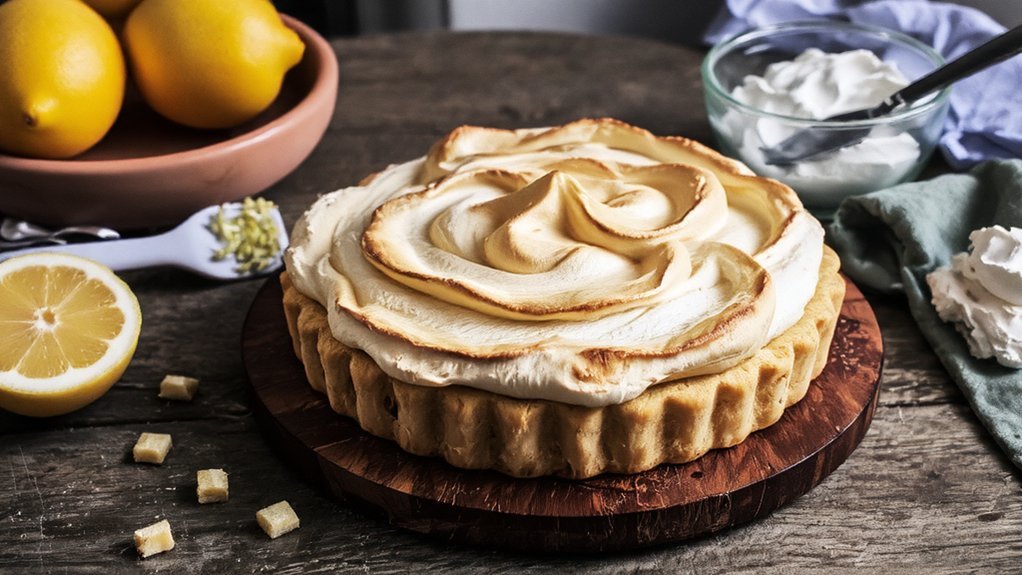

Key Takeaways
- Make a flaky crust by combining flour, salt, and cold butter until pea-sized crumbs form, then blind bake at 375°F with weights for 12–15 minutes.
- Prepare lemon filling by zesting and juicing room-temperature lemons, combining with sugar, then thickening with cornstarch slurry over medium heat until opaque.
- Whip egg whites with salt to soft peaks, gradually add sugar to stiff glossy peaks, then fold in cornstarch and vanilla for stability.
- Apply meringue directly onto hot lemon filling, ensuring contact with crust edges to prevent separation and weeping during baking.
- Bake meringue at 350°F for 10–12 minutes until peaks turn light golden-brown, then crack oven door slightly to manage steam and prevent weeping.
Gathering Your Ingredients and Equipment
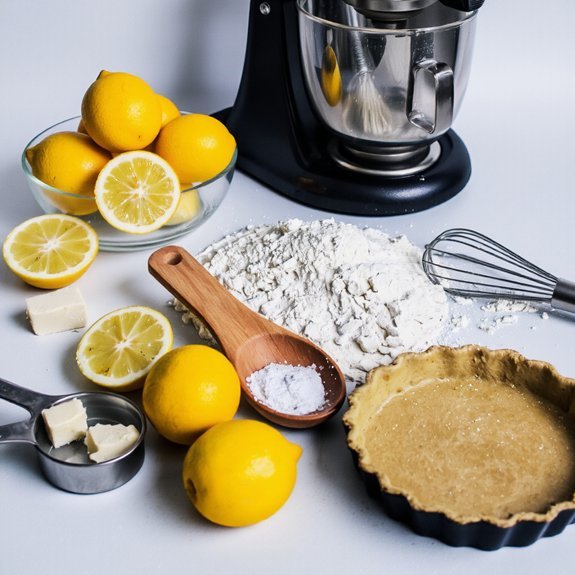
Before you begin baking, you’ll need to gather specific ingredients and equipment to guarantee success.
Gathering specific ingredients and equipment before you begin baking guarantees success with this delicate dessert.
Start with your shopping checklist: fresh lemons, condensed milk, egg yolks, sugar, cornstarch, butter, and egg whites for the meringue.
For equipment, collect a 9-inch pie crust, mixing bowls, measuring cups and spoons, a whisk, electric mixer, and a pie dish.
You’ll also need a zester or grater for lemon zest and a juicer for extraction.
Be sure of proper tool maintenance before starting.
Wash all bowls and utensils thoroughly—any grease residue will prevent meringue from reaching peak stiffness.
Dry everything completely.
Check your oven’s temperature accuracy with a reliable thermometer, as precise heat control is essential for this delicate dessert.
Having everything prepared eliminates interruptions and guarantees consistent, professional results.
Making the Perfect Pie Crust
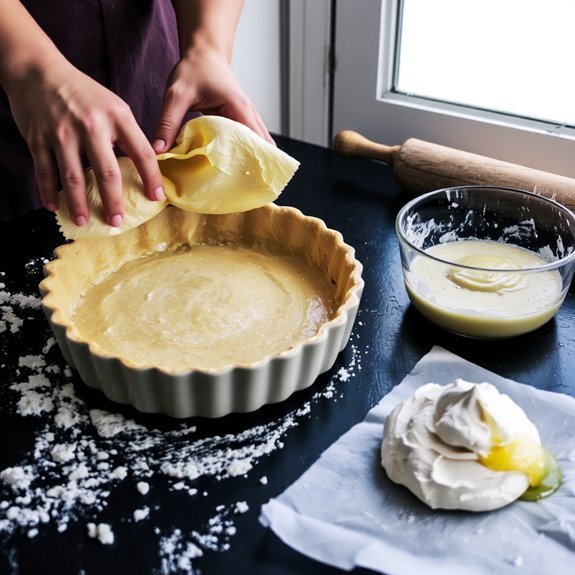
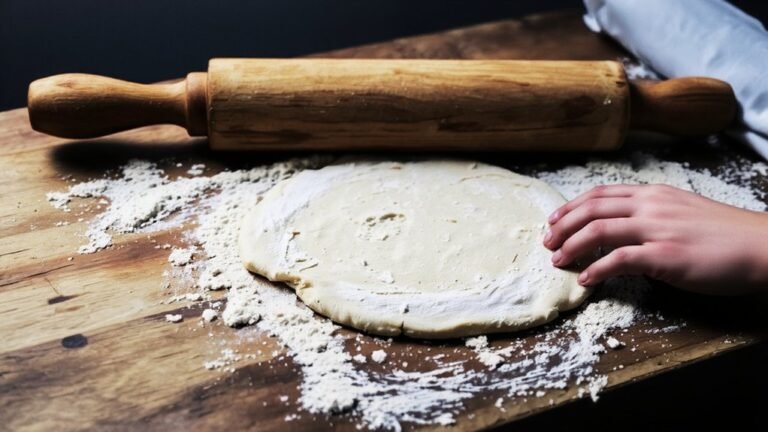
You’ll start by combining flour, salt, and cold butter in precise ratios—typically 2.5 cups flour to 1 cup cold butter cubed—using a pastry cutter to achieve pea-sized crumbs before adding ice water.
Your mixing and handling techniques matter critically: work quickly to keep ingredients cold, mix just until the dough comes together, and avoid overworking, which develops gluten and toughens the crust.
After chilling your dough for at least 30 minutes, you’ll blind bake it at 375°F for 15 minutes with pie weights, then cool it completely before filling to guarantee structural integrity.
Ingredient Selection and Ratios
The foundation of an exceptional lemon meringue pie depends on precise ingredient measurements and quality components for the crust.
You’ll need two and one-half cups all-purpose flour, one teaspoon salt, one tablespoon sugar, and one cup cold unsalted butter, cut into cubes.
Understanding scaling ratios allows you can confidently adjust batch sizes without compromising texture.
The flour-to-fat ratio of 2.5:1 creates ideal flakiness.
For allergen swaps, you’re free to substitute gluten-free flour blend one-to-one or replace butter with coconut oil for dairy-free versions.
Chill all ingredients beforehand—cold components create steam pockets during baking, yielding that desirable tender, crispy crust.
Use ice water sparingly when mixing; you need only enough to bind ingredients.
This disciplined approach guarantees professional results every time.
Mixing and Handling Techniques
Once you’ve assembled your chilled ingredients, proper mixing technique determines whether your crust achieves that coveted flakiness or becomes tough and dense. Keep your grip pressure light and controlled when combining flour and butter—you’re not kneading dough.
Place your bowl on a stable, cool surface to maintain ingredient temperature. Work quickly using a pastry cutter or your fingertips, breaking butter into pea-sized pieces throughout the flour.
Don’t overwork the mixture; stop when it resembles coarse breadcrumbs. Add ice water gradually, mixing just until the dough comes together without becoming wet or sticky.
This restraint preserves the air pockets that create layers, giving you the tender, flaky crust your lemon meringue pie demands.
Blind Baking and Cooling
Preventing a soggy bottom crust requires blind baking your pie shell before adding the filling.
Line your unbaked crust with parchment paper and fill it with dough weights or dried beans to maintain its shape during partial baking.
Prick the bottom with a fork to create oven vents that allow steam to escape evenly.
Bake at 375°F for 12-15 minutes until the edges set but the bottom remains pale.
Remove the weights and parchment carefully.
Return the crust to the oven for 3-5 additional minutes if you prefer extra crispness.
Cool your crust completely on a wire rack before pouring in the lemon filling.
This cooling step prevents thermal shock and maintains structural integrity, ensuring your meringue pie delivers the crisp, flaky texture you demand.
Preparing the Lemon Filling

You’ll begin by zesting and juicing fresh lemons, extracting the aromatic oils and tart liquid that form your filling’s foundation.
Next, you’ll sweeten the mixture with sugar and egg yolks, whisking them together until the combination reaches a pale, ribbon-like consistency.
Finally, you’ll incorporate cornstarch as your thickening agent, which you’ll cook into the filling over medium heat while stirring constantly until it reaches the proper custard-like consistency.
Zest and Juice Extraction
Start by selecting firm, unblemished lemons at room temperature, as they’ll yield more juice than cold fruit. You’ll need specialized zest tools—a microplane grater works best for fine, flavorful zest without the bitter white pith.
| Tool | Purpose | Benefit |
|---|---|---|
| Microplane | Fine zesting | Maximum flavor extraction |
| Channel zester | Strip zest | Visual appeal |
| Citrus juicer | Juice extraction | Efficient yield |
| Fine strainer | Juice preservation | Pulp removal |
Roll each lemon firmly on your counter before cutting to rupture internal membranes. Cut in half and juice using your preferred method, capturing every drop for juice preservation. Strain immediately to remove seeds and excess pulp. Zest your lemons before juicing—you’ll access the skin more easily on whole fruit. Store extracted zest and juice separately in airtight containers, refrigerated, for peak freshness and flavor potency.
Sweetening the Filling Mixture
Once you’ve extracted your zest and juice, combine them with granulated sugar in a heavy-bottomed saucepan, allowing the sugar to absorb the lemon oils and moisture for 5-10 minutes before heating.
This resting period maximizes flavor extraction without degradation.
If you’re exploring natural sweeteners for calorie considerations, honey or agave nectar work effectively, though they’ll alter the filling’s consistency slightly.
Adjust quantities accordingly—use about 20% less than granulated sugar since these alternatives are sweeter.
Heat the mixture over medium heat, stirring constantly until sugar dissolves completely.
You’re looking for a clear, uniform consistency without crystallization.
This typically takes 3-5 minutes.
Don’t rush this step; proper dissolution guarantees a smooth, refined filling without grittiness.
Once dissolved, remove from heat and proceed with your remaining filling ingredients.
Thickening With Cornstarch Properly
While your sugar-lemon mixture rests off the heat, whisk cornstarch with cold water in a small bowl to create a slurry, breaking up any lumps that’d otherwise cause clumping when added to the hot filling.
Slowly pour your starch slurry into the lemon mixture while whisking constantly to guarantee even distribution and prevent lumps from forming.
Return the pot to medium heat and stir continuously. The gelatinization temperature for cornstarch occurs around 160-170°F, where the starch granules absorb liquid and swell, thickening your filling.
Watch for the mixture to shift from translucent to opaque and noticeably thicken—this indicates proper gelatinization has occurred.
Once thickened, remove from heat immediately.
The filling’ll continue thickening slightly as it cools, so avoid over-cooking, which breaks down the starch’s thickening power and creates a weaker filling.
Blind Baking the Crust
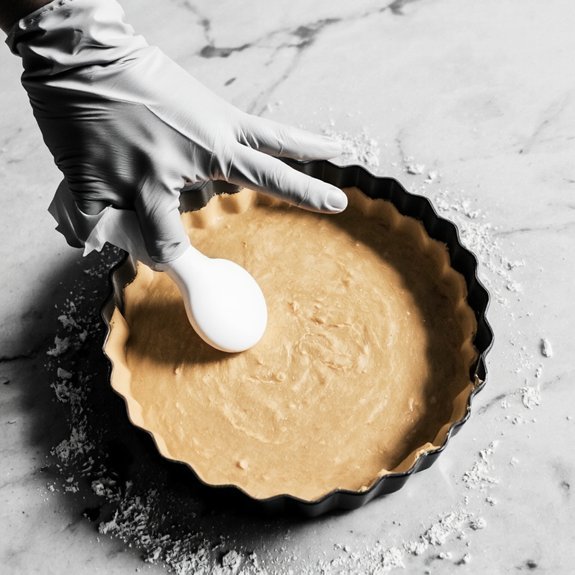
Preparing your pie crust for blind baking requires a few essential steps to prevent it from puffing and shrinking during the initial bake. Line your pastry with parchment paper, then fill it with pie weights or dried beans, distributing them evenly across the bottom and sides. This weight prevents the crust from bubbling upward.
Bake at 375°F for 12-15 minutes until the edges turn light golden. Remove the weights and parchment carefully.
For texture troubleshooting, if your crust appears too soft, return it to the oven for 2-3 minutes. This crispness restoration step guarantees your finished pie maintains structural integrity when you pour in the filling. You’ll achieve a firm, properly set foundation for your lemon meringue pie.
Creating the Meringue Topping
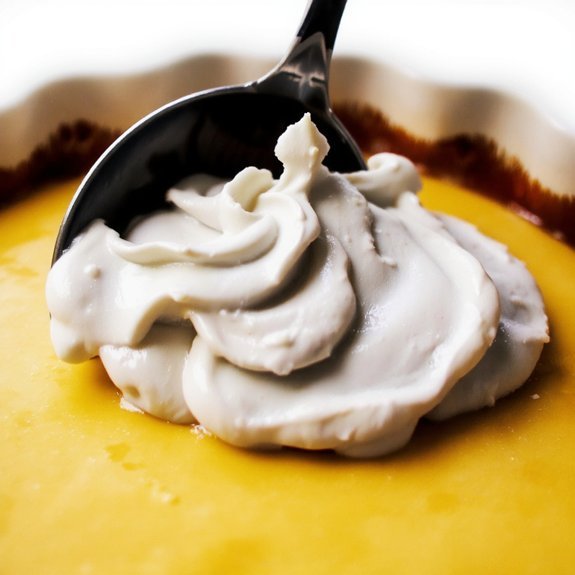
Your pre-baked crust is now ready to receive the lemon filling, but before you pour it in, you’ll want to prepare the meringue that’ll crown your pie.
Whip four egg whites with a pinch of salt until soft peaks form. Gradually add six tablespoons of sugar while beating continuously until stiff, glossy peaks develop. This stability guarantees your meringue won’t weep or shrink.
Fold in one teaspoon of cornstarch and a half-teaspoon of vanilla extract for enhanced structure and flavor. Apply the meringue directly onto the hot lemon filling, making sure it touches the crust edges to prevent separation.
Use decorative piping techniques to create peaks and swirls. For ideal browning techniques, bake at 350°F for ten to twelve minutes until golden brown, creating that signature caramelized finish.
Baking and Cooling Your Pie
Once you’ve applied the meringue to your hot lemon filling, you’ll transfer the pie to a preheated 350°F oven for the final baking stage. Confirm oven calibration using an independent thermometer to guarantee accurate temperature maintenance. Bake for 10-12 minutes until the meringue peaks develop light golden-brown tips.
Manage steam effectively by cracking the oven door slightly after baking completes. This controlled steam management prevents the meringue from weeping or collapsing during the cooling phase.
Cool your pie at room temperature for one hour, allowing the filling to set properly. Transfer to the refrigerator for at least three hours before serving. This extended cooling period guarantees the meringue stabilizes completely and the lemon custard firms to ideal consistency. Slice with a hot, wet knife between cuts for clean portions.
Frequently Asked Questions
Can I Make Lemon Meringue Pie Ahead of Time and Freeze It?
You can freeze lemon meringue pie, though meringue doesn’t freeze ideally. Bake and cool completely, then wrap it tightly in plastic wrap followed by aluminum foil for ideal packaging techniques.
Your storage duration extends up to one month. Freeze the whole pie unbaked for best results—assemble and bake fresh when you’re ready.
This approach gives you maximum control over quality and prevents meringue from becoming soggy or separating during thawing.
How Do I Prevent the Meringue From Shrinking During Baking?
You’ll prevent meringue shrinkage by ensuring proper edge sealing—spread meringue directly onto hot filling, pressing it firmly against the crust’s edges.
Maintain your oven temperature at 350°F consistently; don’t open the door during baking.
Bake for 10-12 minutes until the peaks turn golden.
This technique locks moisture and stabilizes the structure, giving you that perfect, stable meringue you deserve.
What Causes a Soggy Pie Crust and How Do I Fix It?
You’ll prevent soggy crusts by blind baking your shell at 375°F for 10-12 minutes before filling. This pre-baking process sets the crust’s structure, blocking moisture absorption.
Additionally, you’ll control your filling consistency—ensure it’s thick enough that it doesn’t seep through. Pour hot filling into your pre-baked crust immediately, then bake. This dual approach gives you complete command over texture, eliminating the frustrating sogginess that compromises your pie’s integrity.
Can I Substitute Bottled Lemon Juice for Fresh Squeezed Lemon Juice?
You can substitute bottled lemon juice, though you’ll sacrifice complexity. Bottled juice maintains acid equivalence, ensuring your filling sets properly.
However, you’ll lose the zest importance that fresh lemons provide—that aromatic oil elevates flavor notably. If you’re committed to bottled juice, you’re free to proceed; just compensate by adding fresh lemon zest separately.
This approach preserves both the chemical structure your pie requires and the nuanced taste fresh citrus delivers.
Why Did My Meringue Separate or Weep After Baking?
Your meringue separated because you didn’t maintain proper sugar ratio—you’ll need at least one tablespoon sugar per egg white.
Humidity effects also caused weeping; moisture pulled through your meringue during cooling.
You’re best served baking at 350°F for ten minutes, ensuring complete egg white coagulation. Avoid opening your oven door, and cool gradually on the counter rather than refrigerating immediately.




Leave a Comment