
Key Takeaways
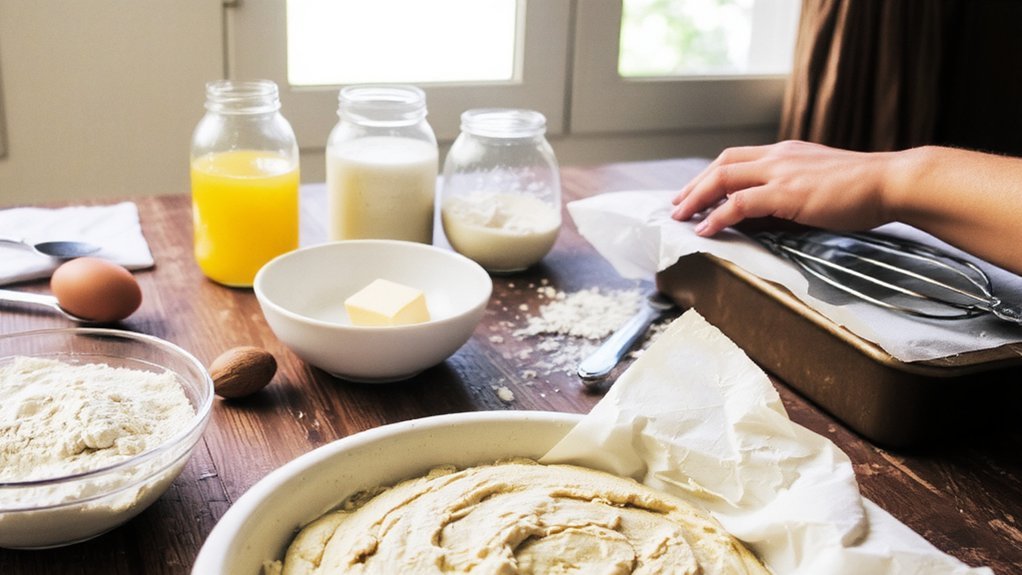
- Use blended flour formulas combining starches (tapioca, cornstarch), legume flours, and whole grains to replicate gluten’s structural network.
- Increase liquid content by 10–20% and allow batter to rest 15–30 minutes for proper starch hydration and texture development.
- Add binding agents like xanthan gum (¼ teaspoon per cup flour), eggs, or psyllium husk to replace gluten’s elasticity.
- Avoid overmixing, which develops starch viscosity and creates dense, gummy crumbs; use meticulous recipe adherence for consistent results.
- Keep detailed baking notes documenting ingredient ratios, timing, and oven performance to troubleshoot issues and achieve reproducible success.
Understanding Gluten and Why It Matters in Baking
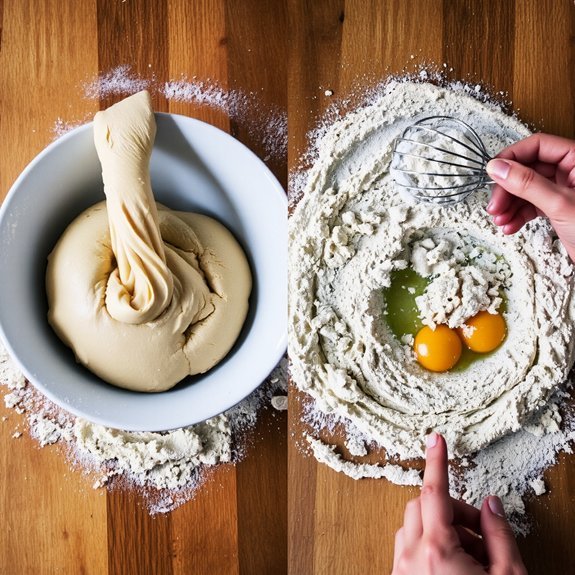
When you mix flour with water, gluten proteins—glutenin and gliadin—form elastic networks that trap gas bubbles and provide structure to baked goods.
This protein matrix gives bread its chewy texture and allows cakes to rise properly.
Understanding gluten history reveals that humans’ve cultivated wheat for millennia, making gluten an ancient dietary staple.
However, gluten myths often oversimplify its role, suggesting it’s universally problematic.
Reality’s more nuanced: only those with celiac disease, non-celiac gluten sensitivity, or wheat allergies must avoid it.
For gluten-free baking, you’ll need to replace gluten’s structural functions using alternative starches, gums, and binders.
Unlike wheat flour’s natural elasticity, gluten-free flours won’t develop that characteristic network independently.
You’ll compensate through strategic ingredient combinations and precise technique, giving you freedom to create satisfying baked goods without gluten’s complications.
Essential Gluten-Free Flour Blends and Alternatives
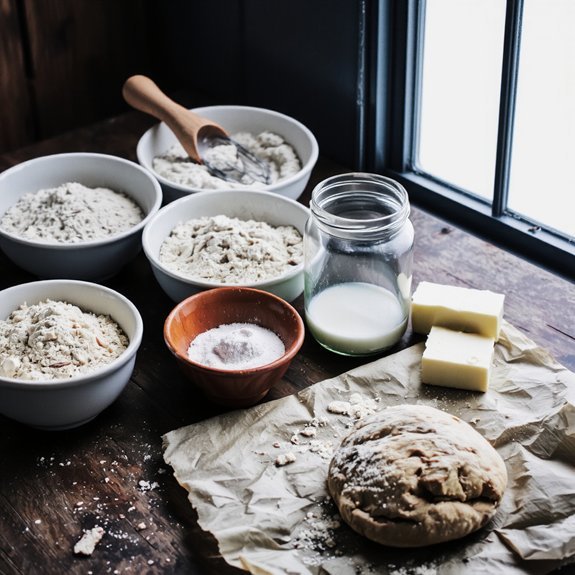
Since gluten-free flours lack the structural proteins that wheat provides, you’ll need to understand how different flours behave individually and in combination.
Rice flour offers neutral flavor and affordability, while almond flour delivers superior nutritional profiles with higher protein content.
Coconut flour absorbs moisture differently, requiring recipe adjustments.
Tapioca starch provides elasticity without nutritional density.
Blended formulas—combining starches, legume flours, and whole grain alternatives—yield ideal texture and rise.
You’re liberated from single-flour limitations by strategic mixing.
Buckwheat and teff introduce distinct flavors and enhanced micronutrients.
Consider environmental impact when selecting flours.
Locally-sourced options reduce transportation emissions.
Regenerative farming practices support sustainable agriculture.
Your choices empower both personal health and ecological responsibility, freeing you from conventional baking’s constraints while maintaining structural integrity in your creations.
Binding Agents: The Secret to Structure Without Gluten
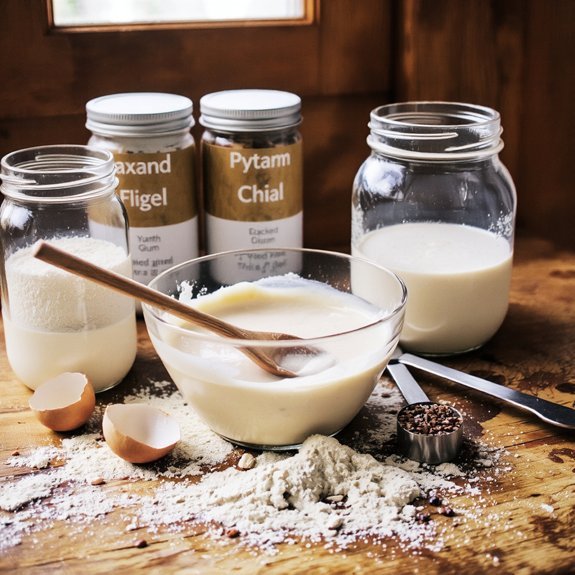
You’ll rely on eggs as your primary binding agent, since they provide both moisture and protein that mimic gluten’s structural role in traditional baking.
Starches and gums—like xanthan gum, psyllium husk, or cornstarch—create the elasticity and texture you’d otherwise get from gluten networks. Additionally, you can use dairy products and oils strategically to enhance moisture retention and prevent the dry, crumbly results common in gluten-free baking.
Eggs: Nature’s Binder
Because gluten-free batters lack the protein network that traditionally holds baked goods together, eggs become your primary structural foundation. Understanding egg anatomy empowers you to manipulate texture precisely—the yolk’s fat content creates moisture while albumin proteins in the egg white provide binding strength.
You’ll notice that culinary history reveals egg-dependent baking predates modern gluten-free trends, giving you time-tested techniques.
For dense applications like brownies, you’ll use whole eggs liberally.
For lighter cakes, you might separate yolks from whites, beating whites into peaks for leavening without heaviness.
Your freedom to bake independently relies on grasping how eggs coagulate during heating, creating that vital structural matrix.
Experiment with ratios—typically one egg per cup of flour—adjusting based on your desired crumb structure and moisture level.
Starches and Gums
Starches and gums function as the molecular scaffolding that replaces gluten’s elastic network, providing structure, elasticity, and moisture retention in your gluten-free batters.
You’ll find that different starches—cornstarch, tapioca, and arrowroot—offer distinct nutrition profiles and processing methods.
Cornstarch delivers neutral flavor and fine crumb structure, while tapioca provides chewiness. Arrowroot offers superior digestibility without cornstarch‘s potential inflammatory properties.
Gums like xanthan and psyllium husk create viscosity, binding ingredients you’d otherwise lose.
You’re not simply replacing gluten; you’re engineering precision into every recipe. Xanthan gum requires minimal quantities—typically ¼ teaspoon per cup of flour—preventing grittiness. Psyllium husk adds fiber alongside binding capability, enhancing your nutritional intake while maintaining structural integrity.
Strategic starch-and-gum combinations liberate you from gluten’s constraints entirely.
Dairy and Oil Replacements
While starches and gums provide the foundational scaffolding, they’re incomplete without proper binding agents to lock moisture and create cohesion.
You’ll discover that dairy and oil replacements offer critical structural support in your gluten-free formulations.
Consider these alternatives:
- Avocado purée: Delivers fat-soluble binding while contributing natural emulsifiers
- Coconut cream: Provides richness and moisture retention without dairy dependence
- Applesauce: Reduces fat content while maintaining tender crumb structure
- Flax eggs: Create binding networks through mucilaginous properties
You’re not simply substituting ingredients—you’re engineering moisture management systems.
Each replacement affects hydration ratios, browning rates, and shelf stability differently.
Your success depends on understanding how these agents interact with your starch-gum matrix.
Experiment methodically to master formulations that deliver the texture and structure you demand.
Mastering Moisture and Texture in Gluten-Free Recipes
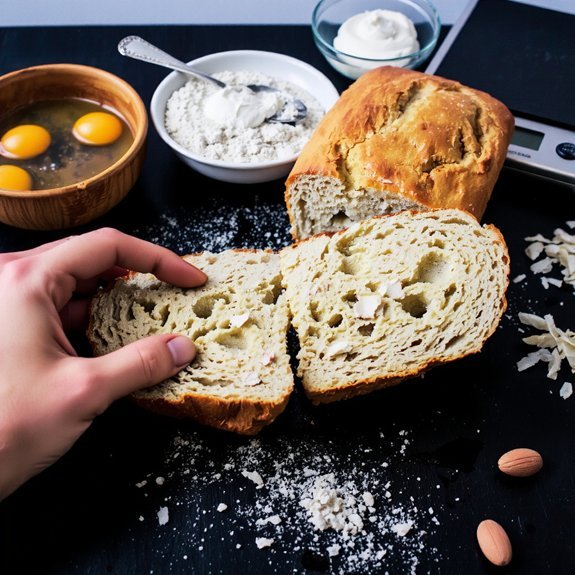
You’ll need to adjust your hydration ratios substantially since gluten-free flours absorb moisture differently than wheat flour, requiring you to increase liquid content by 10-20% to achieve proper dough consistency.
Your binding agents—whether xanthan gum, psyllium husk, or eggs—directly influence how your batter holds together and develops structure, so you’ll want to calibrate their amounts based on your specific flour blend.
Balancing these two elements determines whether you’ll get a crumbly, dense crumb or the tender, moist texture that makes gluten-free baked goods successful.
Hydration Ratios and Absorption
Why does your gluten-free batter feel thicker than conventional dough? Gluten-free flours absorb liquid differently than wheat flour, requiring you to adjust your water percentages strategically.
You’ll need to increase hydration levels by 5-15% compared to traditional recipes.
Here’s what you should know about absorption:
- Gluten-free flours absorb moisture faster, demanding longer mixing times to fully hydrate all particles
- Water percentages vary by flour blend composition and starches present
- Proper hydration prevents dense crumbs and improves rise consistency
- Extended mixing times activate binders like xanthan gum more effectively
You’re not dealing with gluten’s elasticity, so you’re free to experiment boldly.
Start with higher water ratios and adjust downward incrementally. This precision gives you control over your final texture—achieving the moisture balance that traditional bakers can’t replicate.
Binding Agents for Structure
Once you’ve dialed in your hydration levels, you’re ready to address the structural problem that gluten-free batters face: without gluten’s natural binding network, your baked goods need reinforcement.
You’ll rely on binding agents to create the structure that holds everything together.
Xanthan gum and psyllium husk are your workhorses here.
Xanthan gum mimics gluten’s elasticity, while psyllium husk adds viscosity and moisture retention.
Plant fibers like ground flaxseed or chia seeds strengthen your crumb structure while adding nutritional value.
For protein-rich applications, protein isolates enhance binding capacity and create a more cohesive matrix.
You’re basically engineering a network that traps moisture and prevents crumbling.
Master these binding agents, and you’ll achieve the structural integrity that makes gluten-free baking genuinely indistinguishable from conventional methods.
Common Mistakes and How to Avoid Them
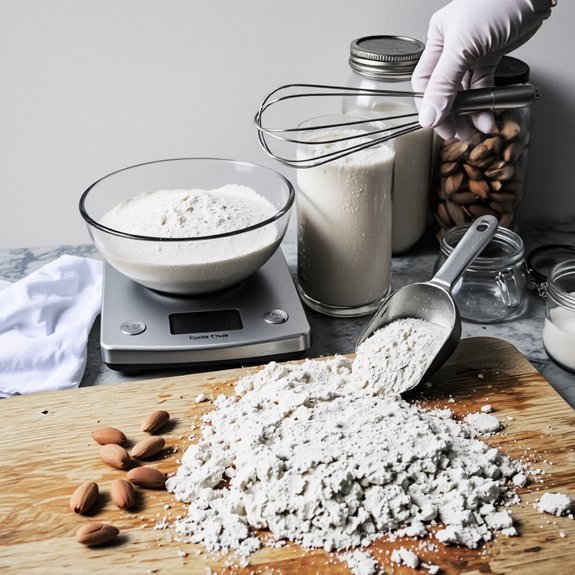
Because gluten-free batters behave differently than their conventional counterparts, certain pitfalls commonly derail even experienced bakers.
You’ll achieve superior results by maintaining recipe fidelity and preventing contamination through meticulous equipment maintenance.
Achieve superior gluten-free baking results through meticulous recipe adherence and scrupulous equipment maintenance practices.
Avoid these critical errors:
- Overmixing your batter – Excessive blending develops starch viscosity, creating dense, gummy crumbs instead of light structure
- Neglecting hydration adjustments – Gluten-free flours absorb moisture differently; you’ll need 5-10% more liquid than conventional recipes
- Skipping rest periods – Allowing batter 15-30 minutes lets starches fully hydrate, improving rise and texture
- Using contaminated tools – Even trace gluten particles undermine your entire batch’s integrity
You’ll notice immediate improvements when you respect these parameters.
Your freedom to bake successfully depends on understanding how gluten-free formulations fundamentally differ from traditional methods.
Adapting Your Favorite Recipes for Gluten-Free Success
Transforming your beloved recipes into gluten-free versions requires systematic substitution rather than simple ingredient swaps.
You’ll need to understand how gluten functions—binding, structure, elasticity—then replace it strategically.
Start by substituting one-to-one gluten-free flour blends for standard flour, adjusting liquid ratios as needed since alternative flours absorb moisture differently.
Consider equipment swaps too; you might require different mixing times and techniques.
Xanthan gum or psyllium husk replaces gluten’s binding properties effectively.
Master flavor pairing by enhancing your adaptations with complementary ingredients.
Vanilla, almond extract, or citrus zest compensate for textural changes and amplify taste complexity.
Test recipes methodically, documenting adjustments.
This disciplined approach liberates you from gluten restrictions while preserving your favorite baked goods’ integrity and satisfaction.
Troubleshooting Guide for Gluten-Free Baking Problems
Even with meticulous recipe adaptation and precise ingredient substitution, you’ll encounter common baking failures that don’t occur in traditional wheat-based baking.
You’ll need systematic troubleshooting to identify root causes and implement effective solutions.
Systematic troubleshooting identifies root causes and implements effective solutions for gluten-free baking challenges.
Common gluten-free issues and fixes:
- Dry crumb texture: Increase liquid content by 5-10% or add eggs for moisture retention
- Dense, gummy results: Reduce liquid slightly and verify oven calibration for accurate temperature
- Excessive spreading: Strengthen dough with xanthan gum or psyllium husk; chill before baking
- Flat or collapsed structure: Check altitude adjustments for your elevation; reduce baking soda accordingly
You’ll benefit from maintaining detailed baking notes documenting exact ingredient ratios, timing, and oven performance.
This data-driven approach empowers you to troubleshoot systematically rather than rely on guesswork, ultimately mastering gluten-free baking with precision and confidence.
Frequently Asked Questions
How Long Does Gluten-Free Baked Goods Typically Stay Fresh Compared to Regular Baked Goods?
You’ll find gluten-free baked goods typically have a shorter shelf life than their conventional counterparts, lasting 1-2 days versus 3-5 days for regular baked goods.
This shelf life comparison stems from gluten-free formulations’ reduced moisture retention capacity. Without gluten’s structural protein network, your baked items dry out faster.
To maximize longevity, you’re best served storing them in airtight containers at room temperature, or freezing them for extended preservation without compromising quality.
Can I Use Regular Kitchen Equipment or Do I Need Specialized Tools for Gluten-Free Baking?
You don’t need specialized tools for gluten-free baking.
Standard kitchen equipment works perfectly fine.
However, you’ll benefit from using silicone bakeware and stainless steel mixing bowls, which prevent cross-contamination and offer superior heat distribution.
These materials won’t absorb gluten particles from previous baking.
Your existing measuring cups, spatulas, and whisks are entirely adequate.
The key difference isn’t equipment—it’s technique and ingredient knowledge.
You’ve got the freedom to bake gluten-free using whatever you already own.
What’s the Cost Difference Between Gluten-Free and Traditional Baking Ingredients?
You’ll encounter noticeable flour premiums when purchasing gluten-free alternatives, typically 2-3 times higher than wheat flour.
Substitute costs for binders like xanthan gum and psyllium husk add further expenses.
However, you’re gaining control over your dietary choices and health outcomes.
Strategic bulk purchasing and choosing versatile blends reduce overall expenses.
Your investment reflects genuine freedom to bake without compromise, making the premium justified for your independence.
Are There Any Health Benefits to Eating Gluten-Free Baked Goods if You’re Not Celiac?
You won’t experience physiological benefits from gluten-free baked goods unless you’ve got celiac disease or gluten sensitivity. Most non-celiac consumers report improvements through the placebo effect rather than actual biological changes.
Here’s the reality: standard gluten-free products often contain nutrient deficiencies compared to their traditional counterparts, lacking essential B vitamins and fiber. You’re choosing a dietary restriction that doesn’t serve your body’s actual needs—a constraint that limits your freedom without tangible health returns.
How Do I Prevent Cross-Contamination When Baking Gluten-Free in a Shared Kitchen?
You’ll maintain dedicated utensils exclusively for gluten-free preparation—separate cutting boards, measuring cups, and mixing bowls prevent cross-contamination.
Establish a rigorous cleaning protocol: wash all surfaces with hot soapy water before starting, use fresh dish towels, and clean your hands thoroughly.
You’re free to bake confidently when you segregate ingredients, designate specific cabinet spaces, and keep gluten-containing products completely isolated.
This systematic approach guarantees your gluten-free creations remain uncontaminated.
Leave a Comment