
Key Takeaways
- Mix 1 cup shredded coconut with 3/4 cup sweetener and three egg whites until moldable, then shape into firm mounds.
- Preheat oven to 325°F and bake macaroons on middle rack for 18–22 minutes until golden-brown with darker edges.
- Test doneness by applying gentle pressure to centers; they should yield slightly while maintaining crispy exterior and chewy interior.
- Space macaroons one inch apart on parchment-lined baking sheet to ensure even heat circulation and uniform browning.
- Store cooled macaroons in airtight containers at room temperature for five days, or freeze in layers for three months.
Gathering Your Ingredients
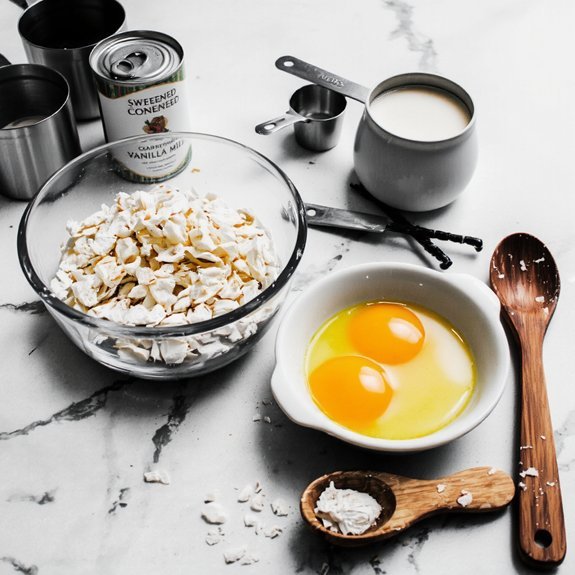
Assembling the right ingredients is essential for macaroons that’ll hold their shape and develop that signature chewy interior with a golden exterior.
Assembling the right ingredients is essential for macaroons that’ll hold their shape and develop that signature chewy interior with a golden exterior.
You’ll need unsweetened shredded coconut as your base—check seasonal availability for the freshest product.
Egg whites provide structure, while sweetened condensed milk creates that distinctive texture.
Consider dietary considerations if you’re accommodating allergies; you can substitute condensed milk with coconut cream for dairy-free versions.
You’ll also need vanilla extract for depth and salt to enhance flavor.
Some recipes call for almond extract for complexity.
Gather everything before starting—mise en place prevents mistakes.
Measure your coconut precisely; too much creates dry macaroons, while insufficient amounts won’t bind properly.
Quality ingredients directly impact your final product’s success.
Preparing Your Baking Station
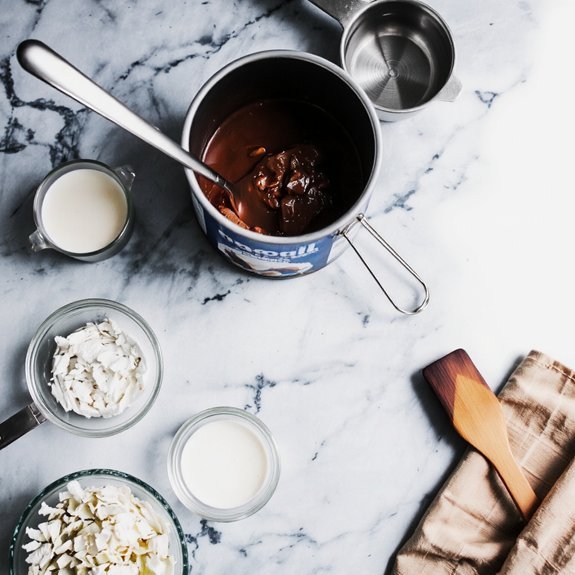
You’ll need to assemble your baking equipment—mixing bowls, measuring cups, a baking sheet, parchment paper, and an oven thermometer—before you begin working with your ingredients.
Arrange your measured coconut, sweetened condensed milk, vanilla extract, and salt within arm’s reach of your workspace to streamline the mixing process.
Position your oven rack to the middle setting and preheat your oven to 325°F so you’re ready to bake immediately after forming your macaroons.
Gather Essential Baking Equipment
Before mixing your first ingredients, organize your workspace with the core tools that’ll guarantee consistent results: a large mixing bowl for combining wet and dry components, measuring cups and spoons for precise ingredient ratios, a wooden spoon or rubber spatula for folding coconut into batter without deflating air pockets, a baking sheet for even heat distribution, parchment paper to prevent sticking and promote browning, a cookie scoop or spoon for uniform macaroon sizing, and an oven thermometer to verify your baking temperature’s accuracy—even slight deviations affect moisture retention and structural integrity in these delicate confections.
| Equipment | Function | Specification |
|---|---|---|
| Mixing Bowl | Combines ingredients | Large capacity (3+ quarts) |
| Oven Thermometer | Verifies heat accuracy | ±5°F precision |
| Baking Sheet | Distributes heat evenly | Aluminum or steel construction |
Organize Your Ingredient Station
Gathering your ingredients before mixing guarantees accuracy and prevents mid-process scrambling that compromises texture. Arrange your shredded coconut, egg whites, sugar, vanilla extract, and salt within arm’s reach of your mixing bowl.
Label containers clearly to avoid confusion between similar-looking ingredients. Implement allergen segregation if you’re preparing macaroons for multiple dietary needs—designate separate utensils and prep areas for nut-free versus standard batches.
Position your measuring cups and spoons nearby for immediate access. This systematic setup eliminates interruptions once you’ve begun combining ingredients.
You’ll maintain consistent ratios and temperature control, both critical for achieving the proper chewy-to-crisp macaroon consistency. A well-organized station accelerates your workflow and reduces errors that could compromise your batch’s final quality.
Mixing the Perfect Coconut Mixture
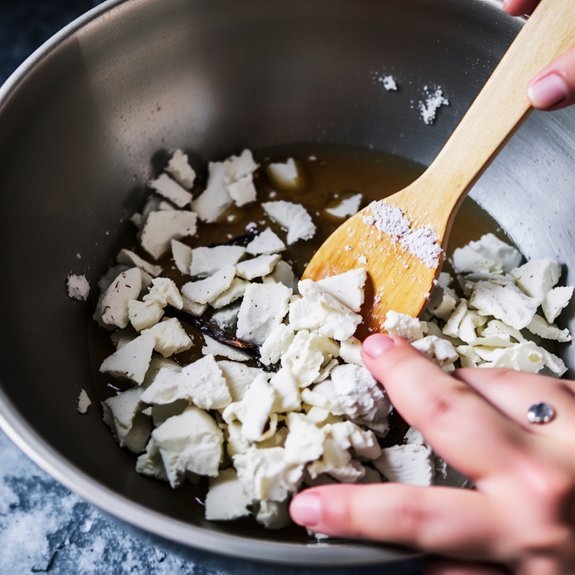
You’ll start by determining your shredding technique—whether you’re using fine, medium, or large shred coconut—since each size affects moisture absorption and texture density differently.
Next, you’ll establish your sweetener-to-binder ratio, typically balancing condensed milk or egg white against your chosen sweetener to achieve the right consistency for binding without creating a mixture that’s either too wet or too crumbly.
Getting these proportions precise guarantees your macaroons hold their shape during baking while developing the ideal interior moisture and exterior browning.
Coconut Shredding Techniques
Selecting the right shredded coconut—whether sweetened, unsweetened, or a blend—fundamentally determines your macaroon’s texture and flavor profile.
You’ll find two primary shredding methods: Hand Shredding and Machine Shredding.
Hand Shredding gives you complete control over particle size, yielding irregular strands that create appealing texture variation. This method requires patience but produces superior results for artisanal batches.
Machine Shredding offers consistency and efficiency, delivering uniform pieces ideal for standardized recipes. A food processor with a shredding blade handles fresh coconut quickly, though you’ll need to account for moisture content differences.
You can’t interchange these methods without adjusting your liquid ratios. Hand-shredded coconut typically contains more moisture, requiring less added liquid. Machine-shredded varieties often need slightly more binding agents. Choose your technique based on your desired crumb structure and available time.
Sweetener and Binder Ratios
Because the coconut itself contains natural moisture and subtle sweetness, your sweetener and binder proportions must balance these existing properties to achieve the ideal consistency for shaping and baking.
You’ll typically need one cup of shredded coconut to three-quarters cup of sweetener.
If you’re experimenting with sugar alternatives like coconut sugar or monk fruit, adjust ratios slightly—they’ll absorb moisture differently than standard sugar.
For binders, you’ve got flexibility: three egg whites create traditional texture, but egg substitutes like aquafaba or flax eggs work equally well.
Use three tablespoons of aquafaba per egg white.
These substitutes don’t compromise structure or browning.
Mix your ingredients until the coconut holds together without excessive moisture.
You’re aiming for a moldable paste that maintains shape without crumbling when baked.
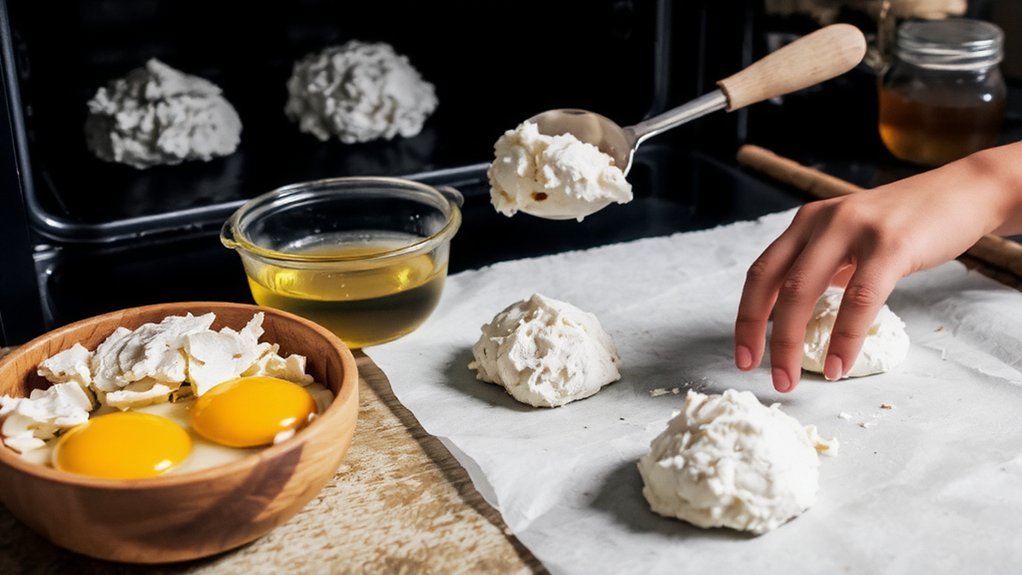
Shaping and Forming Your Macaroons
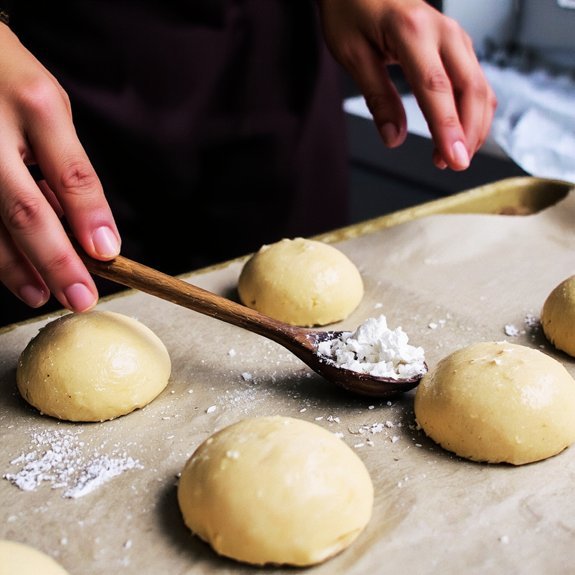
Once your coconut mixture reaches the proper consistency—firm enough to hold its shape yet moist enough to bind—it’s ready for portioning.
The coconut mixture should be firm enough to hold its shape yet moist enough to bind before you begin portioning.
You’ll want to use consistent scoop sizes to guarantee uniform baking and presentation.
A standard ice cream scoop or cookie scoop works effectively, delivering predictable portions each time.
Press the mixture firmly into your chosen scoop, then release onto your prepared baking sheet.
You can shape mounds freely with your hands or two spoons for peak shaping that adds visual appeal.
Create distinct peaks by gently lifting the mixture upward as you form each mound.
Space macaroons about an inch apart to allow heat circulation during baking.
Consistent shaping promotes even moisture loss and browning.
Your technique here directly impacts final texture and appearance, so maintain precision throughout the forming process.
Baking to Golden Perfection
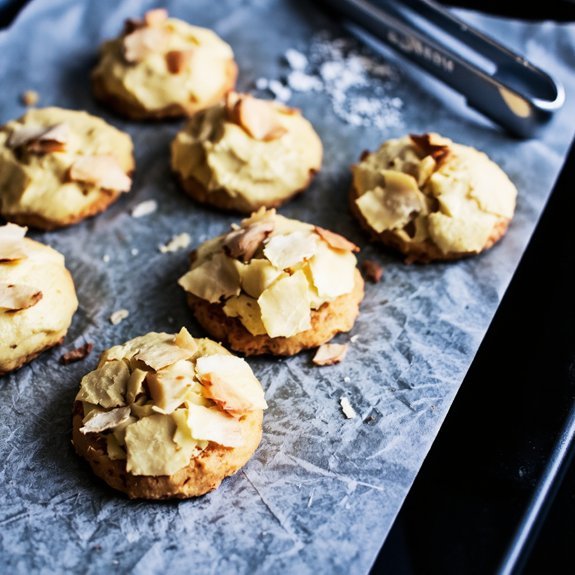
Your macaroons’ll bake best at 325°F for 18–22 minutes, though you’ll want to monitor them closely during the final five minutes.
The browning science depends on precise heat control and coconut moisture content.
Here’s what you need to know:
- Position your rack in the middle oven zone to promote even heat distribution
- Watch for golden-brown surface texture—darker edges signal completion
- Check internal doneness by gentle pressure; centers should yield slightly
- Cool macaroons on the baking sheet for two minutes before transferring
Underbaked macaroons’ll collapse; overbaked ones become brittle.
The coconut’s natural oils caramelize at this temperature, creating that coveted crispy exterior while maintaining a chewy interior.
Your oven’s actual temperature may vary, so calibrate accordingly for consistent results.
Storage and Serving Tips
To preserve your macaroons’ texture contrast, you’ll want to store them in an airtight container at room temperature for up to five days.
For extended storage, freezing methods work exceptionally well—place macaroons in freezer-safe containers with parchment between layers, maintaining quality for three months.
When you’re ready to serve, thaw frozen macaroons at room temperature for thirty minutes.
This restores their signature crispy exterior and chewy interior.
Your presentation ideas should highlight the macaroons’ golden-brown peaks.
Arrange them on minimalist platters or tiered stands to showcase their architectural shape.
Consider pairing them with espresso or tropical beverages that complement their coconut intensity.
Dust with toasted coconut flakes or dark chocolate drizzle for visual impact without compromising texture.
Store garnishes separately until serving to prevent moisture absorption and maintain your macaroons’ structural integrity.
Frequently Asked Questions
Can I Use Shredded Coconut Instead of Sweetened Coconut Flakes?
Yes, you can substitute shredded coconut for sweetened flakes.
However, you’ll need to adjust your moisture content since shredded varieties absorb liquid differently.
Compensate by reducing liquid slightly or increasing binding agents like egg whites.
You’ll also need to bump up sweetness—add an extra tablespoon of sugar or condensed milk since unsweetened shredded coconut lacks the built-in sweetness of flaked versions.
This swap demands precision adjustments for consistent results.
What’s the Difference Between Macaroons and Macarons?
You’ll find macaroons and macarons aren’t interchangeable.
Macaroons are coconut-based confections with chewy, dense texture differences—you’re working with shredded coconut, egg whites, and sugar.
Macarons, conversely, use almond flour, creating delicate, crispy shells with soft centers.
Flavor profiles diverge markedly: macaroons deliver concentrated coconut richness, while macarons showcase subtle almond notes with customizable fillings.
Your technique differs too—macaroons require simple mixing; macarons demand precise meringue folding and piping for consistency.
How Do I Prevent My Macaroons From Burning on the Bottom?
You’ll prevent bottom burning by positioning your oven rack in the middle, allowing consistent heat circulation. Use a silicone mat instead of parchment paper—it distributes heat more evenly and shields your macaroons from direct contact with the baking sheet.
Bake at 325°F for 20-25 minutes until golden. You’re free to customize timing based on your oven’s quirks, but this rack position and silicone mat combination gives you reliable, evenly-baked results every time.
Can I Make Macaroons Without Eggs or Dairy Products?
You can absolutely make vegan macaroons by replacing eggs with aquafaba—the liquid from canned chickpeas works brilliantly as a binder.
Whip three tablespoons of aquafaba until it’s foamy, then fold it into your shredded coconut mixture with coconut oil and sweetener.
Other vegan binders like ground flaxseed mixed with water or cornstarch also work effectively.
You’ll gain the same structure and texture while maintaining complete freedom from animal products.
Why Did My Macaroons Turn Out Chewy Instead of Crispy?
Your macaroons turned chewy because you’ve likely used too high a sugar ratio relative to coconut, which absorbs moisture.
You’re also probably not cooling them properly—they’ll trap steam if you don’t let them cool completely on the baking sheet before transferring.
Reduce sweetener slightly, bake at 325°F for longer, and cool undisturbed. This gives you the crispy exterior you’re after.




Leave a Comment