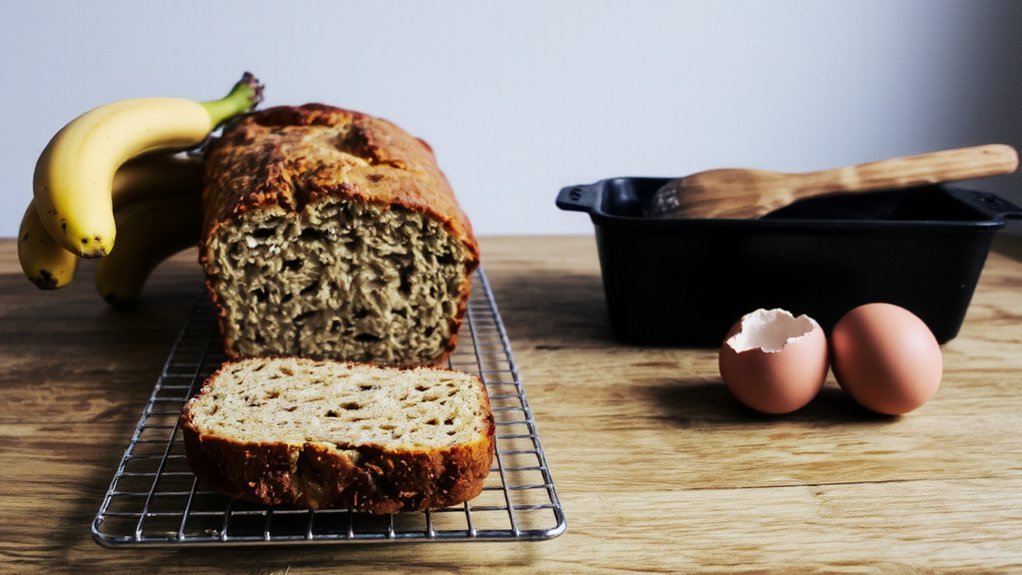

Key Takeaways
- Select yellow bananas with brown spots, peel, and mash to approximately 3/4 cup per medium fruit for optimal sweetness.
- Cream softened butter and sugar for two minutes, then alternately add dry ingredients and mashed bananas, beginning and ending with dry.
- Preheat oven to 350°F and bake for 55–65 minutes until a toothpick emerges with only a few moist crumbs.
- Cool the loaf in the pan for 10 minutes, then invert onto a wire rack and cool completely for 2–3 hours.
- Avoid overmixing the batter and verify oven temperature with a thermometer to prevent dense, dry, or sunken-center loaves.
Selecting and Preparing Your Bananas
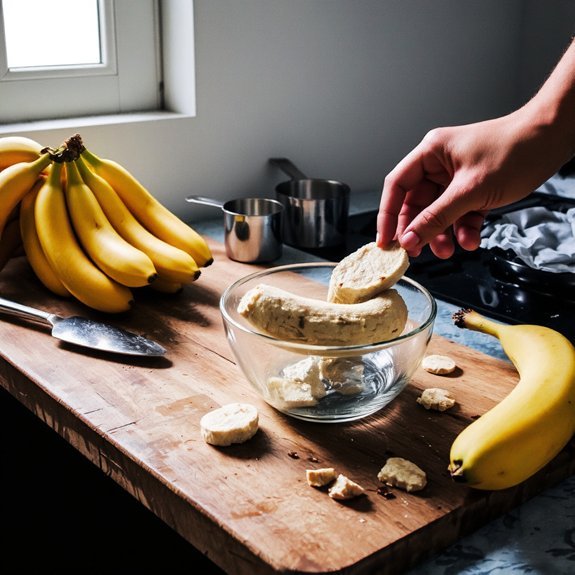
Since banana ripeness directly affects your bread’s flavor and texture, you’ll want to choose bananas with yellow skin dotted with brown spots—they’re at peak sweetness and easier to mash.
Look for ripeness indicators like deep coloring and slight softness when gently squeezed.
Popular banana varieties work well for baking, though standard yellow bananas deliver consistent results.
Avoid green bananas; they’re starchy and won’t provide adequate sweetness.
Overly brown or blackened bananas work too, offering intense flavor.
Peel your bananas and place them in a bowl.
Mash them thoroughly with a fork until you’ve achieved a chunky-smooth consistency—aim for roughly ¾ cup mashed banana per medium fruit.
Don’t over-blend; some texture improves your bread’s crumb structure.
Measure your mashed banana precisely before incorporating it into your batter.
Gathering Your Ingredients and Equipment
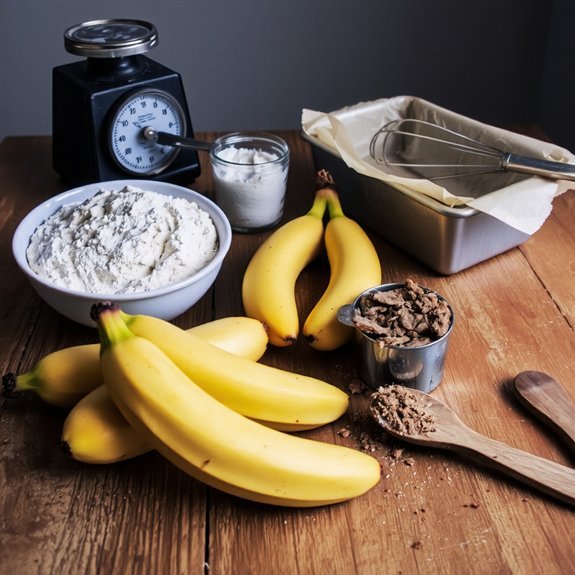
Before you combine your mashed bananas with other ingredients, you’ll need to assemble both your dry and wet components along with the proper equipment. Gather your dry ingredients: two cups all-purpose flour, one teaspoon baking soda, and half a teaspoon salt.
For wet ingredients, collect three-quarters cup vegetable oil, one cup sugar, two eggs, and one teaspoon vanilla extract.
Organize your shelf with these items at arm’s reach. You’ll need a nine-by-five-inch loaf pan, mixing bowls, measuring cups, measuring spoons, and a whisk.
Verify your equipment maintenance is current—clean your bowls thoroughly and check your oven’s calibration for accurate baking temperatures. Having everything prepared and accessible streamlines your baking process, allowing you complete control over your banana bread creation.
Mixing and Preparing the Batter
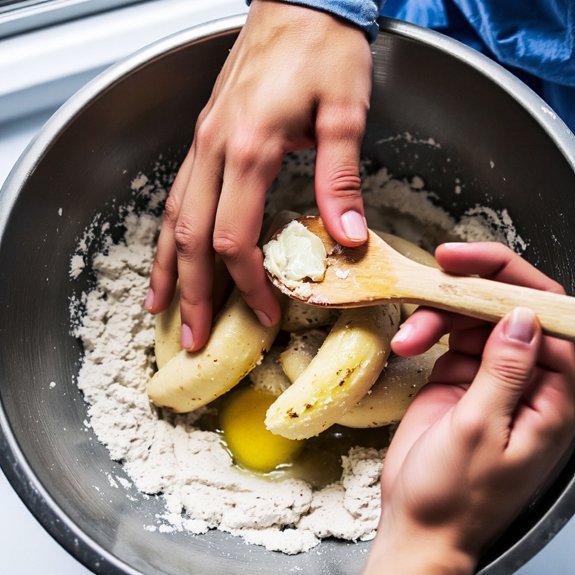
Now that you’ve assembled your ingredients and equipment, you’re ready to begin building your batter.
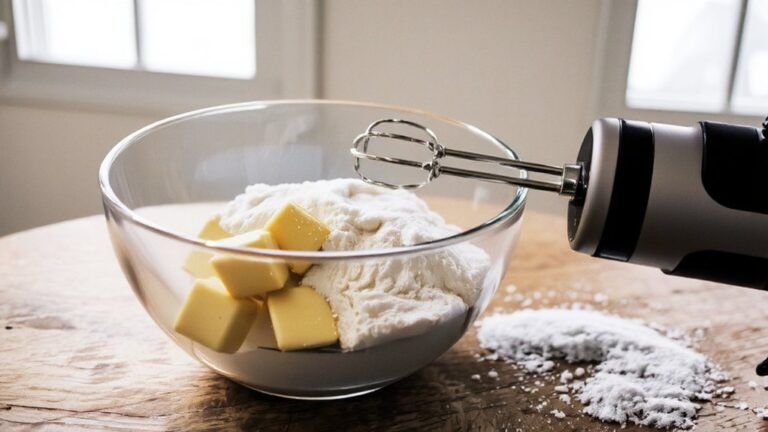
Start by using the creaming method: beat softened butter and sugar together for two minutes until light and fluffy.
Beat softened butter and sugar together for two minutes until light and fluffy, incorporating air for lift.
This incorporates air, creating lift in your finished loaf.
Add eggs one at a time, mixing thoroughly after each addition.
In a separate bowl, whisk together flour, baking soda, and salt.
Mash your bananas to a chunky consistency—don’t over-process them.
Alternate adding dry ingredients and mashed bananas to the butter mixture, beginning and ending with dry ingredients.
Use the folding technique with a spatula to combine gently, stirring just until no flour streaks remain.
Overmixing develops gluten, making your bread tough and dense.
Pour immediately into your prepared pan.
Baking and Cooling Your Loaf
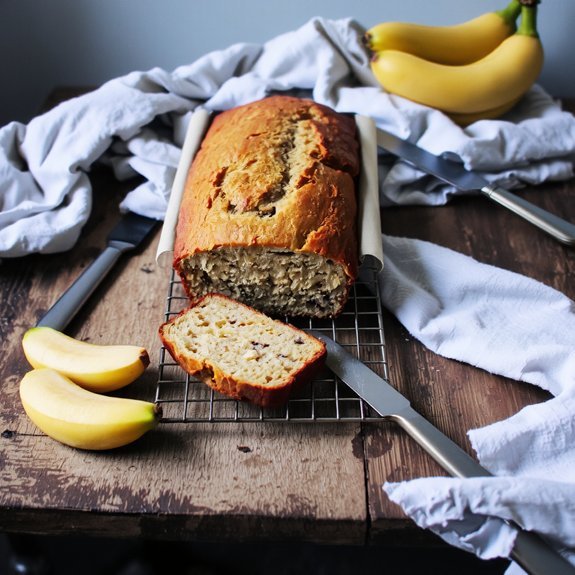
Once you’ve poured the batter into your prepared pan, place it in a preheated 350°F oven for 55 to 65 minutes.
Monitor the loaf closely during the final minutes; it’s done when a toothpick inserted into the center emerges with only a few moist crumbs.
Remove the pan from the oven and let it rest for 10 minutes.
This cooling technique allows the bread to set slightly without becoming brittle.
Invert the loaf onto a wire rack and position it right-side up to cool completely—roughly 2 to 3 hours.
Proper baking times and cooling techniques help you’ll achieve an evenly baked interior with a sturdy, sliceable structure.
Resist cutting into your banana bread until it’s completely cooled; premature slicing compromises texture and causes crumbling.
Troubleshooting Common Baking Problems
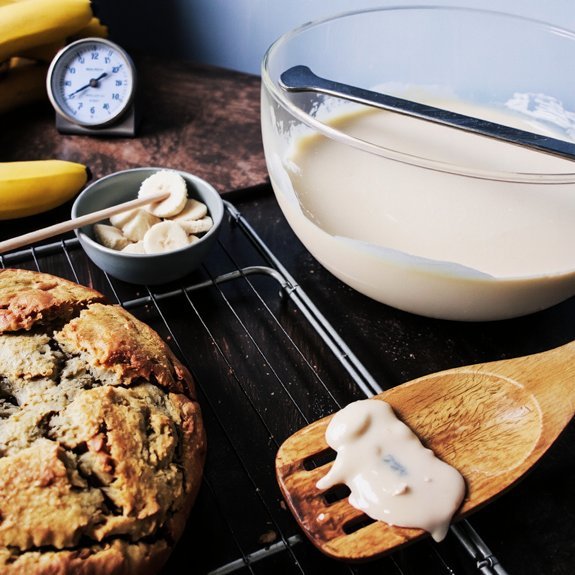
Even when you’ve followed every step carefully, you might encounter issues that affect your banana bread’s texture and appearance.
If your loaf’s dense or underbaked, you’ve likely undermixed your batter or used insufficient leavening agents.
Check your oven’s actual temperature with a thermometer—equipment failure often causes uneven baking.
Increase heat by 25°F if needed.
Conversely, if your bread’s too dry, you’ve overbaked it.
Reduce baking time by 5-10 minutes next attempt.
When recipe scaling, adjust leavening proportionally; doubling ingredients requires double the baking powder and baking soda.
However, don’t double salt or vanilla extract—these intensify.
Sunken centers indicate overmixing or excessive fruit content.
Fold ingredients gently, and don’t exceed two mashed bananas per loaf.
These precise adjustments’ll correct most problems effectively.
Frequently Asked Questions
Can I Freeze Banana Bread, and How Long Will It Last?
You’ll freeze banana bread by wrapping it tightly in plastic wrap, then aluminum foil for freezer storage lasting three months.
For thawing methods, remove it from the freezer and let it sit at room temperature for 2-3 hours unopened, or thaw it overnight in your refrigerator.
You’ve got complete control—slice before freezing for grab-and-go portions, or thaw the whole loaf.
Don’t compromise on freshness; proper wrapping prevents freezer burn entirely.
What Are the Best Toppings or Glazes for Banana Bread?
You’ll achieve superior results by applying salted caramel glaze: combine one cup powdered sugar, two tablespoons butter, and one tablespoon caramel sauce.
Alternatively, craft cinnamon streusel topping by mixing one-half cup brown sugar, one-third cup flour, three tablespoons butter, and two teaspoons cinnamon.
Layer streusel atop batter before baking at 350°F for fifty-five minutes. You’re free to customize either option by adjusting sweetness ratios or adding nuts for textural contrast.
How Can I Make Banana Bread Healthier With Substitutions?
You’ll swap all-purpose flour with almond flour or oat flour—use a 1:1 ratio for oat flour, but reduce almond flour to 3/4 cup per cup called for.
Replace refined sugar with coconut sugar or honey at equal measurements.
Add Greek yogurt (1/4 cup) to boost protein and moisture.
Incorporate ground flaxseed (2 tablespoons) mixed with water for binding.
You’re now controlling exactly what enters your body—no mystery ingredients constraining your choices.
Can I Make Banana Bread Without Eggs or Dairy?
You can absolutely make egg-free, dairy-free banana bread.
Replace each egg with 1/4 cup applesauce or a flax egg (1 tablespoon ground flax mixed with 3 tablespoons water).
Substitute butter with coconut oil at 1:1 ratio and swap milk for almond or oat milk.
Understanding binding science guarantees structural integrity.
Adjust sweetness by reducing sugar 10-15% since substitutes alter flavor profiles.
Mix dry ingredients thoroughly before combining wet components for ideal texture.
What’s the Difference Between Banana Bread and Banana Cake?
You’ll notice the texture contrast between banana bread and cake hinges on ingredient ratios. Bread uses less sugar and fat, yielding a denser, moister crumb that you can slice cleanly.
Cake incorporates higher ratios of these ingredients, creating a lighter, airier structure.
You’re free to adjust either formula—reduce sugar for less sweetness, increase oil for moisture, or modify leavening agents to control rise and texture density to your preference.


Leave a Comment