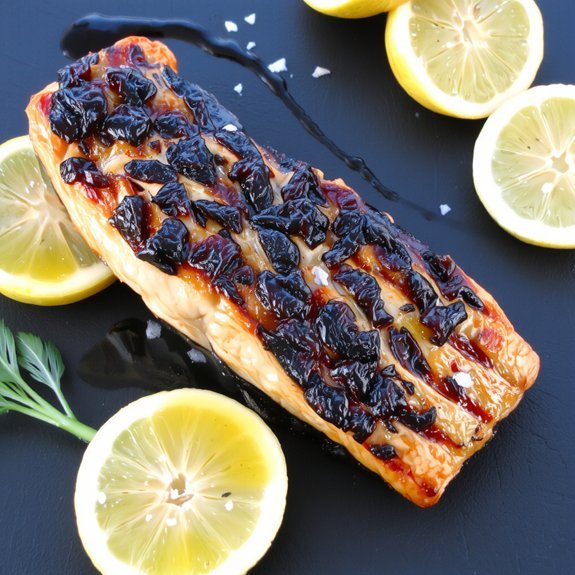

You’ll prep firm salmon, season precisely, and control grill zones to achieve consistent results. You’ll cook skin-side down, monitor internal temperature, and rest fillets to retain juices. This guide gives exact temps, timings, and a simple lemon-butter finish—so you can execute perfectly every time and troubleshoot common problems.
Ingredients and Prep
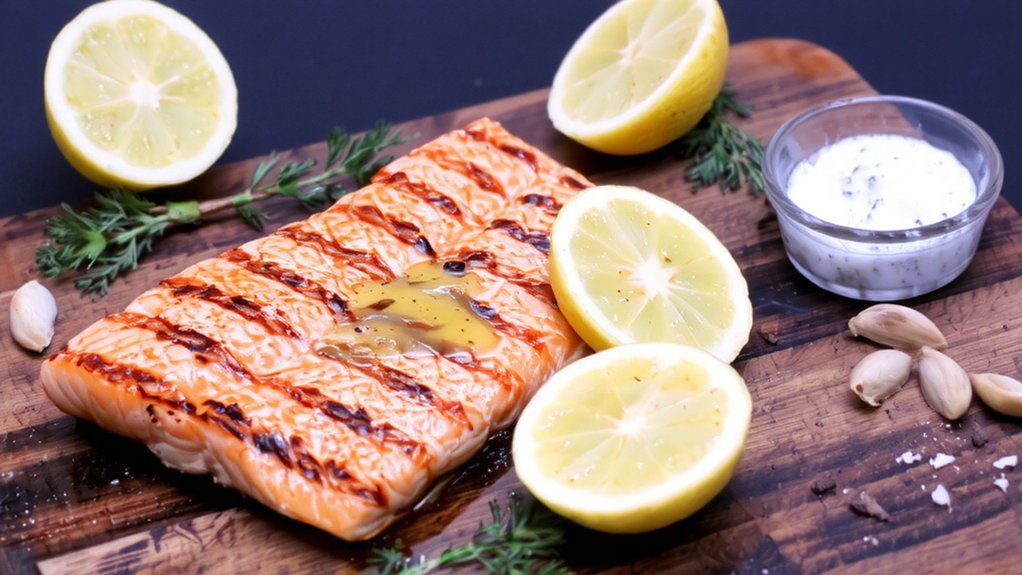
While selecting a fillet, choose firm, vibrantly colored salmon about 1 inch (2.5 cm) thick and keep the skin on for grilling to retain moisture and structure. Inspect for elasticity, uniform color and minimal odor; decide between salmon varieties (wild leaner, farmed fattier) based on fat content and cook tolerance.
Pat fillets dry, remove remaining scales and pin bones, then coat evenly with a neutral oil to prevent sticking. Apply seasoning: sprinkle kosher salt and cracked black pepper on both flesh and skin sides, then add optional blends or minced garlic sparingly.
For marinated options, combine acid, oil, and sweetener and limit marination to 15–30 minutes. Let fillets rest at room temperature 20–30 minutes before cooking. You’ll achieve consistent results following these preparation steps. For best results, cook on a preheated grill over high heat.
Grilling Methods and Setup
A hot, well-oiled grate is essential: choose direct grilling for a quick sear and crispy exterior or foil packets to retain moisture and produce a gentler texture.
You’ll assess grill preparation contrasts—charcoal offers smoky flavor and variable radiant heat; gas gives precise, stable control. Preheat until grates reach medium-high surface temperature; use a charcoal chimney for efficient startup.
Clean and oil grates to prevent sticking and guarantee heat transfer. Position fillets skin-side down when using grates to protect flesh; consider diagonal placement for easier handling.
Keep the lid closed to stabilize conditions. Use neutral, high-smoke-point oil and a probe thermometer to verify internal temperature.
These cooking techniques optimize flavor, safety, and consistent outcomes without procedural sequencing, enhancing even heat distribution across the fillet consistently. For best results, use Skin-on salmon when grilling to retain moisture and flavor.
Step-by-Step Cooking Instructions
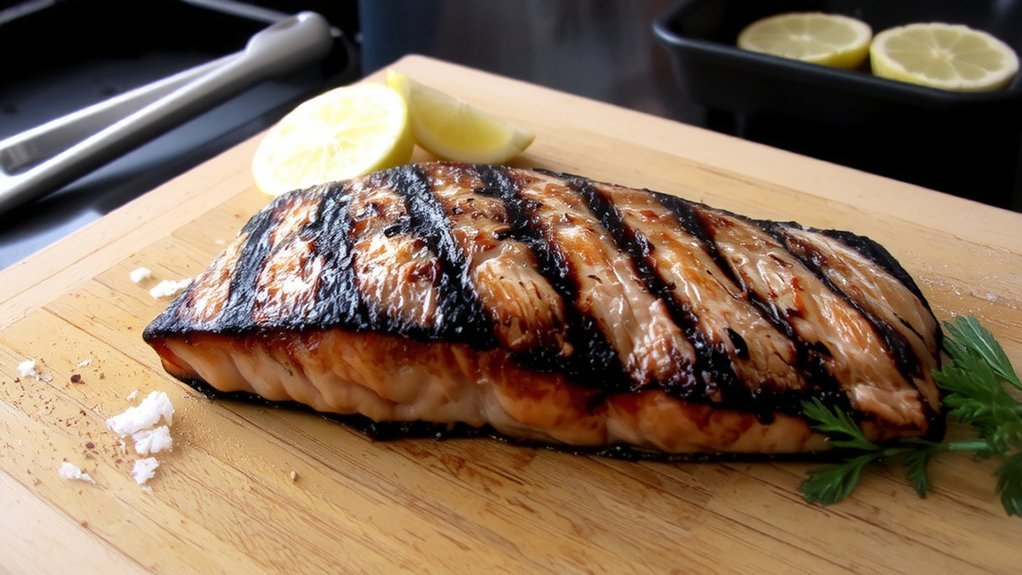
Prepare the salmon and grill as described above, then follow these sequential, actionable steps.
1. Thaw and pat dry the fillets; apply oil, salt, pepper or chosen rub to develop targeted flavor profiles.
Use skin-on salmon like sockeye or coho for the best flavor and texture when grilling.
2. If you opt to marinate, do so briefly; bring fillets to room temperature before placing on the grill.
3. Place skin side down to use direct sear cooking techniques; use an oiled spatula to flip carefully once defined grill marks form.
4. After removing from the grill, transfer to a clean tray and allow juices to redistribute.
Throughout, handle fillets gently, use proper tools, and adjust the grill to maintain even heat for consistent outcomes; monitor rather than guess.
Record each variation to refine cooking techniques and balance your preferred flavor profiles over sessions.
Timing, Temperatures, and Doneness
When you grill salmon, set the grate between 350°F and 450°F and use thickness-based timing: roughly 12–15 minutes per inch at 350°F, 10–12 minutes at 375°F, 8–10 minutes at 400°F, and about 5–7 minutes per inch at 450°F; aim for an internal probe reading of 130–140°F for medium or 145°F for USDA-recommended doneness, and rest fillets 1–3 minutes to allow carryover cooking and juice redistribution. Also, leave skin on when possible to maintain moisture and structure. Use skin-side-down starts to protect flesh and reduce sticking; at high heat flip after 2–3 minutes for marks, then finish skin-side-down as needed. Measure doneness indicators with a probe in the thickest section and observe opacity, firmness, and flake separation. For delicate fillets consider indirect heat, foil, or a sheet to control time and prevent overcooking and verify accuracy.
Flavorings, Sauces, and Garnishes
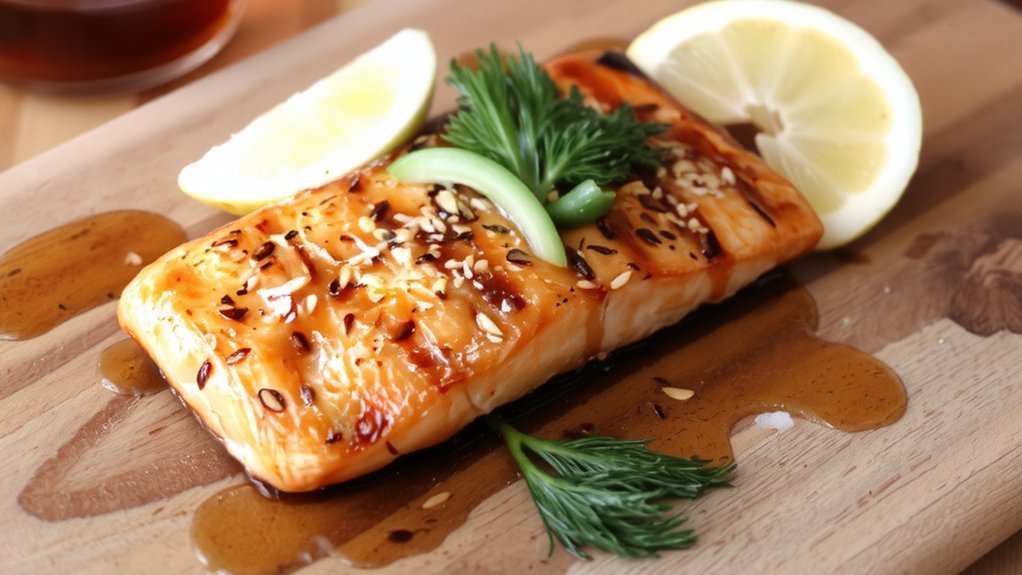
For finishing sauces, you’ll prepare a classic lemon-butter emulsion that balances acidity and fat without breaking. Melt clarified butter, then whisk in fresh lemon juice and a pinch of salt off the heat to stabilize the sauce.
For herb-citrus marinades, combine chopped dill or basil with citrus zest, juice, and a light oil, and marinate the salmon 15–30 minutes to infuse flavor without beginning to cook. For best results, use skin-on fillets when grilling to help prevent the fish from breaking apart.
Classic Lemon Butter Sauce
Typically, you’ll melt real butter over medium heat and gently sauté minced garlic until fragrant but not browned. For best flavor and creaminess, use real butter rather than margarine.
Then simmer fresh lemon juice with white wine or chicken broth briefly to concentrate flavor.
Use precise temperature control: medium heat, avoid browning.
Add heavy cream, simmer to coat spoon, then remove from heat and whisk in cold butter pieces to form an emulsion.
Strain if desired for smooth texture.
Focus on Culinary Techniques and Flavor Balancing: adjust acidity with zest, thickness with cream or reduced stock, and salt to taste.
- Control heat: medium, then off for emulsification.
- Acid: fresh lemon juice + zest for brightness.
- Texture: heavy cream, gradual butter incorporation.
- Optional: white wine or chicken broth to modulate body.
Serve immediately for best results.
Herb and Citrus Marinades
After mastering the lemon-butter emulsion, shift focus to herb-and-citrus marinades that both season and gently tenderize salmon.
Use olive oil as your base to carry flavors and maintain moisture. Whisk measured citrus combinations (lemon, lime, orange) with oil; add zests for aroma.
Select fresh herb selections—parsley, dill, thyme, coriander, chives—finely chopped for even distribution. Season with salt and freshly ground black pepper; optionally add brown sugar or orange marmalade to balance acidity and promote caramelization.
Pat fillets dry, you’ll brush marinade on evenly. Marinate briefly: minutes up to 30 to avoid protein breakdown.
During grilling, reduce reserved citrus-sugar mixtures into a glaze and brush for gloss.
Finish with herb sprigs and citrus wedges for adjustable acidity. Rest three minutes before serving to stabilize juices. This preparation offers about 335 kcal per serving, making it a balanced choice.
Storage, Reheating, and Leftover Tips
Refrigerate cooked salmon within 2 hours in an airtight container at or below 40°F (4°C); consume within 3–4 days or freeze for 2–3 months.
When you freeze, wrap tightly or vacuum-seal and thaw overnight in the refrigerator or under cold running water, and don’t refreeze after thawing.
Reheat gently—steam, low oven, or brief microwave—with a food thermometer reading 165°F (74°C) and use foil or a splash of liquid to prevent drying, then serve immediately. Label the container with the cook date when storing leftovers to track freshness.
Storing Cooked Salmon
If you want cooked salmon to stay safe and high quality, cool it to 40°F (4°C) or below within 2 hours, then transfer it into clean, airtight containers, label them with the cooking date, and place them in the coldest part of the fridge; stored this way, use within 3–4 days. For longer storage, consider freezing portions wrapped tightly in double layers; frozen cooked salmon is best used within 2 months.
Use clean, airtight containers for cold storage and practice strict moisture control: keep containers dry externally, wipe excess juices, and place on a plate to catch drips. Check daily for off-odors, color change, or sliminess; discard if detected.
Reheat only to an internal 165°F (74°C) and heat evenly.
- Seal: airtight, labeled.
- Placement: bottom shelf, coldest zone.
- Inspect: smell, texture, color.
- Reheat: 165°F target.
Discard after recommended storage time immediately.
Freezing and Thawing
To move from short-term refrigeration to long-term storage, prepare salmon so freezing preserves texture and flavor: pat it thoroughly dry if fresh or fully cool cooked portions before packaging to limit ice-crystal damage, portion into meal-sized pieces, and remove as much air as possible. Freezing salmon fillets is a practical preservation method that extends usability and reduces waste.
| Step | Recommendation |
|---|---|
| Packaging | Vacuum seal or double-wrap |
| Temp | 0°F (-18°C) or below |
| Shelf life | Fresh 3 months, cooked 2 months |
| Thawing | Refrigerator overnight or cold-water changes |
Use vacuum sealing or double-wrap method. Follow freezing techniques: label dates; marinaded portions may last up to 6 months. Use thawing methods: never thaw at room temperature. Once thawed, cook within 24 hours; refrigerate leftovers in airtight containers and consume within 2 days. You should avoid refreezing unless you cook the salmon completely first.
Reheating Without Drying
How do you reheat grilled salmon without drying it out? You’ll use controlled reheating techniques and focus on moisture retention. Refrigerate leftovers in an airtight container within two hours, keep ≤40°F (4°C), and eat within 3–4 days. Salmon is nutrient-rich and provides protein, Vitamin B, and Omega-3s, which makes reheated leftovers still a healthy option. Remove from fridge 10–15 minutes before reheating.
- Oven: preheat 250–300°F (120–150°C), brush with oil or add splash of water, cover with foil, heat 10–15 minutes to 145°F (63°C).
- Skillet: nonstick, medium heat, small oil, start skin-side down, flip once, limit to minutes.
- Air fryer: 350°F (180°C), light oil, 4–5 minutes, check 145°F.
- Microwave/shortcuts: avoid high power and uncovered heating; use damp paper towel or foil.
Use a thermometer; trap steam to preserve texture and juiciness. Maintain safe storage temperatures and avoid stacking pieces together unnecessarily.
Leave a Comment