
Key Takeaways
- Use the formula (°F − 32) × 5/9 = °C to convert any baking temperature accurately and systematically.
- Common conversions: 350°F = 175°C, 375°F = 190°C, 400°F = 205°C, 425°F = 220°C, 450°F = 232°C.
- Temperature precision affects moisture evaporation, crumb structure, Maillard reactions, and flavor development in baked goods.
- Calibrate your oven using a thermometer on the working rack to ensure actual temperature matches displayed temperature.
- Test converted recipes with small batches and document results to confirm your oven’s behavior under new temperatures.
The Basic Conversion Formula
Converting Fahrenheit to Celsius requires you to apply a straightforward mathematical formula: subtract 32 from the Fahrenheit value, then multiply the result by 5/9 (or 0.5556).
Understanding the formula derivation helps you grasp why this specific calculation works.
The constant 32 represents the freezing point difference between both scales—water freezes at 32°F but 0°C.
The constant explanation for the 5/9 multiplier stems from the ratio between scale intervals: Celsius spans 100 degrees between freezing and boiling, while Fahrenheit spans 180 degrees.
This 100/180 ratio simplifies to 5/9.
You’ll find this conversion essential for baking, where precision matters.
Whether you’re adjusting oven temperatures or following international recipes, you’re now equipped to convert accurately without relying on external tools.
Common Baking Temperatures Reference Table
Since you’re now familiar with the conversion formula, you’ll find a reference table invaluable. It lets you quickly translate the baking temperatures you’ll encounter most frequently.
You’ll use these dessert benchmarks and savory benchmarks repeatedly:
- 350°F = 175°C (standard cake and cookie baking)
- 375°F = 190°C (pie crusts and pastries)
- 400°F = 205°C (bread and rolls)
- 425°F = 220°C (biscuits and savory items)
- 450°F = 232°C (pizza and high-heat applications)
You’ll notice these temperatures cluster around specific ranges.
Dessert benchmarks typically fall between 325–375°F, while savory benchmarks extend toward 400–450°F.
By memorizing these key conversions, you’ll eliminate calculation time and maintain precision in your baking.
You’re now equipped to confidently navigate any recipe, regardless of its temperature scale.
Why Temperature Precision Matters in Baking

Memorizing these conversions gives you speed, but accuracy demands more than quick reference—it demands understanding why ovens measure temperature so precisely. You’re not simply heating air; you’re controlling chemical reactions that determine your final product’s success.
Temperature precision directly impacts texture development.
A few degrees difference alters moisture evaporation rates, affecting crumb structure and crust formation.
You’ll notice the difference between a tender cake and a dense one often comes down to exact heat application.
Flavor concentration intensifies through precise temperature control. Maillard reactions—responsible for browning and complex flavors—occur within specific temperature ranges. When you deviate from recommended temperatures, you compromise these critical reactions.
You’ve earned the freedom to bake with confidence. Understanding this foundation transforms you from someone following instructions blindly into a baker who makes informed choices and achieves consistent, superior results.
Adjusting for Oven Variations

Even the most accurate temperature conversions won’t guarantee perfect results if your oven doesn’t match its dial reading. You’ll need to calibrate your equipment independently to achieve consistency.
Your oven’s actual temperature often deviates from displayed readings.
Several factors influence this variance:
- Door seal integrity – Compromised seals allow heat escape, lowering internal temperatures
- Heating element positioning – Affects ventilation patterns and heat distribution
- Calibration drift – Occurs gradually over time with regular use
- Rack placement – Influences airflow and temperature zones within the cavity
- Ambient conditions – Kitchen temperature impacts oven performance
You’ll want an oven thermometer to verify actual temperatures.
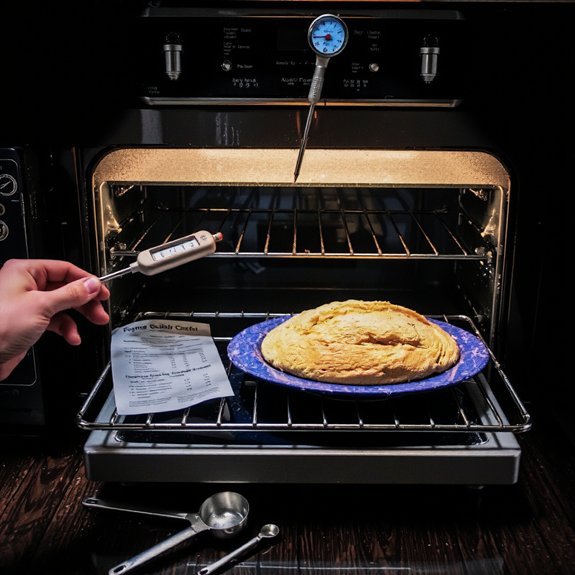
Place it on your working rack, preheat completely, then compare readings. Adjust your set temperature accordingly. This methodical approach guarantees your conversions translate into reliable baking outcomes, giving you the control you deserve.
Tips for Consistent Results Across Different Ovens
Once you’ve calibrated your individual oven, you’ll discover that consistent results across different appliances depend on understanding how each one behaves.
You’re not bound to one machine’s quirks.
Take control by documenting rack positioning for your recipes—center racks typically provide even heat distribution, while upper or lower positions create intentional temperature variations.
You’ll notice that pan material dramatically affects baking outcomes.
Dark steel pans absorb more heat than light aluminum, potentially darkening edges faster.
Adjust your temperature down 25°F when switching from light to dark pans.
Master these variables, and you’ll replicate your best results anywhere.
Test small batches first when using unfamiliar equipment.
Your baking success hinges on this methodical approach to oven independence.
Converting Recipes From International Sources
When you’re adapting recipes from international sources, you’ll need to locate reliable culinary databases and cookbooks that specify Celsius temperatures, which differ notably from the Fahrenheit scales you’re accustomed to using.
Converting these temperatures accurately requires you to apply the formula (°F – 32) × 5/9 = °C, ensuring your oven calibration matches the recipe’s intended heat level.
You must also adjust foreign baking instructions for your specific oven’s performance characteristics, as European and international ovens often operate differently than North American models.
Finding International Recipe Sources
How do you adapt recipes from international cuisines without compromising their intended results? You’ll find authentic sources through culinary archives and regional cookbooks that document traditional techniques and ingredient ratios.
These resources provide the precise measurements and methods you need for accuracy.
Consider these research strategies:
- Consult specialized culinary archives that preserve historical recipes and cultural cooking methods
- Source regional cookbooks written by native cooks who understand local ingredient substitutions
- Cross-reference multiple sources to verify temperature conversions and cooking times
- Identify ingredient availability in your area before committing to recipes
- Document original measurements alongside conversions for future reference
Temperature Conversion Essentials
After you’ve identified authentic recipes and verified ingredient substitutions, you’ll need to master temperature conversion—the technical foundation that separates successful international cooking from inconsistent results.
Understanding unit history clarifies why conversions matter. Fahrenheit scales measure differently than Celsius, requiring precise mathematical translation. You’ll convert using this formula: (°F − 32) × 5/9 = °C.
| Fahrenheit | Celsius | Application |
|---|---|---|
| 350°F | 177°C | Standard baking |
| 375°F | 190°C | Pastries |
| 425°F | 218°C | Bread |
| 475°F | 246°C | High-heat roasting |
Temperature accuracy affects thermal conductivity—how heat penetrates your ingredients. Incorrect conversions compromise texture and doneness. You’ll achieve superior results by respecting these measurements, ensuring your international dishes cook consistently and predictably, granting you complete control over your culinary outcomes.
Adapting Foreign Baking Instructions
Because international recipes often use metric measurements and different oven calibrations, you’ll need to systematize your conversion approach before you begin baking.
When adapting foreign baking instructions, you’re taking control of your culinary independence by mastering cross-cultural techniques.
Start by converting temperatures accurately using the formula (°F × 9/5) + 32.
Address ingredient substitutions based on regional availability and label translations to guarantee precision.
Key considerations:
- Verify oven temperature calibration differences between Fahrenheit and Celsius scales
- Document ingredient substitutions that maintain chemical reactions in your recipes
- Cross-reference label translations for specialty items and weights
- Account for altitude and humidity variations affecting bake times
- Test conversions with small batches before full-scale preparation
Your systematic approach eliminates guesswork, yielding consistent results regardless of recipe origin.
This methodical process empowers you to confidently execute international baking without compromising quality or taste.
Frequently Asked Questions
Does My Oven’s Age or Brand Affect How I Should Adjust Temperature Conversions?
Yes, you’ll want to account for calibration variance across different ovens. Older units often develop heat distribution inconsistencies that newer models avoid.
You shouldn’t rely solely on temperature conversions; instead, invest in an oven thermometer to verify actual internal temperatures. This gives you freedom to adjust independently of your oven’s age or brand, ensuring precise baking results regardless of equipment variables.
Can I Use the Same Conversion Method for Microwave and Convection Cooking?
You can’t apply standard Fahrenheit-to-Celsius conversions uniformly across cooking methods.
Microwaves operate on Microwave Power percentages rather than precise temperatures, making traditional conversions irrelevant.
Convection ovens require you to reduce temperatures by 25°F due to Convection Circulation’s accelerated heat distribution.
You’ve got the freedom to adjust independently—microwaves demand power level adjustments, while convection necessitates temperature reductions for proper results.
What Temperature Conversions Should I Use for Slow Cookers and Dutch Ovens?
You’ll use standard Fahrenheit-to-Celsius conversions for slow cookers and Dutch ovens, converting directly without adjustment.
However, lid impact dramatically affects cooking times—sealed vessels retain heat more efficiently, reducing required duration by 25-50%.
You’re not modifying temperature formulas; you’re accounting for moisture retention and heat distribution.
Lower settings on slow cookers (190-210°F) convert to 88-99°C, while higher settings (280-300°F) equal 138-149°C.
Adjust your cooking times accordingly, not temperatures.
How Do Altitude and Humidity Impact Baking Temperature Conversion Requirements?
You’ll find that altitude and humidity don’t require temperature conversion adjustments themselves, but they’ll demand you modify your technique.
High altitude reduces atmospheric pressure, accelerating leavening behavior and moisture evaporation—you might lower your oven temperature by 15-25°F to prevent over-browning.
Conversely, high humidity increases moisture retention in your batter, potentially requiring slight temperature increases to achieve proper structure development.
You’re ultimately controlling the baking environment’s variables, not the conversion formula itself.
Are There Differences in Conversion Standards Between American and European Ovens?
You’ll encounter significant differences in labeling conventions and terminology differences between American and European ovens.
American ovens use Fahrenheit exclusively, while European models operate in Celsius.
You’re not just converting numbers—you’re maneuvering distinct calibration standards.
European ovens often feature gas mark settings absent in American appliances.
You’ll need to verify your specific oven’s documentation rather than relying on universal conversion formulas, ensuring you’re not compromising your baking results through assumptions.




Leave a Comment