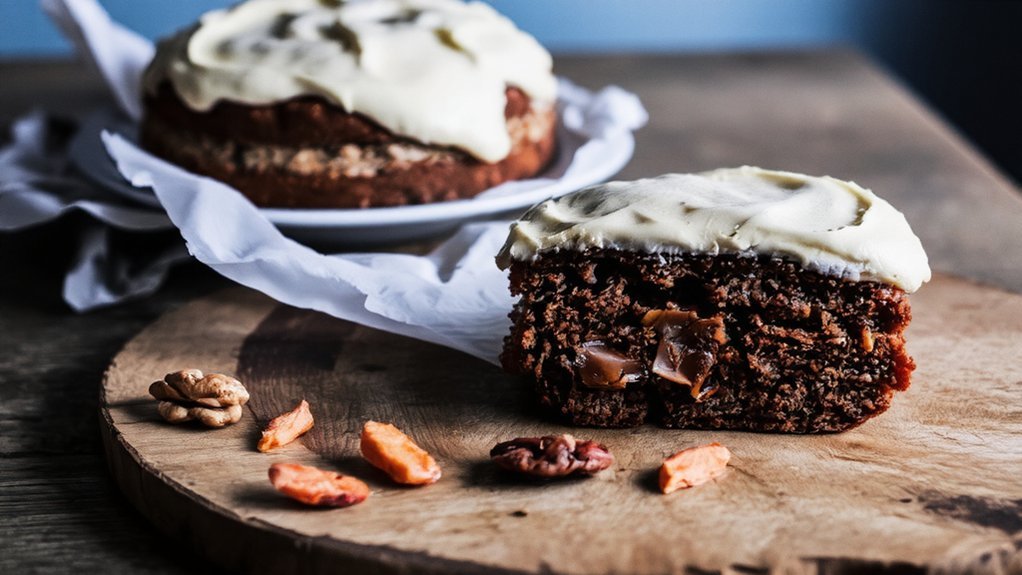

Key Takeaways
- Oil-based batter with crushed pineapple creates naturally moist cake without requiring complex techniques or multiple steps.
- Balanced spice blend of cinnamon, nutmeg, and cloves amplifies carrot sweetness while keeping flavor profile straightforward.
- Cream cheese frosting beats easily when ingredients are room-temperature, yielding smooth, spreadable coating without special equipment.
- Total preparation time takes under two hours including baking, cooling, and frosting for a complete dessert.
- Recipe adapts easily to cupcakes, vegan diets, or tropical variations like coconut flakes with minimal adjustments.
Ingredients You’ll Need
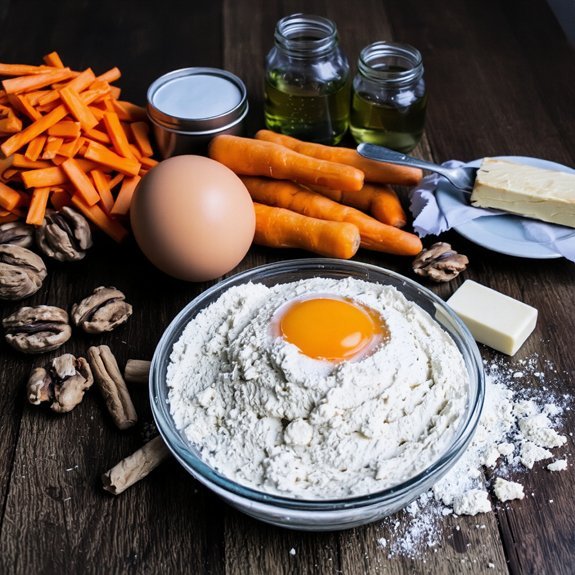
You’ll need just a handful of pantry staples and fresh produce to build this classic dessert.
Start with two cups of all-purpose flour, two teaspoons of baking soda, and one teaspoon of cinnamon—these form your dry foundation.
You’ll want three cups of shredded carrots, one cup of vegetable oil, and one cup of granulated sugar.
Don’t skip the eggs; you’ll need three large ones for binding richness.
For pantry staples, grab baking powder, salt, and vanilla extract.
Fresh pineapple adds moisture and tang, so include one eight-ounce can if you prefer convenience.
Shopping tips: buy pre-shredded carrots to save time, or shred them yourself for superior freshness.
Check expiration dates on your baking soda and powder—they lose potency over time.
Quality ingredients yield superior results, giving you complete control over your dessert’s outcome.
Why This Recipe Works
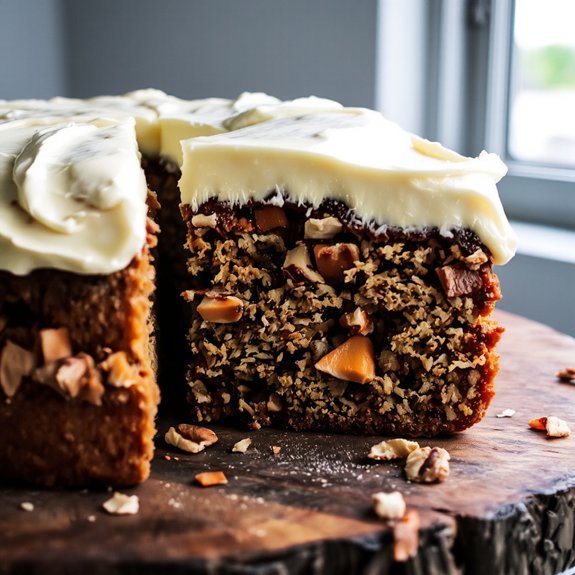
You’ll notice this recipe delivers a moist crumb structure because the oil and crushed pineapple work together to lock in moisture throughout baking.
The balanced spice blend—cinnamon, nutmeg, and cloves—enhances the natural sweetness of carrots without overpowering them.
Top it all off with tangy cream cheese frosting, and you’ve got a dessert that achieves the perfect harmony of flavor and texture.
Moist Crumb Structure
Because oil replaces butter as the primary fat in this carrot cake, it creates an exceptionally tender crumb that stays moist for days.
You’ll notice the difference immediately—this cake won’t dry out on your countertop like traditional butter-based versions.
Oil contributes superior crumb aeration during mixing, allowing you to achieve a lighter, more delicate texture throughout.
The fat molecules distribute evenly, promoting consistent crumb elasticity that bounces back when you press your finger into a slice.
You’re not sacrificing flavor either.
The oil acts as a moisture barrier, sealing in hydration from the carrots and pineapple while allowing the spices to shine.
This approach gives you genuine freedom from constant refrigeration, so you can enjoy fresh cake whenever you want it.
Balanced Spice Blend
The magic of carrot cake lies in how cinnamon, nutmeg, and cloves work together to amplify rather than overpower the cake’s natural sweetness.
You’ll discover that these warm spices create distinct aroma profiles—cinnamon provides comfort and familiarity, nutmeg adds earthiness, and cloves deliver subtle heat.
Understanding pairing principles guarantees you’re not constrained by convention.
You can confidently adjust ratios based on your preferences without sacrificing balance.
The key is using quality spices in proper proportions: typically one and a half teaspoons cinnamon, half a teaspoon nutmeg, and quarter teaspoon cloves per standard recipe.
This measured approach respects your cake’s integrity while letting you exercise creative control.
You’re not following rigid rules—you’re mastering technique that empowers your baking freedom.
Cream Cheese Frosting
Balancing cream cheese‘s tangy bite with butter’s richness creates the perfect frosting counterpoint to spiced carrot cake.
You’ll appreciate how this classic pairing evolved from culinary history, transforming simple ingredients into an iconic topping.
Your frosting succeeds when you understand its key components:
- Cream cheese provides authentic tang and structure that commercial production standardized in the 1970s
- Butter adds luxurious mouthfeel and prevents excessive density
- Powdered sugar delivers sweetness without grittiness
- Vanilla extract enhances depth without overpowering spices
You’re choosing independence from store-bought alternatives by making this yourself.
The slight sourness cuts through the cake’s richness, preventing cloying sweetness.
Room-temperature ingredients emulsify seamlessly, creating silky texture.
This frosting doesn’t just coat—it elevates your entire dessert experience with sophisticated contrast.
Step-by-Step Instructions
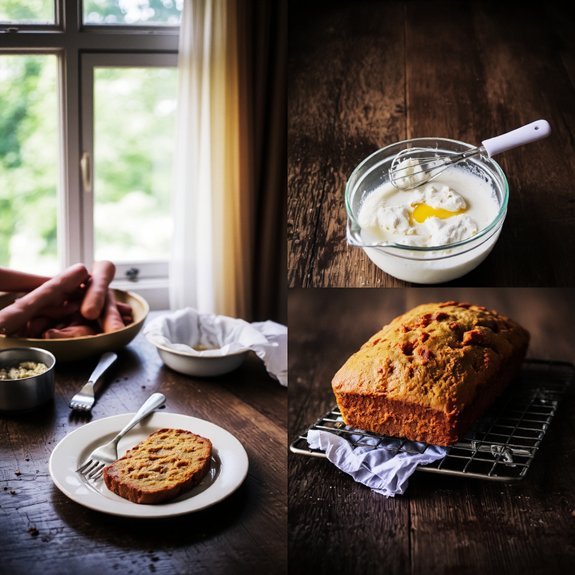
Gather your ingredients and preheat your oven to 350°F—you’ll want everything ready before you start mixing.
Gather your ingredients and preheat your oven to 350°F—everything should be ready before you start mixing.
Follow this numbered checklist: combine flour, baking soda, salt, and spices in a bowl.
In another, whisk oil, eggs, and sugar until smooth.
Fold the dry mixture into the wet ingredients, then stir in grated carrots and crushed pineapple.
Pour batter into greased pans and bake for 35-40 minutes until a toothpick comes out clean.
Use this visual timeline to track your progress: prep takes five minutes, mixing requires ten, baking demands 40, and cooling needs two hours.
Don’t rush the cooling phase—it’s essential for frosting application.
Once completely cooled, you’re ready to spread that cream cheese frosting generously across every layer, creating your masterpiece.
Baking Tips for Success
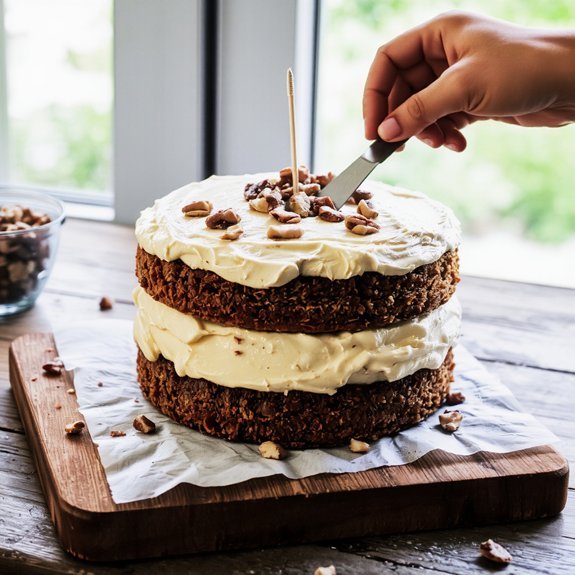
How do you make sure your carrot cake rises evenly and bakes through without drying out? Master these essential techniques:
- Calibrate your oven—invest in an oven thermometer to verify accurate temperature readings; ovens frequently run hot or cold, affecting baking results
- Make altitude adjustments —if you’re baking above 3,000 feet, increase oven temperature by 25°F and reduce baking time slightly
- Use room-temperature ingredients —they combine smoothly, creating a uniform batter that bakes consistently
- Fill pans evenly —distribute batter equally for level rising
Don’t open the oven door during baking; you’ll lose heat and cause uneven cooking.
Position your racks in the center for ideal air circulation.
These straightforward adjustments give you complete control over your baking outcome, ensuring a moist, perfectly risen carrot cake every single time.
Making the Cream Cheese Frosting
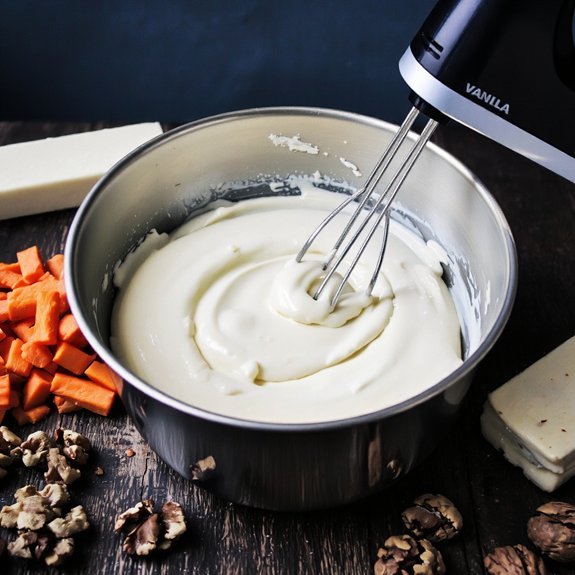
You’ll need cream cheese, butter, powdered sugar, vanilla extract, and a pinch of salt to craft the perfect frosting for your carrot cake.
Beating these ingredients together until you’ve achieved a smooth, fluffy consistency helps your frosting spreads easily and adheres beautifully to each layer. Once you’ve mastered the mixing technique, you’re ready to apply the frosting with confidence and precision.
Ingredients You’ll Need
The cream cheese frosting that’ll crown your carrot cake demands just a handful of quality ingredients: 8 ounces of softened cream cheese, ½ cup of butter at room temperature, 2 cups of powdered sugar, 1 teaspoon of vanilla extract, and a pinch of salt.
You’ll find these staples at any grocery store.
Smart shopping tips’ll help you maximize your budget. Consider these budget ingredients strategies:
- Buy store-brand cream cheese and butter for significant savings
- Purchase powdered sugar in bulk during sales
- Choose vanilla extract wisely—pure costs more but stretches further
- Stock salt from your pantry rather than buying specialty varieties
Quality doesn’t require premium pricing.
You’ve got the freedom to choose affordable options without compromising your frosting’s rich, tangy flavor. These straightforward ingredients combine seamlessly, creating that luscious coating your carrot cake deserves.
Mixing and Application
Once your ingredients reach room temperature, you’re ready to craft frosting that’ll transform your carrot cake into something truly special.
Start by beating softened cream cheese with an electric mixer until it’s smooth and creamy—this is essential for eliminating lumps.
Your tool selection matters here; a sturdy hand mixer or stand mixer works best.
Next, add softened butter and beat until fully incorporated.
Gradually introduce powdered sugar, mixing on low speed to prevent clouds of powder from escaping.
Don’t rush this mixing order; patience guarantees a silky texture.
Finally, add vanilla extract and a pinch of salt.
Beat everything together until you’ve achieved a light, fluffy consistency.
This frosting spreads easily and creates that luxurious coating your carrot cake deserves.
Storage and Serving Suggestions
Proper storage’ll keep your carrot cake moist and delicious for days, whether you’ve frosted it or not.
Store your cake in an airtight container at room temperature for up to three days, or refrigerate it for extended freshness.
For long-term preservation, consider these storage methods:
- Refrigerate frosted cake for up to one week in an airtight container
- Freeze unfrosted layers up to three months for maximum flexibility
- Freezing slices individually wrapped lets you enjoy portions on demand
- Gift packaging in clear containers makes impressive presents for friends and family
When serving, bring refrigerated cake to room temperature for ideal flavor and texture.
Cut clean slices using a hot, wet knife.
Pair your cake with coffee or tea for a satisfying treat that delivers genuine homemade quality you’ll treasure.
Variations to Try
While classic carrot cake’s delicious on its own, you can easily customize it to match your preferences and dietary needs.
For a vegan adaptation, swap eggs for applesauce and use plant-based butter and milk alternatives—you’ll achieve the same moist texture without compromise.
Transform your cake into mini cupcakes for convenient portion control and entertaining.
Simply adjust baking time to 18-20 minutes, and you’re done.
Consider adding crushed pineapple for extra moisture and subtle tanginess, or incorporate coconut flakes for tropical flair.
Spice enthusiasts should experiment with additional ginger or cardamom.
For those seeking richness, cream cheese frosting remains the gold standard, though you can lighten it with Greek yogurt.
These variations let you take ownership of your baking, creating a carrot cake that’s authentically yours.
Frequently Asked Questions
Can I Make Carrot Cake Without Oil or Butter for a Healthier Version?
You can absolutely create a healthier carrot cake by ditching oil and butter. Swap them out with applesauce substitute for moisture and richness without the fat.
Pumpkin puree works equally well, adding natural sweetness and density. Both options let you control your ingredients completely—no compromises on flavor or texture.
You’re free to enjoy indulgent cake while maintaining your health goals. These substitutions deliver tender crumb and satisfying taste, proving that liberation from traditional fats doesn’t mean sacrificing quality.
How Do I Know When the Carrot Cake Is Fully Baked Through?
You’ll know your carrot cake’s done when you insert a toothpick into the center and it emerges clean or with just a few moist crumbs clinging to it.
Don’t settle for guessing—check the internal temperature with a reliable thermometer, aiming for 205-210°F.
You’ve earned the freedom to bake confidently. That perfect golden exterior combined with these foolproof tests guarantees you’ll serve a magnificently moist, fully-baked cake every time.
What’s the Difference Between Carrot Cake and Pineapple Upside-Down Cake?
You’ll find these cakes differ fundamentally in their historical origins and presentation styles.
Carrot cake’s roots trace back to medieval times as a vegetable-forward dessert, while pineapple upside-down cake emerged during the canned fruit boom of the early 1900s.
You’ll notice carrot cake features a cream cheese frosting crown, whereas you flip the pineapple version to showcase caramelized fruit on top.
Both deliver moisture and richness, but they’re distinctly different experiences.
Can I Use Baby Food Carrots Instead of Freshly Grated Carrots?
You can substitute baby food carrots, though you’ll notice a texture comparison that’ll affect your cake’s outcome.
Baby food carrots lack the fibrous structure of fresh-grated ones, resulting in a denser, mushier crumb.
The flavor impact shifts too—you’ll lose that fresh, earthy punch and get something more muted and processed-tasting.
For superior results that give you full control over your baking, stick with freshly grated carrots.
Why Does My Carrot Cake Sometimes Turn Out Dry or Dense?
Your carrot cake turns dry or dense when you’re overmixing batter—you’ll develop too much gluten, creating a tough crumb.
Watch your flour measurement too; you’ve gotta be precise. Use a kitchen scale instead of cups for accuracy.
Mix just until ingredients combine, don’t beat it into submission.
Overmixing destroys the tender texture you’re after. Measure carefully, mix minimally, and you’ll nail that moist, fluffy cake every time.


Leave a Comment