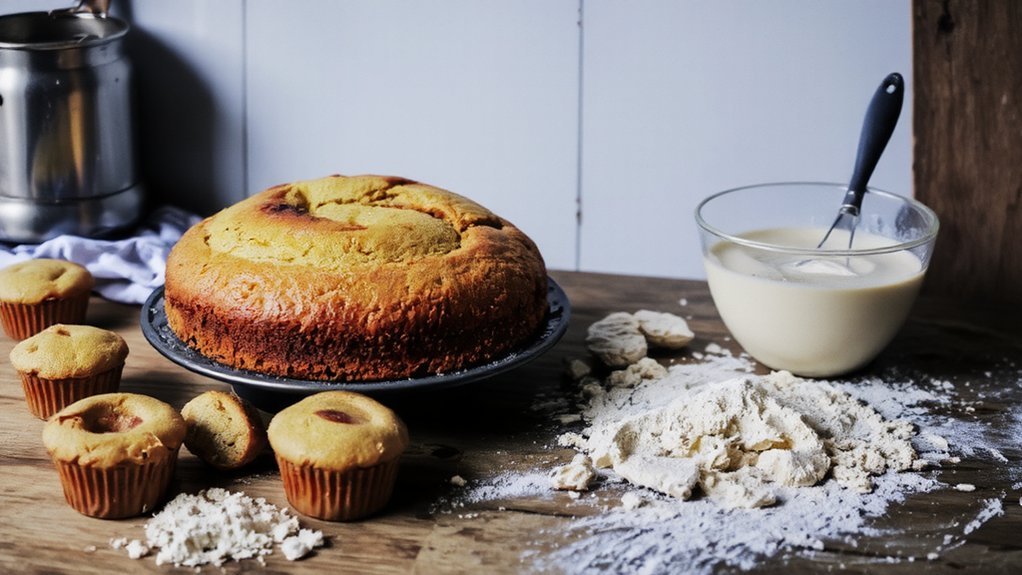

Key Takeaways
- Use a digital scale or spoon-and-level method to measure flour accurately; volume measurements vary widely and cause inconsistent results.
- Mix batter only until just combined to prevent excessive gluten development, which creates tough, dense crumb and tunneling.
- Calibrate your oven monthly with a thermometer; even 25-degree variances substantially alter browning, rise, and texture.
- Cool baked goods on wire racks for 15–30 minutes before wrapping; trapping steam causes soggy exteriors and structural collapse.
- Check leavening agent freshness by mixing with vinegar; vigorous fizzing indicates potency; replace annually if minimal bubbling occurs.
Not Reading the Recipe Thoroughly
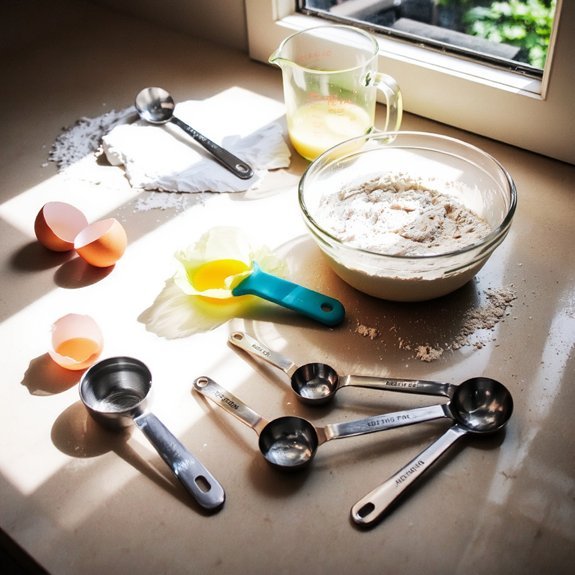
Before you’ve even preheated your oven, you’ve likely already made your first mistake if you haven’t read the entire recipe from start to finish.
Skipping this critical step leaves you vulnerable to costly errors that’ll compromise your results.
Reading thoroughly guarantees you’re aware of all ingredients, including potential allergens for allergy awareness purposes.
You’ll identify specialized equipment needs upfront, establishing proper tool familiarity before you begin mixing.
This prevents mid-bake discoveries that you’re missing essential tools or ingredients.
You’ll also understand timing requirements, temperature adjustments, and technique-specific instructions that aren’t immediately obvious.
Recipes contain vital details about resting periods, folding methods, and cooling procedures that directly impact texture and structure.
Take control of your baking outcomes.
Read completely first.
Execute confidently second.
Ignoring Ingredient Temperatures
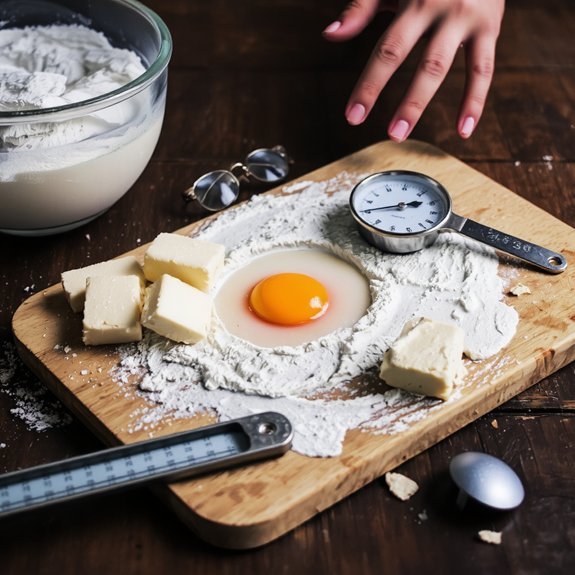
While you’re meticulously measuring flour and sugar, you might overlook a factor that fundamentally affects your bake’s success: ingredient temperature.
Room-temperature butter, eggs, and dairy don’t just mix better—they’re essential for proper emulsification and structure. Cold ingredients create thermal shock, preventing uniform batter consistency and resulting in dense, uneven crumbs.
Room-temperature ingredients are essential for proper emulsification and structure, preventing dense, uneven crumbs from thermal shock.
You’ll compromise flavor retention when temperatures fluctuate, as chemical reactions during baking require ideal starting conditions. Precision matters. Warm ingredients dissolve sugars efficiently, allowing flavors to distribute evenly throughout your batter.
Cold chocolate seizes; cold cream won’t whip properly. You’re not bound by arbitrary rules—understanding the science empowers you to troubleshoot problems independently.
Check your ingredients thirty minutes before baking. This small discipline transforms mediocre results into consistently excellent bakes, giving you control over outcomes rather than accepting disappointing failures.
Measuring Ingredients Incorrectly
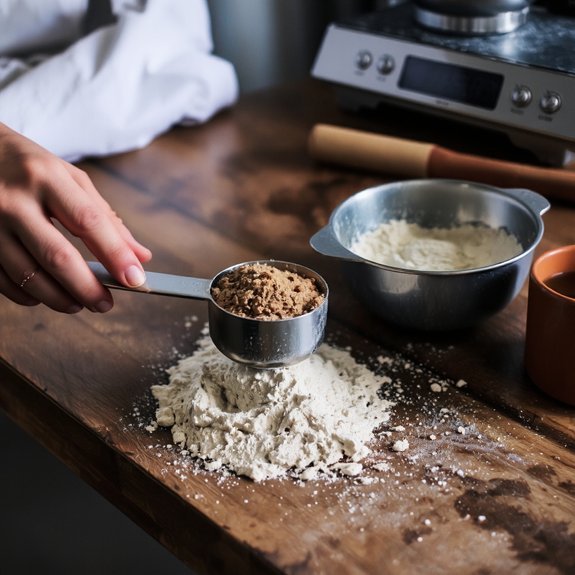
You’ve prepared your ingredients at the correct temperature, but now you’re facing an equally critical challenge: measuring them accurately. Imprecise measurements undermine your baking freedom and compromise results.
- Avoid the scoop-and-level method; it compacts flour inconsistently
- Use spoon leveling by spooning flour into measuring cups, then leveling with a knife
- Invest in a digital scale for scale accuracy; weight measurements eliminate guesswork
- Don’t pack dry ingredients; let them settle naturally before measuring
By-volume measurements vary considerably based on technique.
A cup of flour can weigh anywhere from 120 to 150 grams depending on how densely it’s packed.
Scales provide objective, reproducible precision that guarantees consistent outcomes across every bake.
Abandon approximation—embrace accuracy.
Overmixing the Batter
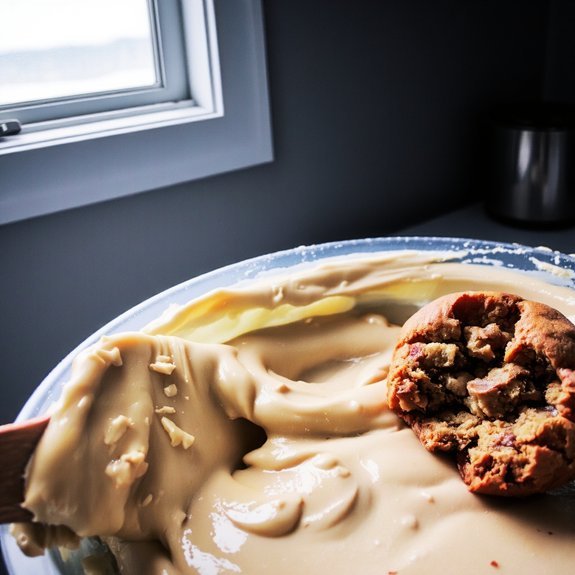
When you overmix your batter, you’re activating excessive gluten development, which creates a tough, dense crumb structure instead of the tender, airy texture you’re after.
This over-activation of gluten proteins causes them to link together too extensively, trapping moisture and resulting in a final product that’s heavy and compact rather than light and fluffy.
You’ll notice the difference immediately in your baked goods’ texture—what should’ve been delicate becomes chewy and cake-like in all the wrong ways.
Gluten Development Problems
Excessive mixing activates gluten proteins, causing them to form tight, interconnected networks that trap moisture and create an undesirably dense, tough crumb structure.
You’re practically engineering a textural failure when you overwork your dough or batter.
Here’s what happens during overmixing:
- Gluten strands elongate and cross-link excessively, restricting rise potential
- Protein content becomes over-developed, requiring more hydration than your recipe provides
- Salt interaction with gluten accelerates network formation, intensifying toughness
- Trapped air bubbles compress under tension, preventing proper expansion during baking
You’ll notice the consequences immediately: your cakes become rubbery, muffins turn gritty, and bread develops an impenetrable crust.
Control your mixing duration carefully.
You’ve got the freedom to achieve tender, moist results—just respect your ingredients’ limits.
Texture and Crumb Structure
Overmixing batter fundamentally compromises crumb structure by disrupting the delicate balance between gluten development and air incorporation. When you overmix, you’re creating excessive gluten networks that trap air bubbles irregularly, resulting in dense, gummy textures rather than the light, open crumb you’re after. This aggressive mixing also accelerates starch gelatinization prematurely, preventing proper moisture distribution during baking.
| Problem | Cause | Solution |
|---|---|---|
| Dense crumb | Excessive gluten strands | Mix until just combined |
| Tunneling | Uneven air pockets | Fold gently, don’t beat |
| Gummy texture | Over-hydrated gluten | Use minimal mixing strokes |
You’ll want to mix only until ingredients incorporate—typically 10-15 seconds for most batters. This restraint preserves your freedom to achieve superior texture and structure that separates artisanal baking from mediocre results.
Opening the Oven Door Too Early
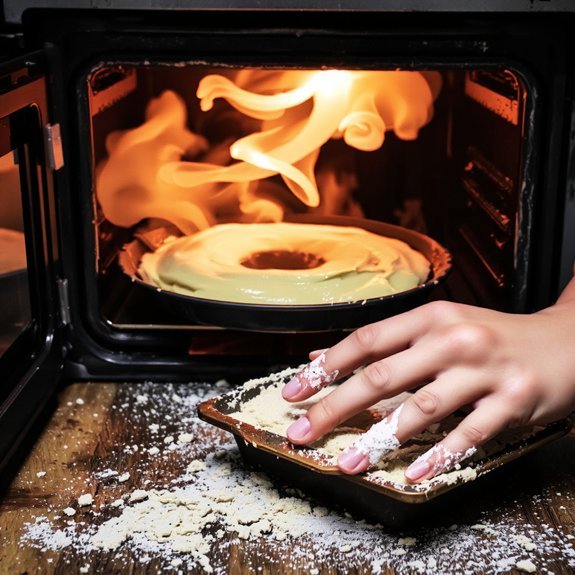
Every time you crack open that oven door during baking, you’re disrupting the carefully calibrated environment your baked goods need to rise and set properly.
Cracking open your oven door disrupts the calibrated environment your baked goods need to rise and set properly.
Temperature drops rapidly, destabilizing your creation’s structure and causing uneven baking.
Key consequences of premature door opening include:
- Moisture redistribution that collapses delicate crumbs
- Rapid temperature fluctuations preventing proper rise
- Visual cues deceiving you into checking before completion
- Structural collapse in custards, soufflés, and breads
You’ll compromise your final product’s texture and consistency.
Instead, resist the urge to peek until the final minutes.
Trust your recipe’s timing and use your oven’s window if available.
This discipline guarantees you maintain the stable thermal environment necessary for ideal results and gives you control over your baking outcomes.
Using Expired Leavening Agents
You’ll want to check your baking soda and baking powder for signs of expiration, such as clumping, discoloration, or a stale smell, as these indicate reduced potency. When you use expired leavening agents, your baked goods won’t rise properly, resulting in dense, flat products with poor texture and an undesirable crumb structure.
To guarantee reliable results, you should replace these ingredients annually and store them in airtight containers away from moisture and heat.
Signs of Expired Leavening
How can you tell if your baking soda or baking powder‘s lost its potency?
You’ll want to inspect them regularly before committing to your baking projects.
Here’s what to watch for:
- Clumpy texture — Moisture absorption causes hardened formations that indicate degradation
- Musty odor — Stale or off-putting smells signal chemical breakdown
- Age beyond expiration — Check dates; baking soda lasts indefinitely when dry, but powder typically expires within 18 months
- Failed reactivity test — Mix a small amount with vinegar; vigorous fizzing indicates freshness; minimal bubbling means replacement is necessary
Don’t compromise your baking independence by using compromised leavening agents.
Replace them immediately when you notice these warning signs.
Your results depend on active, responsive ingredients that’ll give you the rise and texture you’re after.
Trust your senses and stay vigilant about ingredient quality.
Impact on Baked Goods
When you use expired leavening agents, your baked goods won’t rise properly because the chemical compounds that create lift have degraded or lost their reactive capacity.
You’ll notice dense, flat results—cakes that don’t spring up and breads that remain heavy and compact.
Expired baking powder or soda won’t generate adequate carbon dioxide, the gas essential for structure and volume.
Your batter simply won’t expand during baking, compromising texture and crumb quality.
This becomes especially critical when you’re making altitude adjustments, where proper leavening becomes even more vital for success.
Beyond appearance, expired agents affect taste and mouthfeel.
You’re left with subpar products that waste ingredients and time.
Proper equipment maintenance—storing leavening agents in cool, dry conditions and checking expiration dates—prevents these failures.
Take control of your baking outcomes by ensuring your leavening agents remain fresh and potent.
Not Preparing Your Pans Properly
Because baked goods can’t release from poorly prepared surfaces, proper pan preparation is essential to achieving consistent results.
You’ll encounter predictable failures when you neglect this critical step.
Improper greasing leaves residue that compromises texture and appearance.
Parchment placement errors cause sticking and uneven browning.
Here’s your preparation protocol:
- Apply a thin, even grease layer using butter or oil
- Dust with flour, cocoa powder, or cornstarch for non-stick reinforcement
- Line with parchment paper, pressing firmly into corners
- Trim excess parchment to prevent charring
You’re not limited by inferior results when you command your baking environment.
Take control by prepping pans thoroughly before mixing batters.
This foundational practice directly impacts your final product’s structural integrity and presentation quality, ensuring you achieve the professional outcomes you deserve.
Baking at the Wrong Temperature
You’ll find that oven calibration matters most when achieving consistent baking results, as even a 25-degree variance can substantially alter browning, rise, and texture.
Temperature effects on your final product range from underbaked centers and pale crusts at insufficient heat to burnt exteriors and dry interiors when you’ve overheated your oven. Investing in an oven thermometer helps you verify your oven’s actual temperature against its dial setting, ensuring you’re baking at the precise heat your recipes demand.
Oven Calibration Matters Most
One of the most critical yet frequently overlooked variables in baking is oven temperature accuracy.
You’ll discover that even a 25-degree variance ruins your results, so don’t neglect this essential step.
Here’s what you need to know about maintaining peak performance:
- Invest in an oven thermometer for precise readings independent of your oven’s built-in display
- Check calibration frequency monthly, especially if you bake regularly
- Position your probe placement at the center rack where you’ll actually bake
- Recalibrate after any appliance service or malfunction
You’re taking control of your baking destiny when you prioritize calibration.
This straightforward practice eliminates guesswork, guarantees consistent results, and prevents wasted ingredients.
Your independence in the kitchen depends on understanding your equipment’s true capabilities rather than trusting potentially faulty factory settings.
Temperature Effects on Results
Now that you’ve confirmed your oven’s actual temperature, understanding how even small deviations from your recipe’s specified heat affect your baked goods becomes the next frontier.
Temperature directly controls Maillard reactions—the chemical process that creates browning and complex flavors—and sugar caramelization, which develops color and taste complexity.
Baking too cool yields pale, dense results with underdeveloped flavor profiles.
Conversely, excessive heat accelerates these reactions unevenly, burning exteriors while leaving interiors undercooked.
You’ll notice cakes crack, cookies spread excessively, or breads develop thick, dark crusts prematurely.
Precision matters because each degree shift alters moisture evaporation rates and protein coagulation timing.
Master temperature control, and you’ll gain consistent, predictable outcomes that reflect your true baking capability.
Substituting Ingredients Without Consideration
Because baking relies on precise chemical reactions between ingredients, swapping components without understanding their functional properties can compromise your results.
You’ll want to approach substitutions strategically to maintain structural integrity and flavor balance.
Consider these critical factors:
- Binding capacity – Eggs provide moisture and structure; replacing them requires understanding how alternatives affect texture
- Leavening function – Baking soda and powder create lift differently; incorrect substitutions collapse your baked goods
- Fat ratios – Oils, butter, and shortening behave distinctly; mismatched amounts yield greasy or dry results
- Allergy swaps – Specialty substitutions demand precision; gluten-free or dairy-free alternatives need additional adjustments
You’re responsible for understanding how each ingredient contributes to your final product. Don’t assume one-to-one replacements work universally. Research thoroughly before experimenting, or you’ll waste ingredients and time on failed batches.
Rushing the Cooling Process
Cooling represents a critical—yet frequently overlooked—stage where your baked goods establish their final structure and texture. You can’t skip this phase without consequences.
When you rush cooling, you’re compromising your product’s integrity. Premature wrapping traps steam inside, creating condensation buildup that softens crusts and ruins texture. You’ll sabotage your results unnecessarily.
| Issue | Result |
|---|---|
| Wrapping warm baked goods | Soggy exterior, loss of crispness |
| Skipping cooling racks | Trapped moisture underneath |
| Condensation buildup | Structural collapse, texture degradation |
| Moving items too early | Cracks, uneven settling |
Allow your creations adequate cooling time—typically 15-30 minutes on wire racks—before wrapping or storing. This patience guarantees proper moisture evaporation and structural stability. You’re investing in quality results that justify the wait.
Frequently Asked Questions
How Can I Tell if My Baking Soda and Baking Powder Are Still Fresh?
You’ll perform freshness tests by adding baking soda to vinegar—it should fizz vigorously. For baking powder, mix it with hot water; you’ll observe immediate bubbling.
An activation check reveals potency: expired leavening agents won’t produce robust reactions. Store both in airtight containers away from moisture and heat.
Replace annually for best results. These simple tests empower you to maintain baking quality and guarantee your creations rise properly, giving you complete control over your baking outcomes.
What’s the Best Way to Store Baking Ingredients for Maximum Freshness?
You’ll maximize ingredient freshness by storing everything in airtight containers that you keep in cool, dark pantry spaces.
Control humidity meticulously—moisture degrades baking soda, baking powder, and flour rapidly.
Use opaque, sealed containers that prevent light exposure and air infiltration.
Label each container with purchase dates so you’re never guessing shelf life.
This approach gives you complete autonomy over your baking quality and ingredient reliability.
Can I Use Room Temperature Eggs Instead of Cold Eggs in Recipes?
You can absolutely use room temperature eggs, and you’ll actually get better results. Room temperature eggs won’t whip volume as efficiently as cold eggs, but they’ll create superior emulsion stability when you’re mixing batters.
Your ingredients blend more uniformly at warmer temperatures, reducing separation issues. You’ve got the freedom to choose based on your recipe’s demands—cold eggs work for meringues, while room temperature eggs excel in cake batters and custards where you need robust, stable emulsions.
How Do I Know When My Baked Goods Are Completely Cooled?
You’ll know your baked goods are completely cooled when you can’t feel any warmth from the Touch Test—your hand should remain comfortable against the surface.
For precision, use a Thermometer Reading to confirm the internal temperature matches room temperature, typically 68-72°F.
Don’t rush this process; cooling completely guarantees you’re free from structural collapse, frosting melting, or moisture loss. Patience gives you superior results.
Why Does My Cake Sink in the Middle After Baking?
Your cake sinks because you’re likely overmixing your batter, which deflates air pockets and weakens gluten structure.
Additionally, verify your oven temperature’s accuracy with a reliable thermometer—inconsistent heat causes uneven rising and collapse.
You’ve got the power to control these variables. Underbaking also contributes to this problem. Take charge by measuring ingredients precisely, mixing only until combined, and baking at the exact temperature your recipe demands.

Leave a Comment