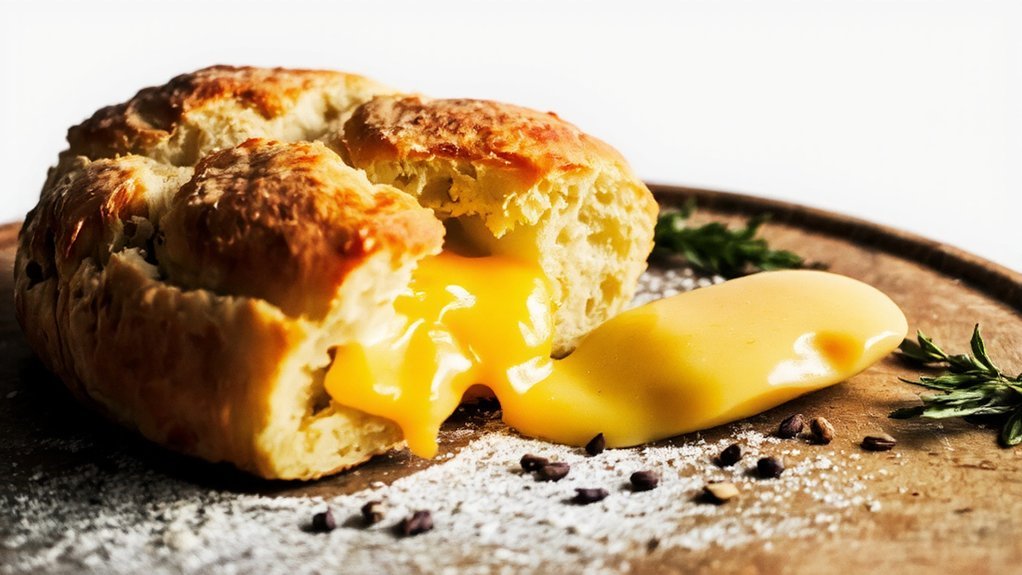

Key Takeaways
- Combine 2 cups all-purpose flour, 2¼ teaspoons active dry yeast, ¾ cup whole milk, 3 tablespoons butter, 1 tablespoon sugar, and 1½ teaspoons salt.
- Mix dough 8–10 minutes until gluten develops, then fold in 1½ cups sharp cheddar cheese (diced into ¼-inch cubes) during final minute.
- Preheat oven to 375°F; bake on preheated baking stone for 25–30 minutes until golden brown and internal temperature reaches 190–210°F.
- Use room-temperature ingredients, weigh flour with a scale for consistency, and select aged cheeses without cellulose to prevent clumping and enhance flavor.
- Cool baked loaf on wire rack 15 minutes before slicing; store in airtight containers or freeze up to three months at 0°F.
Ingredients You’ll Need
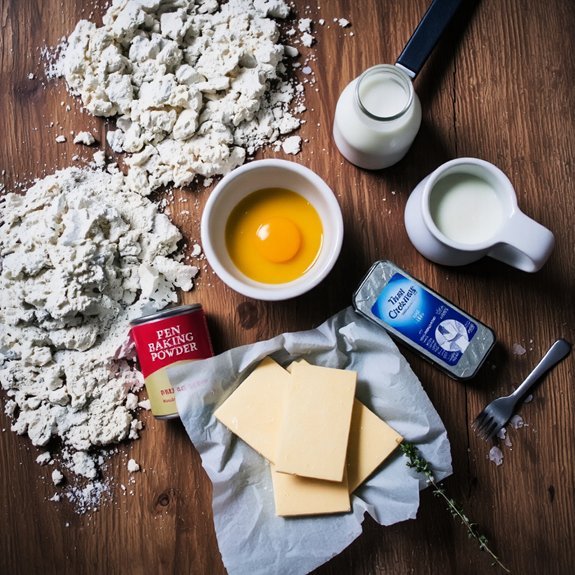
You’ll need all-purpose flour (2 cups), active dry yeast (2¼ teaspoons), whole milk (¾ cup), unsalted butter (3 tablespoons), kosher salt (1½ teaspoons), granulated sugar (1 tablespoon), shredded sharp cheddar cheese (1½ cups), and an egg (1 large) for the egg wash.
When sourcing your ingredients, prioritize high-quality cheese from reputable suppliers for superior flavor development.
Quality cheese sourced from reputable suppliers elevates flavor development and transforms your homemade bread into something truly exceptional.
Your ingredient sourcing directly impacts the final product’s texture and taste profile.
The nutritional breakdown reveals approximately 280 calories per serving, with protein content enhanced by the cheddar cheese.
You’ll achieve ideal gluten development through precise flour measurement and proper hydration ratios.
The yeast-to-flour ratio guarantees adequate fermentation without over-proofing.
Butter contributes richness while salt regulates fermentation speed and enhances flavor perception.
This formulation grants you complete control over your bread’s composition and nutritional composition.
Step-by-Step Instructions
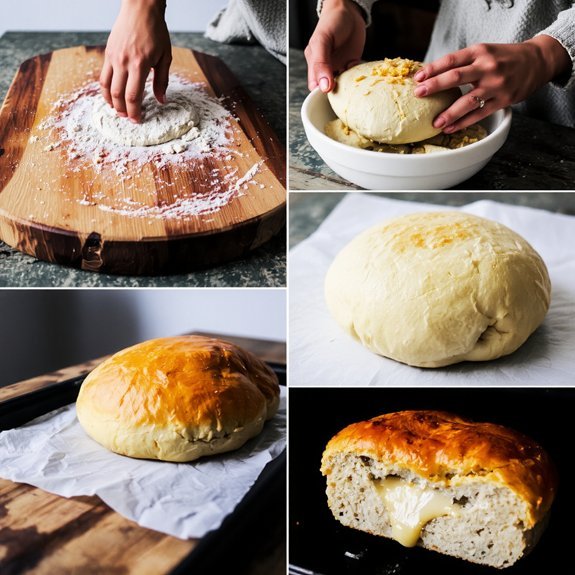
You’ll begin by prepping your ingredients—measure out 2 cups of all-purpose flour, 1 tablespoon of active dry yeast, 1 teaspoon of salt, and 1.5 cups of shredded cheddar cheese to guarantee accurate incorporation.
Next, you’ll combine your dry ingredients in a mixing bowl, then gradually incorporate your wet components while mixing on medium speed until you achieve a cohesive dough.
Finally, you’ll monitor your oven temperature at 375°F and allow your cheese bread to bake for 25-30 minutes until the crust reaches a golden-brown exterior and an internal temperature of 190°F.
Preparing Your Ingredients
Gathering and measuring your components before mixing guarantees accuracy and streamlines the baking process.
Establishing proper mise en place—your organized workspace—empowers you to bake without interruptions or mistakes.
Begin by assembling these essentials:
- Sharp knife skills for uniformly dicing two cups of mozzarella cheese, ensuring even melting throughout your loaf
- Precise measurements of 3½ cups bread flour, 1½ teaspoons salt, and 2¼ teaspoons instant yeast for chemical accuracy
- Room-temperature ingredients—one cup water and three tablespoons olive oil—guaranteeing ideal dough development
Weigh your flour using a scale rather than cups for consistency.
Dice your cheese into ¼-inch cubes, preventing clumping.
Arrange all ingredients within arm’s reach before commencing.
This preparation method eliminates guesswork, allowing you complete control over your baking outcome.
You’re now positioned for success.
Baking and Timing
With your ingredients properly prepared and arranged, it’s time to move into the mixing and baking phases where precise timing determines your bread’s final texture and flavor development.
Preheat your oven to 375°F, allowing it to reach full temperature for even heat distribution.
Mix your dough for 8-10 minutes until gluten development occurs, then fold in cheese during the final minute.
Place your loaf on a preheated baking stone and bake for 28-32 minutes until golden brown.
Account for ambient humidity and altitude adjustments, which affect moisture content and rising times.
Check internal temperature—it should reach 205-210°F at the center.
Remove from heat and cool on a wire rack for 15 minutes before slicing to preserve structural integrity.
Tips for Perfect Cheese Bread
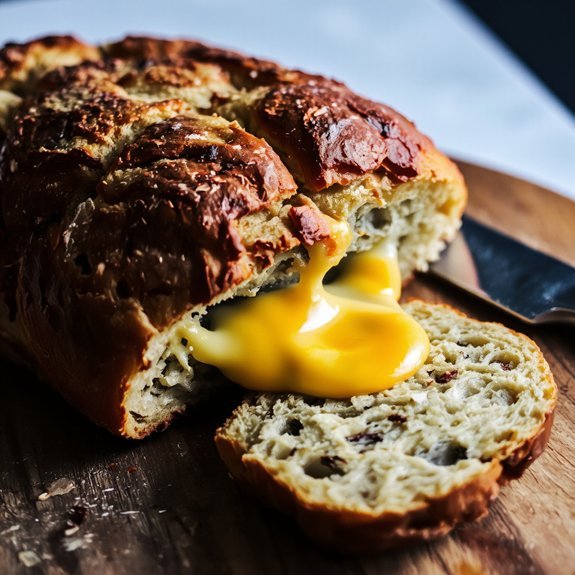
To achieve ideal results, you’ll want to focus on three critical variables: dough hydration, cheese selection, and oven temperature calibration.
These factors directly impact your bread’s texture, flavor profile, and structural integrity.
Consider these essential techniques:
- Maintain precise dough hydration at 65-70% to guarantee peak gluten development and an open crumb structure that showcases your cheese distribution
- Select aged cheeses with higher melting points to prevent excessive grease separation and maintain flavor complexity throughout baking
- Preheat your oven to 450°F minimum to achieve proper crust caramelization and interior steam expansion
For allergy accommodations, substitute dairy cheese with nutritional yeast blends.
Make nutrition tweaks by incorporating whole grain flours at 20-30% ratios.
You’ll control every variable, crafting bread that reflects your standards and dietary preferences without compromise.
Cheese Selection and Variations
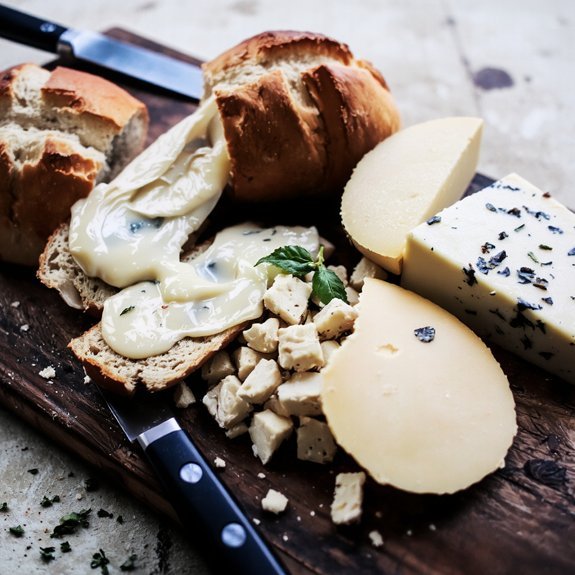
Why does your cheese choice make or break cheese bread?
You’ll achieve superior results by selecting cheeses with complementary texture profiles.
Mozzarella provides stretch and elasticity, while cheddar delivers sharp flavor depth.
Combining milk origins—cow, goat, or buffalo—creates complexity you can’t achieve with single-source cheese.
For ideal outcomes, use aged varieties containing 35-40% moisture content.
Fresh mozzarella won’t bind effectively; instead, opt for low-moisture alternatives.
Incorporate Parmesan at 15-20% of your cheese blend for umami richness and browning acceleration.
You maintain complete control over your bread’s final character.
Experiment with asiago for nuttiness or fontina for creaminess.
Avoid pre-shredded varieties containing cellulose; they prevent even melting.
Your freedom to innovate creates endless variations—try smoked gouda or aged gruyère for distinctive profiles that elevate standard recipes.
Storage and Reheating Guide
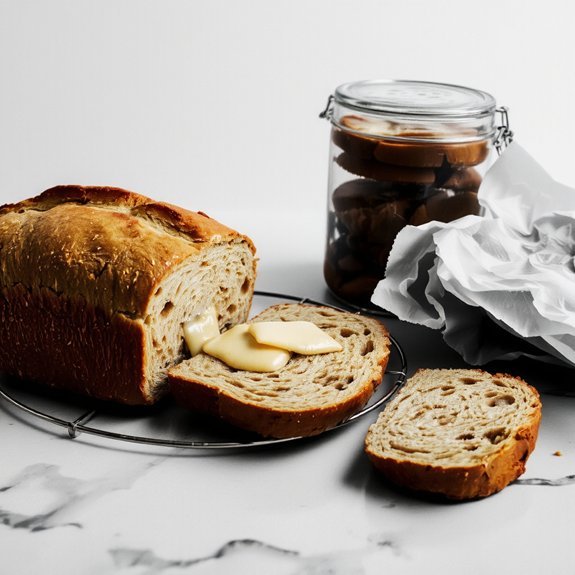
You’ll want to store your cheese bread in an airtight container or resealable freezer bag to maintain moisture and prevent freezer burn during extended storage.
For best results, you should freeze baked cheese bread at 0°F or below for up to three months, then thaw it at room temperature for approximately 30-45 minutes before reheating.
You can restore your bread’s texture by reheating it wrapped in foil at 350°F for 10-15 minutes, or microwaving individual portions for 30-60 seconds until the cheese reaches the desired temperature.
Proper Container Selection
Selecting the right storage container directly impacts your cheese bread’s shelf life and reheating quality.
You’ll want to prioritize material durability and shape ergonomics when choosing your vessel.
Consider these essential factors:
- Airtight glass containers preserve moisture while preventing freezer burn—giving you complete control over freshness duration
- Food-grade plastic with secure sealing mechanisms maintains structural integrity during repeated temperature fluctuations
- Aluminum foil-lined cardboard boxes offer superior insulation, protecting your bread’s texture from oxidation
Opt for containers with dimensions matching your bread’s proportions.
This eliminates unnecessary air pockets that compromise quality.
Hard-sided options outperform soft materials because they resist deformation under pressure.
Select containers you’ll actually use—accessibility encourages proper storage habits.
Your choice directly determines whether you’ll enjoy ideal reheating results or disappointing texture degradation.
Freezing and Thawing Methods
Once you’ve secured the ideal container, mastering the freezing and thawing process becomes paramount to preserving your cheese bread’s quality.
You’ll want to maintain your freezer at 0°F (-18°C) through proper freezer calibration to prevent ice crystallization that compromises texture and flavor.
Freeze your cheese bread unwrapped for two hours.
Then wrap it tightly in plastic wrap followed by aluminum foil. This dual-layer method creates an effective moisture barrier.
When thawing, you’ve got two options: refrigerator thawing overnight or counter thawing at room temperature for 2-3 hours.
Never use hot water or direct heat, as this causes uneven warming and soggy bread.
For reheating, wrap your thawed bread in foil and warm it at 350°F for 10-15 minutes until the cheese melts thoroughly and the crust achieves perfect crispness.
Serving Suggestions
Pairing cheese bread with complementary dishes enhances its appeal as both a standalone appetizer and a supporting side.
Cheese bread transcends its humble origins when strategically paired with complementary dishes, elevating both appetizer and side presentations.
You’ll maximize flavor profiles by considering occasion pairings and strategic garnish ideas tailored to your event.
Consider these impactful serving approaches:
- Pair with robust Italian entrées—lasagna or marinara-based pasta dishes—where cheese bread’s umami-rich composition complements acidic tomato sauces
- Present alongside charcuterie boards and cured meats, allowing guests freedom to customize their tasting experience
- Serve warm at casual gatherings where the aromatic appeal creates memorable social moments
You can elevate presentation through selective garnish ideas: fresh basil microgreens, cracked black pepper, or Italian seasoning dust.
For formal occasions, portion into precise 2-ounce servings on slate boards.
This technical approach transforms cheese bread from simple carbohydrate into a sophisticated culinary component that respects your guests’ desire for quality and authenticity.
Frequently Asked Questions
Can I Make Cheese Bread Without Yeast for a Quicker Preparation?
You’ll absolutely liberate yourself from yeast dependency using baking powder as your leavening agent.
This rapid-rise alternative demands precise measurements—typically 2 teaspoons baking powder per cup of flour. You’re looking at flatbread variations that deliver results in 15-20 minutes.
Combine your dry ingredients, incorporate cheese and wet components, then bake at 400°F.
This technical approach grants you independence from fermentation timelines while maintaining structural integrity and that coveted cheesy satisfaction.
What’s the Best Way to Reheat Frozen Cheese Bread to Restore Crispiness?
You’ll restore crispiness by preheating your oven to 375°F and baking frozen cheese bread for 8-10 minutes directly on the rack. Alternatively, you can employ the air fryer method at 350°F for 5-7 minutes, which delivers superior texture results.
Both techniques reinvigorate the exterior’s crispness while maintaining interior moisture. Avoid microwave reheating, as it compromises structural integrity. Direct heat exposure reactivates the crust’s textural properties without sacrificing quality.
How Long Does Homemade Cheese Bread Typically Stay Fresh at Room Temperature?
You’ll find your homemade cheese bread stays fresh at room temperature for 24-48 hours, though the staling rate accelerates substantially after 24 hours due to moisture migration from the crumb.
To maintain ideal quality, store it in an airtight container, which slows crumb moisture loss and extends freshness. Temperature fluctuations and humidity levels directly impact shelf life, so keep your bread in a cool, stable environment away from direct heat sources for maximum retention.
Can I Substitute Butter With Oil in Cheese Bread Dough?
You can substitute butter with oil in your cheese bread dough using a 3:4 ratio—use three-quarters cup oil for every cup of butter.
This swap won’t drastically alter flavor impact, though you’ll notice a slightly more neutral taste.
The crumb texture becomes marginally more tender and open due to oil’s different emulsification properties.
Maintain precise measurements for ideal results, as oil distributes differently than solid fat during mixing and fermentation stages.
Is Cheese Bread Suitable for People With Lactose Intolerance or Dairy Allergies?
You’ll find traditional cheese bread isn’t suitable for lactose intolerance or dairy allergies due to dairy content.
However, you can modify your recipe by substituting dairy-free cheeses—which contain zero lactase—for conventional cheese.
Additionally, you’re free to use lactase supplements when consuming standard cheese bread, enabling you to enjoy this dish without compromising your dietary restrictions or experiencing adverse physiological reactions.
Leave a Comment