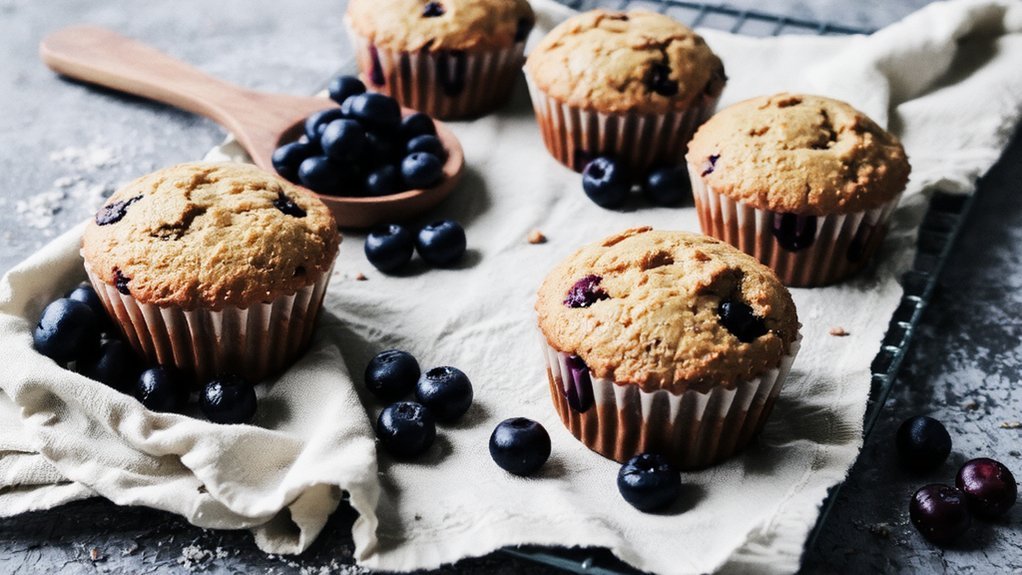

Key Takeaways
- Combine 2 cups flour, baking powder, salt, and sugar; mix wet ingredients separately, then fold together gently to avoid overmixing.
- Use fresh blueberries for superior flavor and texture, or frozen berries for year-round convenience and nutrient retention without thawing first.
- Bake at 375°F for 20–25 minutes in a preheated oven until a toothpick comes out clean and tops turn golden brown.
- Cool muffins in the tin for 5 minutes, then transfer to a wire rack to prevent condensation and maintain ideal texture.
- Store in airtight containers at room temperature for 2–3 days, refrigerate for 5–7 days, or freeze individually wrapped for 3 months.
Ingredients You’ll Need
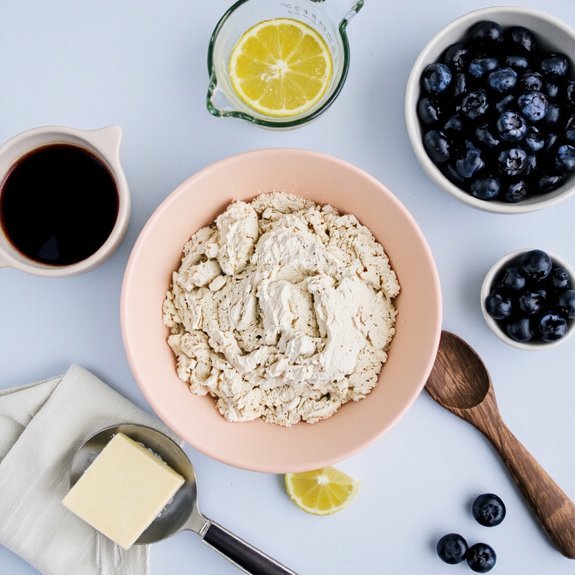
You’ll need two cups of all-purpose flour, three-quarters teaspoon of salt, two and a half teaspoons of baking powder, half a cup of unsalted butter, three-quarters cup of granulated sugar, two large eggs, one teaspoon of vanilla extract, and one cup of fresh or frozen blueberries.
These pantry staples form your muffin’s foundation.
You can substitute conventional dairy with dairy alternatives like coconut oil or plant-based butter if you prefer.
Simply swap the unsalted butter one-to-one with your chosen alternative.
For eggs, you maintain flexibility too.
You’ll find that applesauce or flax eggs work effectively as replacements.
Your blueberries deserve attention—you can use either fresh or frozen varieties without compromising quality.
Frozen berries actually prevent excess moisture in your batter.
Gather these components before mixing to guarantee smooth preparation and consistent results.
Selecting the Perfect Blueberries

You’ll want to decide between fresh and frozen blueberries, as each option affects your muffin’s texture and baking time differently.
Look for fresh berries that are firm, deeply colored, and free from mold or soft spots, as these indicators guarantee ideal flavor and structure in your batter.
If you’re using frozen berries, you can skip the thawing step and add them directly to your mixture, though they’ll release more liquid during baking.
Fresh vs. Frozen Berries
When selecting blueberries for muffins, the choice between fresh and frozen substantially impacts both texture and flavor development.
Fresh berries offer superior taste and structural integrity, maintaining their form during baking.
However, frozen blueberries provide excellent nutrient retention, as freezing preserves antioxidants and vitamins at peak levels.
They’re also more economical, making the cost comparison favor frozen options markedly.
Frozen berries won’t bleed into your batter if you don’t thaw them beforehand—a technical advantage for appearance.
Fresh berries deliver brighter flavor profiles but risk becoming mushy.
You’ll find frozen berries more convenient for year-round baking and budget-conscious preparation.
Consider your priorities: if you demand ideal flavor and texture, choose fresh; if you value nutrient retention and cost efficiency, frozen berries deliver superior value without compromising nutritional benefits.
Ripeness and Quality Indicators
Determining whether you’re purchasing fresh or frozen blueberries, evaluating ripeness and quality directly influences muffin outcomes. You’ll want berries with deep blue coloring and a subtle white bloom—nature’s indicator of peak ripeness.
Fresh blueberries should feel firm without mushiness, signaling ideal sugar content and structural integrity for baking.
Check the Brix measurement when possible; superior blueberries typically register 12-14 Brix, indicating higher sugar concentration. You’re also considering pH level, which should fall between 3.1 and 3.3 for balanced flavor development in your muffins.
Avoid berries showing soft spots, leakage, or mold—these compromise both taste and texture. You’ll get superior results by selecting firm, uniformly colored specimens.
If purchasing frozen blueberries, verify they’re individually quick-frozen without added sugars or thickening agents that interfere with your recipe’s chemistry and final product quality.
Step-by-Step Baking Instructions

Preheat your oven to 375°F and prepare a muffin tin by inserting paper liners or lightly greasing each cup.
Your preheat checklist promotes even heat distribution throughout baking.
Combine dry ingredients—flour, baking powder, salt, and sugar—in a large bowl.
In a separate container, whisk together eggs, milk, melting butter, and vanilla extract.
Pour wet ingredients into dry ingredients, stirring until just combined; don’t overmix.
Gently fold in your ripened blueberries, preserving their integrity.
Distribute batter evenly among pan preparation cups, filling each about three-quarters full.
Place your tin in the preheated oven for 20-25 minutes.
Muffins are done when a toothpick inserted into the center emerges clean and tops turn golden brown.
Cool muffins in the tin for five minutes before transferring to a wire rack.
Pro Tips for Bakery-Quality Results

You’ll achieve bakery-quality muffins by bringing your eggs, milk, and butter to room temperature before mixing, as this guarantees proper emulsification and even crumb structure.
Overmixing your batter develops gluten strands that create dense, tough muffins, so you should fold your ingredients together just until the dry components disappear. These two techniques—temperature control and minimal mixing—directly impact the tender crumb and consistent rise you’re seeking.
Room Temperature Ingredients Matter
When butter, eggs, and dairy aren’t properly tempered, they won’t emulsify effectively into your batter, resulting in dense, unevenly crumbed muffins rather than the tender, uniform structure bakeries achieve.
You’ll maximize butter aeration by letting it sit at 68-70°F before creaming.
This temperature range allows fat molecules to incorporate air efficiently without becoming greasy.
Cold ingredients compromise emulsion stability, forcing you to overmix—a guaranteed path to tough muffins.
Room temperature eggs blend seamlessly with butter, creating a stable emulsion that traps moisture throughout baking.
Cold milk won’t incorporate properly, leaving pockets of separation in your batter.
Don’t skip this step.
Plan ahead by removing ingredients from your refrigerator 30-45 minutes before mixing.
This single adjustment delivers professional results consistently.
Don’t Overmix The Batter
Once you’ve combined your room temperature ingredients, restraint becomes your greatest asset. Overmixing develops gluten networks that compromise crumb tenderness and create dense, tough muffins—the opposite of your goal.
Mix wet and dry components until just barely combined. Lumps are your friends. This technique preserves air retention, which generates those desirable tender crumbs and proper rise during baking.
| Mixing Stage | Time | Result | Texture | Outcome |
|---|---|---|---|---|
| Under-mixed | 15-20 seconds | Visible dry spots | Uneven | Acceptable |
| Properly mixed | 25-30 seconds | Barely combined | Tender crumb | Ideal |
| Over-mixed | 45+ seconds | Fully smooth | Dense structure | Tough muffins |
| Excessive mixing | 60+ seconds | Completely uniform | Compact crumb | Ruined batch |
| Recovery possible | N/A | Minimal folding | Compromised | Salvageable |
Your restraint directly determines muffin quality. Stop mixing early.
Avoiding Common Muffin Mistakes
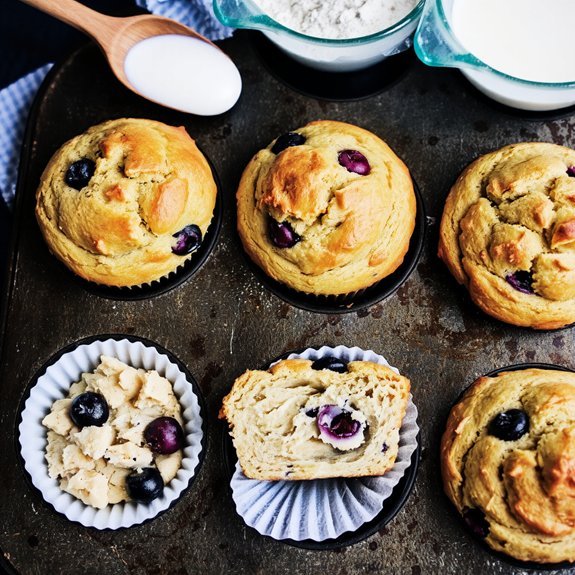
Because blueberry muffins seem straightforward, bakers often overlook the technical details that separate mediocre results from exceptional ones. You’ll want to master several critical factors to achieve superior muffins.
First, manage pan placement carefully. Position your oven rack in the middle; this guarantees even heat distribution and prevents bottoms from burning while tops remain pale.
Second, don’t overmix your batter—fold ingredients until just combined to maintain tender crumbs.
Third, control humidity in your kitchen. Excess moisture affects flour absorption and can yield dense, gummy muffins. Consider your environment when measuring dry ingredients.
Fourth, use fresh baking powder and baking soda; expired leavening agents won’t provide adequate rise.
Finally, don’t skip the resting period—letting batter sit briefly allows flour to fully hydrate, resulting in superior texture and structure.
Storage and Freshness Guide
Preserving your blueberry muffins’ quality requires understanding how moisture, temperature, and time interact with your baked goods. You’ll want to employ airtight containers immediately after cooling to prevent staleness and degradation of your carefully balanced ingredients.
| Storage Method | Duration | Best For |
|---|---|---|
| Airtight container (room temp) | 2-3 days | Immediate consumption |
| Refrigerator | 5-7 days | Extended freshness |
| Freezer | 3 months | Long-term preservation |
Moisture control remains critical throughout storage. You’re protecting the delicate crumb structure you’ve developed, so make sure your muffins cool completely before sealing them away. This prevents condensation from making them soggy. For freezing, wrap individual muffins in parchment paper before placing them in airtight containers. You’ll maintain ideal texture and flavor integrity this way, guaranteeing each bite delivers the blueberry-forward experience you’ve worked to achieve.
Variations and Creative Twists
Why settle for traditional blueberry muffins when you can elevate them with complementary ingredients and flavor profiles?
You’ll discover endless possibilities by experimenting with Savory Twists—incorporating herbs like rosemary, adding sharp cheddar cheese, or mixing in cracked black pepper. These combinations transform your muffins into sophisticated brunch items that challenge conventional expectations.
Alternatively, explore Dessert Mashups by combining blueberry muffin elements with other beloved treats. You can infuse lemon zest and white chocolate, create a streusel topping with crushed graham crackers, or swirl in cream cheese filling. You might layer brownie batter underneath, top with cheesecake crumbles, or dust with cinnamon sugar.
These variations let you tailor muffins to your specific cravings, breaking free from monotonous recipes. You control the flavor direction—whether you’re chasing complexity, indulgence, or novelty. Your kitchen becomes your laboratory for culinary freedom.
Frequently Asked Questions
Can I Make Blueberry Muffins Without Eggs for Vegan Dietary Requirements?
You’ll absolutely create vegan blueberry muffins by substituting eggs with a flax egg—combine one tablespoon ground flaxseed with three tablespoons water per egg, letting it sit five minutes. Alternatively, you’ll use aquafaba substitute, employing three tablespoons per egg.
Both options deliver comparable binding and moisture properties. You’re free to choose whichever aligns with your pantry.
These substitutes won’t compromise your muffins’ structure, texture, or rise when you properly incorporate them into your batter.
What Is the Exact Baking Time Needed at High Altitude Locations?
You’ll need to adjust your baking time when you’re at high altitude.
Start by reducing it to 15-18 minutes at 375°F, checking doneness early since moisture evaporates faster.
Make altitude adjustments by increasing oven temperature 25°F and verify proper oven calibration before baking.
You’re free to experiment slightly—every oven behaves differently at elevation.
Don’t rely solely on standard recipes; your ingredient ratios and baking conditions demand personalized timing for best results.
How Do I Convert This Recipe to Gluten-Free Flour Successfully?
You’ll need to adjust your blend ratios carefully—substitute all-purpose flour with a 1:1 gluten-free blend containing rice flour, tapioca starch, and potato starch.
Your binder choices matter critically; add xanthan gum or psyllium husk to replace gluten’s binding properties. Use roughly 1 teaspoon binder per cup of flour.
You’ll also benefit from slightly increasing your wet ingredients by 2-3 tablespoons, as gluten-free flour absorbs moisture differently, ensuring moist, tender muffins without dense texture.
Can Frozen Blueberries Work as Well as Fresh Ones in Muffins?
You can absolutely use frozen blueberries, though you’ll notice a texture comparison—they’ll yield softer muffins than fresh berries.
Here’s your freedom move: don’t thaw them.
Toss frozen berries directly into your batter to prevent bleeding, which releases anthocyanins and creates blue streaks throughout.
This technique locks in flavor intensity while maintaining structural integrity. You’re trading slight firmness for convenience and consistent results every time.
What Equipment Is Essential for Making Professional-Quality Blueberry Muffins at Home?
You’ll need a convection oven for even heat distribution and consistent browning across your muffin tops.
A digital scale guarantees precise ingredient measurements—critical for professional results.
You’ll also want quality muffin tins, a stand mixer for proper batter incorporation, and reliable thermometers.
These tools give you control over texture and moisture content, eliminating guesswork from your baking process.





Leave a Comment