

Key Takeaways
- Silicone piping bags offer superior control, puncture resistance, and less hand slipping compared to plastic or cloth alternatives.
- Hold piping bags at 45 degrees for most decorating; adjust to 90 degrees for rosettes and nearly horizontal for writing.
- Disposable plastic bags provide maximum convenience and quick cleanup but lack environmental sustainability.
- Cloth bags are reusable, durable options lasting years with proper maintenance and washing.
- Consistent pressure control creates uniform lines; light pressure produces delicate details while firm pressure generates bold patterns.
Types of Piping Bags and Their Advantages

Piping bags come in three primary materials—disposable plastic, cloth, and silicone—each offering distinct advantages for different applications.
Disposable plastic bags provide maximum convenience when you’re handling messy fillings or need quick cleanup.
You’ll appreciate their affordability and single-use simplicity, though they lack environmental sustainability.
Cloth bags deliver reusable durability that withstands repeated washing and years of use.
You’ll find they’re more environmentally responsible and cost-effective long-term, though they require proper maintenance and drying.
Silicone bags combine the best attributes: they’re washable, puncture-resistant, and incredibly flexible.
You’ll notice superior control and precision because silicone doesn’t slip in your hands like plastic does.
Your choice depends on your priorities.
Choose disposable convenience for commercial settings, cloth for budget-conscious professionals, or silicone when you demand maximum performance and sustainability.
Essential Tips for Different Decorating Techniques
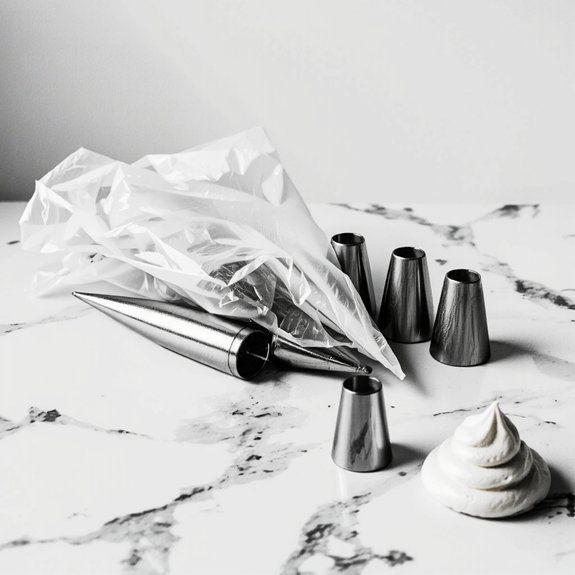
Once you’ve selected your ideal piping bag, mastering the techniques that maximize its potential becomes your next priority.
You’ll need to develop consistent pressure control to achieve uniform lines, borders, and decorations. Vary your grip tension deliberately—light pressure creates delicate details, while firm pressure produces bold, defined patterns.
Master consistent pressure control—light grip for delicate details, firm pressure for bold, defined patterns.
Angle adjustments are equally critical. You’ll hold your bag at 45 degrees for most applications, but rosettes demand a 90-degree angle, and writing requires nearly horizontal positioning. Experiment with different angles to understand how they affect your output.
Practice maintaining steady hand movement while adjusting pressure simultaneously. You’ll discover that mastering these fundamental techniques unleashes your creative freedom, allowing you to execute intricate designs with confidence and precision across any decorating project you undertake.
Frequently Asked Questions
How Do You Clean and Properly Maintain Piping Bags for Longevity?
You’ll maximize your piping bags’ lifespan by implementing proper sanitizing techniques immediately after use.
Rinse thoroughly with hot water, then wash with food-grade soap to eliminate residual debris.
For storage solutions, you’ve got flexibility—air-dry completely before placing them in breathable containers away from direct sunlight.
Store tips separately in airtight cases.
This approach prevents mold, maintains material integrity, and guarantees your equipment performs reliably for countless projects ahead.
What Is the Average Cost of Quality Piping Bags and Tip Sets?
You’ll find quality piping bag and tip sets ranging from $15–$50, depending on your standards.
Basic reusable silicone bags cost $20–$30, while professional-grade sets run $40–$60.
Your budget breakdown should account for durability; investing in premium brands like Wilton or Ateco guarantees longevity.
Brand comparison reveals that mid-range options ($25–$35) deliver excellent performance without excessive spending, giving you freedom to experiment with decorating techniques without financial strain.
Can You Use Piping Bags for Savory Foods or Only Desserts?
You’re absolutely not limited to desserts—piping bags excel in savory applications too.
You can use them for cheese piping, whipped butter, hummus, guacamole, and mashed potatoes.
They’re ideal for plating gourmet dishes professionally.
You’ll find that sturdy bags with larger tips handle savory ingredients efficiently.
Choose bags rated for hot foods when working with warm preparations.
This versatility gives you complete control over presentation across your entire menu.
How Do You Prevent Piping Bags From Bursting During Use?
You’ll prevent piping bag bursts by selecting bags with quality seam reinforcement along stress points.
Apply consistent pressure rather than sudden squeezes that strain the material.
Don’t overfill—leave adequate headspace for control.
Use proper technique: grip the bag’s upper third firmly while guiding with your other hand.
Choose heavyweight bags designed for demanding applications.
Check for punctures before use, and replace worn bags immediately.
These practices keep you in complete control of your decorating work.
What Size Piping Bag Should You Choose for Different Decorating Projects?
You’ll want to match your piping bag size to your project scale and decorating technique. For intricate detail work, you’ll choose smaller 8-12 inch bags that give you precise control.
Medium 14-16 inch bags work well for general frosting and filling tasks. Larger 18-20 inch bags handle heavy-duty applications like piping buttercream borders and substantial decorations.
You’re free to switch sizes as your project demands, ensuring peak performance without compromise.

Leave a Comment