
Key Takeaways
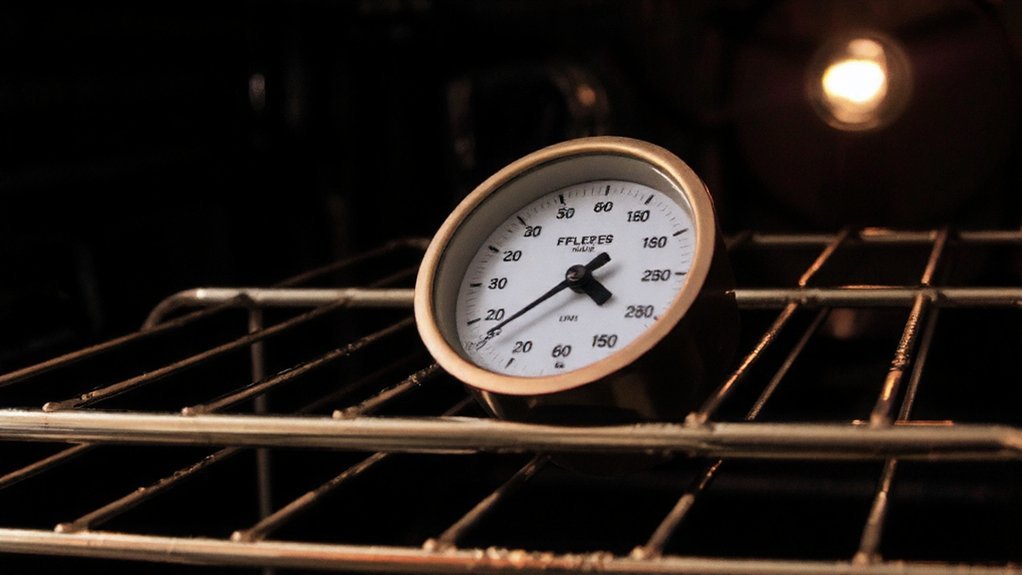
- Most ovens deviate 25–50°F from displayed settings; digital thermometers verify actual temperatures within 1–2 degrees for accurate baking.
- Place thermometers on the middle rack center, three inches from the back wall, avoiding direct heat and walls.
- Digital models with wireless connectivity and smartphone alerts enable remote monitoring without repeatedly opening the oven door.
- Recalibrate or replace thermometers annually to maintain accuracy and ensure consistent temperature readings for reliable baking results.
- Quality oven thermometers range from $15–$150; investing in one reduces baking failures and eliminates frustrating guesswork about heat levels.
Why Your Oven Temperature Matters More Than You Think
Ever wonder why your baked goods don’t turn out as expected? The culprit often isn’t your recipe or technique—it’s your oven’s temperature accuracy. You’re likely dealing with an oven that doesn’t maintain consistent heat, and an oven thermometer gives you the independence to verify actual temperatures rather than trusting your appliance’s built-in gauge.
Your oven’s temperature accuracy, not your recipe, is likely why baked goods disappoint. An oven thermometer gives you the independence to verify actual temperatures.
Most ovens deviate 25 to 50 degrees Fahrenheit from their displayed settings. You need precise data to compensate for this variance. Digital oven thermometers provide real-time temperature readings accurate within 1-2 degrees, while analog models typically offer ±2-3 degree accuracy. When you’re baking at 350°F, that precision directly impacts rise rates, browning patterns, and structural integrity of your final product.
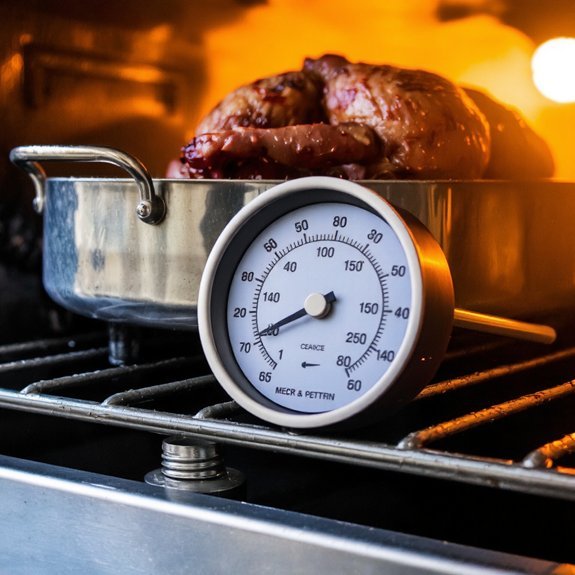
For accuracy testing, you’ll want to place your thermometer in the center of your oven’s middle rack—this is the hottest spot in most units. Avoid positioning it against walls or near heating elements, as these locations create false readings.
Take multiple measurements across 15-minute intervals to identify temperature fluctuations. You’re not just getting a single number; you’re capturing your oven’s actual performance profile.
Placement tips matter critically for gathering reliable data. Insert the thermometer approximately three inches from the oven’s back wall if you’re using a hanging model. This positioning keeps it away from direct radiant heat while remaining in the primary cooking zone.
If you’re using a standing thermometer, make sure it’s visible through your oven window without opening the door excessively—each door opening drops internal temperature by 25 degrees.
You should recalibrate or replace your thermometer annually. Quality options like the ThermoPro TempSpike offer wireless connectivity and smartphone alerts, giving you complete temperature control without manual checking.
The MEATER Plus provides similar functionality with Bluetooth capabilities. If you prefer traditional analog models, the classic dial thermometers remain reliable despite lacking digital precision.
Your choice determines your freedom in the kitchen. Digital thermometers eliminate guesswork and give you concrete data for recipe adjustments.
You’ll know exactly how much to increase your baking time or temperature to achieve desired results. This empirical approach transforms you from a passive baker following instructions to an informed baker making deliberate adjustments based on actual conditions.
Investing in a quality oven thermometer costs between 15 and 150 dollars, depending on features. This expense pays dividends through reduced baking failures and consistent results.
You’re not just purchasing a tool; you’re reclaiming control over your cooking outcomes and eliminating the frustration of temperature-related failures.
Frequently Asked Questions
What’s the Difference Between Dial and Digital Oven Thermometers?
Dial thermometers rely on mechanical expansion to indicate temperature without battery requirements, offering you independence from power sources.
Digital thermometers demand battery replacements but deliver superior display readability with precise numerical readings.
You’ll appreciate dial models’ durability and freedom from maintenance, while digital variants give you exact temperature data at a glance.
Your choice depends on whether you prioritize reliability and autonomy or precision and convenience in monitoring oven heat.
How Often Should I Replace My Oven Thermometer for Accuracy?
You should replace your oven thermometer every 1-2 years, depending on your calibration schedule and usage frequency.
Watch for expiration signs like erratic readings, visible damage, or consistent temperature deviations exceeding ±5°F.
Don’t let inaccurate measurements compromise your cooking freedom. Regular recalibration extends lifespan, but worn components can’t recover full precision.
High-heat environments accelerate degradation, necessitating more frequent replacements. Trust your equipment’s performance data to maintain ideal baking and roasting results consistently.
Can I Use an Oven Thermometer in a Convection Oven?
You can absolutely use an oven thermometer in your convection oven. However, you’ll want to position it on the center rack where you’re cooking to capture accurate air circulation patterns.
Convection ovens distribute heat differently than conventional models, so placement matters notably. You’re free to choose any standard oven thermometer—it’ll function reliably. Just make sure you’re reading temperatures at your actual cooking zone, not relying solely on the oven’s display for precise results.
Do Oven Thermometers Work in All Oven Types and Sizes?
You’ll find that oven thermometers work across most oven types, but you’ve got size limitations to bear in mind. Compact models fit standard cavities, while larger ovens demand bigger thermometers for accurate readings.
Placement guidance matters critically—position yours away from walls and heating elements for precise temperature data. Your specific oven dimensions determine compatibility, so verify clearance before purchasing.
This freedom to choose guarantees you’re getting reliable measurements tailored to your cooking setup.
What Temperature Range Should a Reliable Oven Thermometer Measure?
You’ll want a reliable oven thermometer measuring 50°F to 500°F minimum.
That range covers your complete baking spectrum without compromise.
Premium models extend to 600°F, giving you freedom for high-heat applications.
These safety thresholds guarantee accurate readings across standard home cooking scenarios.
You’re not locked into limited functionality—you’re empowered with precise temperature data.
Most quality units won’t drift beyond ±5°F, maintaining the accuracy you demand for consistent results.




Leave a Comment