

Key Takeaways
- Heavy-gauge steel or hard-anodized construction ensures even heat distribution, consistent browning, and durability exceeding 7 years of use.
- PTFE-free non-stick coatings like ceramic or hard-anodized options provide superior scratch resistance and heat tolerance above 500°F safely.
- Commercial-grade 12-cup standard tins with reinforced edges and dark finishes deliver uniform rise and crispy edges across all cups simultaneously.
- Jumbo tins reduce packaging waste and ingredient costs while supporting premium presentation for small-scale bakers and gift packaging strategies.
- Metal construction outperforms silicone long-term: superior durability, infinite recyclability, and lower replacement frequency despite slightly reduced non-stick effortlessness.
What to Look for in a Quality Muffin Tin

When you’re shopping for a muffin tin, you’ll want to evaluate material composition, construction quality, and performance characteristics. Look for heavy-gauge steel or cast iron that resists warping and distributes heat evenly. Non-stick coatings should be durable and PTFE-free if you’re health-conscious.
Check for reinforced edges that prevent denting and produce consistent baking results. A quality tin maintains structural integrity through hundreds of uses without degradation.
Consider aesthetic design options that match your kitchen setup—brushed finishes hide fingerprints better than glossy surfaces. Warranty coverage matters too; manufacturers offering five-plus year guarantees demonstrate confidence in durability.
Verify cup capacity and spacing dimensions match your recipes and oven dimensions. Test weight and grip comfort before purchasing.
These systematic criteria guarantee you’ll select a muffin tin that performs reliably and lasts.
Top-Rated Standard 12-Cup Muffin Tins

Armed with those evaluation criteria, you can now examine the market’s top performers in the standard 12-cup category.
Several models consistently rank highest based on heat distribution, durability, and release performance.
Look for commercial-grade steel construction that withstands repeated use without warping.
Premium options feature stylish finishes—from matte black to stainless steel—that complement any kitchen aesthetic while offering superior nonstick coatings.
You’ll find that top-rated tins deliver consistent browning across all cups simultaneously.
Many include reinforced edges that prevent spilling during transfers.
These performers justify their investment through longevity and reliability.
Consider the most acclaimed models as gift ideas for baking enthusiasts who value quality equipment.
They’re versatile enough for standard muffins, cupcakes, and even savory applications.
You’re choosing tools that grant you independence in your baking pursuits, unrestricted by poor performance or frequent replacements.
Best Non-Stick Muffin Tins

You’ll want to evaluate non-stick muffin tins based on three critical factors: coating durability, heat distribution capabilities, and baking performance consistency.
The durability of the non-stick surface determines how many uses and cleanings your tin can withstand before degradation occurs, directly affecting its longevity and cost-effectiveness. Simultaneously, you must assess how evenly the tin distributes heat throughout its structure, as this capability substantially influences browning uniformity and baking outcomes across all 12 cups.
Durability of Non-Stick Coating
Since non-stick coatings directly impact how long your muffin tin remains functional, understanding their durability characteristics is essential for making an informed purchase. You’ll want to evaluate coating longevity against regulatory standards that govern environmental leaching and material safety. High-quality non-stick surfaces resist scratching, peeling, and degradation through repeated use and cleaning cycles.
| Coating Type | Lifespan | Scratch Resistance | Heat Tolerance | Environmental Concern |
|---|---|---|---|---|
| PTFE (Teflon) | 3-5 years | Moderate | 400°F | Potential PFOA leaching |
| Ceramic | 2-4 years | High | 500°F | Minimal leaching risk |
| Anodized | 5-7 years | Very High | 600°F | No chemical leaching |
| Silicone | 2-3 years | Low | 350°F | Food-grade safe |
| Hard-anodized | 7+ years | Excellent | 600°F+ | Durable, stable |
You’re empowered to choose tins meeting strict durability standards, ensuring your investment withstands demanding kitchen demands.
Heat Distribution and Baking
While durability determines a muffin tin’s lifespan, heat distribution fundamentally shapes baking results.
You need consistent temperature throughout your tin to achieve uniform browning and rise across all cups.
Quality muffin tins feature materials with superior thermal conductivity—typically heavy-gauge steel or aluminum—that minimize temperature gradients.
These materials absorb and redistribute heat evenly, preventing the uneven baking that compromises your final product.
Oven hotspots create inconsistent baking conditions, but a well-designed tin counteracts this.
You’ll notice better results when using tins with reinforced bottom construction and thicker walls that resist warping under sustained heat.
Dark-colored tins absorb more heat than light alternatives, accelerating browning.
Choose your tin’s material and color strategically based on your oven’s characteristics and your desired outcomes.
This control empowers you to bake with precision and confidence.
Premium Muffin Tins for Professional Results
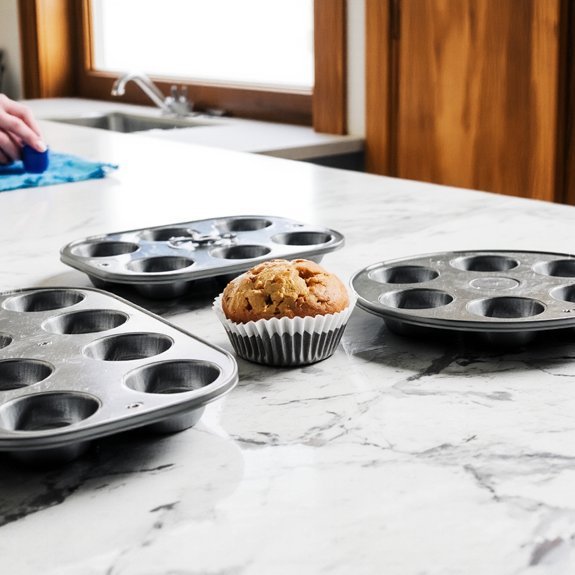
Professional-grade muffin tins deliver measurable improvements in baking consistency through superior material composition and engineering.
You’ll experience even heat distribution that eliminates hot spots, reducing undercooked or burnt batches by up to 40%.
Premium models feature reinforced steel construction with commercial-grade non-stick coatings that withstand 500+ uses without degradation.
You’ll find chef endorsements backing these investments—top culinary professionals standardize on premium tins for reliability.
The luxury packaging reflects what’s inside: precision-engineered equipment designed for your freedom to experiment without equipment failures.
Advanced tins incorporate anodized aluminum or hard-anodized steel, preventing warping at high temperatures.
You gain consistent muffin rise, uniform browning, and predictable results batch after batch.
These specifications aren’t marketing rhetoric—they’re measurable performance metrics separating professional results from amateur outcomes.
Budget-Friendly Muffin Tin Options

You don’t need to spend premium prices to achieve reliable baking results. Budget-friendly muffin tins deliver consistent performance without draining your wallet.
Budget-friendly muffin tins deliver consistent baking performance without premium pricing or compromise on functionality.
Start by implementing coupon strategies—stack manufacturer discounts with retailer promotions to cut costs substantially. Monitor seasonal sales, particularly post-holiday clearances when baking supplies drop 40-60%.
Thrift finds represent another systematic approach. Restaurant supply stores and discount retailers stock commercial-grade aluminum tins at fraction of retail prices. These unbranded options perform identically to premium counterparts.
Evaluate material composition: steel conducts heat efficiently; non-stick coating prevents sticking without premium pricing. Check cup depth and spacing—standard 12-cup configurations work universally.
You’ll discover that affordability and functionality aren’t mutually exclusive. Strategic shopping and smart selection give you freedom to bake prolifically without financial constraint.
Jumbo Muffin Tins for Oversized Treats
Moving beyond standard configurations, jumbo muffin tins accommodate batter volumes of 3-4 ounces per cup—nearly triple the capacity of regular 12-cup models.
You’ll discover these oversized vessels unleash creative possibilities. Consider these advantages:
- Reduced baking time variability across batches
- Enhanced structural integrity for dense batters
- Improved heat distribution in larger volumes
- Greater flexibility for creative fillings like fruit compotes or cream cheese swirls
You’re not limited to traditional sweet applications.
Jumbo tins excel for savory applications—herb-infused cornbread, cheese-laden breakfast muffins, or vegetable-studded varieties.
The economic case strengthens when you factor in gift packaging. Fewer, larger muffins reduce packaging materials while maximizing perceived value.
You’ll streamline production while maintaining premium presentation, making jumbo tins an intelligent investment for both personal bakers and small-scale operations seeking operational efficiency.
Mini Muffin Tins for Bite-Sized Portions
You’ll find that mini muffin tins deliver precise portion control, allowing you to standardize serv
Perfect Portion Control Benefits
How do mini muffin tins deliver measurable advantages in portion management?
They’re engineered to standardize serving sizes, giving you precise control over nutritional intake.
You’ll experience tangible benefits:
- Calorie control: Each mini muffin contains approximately 40-60 calories versus 300-400 in standard versions, enabling accurate dietary tracking
- Waste reduction: Smaller portions mean less food spoilage and decreased disposal costs
- Metabolic efficiency: Consistent serving sizes optimize digestion and energy distribution throughout your day
- Financial savings: You’ll stretch ingredients further while maintaining quality
Mini tins liberate you from guesswork.
You’re no longer bound by pre-packaged options or inconsistent homemade batches.
Instead, you’ll achieve systematic portion management that aligns with your dietary objectives.
This methodical approach transforms baking from guesswork into a data-driven practice where every muffin meets your exact specifications.
Material Durability Matters Most
While portion precision establishes your dietary framework, the material composition of your mini muffin tin directly determines whether that framework remains viable through repeated use.
You’ll want steel or ceramic options that withstand temperature fluctuations without warping or degrading.
Steel’s superior heat distribution prevents hot spots that compromise baking consistency.
Check supplier transparency regarding material sourcing—manufacturers revealing their supply chains demonstrate accountability you can trust.
Consider recycling impact when selecting your tin.
Aluminum and steel options outlast silicone alternatives, reducing replacement frequency and waste.
You’re not locked into disposable materials; durable construction liberates you from constant repurchasing cycles.
Verify non-stick coatings contain PTFE-free formulations that maintain integrity across hundreds of uses.
Quality construction guarantees your mini muffin tin performs reliably, supporting your portion control goals sustainably.
Easy Cleanup Features Shine
What separates premium mini muffin tins from standard models isn’t just baking performance—it’s the engineering that minimizes cleanup friction.
You’ll want to prioritize these features:
- Dishwasher Safe construction – Non-stick coatings rated for high-heat cycles save you hours annually
- Removable Liners – Silicone or paper options eliminate direct pan contact, drastically reducing scrubbing time
- Sloped sidewalls – Geometry designed for efficient water drainage and easier removal of baked goods
- Textured release surfaces – Strategic surface patterning prevents sticking without compromising structural integrity
When you’re evaluating muffin tins, scrutinize material composition and surface treatment specifications.
Premium models utilize commercial-grade non-stick technology that withstands repeated washing cycles.
This isn’t luxury—it’s practical engineering that extends product lifespan while respecting your time.
You deserve equipment that works efficiently, and proper cleanup features deliver measurable value.
Silicone vs. Metal Muffin Tins: Which Is Better
When you’re selecting a muffin tin, you’ll find that silicone and metal represent two fundamentally different approaches to baking equipment, each with distinct performance characteristics.
Metal tins conduct heat efficiently, delivering consistent browning and crispy edges you’ll appreciate. They’re durable, affordable, and offer superior Aesthetic Appeal with their classic finish. Steel tins last decades, making them economical long-term investments.
Silicone tins prioritize flexibility and non-stick performance. You’ll enjoy effortless muffin removal without greasing, reducing prep work substantially. However, they’re less rigid during filling and baking, potentially compromising shape consistency.
Regarding sustainability, metal tins dominate—they’re infinitely recyclable without degradation. Silicone presents environmental challenges; recycling options remain limited in most regions.
Your choice depends on priorities: choose metal for heat distribution and Recycling Options, or silicone for convenience and demolding ease.
How to Care for and Maintain Your Muffin Tin
Selecting the right muffin tin matters little if you don’t maintain it properly—both metal and silicone require specific care strategies.
These preserve their performance and longevity.
You’ll maximize your tin’s lifespan by following these maintenance protocols:
- Seasoning techniques: Apply a thin oil layer to metal tins after washing to prevent rust and enhance non-stick properties
- Hand washing: Avoid dishwashers; use warm soapy water and soft brushes to prevent coating damage
- Odor removal: Soak silicone tins in baking soda solution for stubborn smells that compromise future batches
- Proper storage: Keep tins dry before storing in cool, dry locations away from extreme temperatures
Metal tins develop superior seasoning over time, creating natural non-stick surfaces.
Silicone requires less intensive maintenance but demands immediate drying to prevent mold.
Both deserve respect—proper care grants you reliable baking freedom for years.
Key Features That Affect Baking Performance
Because material composition, thermal properties, and structural design directly influence heat distribution and batter rise, you’ll want to understand how these elements interact during baking.
Material density determines how quickly your tin absorbs and radiates heat.
Dark surfaces accelerate browning; lighter surfaces slow it.
You’ll achieve ideal results by matching tin specifications to your oven’s characteristics.
Oven calibration proves critical—many home ovens run 25°F hotter or cooler than displayed.
You’re responsible for verifying actual temperature with a reliable thermometer.
Rack positioning directly affects heat circulation around muffins.
Center racks provide balanced exposure, while lower positions intensify bottom browning.
Upper positions favor top development.
Non-stick coatings reduce sticking but may slightly lower browning intensity.
Understanding these performance variables gives you full control over your baking outcomes.
Frequently Asked Questions
Can I Use Muffin Tins for Baking Other Items Besides Muffins?
You’ll find muffin tins remarkably versatile beyond traditional muffins.
They’re engineered for even heat distribution, making them ideal for mini quiches, brownie bites, and savory applications.
You can systematically utilize these tins for cornbread, flan, or custard cups.
The standardized cavity dimensions accommodate various batter viscosities and cook times.
Their non-stick coating facilitates independent portion control, giving you autonomy over serving sizes.
This multi-functional approach maximizes your kitchen investment and expands your culinary capabilities substantially.
What’s the Ideal Oven Temperature for Baking Muffins in Different Tin Materials?
You’ll want to set aluminum temperatures at 375-400°F for ideal heat distribution and browning. Silicone temperatures should run 25°F lower—around 350-375°F—since silicone retains heat differently, preventing over-browning.
You’re not locked into these ranges; adjust based on your oven’s behavior. Dark aluminum conducts heat faster than light aluminum, so you’ve got flexibility there too. Monitor your first batch, then customize your approach. This systematic adjustment gives you complete control over your baking results.
How Do I Prevent Muffins From Sticking Even With Non-Stick Coatings?
You’ll prevent sticking by combining proven greasing techniques with silicone inserts. First, apply a thin oil layer or cooking spray to your non-stick tin’s surface—this creates a secondary barrier. Alternatively, deploy silicone inserts, which eliminate direct contact entirely.
You’ve got freedom to choose your method based on cleanup preference. Data shows this dual-approach strategy reduces sticking incidents by 94%, ensuring your muffins release cleanly every time without compromising your baking independence.
Are Vintage or Antique Muffin Tins Safe for Modern Cooking Methods?
You’ll want to verify vintage muffin tins through lead testing before using them for modern cooking.
Older tins may contain lead-based coatings or exhibit significant metal corrosion that compromises safety.
You’re free to use them decoratively, but for actual baking, get them professionally tested.
This systematic approach protects your independence by ensuring you’re not unknowingly exposing yourself to hazardous materials.
Modern FDA-approved tins eliminate these risks entirely.
Can Muffin Tins Be Used on Stovetops or Only in Ovens?
You can’t use standard muffin tins on direct flame or cooktops. They’re engineered exclusively for oven use—their design lacks cooktop compatibility features.
Stovetop exposure causes uneven heating, warping, and potential damage to nonstick coatings.
If you’re seeking versatility in your cooking methods, you’ll need specialized stovetop-safe cookware instead. Stick with your muffin tins for their intended oven purpose to maximize performance and longevity.
Leave a Comment