

Key Takeaways
- Weight-based measurements in grams eliminate flour variability and ensure consistent, reproducible baking results every time.
- Digital scales offer superior precision to 0.1 grams, essential for accurate moisture balance and professional-quality outcomes.
- The Hario V60 Drip Scale combines 0.1-gram accuracy with a built-in timer and minimalist design for home bakers.
- Budget-friendly scales with load cell sensors deliver professional-grade accuracy without premium pricing for cost-conscious bakers.
- Tare function allows sequential ingredient layering without calculations, streamlining workflow and preventing compounding measurement errors.
Why Weight Matters in Baking

Because baking’s a science that demands precision, you’ll find that weight measurements—not volume—deliver consistency that cup-and-spoon methods can’t match.
When you weigh ingredients in grams, you’re eliminating variables that plague traditional measuring.
A packed cup of flour differs drastically from a loosely filled one, sabotaging your recipe consistency before you’ve even mixed your batter.
Weight-based measurements guarantee accurate moisture balance in your dough, guaranteeing reliable results every single time.
You’re taking control away from guesswork and placing it squarely in your hands.
Professional bakers understand this fundamental principle: precision scales aren’t luxuries—they’re essential tools for reproducible outcomes.
Whether you’re crafting delicate pastries or sturdy bread, you deserve the accuracy that transforms you from occasional baker to confident craftsperson.
Digital Scales vs. Analog Scales

When you’re selecting a kitchen scale, you’ll encounter two primary technologies: digital and analog.
Digital scales offer superior precision, typically measuring to 0.1 ounces, making them ideal for exact baking requirements. They’re user-friendly with clear LCD displays and quick readings. However, they require batteries and contain electronic components that eventually become e-waste, creating environmental impact concerns.
Analog scales represent the historical evolution of weighing technology. They’re mechanical, requiring no batteries, thereby reducing environmental footprint. You’ll appreciate their durability and longevity. The tradeoff? They’re less precise, generally accurate to 0.5 ounces, and reading the dial demands careful attention.
For serious bakers prioritizing accuracy, digital scales win. If you value sustainability and mechanical reliability, analog scales deliver freedom from electronic dependency while still performing adequately for most baking applications.
Top Features to Look For
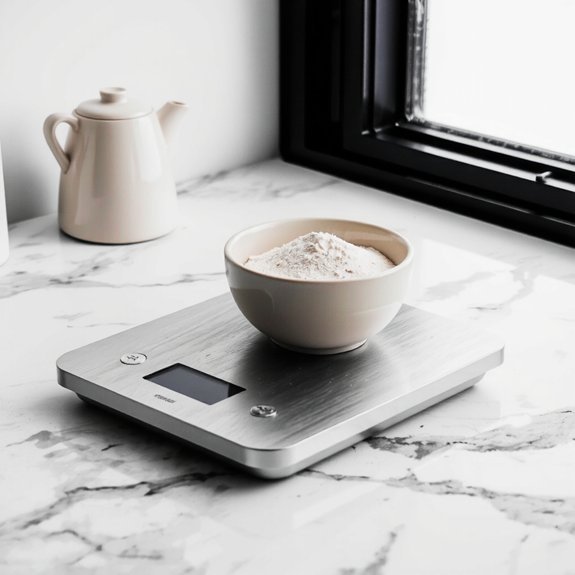
After you’ve decided between digital and analog technologies, several key features’ll substantially impact your baking success. Prioritize precision first—you’ll need accuracy within 0.1 grams for reliable results.
Look for scales offering multiple measurement units, granting you flexibility with various recipes and ingredients. Weight capacity matters; make sure your scale accommodates your typical baking batches without compromise.
A tare function lets you reset to zero, enabling efficient ingredient layering without mental calculations. Consider durability and design.
Stainless steel or glass platforms resist wear while maintaining aesthetic finishes that complement your kitchen. Battery life deserves attention—reliable power ensures consistent performance.
Increasingly, manufacturers prioritize eco packaging, reducing waste without sacrificing protection. This choice aligns with your values while delivering quality equipment.
You’ll maximize baking precision by selecting scales combining accuracy, functionality, and responsible production practices.
Best Overall Kitchen Scale

Now that you understand what features matter most, the Hario V60 Drip Scale stands out as the top choice for home bakers. This Japanese brand reputation stems from decades of precision engineering, delivering accuracy within 0.1 grams—essential for consistent results.
The Hario V60 Drip Scale delivers precision within 0.1 grams, essential for consistent baking results backed by Japanese engineering expertise.
You’ll appreciate its minimalist aesthetic styles that complement any kitchen without compromising functionality. The scale features a built-in timer, perfect for sequential ingredient additions, and its compact design won’t clutter your workspace.
The durable construction withstands daily professional-grade use while remaining accessible to home enthusiasts. Its intuitive interface requires no learning curve, giving you complete control over your baking process.
Whether you’re crafting artisan breads or delicate pastries, this scale’s reliability and elegant design make it the definitive choice for bakers who demand excellence without unnecessary complexity.
Best Budget-Friendly Option

You don’t need to spend premium dollars to get a kitchen scale that delivers accurate measurements for your baking projects.
Budget-friendly scales built with durable materials and reliable sensors give you the precision you need without the unnecessary markup.
When you choose a solid budget option, you’re investing in dependable performance that serves home bakers just as well as expensive models.
Accuracy Without Premium Price
Since precision doesn’t require luxury pricing, many home bakers discover that mid-range digital scales deliver professional-grade accuracy at fraction of the cost.
You’ll find reliable options emerging from manufacturing hubs in Asia, where competitive production keeps prices accessible despite import tariffs affecting final retail costs.
Consider these budget-conscious features:
- Load cell sensors capable of 0.1-gram increments for precise measurements
- Stainless steel platforms resisting corrosion without luxury markup
- LCD displays providing clear readouts in multiple units
You’re not sacrificing accuracy by avoiding premium brands.
Mid-range scales meet professional standards for home baking, measuring flour, sugar, and leavening agents with reliability.
Smart shopping means prioritizing measurement precision over unnecessary features that inflate costs without improving your baking results.
Durable Budget Scale Features
When durability matters most on a tight budget, look for scales built with reinforced load cells and protective housing that’ll withstand years of regular kitchen use. You’ll want shock absorption features that protect internal components from accidental drops. Stainless steel platforms offer rust resistance, ensuring longevity without premium costs.
| Feature | Benefit |
|---|---|
| Reinforced load cells | Enhanced accuracy retention |
| Shock absorption | Impact protection |
| Rust-resistant coating | Extended lifespan |
| Non-slip base | Stability during use |
You’re investing in reliability when you prioritize these durable elements. Budget scales featuring these specifications give you freedom from frequent replacements. Look for models with sealed button mechanisms that resist moisture and debris infiltration. These practical features combine affordability with lasting performance, delivering genuine value for your baking operations.
Value for Home Bakers
Why do home bakers need a scale that doesn’t drain your wallet?
You’re not sacrificing quality when you choose an affordable digital scale.
Budget-friendly models deliver the precision you need without unnecessary premium features. Here’s what you gain:
- Cost savings through elimination of wasteful ingredient guessing and failed batches
- Consistent results that build your baking confidence across all recipes
- Freedom to experiment without financial pressure on your hobby
A reliable budget scale measures in grams and ounces with accuracy to 0.1 ounces, meeting professional standards at a fraction of premium prices.
You’ll recoup your investment immediately through reduced ingredient waste and successful first attempts.
Your independence as a baker doesn’t depend on expensive equipment—it depends on precise measurement.
Choose the scale that empowers your skills and respects your budget.
Best Scale for Small Spaces
When you’re working with limited kitchen real estate, you’ll want a scale that doesn’t demand valuable counter or cabinet space. Compact design features like a slim profile, foldable components, or a footprint under 6×6 inches let you store your scale vertically or tuck it into narrow gaps between appliances.
You’ll appreciate models that prioritize portability too—lightweight construction and carrying cases mean you can relocate your scale wherever you need it, whether that’s a studio apartment or a shared kitchen.
Compact Design Features
For kitchens where counter space is at a premium, you’ll want a baking scale that doesn’t sacrifice functionality for footprint.
Compact baking scales deliver professional-grade precision without dominating your workspace.
Consider these essential features:
- Slim profiles – Models under 2 inches deep fold seamlessly into cabinets or narrow gaps between appliances
- Minimalist aesthetics – Clean lines and streamlined designs eliminate visual clutter while maintaining precision up to 5kg capacity
- Multiple color options – Choose neutral blacks, whites, or stainless finishes that complement any kitchen décor
Look for scales with collapsible platforms or integrated storage compartments.
Digital displays should remain legible without requiring bulky frames.
Weight capacity shouldn’t suffer; quality compact scales handle baking demands efficiently.
You’ll maintain complete control over your space and your baking precision simultaneously.
Storage and Portability
Since compact scales must serve double duty as both functional tools and space-saving solutions, you’ll want models that prioritize storage efficiency without compromising measurement accuracy. Portable scales give you freedom to organize your kitchen however you choose, whether on crowded countertops or within cabinet shelf organization systems.
| Feature | Benefit | Best For |
|---|---|---|
| Protective case options | Dust protection during storage | Frequent movers |
| Foldable designs | Minimal footprint | Tight spaces |
| Wall-mount capability | Vertical storage solutions | Limited countertop area |
| Cord management | Organized cable storage | Neat kitchen setups |
| Compact footprint | Drawer accessibility | Mobile bakers |
You’ll appreciate scales featuring integrated carrying handles and durable case options that safeguard your investment. These designs let you maintain kitchen flexibility while keeping measurement tools readily accessible for your baking projects.
Best Scale With Advanced Features
Advanced kitchen scales elevate your baking precision by incorporating features like built-in timers, multiple unit conversions, and connectivity options that streamline your workflow.
Advanced kitchen scales bring precision and efficiency to your baking through integrated timers, unit conversions, and seamless connectivity options.
You’ll gain complete control over your baking process with these sophisticated tools.
Top advanced features you should consider:
- Firmware Updates – Keep your scale’s functionality current with automatic software improvements that enhance accuracy and introduce new capabilities
- Developer API – Access integration options that connect your scale to custom applications, giving you freedom to build personalized baking solutions
- Bluetooth Connectivity – Sync data to your smartphone for real-time recipe adjustments and detailed logging
These features aren’t luxuries; they’re practical investments for serious bakers who demand precision without compromise.
You’ll access professional-grade control that transforms your baking results.
How to Use Your Kitchen Scale Effectively
Why do so many home bakers still struggle with consistency despite owning precision scales?
They’re neglecting the tare technique.
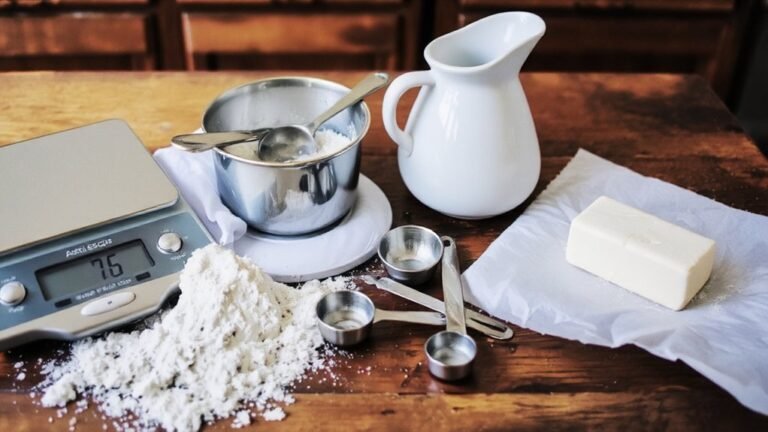
Master this fundamental skill: place your bowl on the scale, press tare to zero it out, then add ingredients directly.
This eliminates compounding measurement errors that plague traditional volume-based methods.
You’ll achieve repeatability that frees you from recipe failures.
For portion control, establish your target weight before mixing.
Weigh each ingredient sequentially, taring between additions.
This approach grants you complete command over your formulations.
Calibrate your scale monthly using standard weights to maintain accuracy.
Keep it on a level, stable surface—never near vibrating appliances.
You’re not just baking; you’re engineering precision into every batch, ensuring results that match your exacting standards.
Maintenance and Care Tips
Protecting your scale’s accuracy requires consistent upkeep and proper handling.
Protecting your scale’s accuracy requires consistent upkeep and proper handling to maintain precision for reliable baking results.
Your kitchen scale demands respect to maintain precision.
Here’s what you’ll do:
1. Surface cleaning: Wipe your scale with a slightly damp, lint-free cloth after each use.
Avoid submerging electronic models, and never use abrasive scrubbers that’ll damage the display or sensors.
2. Gentle handling: Transport and store your scale carefully.
Don’t drop it or apply excessive force to the platform.
Treat it as the precision instrument it is.
3. Battery maintenance: Replace batteries promptly when indicators appear.
Corroded batteries damage internal components irreparably.
Store your scale in a cool, dry location away from moisture and extreme temperatures.
Calibrate periodically using certified weights to verify accuracy.
You’ll keep your baking results consistently excellent by investing minimal effort in maintenance.
Frequently Asked Questions
What Is the Ideal Weight Capacity for a Home Baking Kitchen Scale?
You’ll want a scale that handles 5-11 pounds (2-5 kilograms) for most home baking projects.
This capacity accommodates typical batch sizes without compromise.
Choose one with a bowl-compatible platform—you’ve got the freedom to measure directly into mixing bowls, eliminating transfer steps.
Scales exceeding 11 pounds accommodate larger batches if you’re experimenting with multiple recipes simultaneously.
Conversely, smaller capacities restrict your flexibility.
Verify the scale’s precision at maximum weight; you’re demanding accuracy across your entire range.
Are Kitchen Scales Accurate Enough for Professional Baking Purposes?
You’ll find that quality kitchen scales deliver the precision you’re seeking for professional baking.
They’ll maintain ingredient hydration ratios and batch consistency with accuracy you can rely on.
You’re looking at tolerances within 0.1 grams on high-end models, which meets professional standards.
You’ve got the freedom to scale recipes confidently, ensuring reproducible results.
However, you’ll want commercial-grade equipment for high-volume production demands where you’re processing multiple batches simultaneously.
Can Kitchen Scales Measure Both Metric and Imperial Units?
You’ll find most modern kitchen scales offer unit toggling between metric and imperial measurements, giving you complete measurement flexibility.
This conversion convenience means you’re not locked into one system—you can switch between grams, ounces, pounds, and milliliters instantly.
You’ve got the freedom to follow any recipe without manual conversions, making your baking process streamlined and accurate regardless of your preferred measurement standard.
How Often Should I Recalibrate My Kitchen Scale for Accuracy?
You’ll want to recalibrate your kitchen scale every 3-6 months for peak accuracy.
Implement a calibration schedule that accounts for drift detection—the gradual measurement shift occurring over time.
If you’re serious about precision baking, you’ve got the freedom to establish your own testing protocol. Check your scale monthly using calibration weights, then perform full recalibration quarterly.
This independent approach guarantees you’re not dependent on manufacturer claims and maintains your baking integrity.
What Is the Typical Lifespan of a Quality Kitchen Scale?
You’ll typically get 3-5 years from a quality kitchen scale with proper care. Battery longevity directly impacts this timeline—you’re looking at 1-2 years per set of batteries depending on usage frequency.
Component wear gradually affects accuracy over time, particularly the strain gauges and load cells.
Investing in reputable brands gives you superior durability and extended performance, ensuring your baking precision remains uncompromised throughout the scale’s operational life.
Leave a Comment