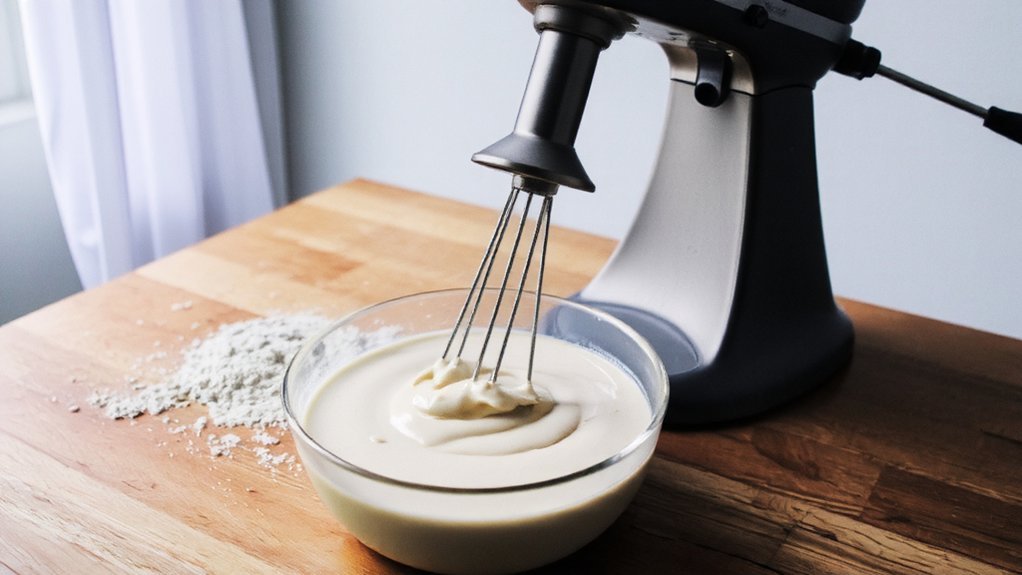

Key Takeaways
- Look for at least 200 watts of motor power to handle thick doughs and batters without stuttering or stalling.
- Variable speed control from 1-9 ensures proper aeration, emulsification, and prevents flour clouds when combining dry ingredients.
- Choose models with ergonomic handles weighing 3-5 pounds to reduce wrist fatigue during extended mixing sessions.
- Select quieter motors below 75 decibels with noise-dampening technology for comfortable household use at any time.
- Verify multiple attachments including beaters, dough hooks, and whisks to maximize versatility across different baking recipes.
Essential Features to Consider When Choosing a Hand Mixer

A hand mixer’s primary function is to blend, whip, and incorporate ingredients with mechanical efficiency that surpasses manual effort. When you’re working with dense batters or stiff meringues, you’ll appreciate how a quality hand mixer transforms tedious manual whisking into streamlined preparation.
You’ll want to prioritize models featuring an ergonomic handle that distributes weight evenly across your palm and fingers, reducing fatigue during extended mixing sessions. A comfortable grip becomes essential when you’re beating egg whites for fifteen minutes or creaming butter and sugar until pale and fluffy.
Noise levels substantially impact your baking experience, particularly if you’re mixing early mornings or late evenings. You’ll find that quieter motors operating below seventy-five decibels allow you to focus on ingredient incorporation without jarring disruption.
Premium models employ noise-dampening technology that doesn’t compromise power delivery, meaning you’re not sacrificing performance for peace.
When selecting your mixer, consider the motor’s wattage carefully. You’ll need at least two hundred watts for consistently handling thick cookie doughs and muffin batters without motor strain.
Models exceeding three hundred watts provide reserve power that prevents stuttering when you’re incorporating dense ingredients like mashed bananas or chocolate chips.
Speed control proves indispensable for achieving proper emulsification and aeration. You’ll want variable speeds ranging from one through nine, allowing you to start slowly when combining dry ingredients and gradually accelerate for ideal whipping action.
This precision prevents flour clouds and guarantees even distribution of leavening agents throughout your batter.
Attachment options determine your mixer’s versatility. Standard beaters work for most applications, but you’ll benefit from dough hooks when preparing yeast breads, requiring significant kneading action.
Whisk attachments excel at aerating eggs and cream, creating the volume necessary for delicate sponge cakes and mousses.
Weight and balance matter more than you might expect. You’ll appreciate a mixer weighing between three and five pounds—substantial enough for stability but manageable for extended handheld use.
Poorly balanced models tire your wrist unnecessarily, diminishing mixing quality toward the end of your session.
Finally, you’ll want warranty coverage exceeding two years, reflecting manufacturer confidence in their engineering. Choose hand mixers constructed from durable materials like stainless steel components and heat-resistant handles that won’t degrade with repeated use.
Your investment in quality equipment directly impacts your baking consistency and overall enjoyment of the craft.
Frequently Asked Questions
Can Hand Mixers Handle Thick Cookie Dough or Bread Dough?
You can handle thick cookie dough, but bread dough’ll push most hand mixers to their limits.
Check your beater types—flat beaters work better than wire whisks for dense mixtures.
Don’t overload the bowl; you’ll risk motor burnout.
For serious kneading techniques, you’re better off using a stand mixer or doing it by hand.
Your freedom to choose depends on dough consistency and your mixer’s wattage rating.
How Long Do Hand Mixer Motors Typically Last Before Replacement?
Your hand mixer’s motor lifespan typically ranges from 5-10 years, depending on your usage patterns. If you’re regularly mixing dense dough or thick batters, you’ll stress the motor more, reducing its longevity.
Light-duty mixing extends motor life considerably. Quality construction matters—premium models withstand rigorous ingredient work better. You’re not locked into replacement; many manufacturers offer affordable motor replacements, letting you maintain your preferred mixer rather than scrapping it entirely.
Are Hand Mixers Better Than Stand Mixers for Small Batches?
Yes, hand mixers excel for small batches.
You’ll appreciate their portability advantages—they’re lightweight and take up minimal counter space.
Cleaning ease matters too; you’ll rinse components quickly without disassembling complex machinery.
For ingredient-focused work, you’ve got direct control over mixing speeds and techniques.
Hand mixers won’t overwork delicate batters, giving you the freedom to achieve precise textures.
You’re choosing efficiency and simplicity over bulky equipment for modest baking projects.
What’s the Average Price Range for Quality Hand Mixers?
You’ll find quality hand mixers ranging from $25–$150, depending on your budget tiers and needs.
Entry-level models ($25–$50) handle basic mixing tasks effectively.
Mid-range options ($50–$100) offer superior motor power and enhanced whisk designs for demanding batters.
Premium mixers ($100–$150) feature advanced technology and ergonomic controls. Your feature comparison should prioritize wattage, bowl capacity, and attachment variety to maximize your baking freedom without overspending.
Do Hand Mixers Come With Warranty Coverage and Customer Support?
Yes, you’ll find warranty lengths vary substantially among manufacturers—typically ranging from one to three years.
Most reputable brands offer extensive aftercare services including replacement parts, repair support, and technical guidance.
You’re not locked into limited options; premium models often provide extended coverage plans you can purchase.
When selecting your mixer, verify the specific warranty terms and aftercare availability, ensuring you’ve got the freedom to maintain your equipment without unexpected costs or service limitations.



Leave a Comment