

Key Takeaways
- Wire mesh designs offer superior airflow and rapid, uniform heat dissipation for fastest cooling performance.
- Stainless steel racks with non-slip feet provide durability, stability, and 7–10 year longevity with extended warranties.
- Stackable three-tier models maximize counter space while cooling multiple batches of baked goods simultaneously.
- Grid designs support heavier items better but leave slight marks; mesh minimizes imprints on delicate pastries.
- Dishwasher-compatible racks with nonstick surfaces simplify cleanup while stainless steel resists staining and odor retention.
Types of Cooling Racks

You’ll find cooling racks come in several distinct varieties, each designed to suit different baking needs and kitchen spaces. Wire racks represent the most popular option, featuring sturdy construction that promotes ideal air circulation around your baked goods.
Stackable models maximize your counter space, allowing you to cool multiple batches simultaneously without cluttering your kitchen.
For those prioritizing aesthetics, decorative styles incorporate ornamental feet and attractive finishes that complement your décor. Collapsible racks offer portability and convenient storage when you’re not baking.
Some manufacturers produce seasonal themes—autumn leaves, winter snowflakes, or holiday patterns—allowing you to refresh your kitchen’s appearance throughout the year.
Commercial-grade racks provide heavy-duty durability for serious bakers. Ultimately, your choice depends on your baking frequency, available space, and personal preferences. Select what works best for your needs.
Wire Mesh vs. Grid Design
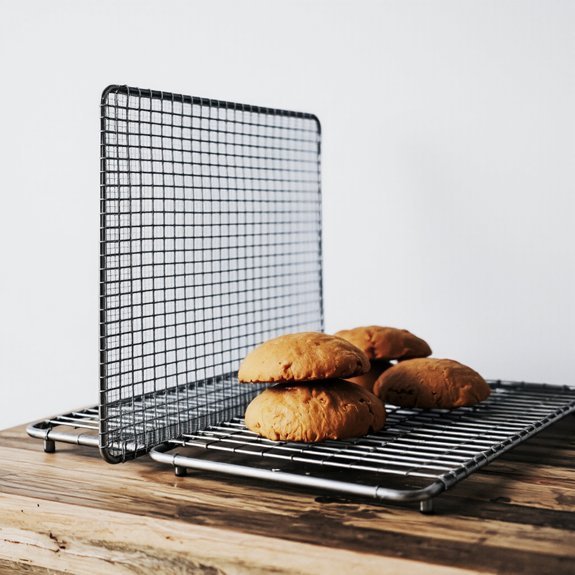
When you choose between wire mesh and grid design cooling racks, you’ll notice distinct differences in how air circulates around your baked goods—mesh designs typically offer superior airflow due to their smaller openings, while grids create larger gaps that may allow some items to sag slightly.
You should consider the surface contact each design provides: mesh racks distribute weight more evenly across numerous support points, whereas grid racks concentrate contact on fewer, thicker wires that can leave marks on delicate surfaces.
Your maintenance routine will differ as well, since mesh designs trap more crumbs and debris requiring thorough cleaning, while grid patterns allow easier access for quick wipe-downs.
Air Circulation Differences
Beneath the surface of cooling rack design, air circulation patterns diverge markedly between wire mesh and grid configurations. You’ll notice distinct differences in how each style manages heat dissipation through convection patterns and ventilation efficiency.
| Feature | Wire Mesh | Grid Design |
|---|---|---|
| Airflow Direction | Multidirectional | Channeled paths |
| Ventilation Efficiency | Higher surface contact | Lower obstruction |
| Convection Patterns | Turbulent circulation | Laminar flow |
| Heat Dissipation | Rapid, uniform | Moderate, directional |
Wire mesh designs give you superior airflow because their tightly woven construction creates turbulent convection patterns that surround baked goods from all angles. Grid designs, conversely, channel air through defined pathways, offering less surface contact but reducing obstruction. You’ll achieve faster cooling with mesh racks when maximum ventilation efficiency matters. Grid racks work better when you need gentle, controlled air movement. Your choice depends on whether you prioritize speed or precision in your cooling process.
Surface Contact Comparison
While airflow patterns establish the foundation for cooling efficiency, the actual contact between your baked goods and the rack surface plays an equally important role in heat transfer.
Wire mesh designs distribute contact pressure evenly across smaller surface areas, minimizing pattern imprints on delicate items like cookies and pastries. Grid designs, conversely, concentrate pressure on larger intersection points, potentially creating visible marks on softer baked goods.
You’ll find wire mesh superior for items requiring pristine appearances. Grid patterns, however, offer enhanced structural support for heavier cakes and breads. The choice depends on your priorities: aesthetic preservation versus load-bearing capacity. Understanding these surface contact differences empowers you to select the rack that best serves your specific baking needs, ensuring ideal results with complete control over your cooling process.
Durability and Maintenance Needs
As your cooling racks age, their construction type directly influences how well they’ll withstand repeated use and cleaning.
| Feature | Wire Mesh | Grid Design |
|---|---|---|
| Rust Resistance | Moderate | High |
| Dishwasher Safe | Limited | Full |
| Longevity | 3-5 years | 7-10 years |
| Warranty Coverage | 1-2 years | 3-5 years |
| Replacement Availability | Common | Widely Available |
Wire mesh racks demand regular inspection for corrosion spots, particularly in humid kitchens. You’ll find grid designs more forgiving—they resist warping and maintain structural integrity through countless wash cycles. Grid construction also offers superior warranty coverage and easier replacement availability when damage occurs. If you prioritize independence from frequent replacements, grid designs deliver better long-term value. Wire mesh requires more vigilant maintenance but costs less upfront. Your choice hinges on whether you’ll invest time in care or accept higher initial expenses for durability.
Size and Space Considerations
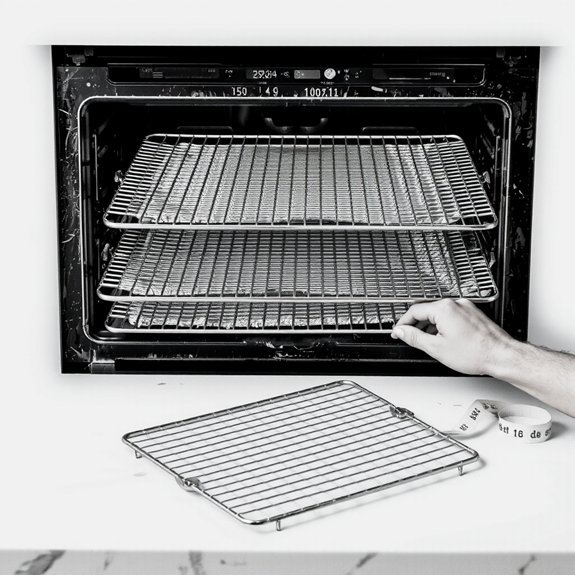
Choosing the right cooling rack dimensions depends on your kitchen layout and baking volume.
You’ll want to assess your counter footprint first—measure the available space where you’ll store or use your rack regularly.
Consider whether you’re working in a compact kitchen or have expansive counter real estate.
Standard racks measure 10×16 inches, fitting most standard sheet pans.
However, larger commercial-grade racks extend up to 18×26 inches, demanding more cabinet fit consideration.
Stackable designs offer flexibility if you bake frequently but lack storage space.
Think vertically if horizontal room’s limited.
Wall-mounted or tiered racks maximize efficiency without consuming valuable counter area.
Your choice directly impacts workflow—too small and you’ll bottleneck production; too large and you’ll sacrifice functionality.
Match dimensions to your actual baking needs, not idealistic aspirations.
Material Durability and Safety

You’ll frequently encounter three primary materials in cooling rack construction: stainless steel, chrome-plated steel, and nonstick coatings. Each offers distinct advantages for your baking needs.
| Material | Food Grade Certified | Heat Resistance | Recyclability |
|---|---|---|---|
| Stainless Steel | Yes | 500°F+ | Highly recyclable |
| Chrome-Plated Steel | Varies | 400°F+ | Limited recyclability |
| Nonstick Coating | Yes | 350°F | Recyclability concerns |
Stainless steel racks provide superior durability and withstand repeated use without degradation. Chrome-plated options offer affordability but may chip over time, exposing underlying steel. Nonstick surfaces require careful handling to prevent coating damage that compromises food safety.
Verify food grade certification before purchasing, ensuring your rack won’t leach harmful substances onto baked goods. Consider recyclability concerns—stainless steel remains the most environmentally responsible choice when your rack reaches end-of-life, allowing you to dispose responsibly without waste guilt.
Heat Resistance and Performance

When you place a hot baking sheet directly onto a cooling rack, the rack’s heat resistance determines how it’ll perform under thermal stress.
A cooling rack’s heat resistance is critical when bearing the thermal stress of a hot baking sheet.
Quality racks withstand repeated thermal cycling without warping or degrading.
You’ll notice superior models maintain structural integrity even when exposed to extreme temperature fluctuations.
Heat retention affects cooling efficiency.
Racks with efficient designs dissipate heat quickly rather than absorbing it, allowing your baked goods to cool uniformly.
Steel and stainless steel options outperform inferior materials that retain excessive warmth.
You’re investing in longevity when you choose racks engineered for sustained high-temperature exposure.
These won’t degrade, discolor, or develop weak points after years of use.
Performance-tested cooling racks give you reliability and consistent results every time you bake.
Stackable and Collapsible Options
Space constraints often determine which cooling racks work best in your kitchen.
You’ll appreciate models that collapse when you’re not using them, freeing up valuable cabinet or drawer space.
These innovative designs give you flexibility without sacrificing functionality.
Look for racks featuring:
- Durable locking mechanisms that hold positions securely
- Lightweight frames that collapse with minimal effort
- Non-slip feet preventing shifting during use
- Quick assembly tips requiring no tools
- Stable stacked configurations for multiple racks
When evaluating stackable options, check that locking mechanisms engage firmly to prevent accidental collapse.
Review assembly tips provided by manufacturers to make sure you’re setting them up correctly.
You’ll gain the freedom to store your cooling racks efficiently while maintaining their structural integrity and performance when you need them most.
Non-Slip Feet and Stability
You’ll want to make sure your cooling rack features rubber feet that prevent slipping on countertops and stovetops during use.
The stability these feet provide becomes essential when you’re placing hot baked goods on the rack, as any shifting can compromise your results or create safety hazards.
Your choice of rack with superior surface grip performance directly impacts how reliably it remains stationary under the weight and movement involved in heavy baking sessions.
Rubber Feet Prevent Slipping
Because cooling racks sit on countertops and stovetops where they’re frequently moved and adjusted, rubber feet play a critical role in preventing unwanted slipping.
You’ll appreciate how quality rubber feet deliver multiple benefits:
- Grip surfaces securely without marring countertops
- Reduce noise reduction when you shift the rack around
- Enhance child safety by keeping the rack stationary during handling
- Maintain stability even on smooth, slippery surfaces
- Resist wear and degradation over extended use
When you’re working with hot baked goods, you need confidence that your cooling rack won’t slide unexpectedly.
Rubber feet absorb movement and vibration, giving you complete control.
You’re free to reposition your rack without worry, knowing it’ll stay exactly where you place it.
This stability matters whether you’re a casual baker or serious enthusiast demanding reliability from your equipment.
Stability During Heavy Use
When cooling racks endure repeated repositioning and support multiple batches of baked goods simultaneously, non-slip feet become essential for maintaining structural integrity. You’ll find that quality racks undergo rigorous load testing to guarantee they won’t shift during heavy use.
The rubber feet distribute weight evenly across your work surface, preventing the rack from sliding when you’re moving hot items or stacking multiple trays. This stability matters because you’re free to work efficiently without constantly readjusting your equipment.
Proper weight distribution means you can confidently place dense baked goods on any section of the rack without worrying about tipping or movement. When you’re managing a busy kitchen, you need cooling racks that stay put, allowing you to focus entirely on your baking production without compromises.
Surface Grip Performance Matters
The effectiveness of non-slip feet directly determines whether a cooling rack maintains its position on various kitchen surfaces.
You’ll want to evaluate grip metrics carefully when selecting your rack, as superior coating textures prevent unwanted movement during baking sessions.
Consider these essential grip features:
- Rubber or silicone feet that resist sliding on countertops
- Textured surfaces that increase friction contact
- Materials rated for high-temperature stability
- Feet designed for both smooth and textured counters
- Durable coatings that withstand repeated use
You gain control and confidence when your cooling rack stays exactly where you place it.
Quality non-slip feet protect your work surface while preventing spills and accidents. Prioritize racks with independently tested grip performance, ensuring they’ll hold firm regardless of your kitchen’s layout or counter material.
Ease of Cleaning and Maintenance
Maintaining your cooling rack doesn’t require specialized techniques or excessive effort.
You’ll appreciate dishwasher compatibility—many quality racks withstand high-temperature cycles without warping or coating damage.
Hand washing works equally well; simply use hot soapy water and a soft brush to dislodge dried residue.
Residue release matters considerably.
Non-stick coatings facilitate effortless cleanup, preventing baked-on material from bonding permanently.
Stainless steel options resist staining and don’t retain odors, making them exceptionally low-maintenance.
For stubborn buildup, soak your rack in warm water for fifteen minutes before scrubbing.
Air-dry completely to prevent water spots.
Store your rack flat or upright in a cabinet—either orientation works fine.
Smart maintenance preserves your rack’s longevity and performance, ensuring years of reliable service without compromise.
Top-Rated Cooling Rack Models
Quality separates exceptional cooling racks from mediocre ones.
Several models consistently outperform their competitors.
You’ll find that brand comparisons reveal distinct advantages across different options.
User testimonials highlight which racks truly deliver results without compromise.
User testimonials reveal which cooling racks truly deliver exceptional results without any compromise.
Consider these top performers:
- Wilton three-tier steel racks for serious bakers
- Checkered Chef stainless steel designs for durability
- Libertyware commercial-grade models for heavy use
- AirBake nonstick surfaces for effortless release
- Mrs. Anderson’s silicone feet for stability
You deserve equipment that matches your baking ambitions.
These models consistently earn praise for their construction quality and performance reliability.
They won’t let you down when you’re tackling ambitious projects.
Each option offers distinct benefits, so you can choose based on your specific needs and preferences.
How to Choose the Right Cooling Rack for Your Kitchen
What factors should guide your cooling rack selection?
You’ll want to evaluate size first—measure your counter space and oven capacity to guarantee proper fit.
Consider the material; stainless steel offers durability and easy cleaning, while nonstick surfaces prevent sticking but require gentler handling.
Budget planning matters substantially.
Entry-level racks cost under $15, while premium models exceed $50.
Determine your baking frequency to justify spending.
Height becomes essential for airflow.
Taller racks promote better circulation around baked goods.
Check the grid spacing too—smaller gaps work for cookies, larger ones for bread.
Aesthetic match shouldn’t be overlooked.
Your rack should complement your kitchen’s style, whether modern or traditional.
Finally, read reviews about stability and weight capacity to avoid wobbling during use.
Frequently Asked Questions
Can Cooling Racks Be Used for Purposes Other Than Cooling Baked Goods?
Yes, you’re not limited to cooling baked goods. You can repurpose your cooling rack as a dehydration rack for fruits, vegetables, or herbs—it’ll maximize airflow for efficient drying.
Use it as a craft organizer by storing small supplies, jewelry, or office items on each tier. You’ll appreciate the versatile mesh design that accommodates various projects.
These racks offer practical storage solutions and liberate you from single-use kitchen tools, giving you flexibility to customize your space independently.
What Is the Ideal Cooling Time for Different Types of Baked Products?
You’ll find cookie cooling requires just 2-3 minutes on the rack before transferring to storage.
Cake resting demands 10-15 minutes in the pan, then 30-45 minutes on the cooling rack for structural stability.
Bread cooling takes 1-2 hours for proper crumb formation.
Pastries need 5-10 minutes.
Don’t rush these timelines—they’re essential for achieving your desired texture and preventing collapse.
Your baking success depends on respecting these cooling periods.
How Do Cooling Racks Improve Air Circulation Compared to Cooling on Countertops?
You’ll notice cooling racks deliver superior results through elevated airflow and bottom ventilation that countertops simply can’t match. By lifting your baked goods off the surface, you’re creating space for air circulation underneath—something a flat countertop blocks entirely.
This unrestricted airflow prevents moisture from trapping underneath, eliminating that soggy bottom problem. You’re taking control of your cooling process, ensuring even temperature reduction and maintaining the independence to achieve professional-quality results in your own kitchen.
Are Cooling Racks Dishwasher Safe, or Should They Be Hand Washed Only?
You’ll find most cooling racks are dishwasher safe, though hand washing extends coating durability considerably.
High heat and aggressive detergents can compromise protective finishes, undermining rust prevention capabilities.
To maintain your rack’s integrity, you’re better off washing by hand with warm soapy water.
This straightforward approach keeps your cooling rack functioning optimally for years, preserving the coating that guards against corrosion and guarantees reliable performance whenever you need it.
What Size Cooling Rack Works Best for Standard Home Oven Dimensions?
You’ll want a 16×24-inch cooling rack for standard home ovens—it’s the most common Oven Compatible Size.
This dimension gives you ideal Rack Clearance from your oven walls, typically leaving 1-2 inches on each side.
Make sure you’re measuring your actual oven cavity before purchasing.
Half-sheet pans pair perfectly with this size, letting you bake and cool freely without restrictions.
Verify your specific oven’s interior dimensions to guarantee the best fit for your baking independence.



Leave a Comment