

Key Takeaways
- Prioritize ball bearing mechanisms and sealed designs to ensure smooth, wobble-free rotation during frosting and decorating work.
- Select turntables with verified weight capacity for multi-tiered cakes and non-slip surfaces on both platform and base.
- Choose models featuring low-torque rotation requiring minimal hand effort to reduce fatigue during extended decorating sessions.
- Look for height-adjustable turntables with secure locking mechanisms to position at eye level and improve ergonomics.
- Opt for stainless steel bases and polycarbonate platforms from manufacturers offering warranties and positive customer reviews.
What to Look for in a Cake Turntable
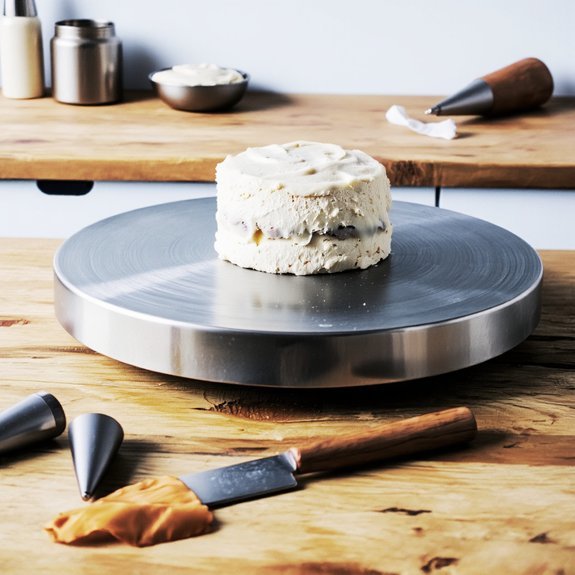
A cake turntable—also called a rotating cake stand or decorating turntable—is a circular platform that rotates on a bearing mechanism, allowing bakers and decorators to access all sides of a cake without manually repositioning it.
A cake turntable—a rotating platform on a bearing mechanism—lets bakers access all sides of their cake without repositioning it.
When you’re selecting the best turntable for your needs, you’ll want to take into account several critical factors that directly impact your decorating efficiency and final product quality.
Rotational stability forms the foundation of any reliable turntable.
You’ll benefit from models featuring ball bearings or sealed mechanisms that prevent wobbling during application of frosting, fondant, or intricate designs.
The platform’s weight capacity matters substantially—you’re looking for turntables that can support multi-tiered cakes without tilting or grinding.
Quality construction typically means non-slip surfaces on both the rotating platform and the base, ensuring your cake won’t shift unexpectedly while you’re working.
You’ll appreciate models with smooth rotation that doesn’t require excessive force to turn, as this reduces hand fatigue during extended decorating sessions.
Height adjustment capabilities give you greater control over your workspace ergonomics.
You’re able to position your cake at eye level, which reduces neck and back strain during detailed work.
The best turntables offer multiple height settings or continuous adjustment mechanisms, accommodating various cake sizes and decorator preferences.
Some premium models include locking mechanisms that hold your chosen height securely, preventing unwanted drops while you’re focused on your design work.
You’ll find that material composition directly affects durability and maintenance.
Stainless steel bases resist corrosion and withstand the moisture inherent in baking environments.
Plastic platforms might seem economical initially, but quality polycarbonate or acrylic options provide better longevity and cleaner aesthetics than cheaper alternatives.
You’re investing in equipment that’ll handle repeated exposure to water, oils, and acidic cake components.
The diameter you choose depends on your typical cake sizes.
You’re generally safe with 12-inch platforms for standard cakes, though larger decorators often prefer 15-inch surfaces for more maneuvering space.
Conversely, smaller turntables suit cupcake decorating and miniature cake work.
When you’re evaluating your options, prioritize models from manufacturers with verified customer reviews and warranty coverage.
You’re making an equipment investment that should deliver consistent performance across hundreds of decorating projects.
Don’t compromise on bearing quality or platform stability—these elements directly determine whether your decorating experience enhances or hinders your creativity and productivity.
Frequently Asked Questions
How Do I Clean and Maintain My Cake Turntable Properly?
You’ll maintain your cake turntable by washing it immediately after use with hot, soapy water and a soft cloth.
For sanitizing methods, run it through your dishwasher’s hot cycle or use a food-safe sanitizing solution.
Dry it thoroughly to prevent rust.
Storage tips include keeping it in a cool, dry cabinet away from moisture and extreme temperatures. Store the ball bearing separately if removable to extend its lifespan and guarantee peak rotation performance.
Can I Use a Cake Turntable for Tasks Other Than Decorating?
You’ll find your cake turntable remarkably versatile beyond decorating. It’s ideal for food photography, allowing you to rotate your subject for best angle capture without manual repositioning.
You can leverage it for craft projects requiring 360-degree access—jewelry making, model assembly, or painting detailed miniatures. The turntable’s smooth rotation eliminates unnecessary movement, ensuring precision work.
Its stable platform supports various weights, making it an efficient workspace addition that maximizes your creative freedom and productivity.
What’s the Price Range for Quality Cake Turntables?
You’ll find quality cake turntables ranging from $20–$50 for budget options that deliver solid performance. Mid-range models cost $50–$150, offering superior stability and smoother rotation.
Luxury models exceed $150, featuring premium materials and precision engineering. Your choice depends on frequency of use and professional requirements.
You’re not locked into expensive equipment; budget options serve home decorators well, while professionals justify investing in high-end turntables for consistent, reliable results.
Do Professional Bakers Prefer Ball Bearings or Other Rotation Mechanisms?
You’ll find professional bakers overwhelmingly favor ball bearing mechanisms for superior bearing performance and smooth rotation control.
They appreciate the precision ball bearings deliver when you’re executing detailed piping work or applying intricate fondant designs.
While geared alternatives exist, they’re generally considered inferior for professional applications—you’ll encounter resistance and inconsistent speeds that compromise your craftsmanship.
Ball bearings remain the industry standard because you’re empowered to work with complete rotational fluidity and reliability.
How Do I Prevent My Cake From Slipping on the Turntable?
You’ll prevent slipping by using nonstick mats designed for turntables—they’ve got superior grip without damaging your cake’s base.
Chill your cake’s bottom before placing it on the mat; cold surfaces create friction that locks everything in place.
You’re free to work confidently knowing your creation won’t shift.
Make sure the mat’s completely dry and positioned flat against the turntable’s surface for maximum stability during your decorating process.
Leave a Comment