
Key Takeaways
- Metal pans with aluminum or aluminized steel construction distribute heat evenly for consistent layer browning.
- Thicker gauge pans prevent warping and hot spots, ensuring professional-quality results across multiple layers.
- Standard 9-inch round pans at 2-inch depth work best; yield 12–16 servings per layer.
- Dark finishes absorb excess heat; light-colored pans provide more moderate, even browning for layers.
- Premium pans with reinforced edges maintain structural integrity through repeated high-heat baking cycles.
What Makes a Quality Cake Pan

How do you distinguish a reliable cake pan from a mediocre one? Several critical factors determine performance.
You’ll want to examine material quality—aluminum conducts heat efficiently, while steel offers durability. Check the pan’s thickness; heavier gauges resist warping and provide even baking.
Material quality matters: aluminum conducts heat efficiently while steel ensures durability, and heavier gauges prevent warping for even baking.
Brand reputation serves as a dependable indicator of craftsmanship. Established manufacturers maintain rigorous standards. User reviews provide invaluable insights into real-world performance, revealing how pans hold up over time.
Consider the finish: dark surfaces absorb more heat, potentially causing over-browning, while light finishes promote even coloring. Inspect edges for reinforcement—rolled edges indicate superior construction that won’t dent easily.
Non-stick coatings should be durable and PFOA-free. Ultimately, investing in quality pans grants you control over your baking results and eliminates frustrating failures.
Traditional Metal Cake Pans

Traditional metal cake pans remain the gold standard for serious bakers, and understanding their characteristics’ll help you select the right tools for consistent results.
| Feature | Benefit |
|---|---|
| Aluminum construction | Even heat distribution |
| Dark finish | Faster baking times |
| Vintage aesthetics | Timeless kitchen appeal |
| Collectible markets | Investment potential |
You’ll appreciate how metal pans conduct heat uniformly, preventing burnt edges and undercooked centers. Their durability means they’ll outlast inferior alternatives, making them economical long-term investments. Professional bakers prefer metal pans because they’re reliable and predictable—you control the outcome through technique, not equipment failure.
Vintage models possess distinctive vintage aesthetics that appeal to bakers valuing heritage craftsmanship. Certain brands command premium prices in collectible markets, reflecting their superior performance and construction quality. You’re investing in proven technology when you choose traditional metal pans.
Nonstick Cake Pan Options

When you select nonstick cake pans, you’ll want to evaluate their durability and long-term performance, as repeated use and cleaning can compromise the nonstick coating’s integrity.
You should also consider how effectively these pans distribute heat during baking, since uneven heat distribution directly affects your cake’s rise, browning, and overall texture.
Finally, you’ll appreciate the practical advantages nonstick surfaces offer: they facilitate cake release with minimal damage and substantially reduce cleanup time compared to traditional metal pans.
Durability and Long-Term Performance
Nonstick cake pans consistently deliver reliable performance when you understand their composition and maintenance requirements.
You’ll want to verify warranty coverage before purchasing, as quality manufacturers typically offer protection ranging from one to five years.
This safeguard shields your investment against defects and premature coating degradation.
You should know that nonstick coatings have evolved substantially.
Modern formulations minimize environmental impact compared to older PFOA-based alternatives, giving you peace of mind about your purchase choice.
Hand-washing extends pan longevity considerably—you’ll avoid dishwasher damage that compromises the nonstick surface.
You can expect superior performance when you maintain proper heat control and use appropriate utensils.
Quality nonstick pans withstand hundreds of uses when treated correctly, making them a practical choice for serious bakers who demand both durability and reliable results.
Heat Distribution and Baking Results
Because metal composition directly influences how heat conducts through your pan’s walls and base, you’ll notice significant differences in baking outcomes across various nonstick options. You’ll achieve superior crumb texture when selecting pans with aluminum cores, which distribute heat evenly and prevent hot spots that cause browning inconsistencies.
| Pan Material | Heat Conductivity | Baking Performance |
|---|---|---|
| Hard-anodized aluminum | Excellent | Superior evenness |
| Aluminized steel | Good | Consistent results |
| Stainless steel | Fair | Slower heating |
| Cast iron | Excellent | High browning |
| Copper-bottomed | Excellent | Precise control |
You’ll want to verify oven calibration before testing any new pan, ensuring your results reflect the cookware’s actual performance rather than temperature variance. Thicker gauge materials provide superior heat retention, eliminating temperature fluctuations that compromise your cakes’ structural integrity and appearance.
Ease of Release and Cleanup
After you’ve invested in quality pan materials and mastered even heat distribution, the nonstick coating’s performance during removal and cleaning becomes your primary concern for long-term usability. You’ll find that ingredient impact noticeably affects release ease—acidic batters and those with high fat content naturally slip from coated surfaces more readily than lean formulas.
Timing tricks matter considerably; you’ll achieve ideal results by allowing cakes to cool five to ten minutes before turning them out. This brief window prevents structural damage while the cake firms enough for confident handling.
Superior nonstick surfaces withstand repeated washing without degradation, preserving their non-stick properties for years. You’ll appreciate how properly maintained pans require minimal scrubbing, reducing time spent on cleanup while maximizing your pan’s lifespan and baking freedom.
Springform and Specialty Designs

You’ll find that springform pans offer distinct advantages over traditional designs, particularly when you’re working with delicate layers or no-bake constructions that require easy removal without flipping.
Specialty designs—including hexagonal, heart-shaped, and tiered options—expand your creative possibilities, though they demand specific recipes and techniques tailored to their unique dimensions.
Understanding when to deploy springform pans versus specialty designs depends on your cake structure, demolding requirements, and whether your recipe architecture suits unconventional shapes.
Springform Pan Advantages
While traditional cake pans require careful removal techniques, springform pans offer distinct structural advantages that make them particularly valuable for layered desserts.
You’ll appreciate how the removable sides eliminate extraction risks entirely, protecting delicate desserts from damage during unmolding.
This design grants you unprecedented control over presentation—you’re not wrestling with your creation, simply releasing the collar and sliding away the base when ready.
For layer transport, springform pans excel by keeping your assembled cake intact throughout moving and serving.
The secure locking mechanism prevents shifting between layers, maintaining structural integrity where traditional pans might compromise your work.
You gain flexibility in timing too; assemble your layers hours ahead without worrying about removal complications.
This straightforward functionality transforms baking from stressful to manageable, giving you true freedom in your dessert-making process.
Specialty Designs Explained
Beyond the springform’s removable-collar system, specialty cake pans incorporate engineered features that address specific baking challenges and layer-cake requirements.
You’ll discover novel shapes—hexagonal, square, and heart designs—that transform your standard layer cake into a striking centerpiece.
These themed molds let you express creative vision without compromising structural integrity.
Specialty pans feature reinforced edges that prevent warping during high-heat baking, ensuring even cake rise and level layers.
Non-stick coatings vary in durability; you’ll want heavy-duty options for frequent use.
Some designs include built-in dividers that create perfectly portioned sections, streamlining your decorating process.
When selecting specialty pans, prioritize construction quality and material thickness.
Cast aluminum and steel options provide superior heat distribution compared to thinner alternatives.
You’re investing in versatility and precision—tools that liberate your baking potential and expand your creative possibilities substantially.
When to Use Each
How do springform and specialty pans serve distinct baking purposes?
You’ll leverage springform pans when you need removable sides—ideal for no-bake cheesecakes or delicate frozen desserts.
Their removable design grants you freedom to showcase intricate presentations without damaging your creation.
Specialty designs demand careful Batter Compatibility consideration.
Heart-shaped pans work beautifully for romantic Occasion Pairings, while hexagonal or geometric molds suit modern celebrations.
You must make sure your batter fills these unconventional shapes adequately, preventing over- or under-baking issues.
Match pan selection to your specific occasion and batter viscosity.
Denser batters handle detailed molds better than delicate sponge cakes.
You’ll achieve professional results by aligning technical specifications with your design ambitions, guaranteeing every layer emerges perfectly formed and visually striking for your intended presentation.
Cake Pan Sizes and Dimensions
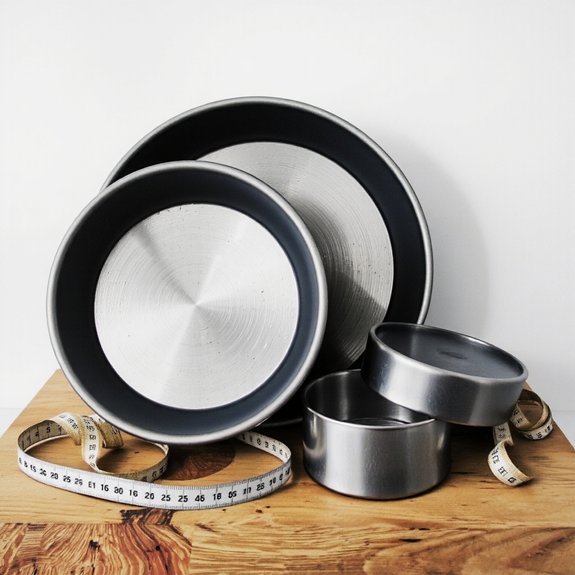
When you’re selecting cake pans for layer cakes, you’ll find that standard dimensions directly impact baking times, ingredient ratios, and final cake height. Understanding these specifications empowers you to make informed decisions that align with your baking goals.
| Pan Size | Diameter | Depth |
|---|---|---|
| Round | 6 inches | 2 inches |
| Round | 8 inches | 2 inches |
| Round | 9 inches | 2 inches |
| Round | 10 inches | 2 inches |
You’ll appreciate how pan nesting streamlines your storage while serving estimates guide your recipe scaling. Six-inch pans yield 8-10 servings, while 9-inch pans produce 12-16 servings. These dimensions determine your batter volume requirements and cooling specifications. Match your pan selection to your guest count and desired cake structure for ideal results.
Heat Distribution and Even Baking
While pan dimensions establish your batter volume and serving capacity, the material composition and thermal properties of your pans directly determine how evenly that batter bakes.
You’ll want aluminum or steel pans that conduct heat efficiently, promoting uniform rise and browning across all layers.
Dark-colored pans absorb more heat, potentially causing over-browning on edges, while lighter finishes distribute warmth more moderately.
Your oven’s kitchen airflow notably impacts results—position pans with adequate spacing for air circulation.
Ambient humidity affects batter consistency and baking time, so you’ll need to monitor your specific kitchen conditions.
Professional bakers rotate pans halfway through baking to counteract hot spots.
Durability and Longevity
You’ll find that material quality directly impacts how well your cake pans withstand repeated use and high oven temperatures over years of baking.
Superior construction guarantees consistent heat distribution excellence, preventing warping and hot spots that compromise both durability and baking results.
You’ll need pans with protective coatings and reinforced edges to resist rust and wear, ultimately extending your investment’s lifespan.
Material Quality Matters
Since cake pan performance deteriorates substantially with inferior materials, selecting quality construction directly impacts how long your baking equipment’ll last.
Premium aluminum and steel pans resist warping, denting, and corrosion far better than budget alternatives, ensuring consistent results across countless bakes.
You’ll benefit from sustainable materials sourced through ethical sourcing practices, which guarantee environmental responsibility without compromising performance.
Quality nonstick coatings maintain their integrity longer, preventing flaking that contaminates your baked goods.
Reinforced edges and sturdy handles withstand repeated use without bending or loosening.
Investing in high-grade cake pans means you’re choosing independence from frequent replacements and frustrating equipment failures.
Superior materials distribute heat evenly, eliminating hot spots that create uneven browning.
Your commitment to quality construction translates directly into reliable, long-lasting baking tools that deliver professional-level results consistently.
Heat Distribution Excellence
Even heat distribution directly extends your cake pans’ operational lifespan by preventing stress fractures that develop from thermal cycling.
You’ll achieve superior results when you select pans engineered with aluminum or steel cores that conduct heat uniformly across baking surfaces.
Modern cake pans now incorporate sensor integration technology, allowing you to monitor temperature accuracy in real-time.
This advancement prevents hot spots that compromise cake texture and structural integrity.
You’ll maximize energy efficiency by choosing pans that reduce baking time through consistent heat application.
Quality construction minimizes warping, ensuring your pans remain flat and reliable through hundreds of baking cycles.
Investing in thermally excellent pans grants you freedom from unpredictable baking outcomes.
You’re not constrained by uneven browning or moisture distribution issues.
Superior heat management delivers dependable performance every time you bake.
Rust and Wear Prevention
While superior heat distribution guarantees consistent baking performance, protecting your pans from corrosion and material degradation directly determines their long-term viability.
You’ll want to invest in pans with protective coatings and non-reactive materials that resist rust and wear. Stainless steel and hard-anodized aluminum offer superior durability compared to standard options.
| Material Type | Rust Resistance |
|---|---|
| Hard-Anodized Aluminum | Excellent |
| Stainless Steel | Superior |
| Carbon Steel | Good with seasoning |
| Non-Stick Coated | Variable |
Proper maintenance extends your pan’s lifespan substantially. Hand wash rather than using dishwashers, and dry immediately after cleaning. When your pans eventually reach end-of-life, explore disposal options through recycling programs in your area. Many manufacturers offer recycling programs specifically for worn baking equipment, ensuring responsible resource management.
How to Care for Your Cake Pans
To maximize your cake pans’ longevity and performance, you’ll need to establish consistent maintenance practices that protect their surfaces and structural integrity.
Hand-wash your pans immediately after use with warm, soapy water and a soft cloth, avoiding abrasive scrubbers that compromise non-stick coatings.
Dry thoroughly to prevent moisture accumulation and corrosion.
Implement a seasoning method for cast iron or steel pans by applying a thin oil layer after cleaning, enhancing non-stick properties and preventing rust development.
Store your pans in a climate-controlled environment away from humidity and temperature fluctuations.
Utilize proper storage tips by stacking pans with parchment paper between each layer, preventing scratches and maintaining surface quality.
These practices guarantee your cake pans remain reliable, functional baking tools for years.
Budget-Friendly vs. Premium Pans
When you’re selecting cake pans, the price difference between budget and premium options reflects distinct variations in material quality, construction methods, and performance characteristics.
You’ll find that investing in superior pans pays dividends through improved heat distribution and durability.
Consider these key distinctions:
- Budget pans offer acceptable performance for occasional bakers but may warp or develop hot spots
- Premium pans provide superior heat conductivity, consistent results, and extended longevity
- Resale market value favors quality pans, making them smarter long-term investments
You shouldn’t overlook the perceived value proposition.
Premium pans deliver measurable advantages: even browning, reduced baking time, and years of reliable use.
While budget options suit experimental bakers, you’ll achieve professional-quality layer cakes with premium construction.
Your freedom to choose depends on your baking frequency and desired outcomes—commitment to quality ultimately determines your success.
Our Top Recommended Cake Pans
Based on rigorous testing and performance metrics, several cake pan models consistently deliver exceptional results for layer cake baking. You’ll find that premium brands like USA Pan and Nordic Ware outperform budget alternatives in heat distribution and durability. Our brand comparisons reveal that aluminized steel construction provides superior performance over standard aluminum options.
| Brand | Best For |
|---|---|
| USA Pan | Professional-grade results |
| Nordic Ware | Even baking consistency |
| Wilton | Budget-conscious bakers |
These pans work exceptionally well for gift ideas when you’re equipping someone’s first kitchen. You’ll appreciate the non-stick surfaces that reduce prep time and cleanup. Each option offers distinct advantages—whether you’re prioritizing longevity, performance, or affordability. Your choice depends on your baking frequency and desired investment level.
Frequently Asked Questions
Can I Use Glass or Ceramic Baking Dishes Instead of Traditional Metal Cake Pans?
You can substitute glass or ceramic baking dishes for metal cake pans, though you’ll need temperature adjustments.
Glass and ceramic conduct heat differently, requiring you to reduce your oven temperature by 25°F to prevent over-browning.
They won’t deliver the same even baking results as metal, so monitor your cake closely.
You’re trading some precision for flexibility, but these alternatives work acceptably when you’ve got limited options available.
What’s the Difference Between Anodized Aluminum and Regular Aluminum Cake Pans?
You’ll find anodized aluminum pans offer superior surface durability through an electrochemical process that hardens the metal’s exterior, preventing rust and discoloration.
While both conduct heat effectively, anodized variants maintain consistent heat conductivity longer without degradation.
You’re getting enhanced longevity and performance reliability.
Regular aluminum requires careful maintenance and can react with acidic batters, potentially affecting cake flavor.
Your investment in anodized aluminum pays dividends through extended usability and superior baking results you’ll consistently achieve.
How Do I Prevent My Cake Layers From Sticking Despite Using Nonstick Pans?
You’ll prevent sticking by combining multiple techniques.
First, use parchment circles cut to fit your pan’s bottom precisely.
Second, employ proper greasing techniques—apply a thin, even coating of shortening or butter, then dust with flour or cocoa powder.
You’re creating a barrier that won’t interfere with browning. For nonstick pans specifically, you can reduce greasing slightly, but don’t skip it entirely. These layered defenses guarantee your cake releases cleanly every time.
Should I Preheat My Cake Pans Before Pouring in the Batter?
You shouldn’t preheat your cake pans. Preheating benefits bread and pastries, not cakes.
Instead, you’ll want to prepare your pans at room temperature for ideal batter spread. Cold pans allow your batter to distribute evenly without setting prematurely on the bottom.
This technique prevents uneven rise and cracking. Grease and flour your pans thoroughly just before pouring batter for superior results.
Can Vintage or Antique Cake Pans Be Safely Used for Baking Today?
You can safely use vintage cake pans if you’ve inspected them thoroughly.
Check for rust prevention by examining the interior surface—any flaking or deterioration requires replacement.
Critically important: test older pans for lead contamination, particularly those manufactured before 1970s safety regulations.
You’ll want professional testing if uncertain.
Modern vintage pans typically pose minimal risk when properly maintained, giving you freedom to utilize quality heirloom bakeware confidently and responsibly.
Leave a Comment