

Key Takeaways
- Select wild-caught salmon with firm, translucent flesh and bright coloring; verify sustainability labels and request freshly cut fillets.
- Remove pin bones with tweezers and decide whether to keep skin on for moisture or remove for delicate texture.
- Season just before baking with salt, pepper, fresh dill, and lemon; salt enhances flavor when applied 15–40 minutes prior.
- Preheat oven to 400°F and bake 1-inch fillets for 12–15 minutes until internal temperature reaches 145°F for optimal doneness.
- Use visual cues, internal thermometer readings, and the flake test together to confirm doneness; rest 3–5 minutes before serving.
Selecting Quality Salmon
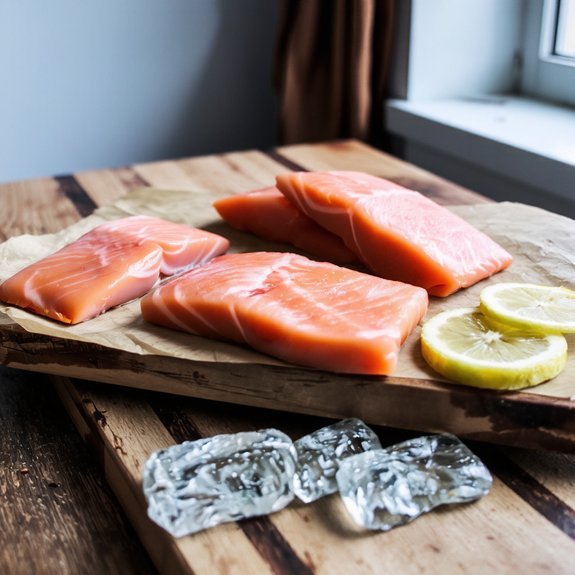
Why does salmon quality matter so much when you’re baking?
Superior fish yields better results because high-quality flesh contains ideal fat distribution and moisture content, ensuring even cooking and superior flavor development.
High-quality salmon’s ideal fat distribution and moisture content ensure even cooking and superior flavor development in baked dishes.
You’ll want to select wild-caught salmon whenever possible, as it typically exhibits firmer texture and more complex taste than farmed varieties.
Check for sustainability labels like MSC certification, which guarantees responsible fishing practices that preserve ocean ecosystems.
Consider seasonal availability in your region.
Spring and summer typically offer peak freshness when salmon migration patterns bring superior specimens to market.
You should inspect the flesh for firm texture, bright coloring, and a clean ocean scent—never ammonia odors.
Fresh salmon with proper handling transforms your baking results dramatically, delivering restaurant-quality outcomes through informed selection.
Preparing Your Salmon Fillets

You’ll begin by selecting quality fillets with firm, translucent flesh and no browning at the edges, which indicate freshness and ideal cooking results.
Next, you’ll remove any remaining pin bones using tweezers and decide whether to leave the skin on for added moisture retention or remove it for a more delicate texture.
Finally, you’ll season your fillets strategically with salt, pepper, and complementary herbs just before baking to enhance flavor while preventing moisture loss.
Selecting Quality Fish Fillets
When you’re ready to bake salmon, the quality of your fillets determines the dish’s success.
Look for firm flesh with a vibrant color—deep pink or orange indicates freshness and proper nutrition.
Check for environmental certifications like MSC or ASC labeling, ensuring your salmon comes from responsibly managed sources that respect ocean ecosystems and your freedom to choose ethically.
Consider market seasonality when purchasing.
Wild salmon peaks in summer and early fall, offering superior flavor and texture.
Farm-raised options provide consistency year-round but require certification verification.
Inspect the fillet’s surface for moisture without excessive liquid.
The flesh should spring back when pressed gently.
Avoid discolored patches or a dull appearance.
Request freshly cut fillets from the counter rather than pre-packaged options when possible—you’ll control thickness and quality directly.
Removing Bones and Skin
Preparing salmon fillets for baking requires removing both the pin bones and skin to achieve ideal texture and presentation. You’ll need a fine-tipped tweezers and sharp knife to execute this process efficiently.
| Tool | Purpose | Technique |
|---|---|---|
| Tweezers | Pin bone extraction | Grasp at angle, pull toward head |
| Knife | Skin separation | Angle blade at 30°, slice lengthwise |
| Paper towel | Grip enhancement | Improves traction during removal |
| Cutting board | Work surface | Stabilizes fillet during processing |
Consider bone repurposing by freezing them for stock preparation. Skin applications extend beyond waste—you can roast salmon skin separately for a nutrient-dense crispy snack. Both techniques maximize your ingredient utilization while minimizing kitchen waste. Your baked salmon will achieve superior texture without compromising nutritional integrity when you’ve properly prepared the fillet.
Seasoning Before Baking
How does proper seasoning transform baked salmon from adequate to exceptional? Understanding salt penetration reveals the key.
When you apply salt to your fillet’s surface, osmotic pressure forces it deeper into muscle tissue, enhancing flavor throughout rather than merely coating the exterior.
You’ll achieve best results by seasoning 15-40 minutes before baking, allowing adequate penetration time.
Marinade chemistry amplifies this effect—combining salt with acidic components like lemon juice or vinegar denatures proteins slightly, promoting moisture retention and tenderness.
You’re not limited to salt alone. Layer complementary seasonings: cracked black pepper, dried herbs, or fresh dill.
This strategic approach gives you complete control over your salmon’s final taste profile. Your freedom to experiment within these scientific parameters guarantees consistently superior results.
Essential Seasonings and Flavor Enhancements

Elevating baked salmon requires understanding how salt, acid, and fat interact with the fish’s delicate proteins and lipids. You’ll want to layer your seasonings strategically to maximize flavor without overpowering the salmon’s natural taste.
Salt enhances umami compounds and draws out the fish’s inherent sweetness. Acid balances richness through citrus juice or vinegar, brightening each bite.
You can introduce smoky accents using smoked paprika, cumin, or even a touch of liquid smoke to add complexity and depth.
Don’t overlook fat’s role—olive oil carries flavor compounds while protecting the salmon’s moisture. Combine these elements thoughtfully: perhaps lemon zest with fresh dill, or chili flakes with garlic. You control the intensity, adjusting ratios to suit your preferences. This scientific approach guarantees consistent, exceptional results every time you bake salmon.
Setting the Right Oven Temperature

Once you’ve layered your seasonings with precision, temperature becomes your next control variable. You’ll want to preheat your oven to 400°F, which gives you even heat distribution without drying your salmon. Oven calibration matters critically—use an independent thermometer to verify your oven’s actual temperature, as many units run hot or cold.
| Temperature | Cook Time | Result |
|---|---|---|
| 375°F | 15-18 min | Gentle, moist |
| 400°F | 12-15 min | Ideal balance |
| 425°F | 10-12 min | Firmer texture |
Rack positioning should be center-height, allowing air circulation around your fish. This placement prevents bottom burning while ensuring even top browning. You’re in command of your cooking environment—don’t settle for guesswork. Verify, adjust, and execute with confidence.
Determining the Perfect Cooking Time

Why does timing matter more than you’d think?
Because you’re in control of your salmon’s destiny.
Cook times vary based on thickness and portion scaling—a one-inch fillet needs roughly 12-15 minutes at 400°F, while thicker cuts demand 15-20 minutes.
Here’s the critical detail: remove your salmon when it reaches 145°F internally, accounting for carryover cooking.
Remove salmon at 145°F internally to account for carryover cooking and achieve perfect results every time.
That residual heat’ll continue cooking your fish 3-5 degrees after you’ve pulled it from the oven.
Don’t rely on appearance alone.
Use a meat thermometer for precision.
Insert it at the thickest point, parallel to the fillet.
You’ll achieve perfectly moist, flaky salmon every time—no guesswork, no dry disasters.
Your freedom to nail this technique starts with respecting the numbers.
How to Tell When Salmon Is Done
You’ll recognize properly baked salmon through three reliable indicators: visual color changes, an internal temperature test, and the flake test method.
Each method provides objective data about your salmon’s doneness without requiring guesswork. Together, these techniques guarantee you achieve consistent, perfectly cooked results every time.
Visual Color Changes
As salmon bakes, its flesh undergoes a distinct transformation from translucent to opaque, which serves as a reliable visual indicator of doneness.
This color shift results from myoglobin oxidation and pigment denaturation as heat penetrates the protein structure.
Initially, raw salmon displays a deep red or orange hue due to unconverted myoglobin.
As you bake it, the flesh gradually lightens, progressing through pink to pale salmon tones.
You’ll recognize fully cooked salmon when it achieves an opaque, light pink appearance throughout.
The flesh should no longer appear translucent or glossy.
This visual transformation typically occurs around 12-15 minutes at 400°F, depending on thickness.
Trust this color indicator—it’s your most immediate, judgment-free method for achieving perfectly baked salmon every time.
Internal Temperature Test
While visual cues provide initial guidance, an instant-read thermometer offers the most precise method for determining doneness.
You’ll achieve ideal results by understanding thermometer accuracy and calibration methods.
Here’s how you’ll verify your salmon’s internal temperature:
- Insert the thermometer into the thickest part of the fillet, avoiding bone contact
- Wait 3-5 seconds for an accurate reading without removing the probe
- Look for 145°F (63°C)—the FDA standard for food safety
- Verify thermometer accuracy monthly using ice water (32°F) and boiling water (212°F) calibration methods
You’re not guessing anymore.
This scientific approach eliminates uncertainty, ensuring perfectly baked salmon every time.
Don’t settle for approximation when precision is within your control.
Flake Test Method
How can you confirm doneness without a thermometer? You’ll use the probe technique to assess your salmon’s internal structure.
Insert a fork or thin metal skewer into the thickest portion of the fillet at a forty-five-degree angle. Gently twist and pull the utensil toward you, observing the flake consistency as the flesh separates.
Properly cooked salmon should flake easily into distinct, opaque pieces. The flesh won’t offer resistance and will break apart naturally along its muscle fibers.
If you encounter translucent sections or the fish resists flaking, it needs additional cooking time.
This method gives you complete control and immediate feedback. You’re not dependent on equipment—just your tactile assessment and visual observation. Master this technique, and you’ll consistently achieve perfectly baked salmon every time.
Techniques for Preventing Dry Fish
Maintaining ideal moisture content requires you to understand salmon’s protein structure and how heat denatures it.
Understanding salmon’s protein structure and heat denaturation is fundamental to maintaining ideal moisture content.
Protein molecules denature between 140-158°F, releasing moisture that escapes as steam.
You’ll prevent dryness by controlling this process strategically.
- Use sous vide finishing at 122-130°F for precise temperature control before searing
- Employ resting periods of 5-10 minutes post-cooking to redistribute internal fluids
- Apply protective salt crusts or herb coatings to create moisture barriers
- Maintain oven temperatures below 400°F to slow protein denaturation rates
You’re not bound by conventional cooking methods—these techniques grant you freedom to achieve restaurant-quality results consistently.
Monitoring internal temperature with a thermometer guarantees you’ll hit your target doneness without overshooting.
Your salmon emerges tender, succulent, and perfectly cooked every time.
Serving and Storing Your Baked Salmon
Your perfectly baked salmon deserves thoughtful handling once it leaves the oven.
Allow the fish to rest for three minutes, enabling carryover cooking and moisture redistribution.
Plate immediately with complementary side pairings—roasted vegetables, quinoa, or citrus-infused grains enhance the salmon’s delicate flavor profile without overwhelming it.
For storage tips, refrigerate leftovers within two hours in an airtight container.
Properly stored salmon remains safe for three to four days.
You can freeze portions for extended preservation; wrap them individually in parchment paper, then place in freezer bags to prevent oxidation and freezer burn.
Reheat gently at 275°F until the internal temperature reaches 125°F, preserving texture and nutritional integrity.
You’ll maintain your salmon’s quality and safety through deliberate post-cooking practices.
Frequently Asked Questions
Can I Bake Salmon From Frozen, or Must It Be Thawed First?
You can bake salmon directly from frozen, though thawing first yields superior results.
When baking frozen salmon, you’ll need to extend cooking time by approximately 50% and adjust your seasoning strategy—apply seasonings after thawing or use oil-based rubs that adhere better to icy surfaces.
Following USDA safety guidelines, make sure your salmon reaches an internal temperature of 145°F.
This approach gives you flexibility without compromising food safety or quality outcomes.
What’s the Difference Between Baking Salmon Skin-Side up Versus Skin-Side Down?
When you bake salmon skin-side down, you’ll achieve crispy skin through direct heat contact with the baking surface.
Conversely, skin-side up exposes the flesh directly to heat, yielding faster cooking and more moist flesh retention. You’re choosing between textural preference and moisture control. For ideal results, start skin-side down to render fat and crisp the dermis, then flip if needed for even cooking. Your method determines your final outcome’s structural integrity.
How Do I Remove Salmon’s Small Pin Bones Before Baking?
You’ll remove pin bones using the tweezers technique by locating them along your salmon’s centerline—they’re part of the fish’s anatomy running from head to tail.
Grasp each bone firmly with tweezers and pull at a slight angle following the bone’s natural direction.
Work systematically from head to tail, applying gentle pressure to avoid tearing the flesh.
This method guarantees clean extraction without compromising your fillet’s integrity before baking.
Can I Bake Multiple Salmon Fillets Simultaneously Without Affecting Cooking Time?
Yes, you can bake multiple salmon fillets simultaneously without extending cooking time, provided you’re mindful of oven crowding.
Arrange fillets with adequate spacing to promote proper heat circulation around each piece. You’ll want at least an inch between fillets.
This prevents steam accumulation and guarantees uniform temperature distribution throughout your batch. When you maintain this spacing protocol, your fillets cook consistently at the same rate as individual portions would.
What Wine Pairs Best With Baked Salmon for Serving?
You’ll want to select wines with sufficient acidity to cut through salmon’s richness. Sauvignon Blanc offers crisp acidity without oak influence, letting your fish’s delicate flavors shine. Pinot Noir works beautifully if you prefer red wine—its moderate tannins and acidity won’t overpower your baked salmon.
Alternatively, Albariño provides bracing acidity with subtle oak influence that complements the fish’s natural oils. Choose based on your sauce; lemon-based preparations pair excellently with unoaked whites, while herb-crusted fillets benefit from light oak presence.





Leave a Comment