
Key Takeaways
- Select firm, deep blue blueberries roughly 12–14 mm in diameter, wash gently, and pat dry thoroughly before baking.
- Sift flour and combine with baking powder, baking soda, and salt, then whisk for 30 seconds for even leavening.
- Fold wet ingredients into dry with 12–15 deliberate strokes until slightly lumpy, then gently fold in blueberries last.
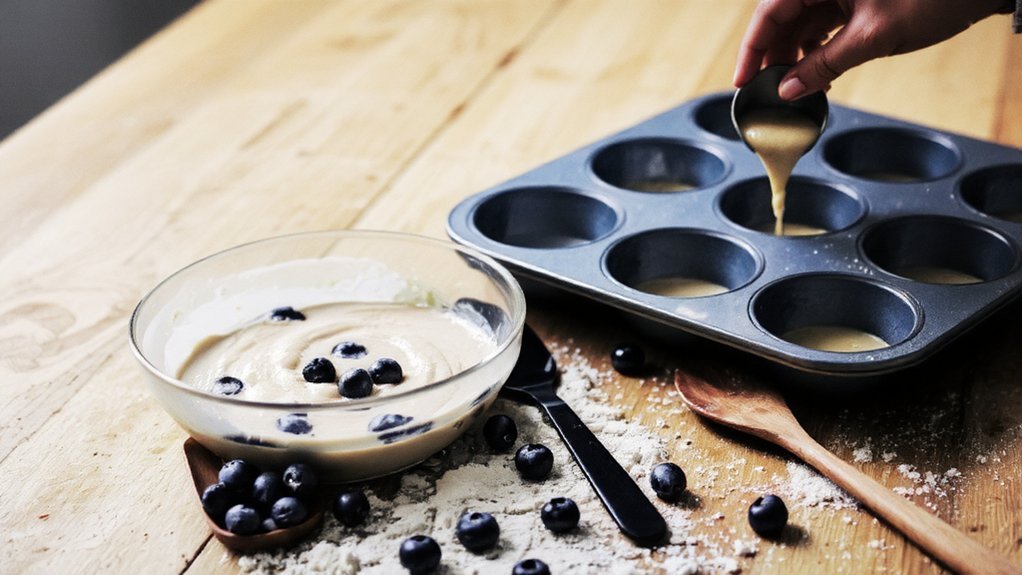
- Fill muffin cups two-thirds full, bake at 375°F for 18–22 minutes until golden-brown peaks form and toothpick emerges clean.
- Cool muffins in tin for 5 minutes, transfer to rack, and cool completely to prevent soggy bottoms before serving.
Gathering Your Ingredients
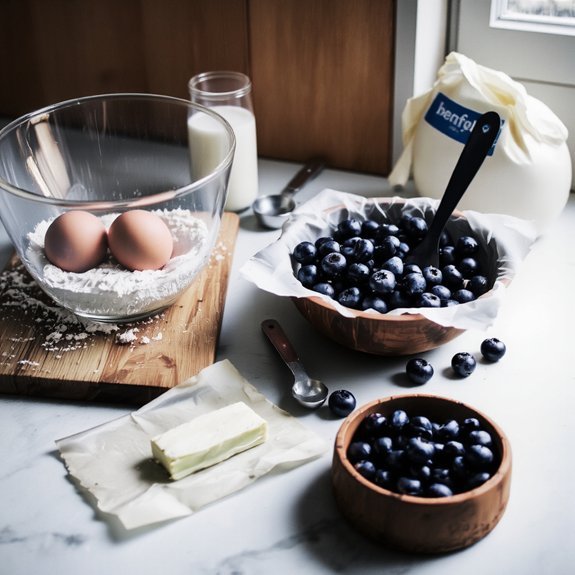
Before you begin mixing, gather 2 cups all-purpose flour, 1 tablespoon baking powder, ½ teaspoon salt, ¾ cup granulated sugar, 2 large eggs, 1 cup whole milk, ⅓ cup melted butter, 1 teaspoon vanilla extract, and 1½ cups fresh blueberries.
Gather 2 cups flour, baking powder, salt, sugar, eggs, milk, melted butter, vanilla, and fresh blueberries before mixing.
You’ll also need your equipment checklist: a muffin tin, paper liners, mixing bowls, measuring cups and spoons, a whisk, and a spatula. Don’t overlook a standard oven thermometer to verify accurate baking temperatures.
Consider allergen alternatives if you’re accommodating dietary restrictions. You can substitute all-purpose flour with a gluten-free blend or use plant-based milk instead of whole milk. Replace eggs with flax eggs—combine 2 tablespoons ground flaxseed with 6 tablespoons water per egg. Swap butter for coconut oil in equal proportions.
Arrange all components within arm’s reach before commencing. This preparation method, called mise en place, streamlines your workflow and prevents missing ingredients mid-process.
2. Selecting and Preparing Your Blueberries
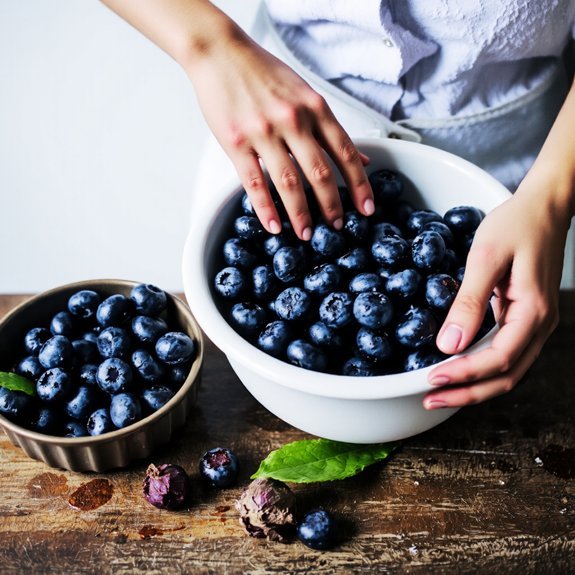
You’ll want to select blueberries that are firm, uniform in size, and exhibit a deep blue hue with a silvery bloom coating.
Rinse your blueberries under cool running water, gently agitating them to remove debris and dust without crushing the delicate skin.
Pat them dry thoroughly with paper towels or a clean cloth to prevent excess moisture from compromising your batter’s consistency.
Choosing Fresh Blueberries
What distinguishes superior muffins from mediocre ones often comes down to berry quality.
You’ll want to select plump, firm blueberries with deep blue coloring and a natural silvery bloom coating their surface.
This waxy layer indicates freshness and ideal ripeness.
Inspect berries individually for mold, soft spots, or shriveling—any defects compromise flavor profiles and nutritional benefits.
You’re looking for uniform size, roughly 12-14mm diameter, ensuring even baking and consistent moisture distribution throughout your muffins.
You have freedom in sourcing: farmers markets offer peak-season berries with superior taste complexity, while frozen cultivars work reliably year-round if thawed and drained properly.
Check harvest dates on packaging.
Fresh berries maintain enzymatic activity and antioxidant density better than aged stock, directly impacting your final product’s quality and nutritional integrity.
Washing and Drying Technique
Gently rinsing your blueberries under cool running water removes surface debris, dust, and residual pesticides while preserving the delicate skin integrity. You’ll want to use minimal gentle agitation—simply swirling berries in your palm rather than rubbing them aggressively. This technique maintains structural integrity while ensuring thorough cleansing.
| Drying Method | Duration |
|---|---|
| Cotton towel drying | 2-3 minutes |
| Air drying | 5-10 minutes |
| Colander straining | 1 minute |
| Paper towel absorption | 3-5 minutes |
After rinsing, employ cotton towel drying for ideal results. Lay berries on a clean cotton towel and gently pat them dry. This method prevents moisture accumulation that’d compromise your muffin’s crumb structure. You’re now prepared to incorporate perfectly prepared blueberries into your batter, ensuring consistent baking performance and superior texture throughout your finished product.
3. Mixing the Dry Ingredients
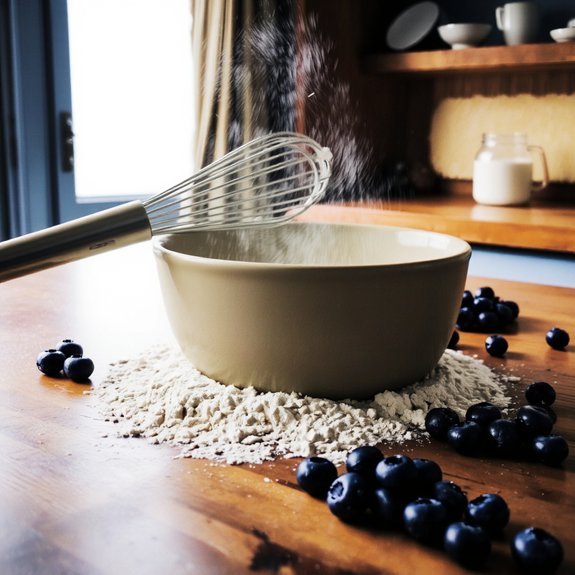
Three essential steps form the foundation of proper dry ingredient preparation.
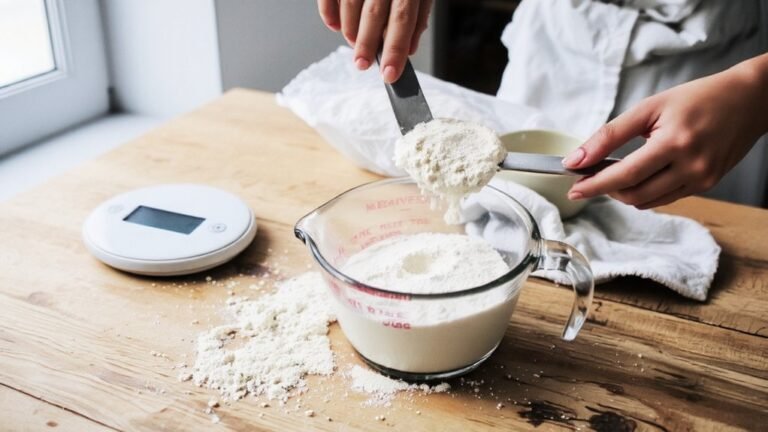
First, you’ll sift flour to eliminate lumps and incorporate air, which promotes even leavening.
Second, combine your sifted flour with baking powder, baking soda, and salt in precise measurements—typically one and three-quarter cups flour, one and one-half teaspoons baking powder, one-quarter teaspoon baking soda, and one-half teaspoon salt for standard ingredient ratios.
Third, whisk these components together thoroughly for thirty seconds.
This integration distributes leavening agents uniformly throughout your dry base, preventing dense pockets in your finished muffins.
You’re establishing the chemical foundation that’ll give your blueberry muffins their characteristic light, tender crumb structure.
Proper dry ingredient mixing requires no shortcuts—this fundamental technique directly impacts your baking success, giving you control over your final product’s quality.
4. Combining the Wet Ingredients
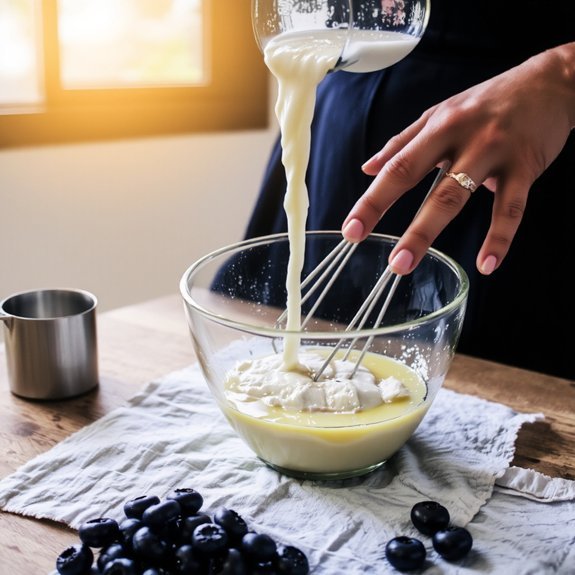
While you’ve mastered your dry ingredients, you’ll now focus on creating the wet base that’ll bind everything together.
In a separate bowl, whisk together one large egg, one-third cup vegetable oil, and one cup buttermilk. The tempering eggs process requires gentle whisking to incorporate air without overdeveloping structure. This emulsifying fats stage guarantees uniform fat distribution throughout your batter.
| Ingredient | Measurement | Function |
|---|---|---|
| Egg | 1 large | Binding agent |
| Vegetable oil | ⅓ cup | Emulsifying fats |
| Buttermilk | 1 cup | Acidic liquid |
Maintain a temperature range of 68–72°F for ideal incorporation. The emulsion’ll stabilize when whisked for approximately forty-five seconds. You’re establishing the foundation that’ll support your blueberries and create a tender crumb structure. Don’t rush this critical step—precision here determines your muffins’ final texture and rise.
5. Creating the Perfect Batter
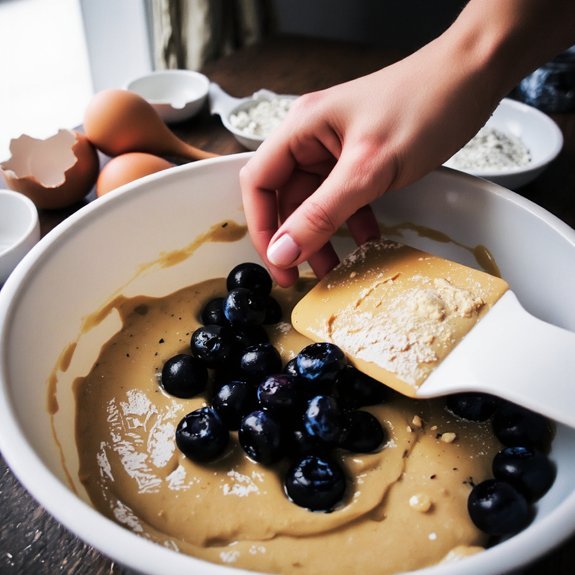
Fold your wet ingredients into the dry mixture using a spatula with twelve to fifteen deliberate strokes, stopping before you’ve achieved complete homogeneity.
Fold wet into dry with twelve to fifteen deliberate strokes, stopping before complete homogeneity is achieved.
This folding technique prevents overdevelopment of gluten, which’d compromise texture and create dense muffins.
Your batter should retain visible streaks of flour and maintain a slightly lumpy consistency.
Overmixing deflates batter aeration, reducing rise and creating tough crumbs.
The incomplete incorporation allows carbon dioxide bubbles to expand freely during baking.
Gently incorporate blueberries last, using two or three additional folds.
This prevents crushing and guarantees even distribution.
Don’t obsess over perfect uniformity—slight variations actually enhance moisture retention and crumb structure.
You’ve now achieved ideal batter composition: aerated, structured, and ready for the oven.
This precision directly determines your final product’s quality.
6. Baking and Cooling Your Muffins
Once you’ve achieved the ideal batter consistency, you’ll transfer it to your prepared muffin tin, filling each cup approximately two-thirds full.
Preheat your oven to 375°F and bake for 18-22 minutes, depending on your oven’s calibration and muffin size. Your bake timing is critical—insert a toothpick into the center of a muffin; it should emerge with minimal crumbs.
- Remove the tin immediately when golden-brown peaks form
- Place the muffin tin on a cooling rack for 5 minutes
- Transfer individual muffins to the cooling rack to prevent moisture buildup
- Allow complete cooling before storing or serving
This cooling rack step prevents soggy bottoms and maintains your muffins’ structural integrity. Once cooled completely, you’ve earned the freedom to enjoy your homemade blueberry muffins.
Frequently Asked Questions
Can I Use Frozen Blueberries Instead of Fresh Ones for This Recipe?
Yes, you can substitute frozen blueberries for fresh ones. Frozen benefits include year-round availability and extended shelf life.
However, you’ll notice texture differences—frozen berries release more liquid during baking, potentially creating a wetter batter. To mitigate this, don’t thaw them beforehand; incorporate frozen berries directly into your batter at 350°F. This technique minimizes juice leakage and maintains structural integrity throughout the baking process, yielding ideal results.
How Do I Know When My Muffins Are Completely Done Baking Inside?
You’ll know your muffins are completely done when you insert a toothpick into the center and it emerges clean or with just a few moist crumbs. Simultaneously, verify the internal temperature reaches 200-205°F using a reliable meat thermometer.
The muffin tops should display golden-brown coloration with firm edges. Don’t rely solely on appearance; these dual verification methods guarantee you’ve achieved ideal doneness while maintaining moisture and avoiding overdrying your batch.
What’s the Best Way to Store Leftover Blueberry Muffins for Freshness?
You’ll maximize freshness by storing cooled muffins in airtight containers at room temperature for up to two days.
For extended preservation, you’ve got freedom to utilize freezer storage—seal them individually in freezer bags or rigid containers for up to three months.
This method maintains ideal moisture retention and structural integrity.
Thaw muffins at ambient temperature before consumption, ensuring you’re not constrained by abbreviated shelf life while retaining superior organoleptic properties.
Can I Make the Batter Ahead of Time and Bake Later?
You can prepare batter ahead, though you’ll notice flavor development and texture changes during storage.
Refrigerate unbaked batter in an airtight container for up to 24 hours maximum.
Cold batter requires extended baking time—approximately 3-5 minutes longer.
Note that leavening agents diminish over time, potentially compromising rise.
For best results, fold in blueberries immediately before baking to prevent color bleeding and maintain structural integrity throughout the muffin crumb.
Why Are My Muffins Sinking to the Bottom of the Cups?
Your muffins sink because you’re likely overmixing batter, which degrades gluten structure and reduces leavening failure resistance.
You’ll want to fold ingredients gently until just combined—overworking develops excessive gluten that collapses during baking.
Additionally, make sure your leavening agents (baking powder/soda) are fresh and properly measured.
Use precise measurements and don’t skip sifting dry ingredients.
Let batter rest briefly before baking, allowing chemical reactions to stabilize your rise.


Leave a Comment