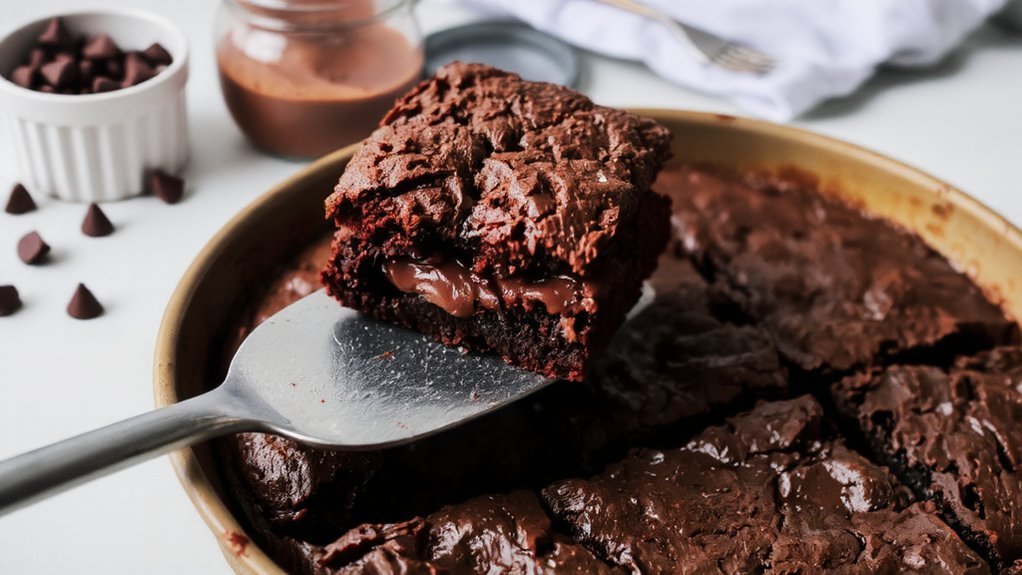

Key Takeaways
- Melt 6 oz unsweetened chocolate and 8 oz butter together at 50°C, stirring continuously to prevent separation.
- Whisk 3 eggs with 1.5 cups granulated sugar to ribbon stage for proper emulsification and air incorporation.
- Bake at 350°F for 25–30 minutes until internal temperature reaches 200°F; remove slightly underbaked for fudgy texture.
- Use 60–70% cacao solids chocolate and fold dry ingredients gently in two additions to prevent overmixing.
- Store cooled brownies in airtight containers at room temperature up to five days, layering parchment between pieces.
Essential Ingredients for Perfect Brownies
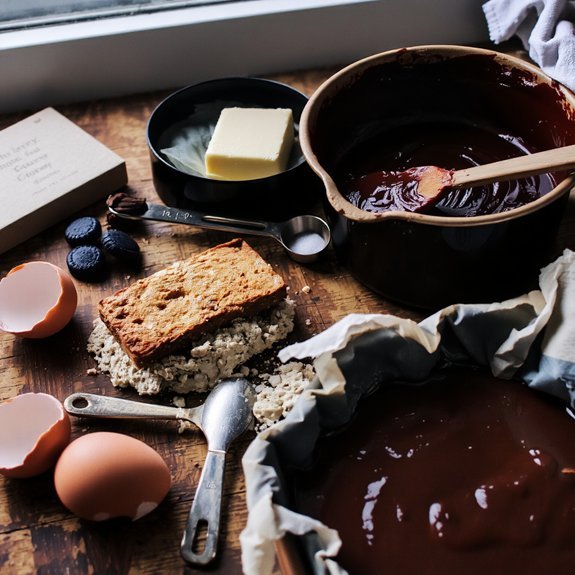
You’ll need four core components to create fudgy brownies with the ideal texture: unsweetened chocolate (6 ounces), butter (8 ounces), granulated sugar (1.5 cups), and large eggs (3).
Fat selection determines your brownie’s moisture content and richness. Butter provides superior flavor development compared to oils, creating that coveted fudgy crumb.
Your chocolate must be pure unsweetened varieties—no added sugars diluting the cocoa intensity.
Sugar types matter equally. Granulated sugar dissolves cleanly, promoting even browning and desired texture.
Some bakers incorporate brown sugar for enhanced moisture, though this risks dense results.
Eggs serve dual purposes: binding ingredients while incorporating air through whisking. Room-temperature eggs emulsify more effectively than cold ones.
This precise ingredient ratio—maintaining proper chocolate-to-fat balance—delivers brownies with concentrated chocolate flavor and that signature fudgy center you’re after.
Choosing the Right Cocoa Powder and Chocolate
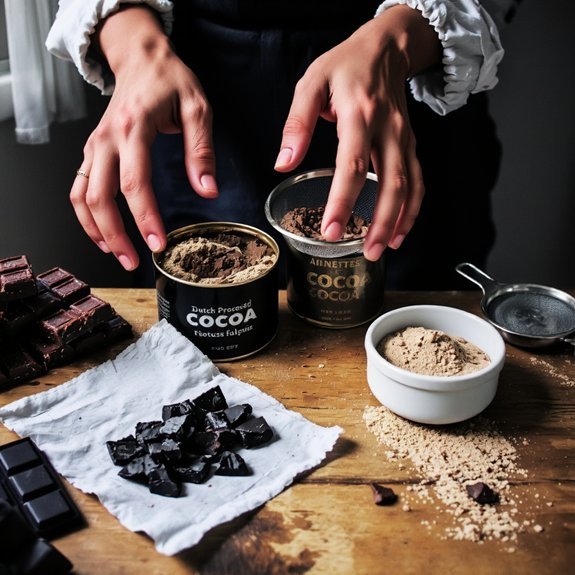
How does chocolate quality differentiate a mediocre brownie from an exceptional one?
You’ll discover that premium chocolate and cocoa powder directly impact your brownie’s depth and intensity.
Cocoa terroir—the origin region’s climate, soil, and altitude—fundamentally shapes flavor profiles.
You’re choosing between Dutch-processed cocoa, which neutralizes acidity and darkens crumb color, and natural cocoa, which delivers vibrant chocolate notes and subtle fruity undertones.
Dutch-processed cocoa darkens crumb and neutralizes acidity, while natural cocoa delivers vibrant chocolate notes with subtle fruity undertones.
Processing differences matter substantially.
You should select chocolate containing 60-70% cacao solids for ideal fudginess.
Couverture chocolate, containing cocoa butter above 32%, guarantees silky texture and superior mouthfeel.
Source single-origin chocolate when possible; you’ll taste distinct regional characteristics.
For your ratio, use equal parts cocoa powder and melted chocolate to achieve balanced richness without overwhelming bitterness.
Mixing and Preparation Techniques
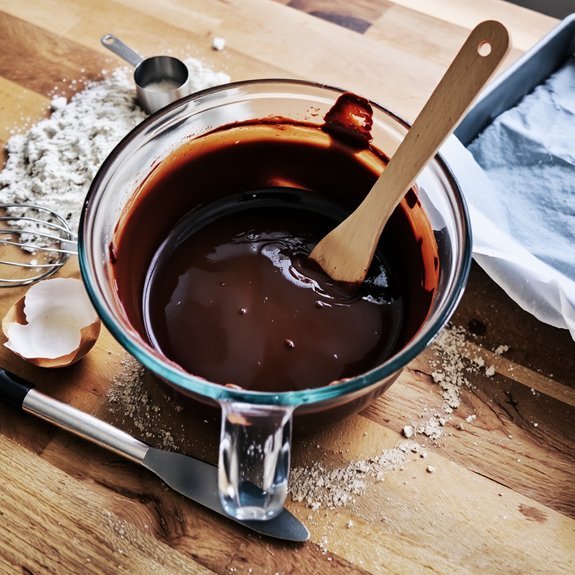
Mastering the emulsification of fats and liquids sets the foundation for fudgy brownies.
You’ll achieve superior texture by respecting proper mixing order and precise technique.
Here’s your approach:
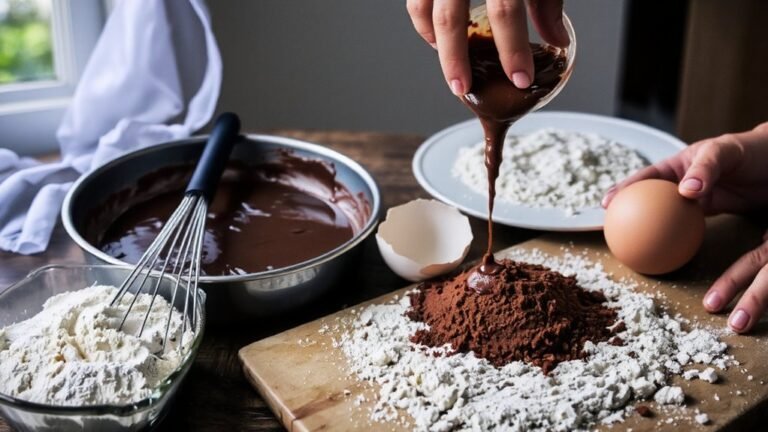
- Melt butter and chocolate together at 50°C, stirring continuously to prevent separation
- Whisk eggs with sugar until you’ve reached ribbon stage—approximately 3-4 minutes
- Combine wet ingredients using gentle folding technique to maintain air incorporation without deflating
- Fold in flour and cocoa in two additions, using a spatula with deliberate bottom-to-top motions
You’re free to experiment with ratios, but maintain a 1:1 fat-to-dry ratio for ideal fudginess.
Don’t overmix once flour’s incorporated—this develops gluten, toughening your brownies.
Your restraint here determines whether you’ll achieve that coveted dense, fudgy crumb structure.
Baking Time and Temperature Guidelines
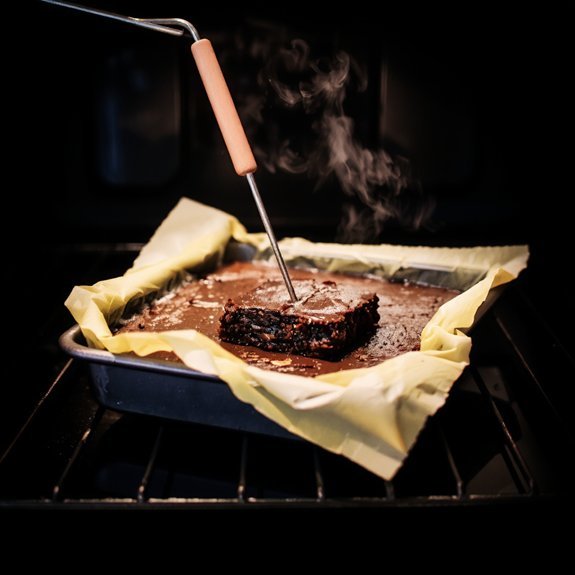
Perfect mixing technique means nothing without precise thermal management during baking.
You’ll want to preheat your oven to 350°F, making sure proper oven calibration beforehand—don’t skip this step, as temperature variance directly impacts brownie texture.
Position your rack in the center of your oven.
This rack positioning promotes even heat distribution around your pan, preventing over-browning on edges while maintaining that fudgy center you’re after.
Bake your brownies for 25-30 minutes, depending on your specific oven’s characteristics.
You’re targeting an internal temperature of 200°F at the center—use an instant-read thermometer to verify doneness.
The toothpick test works too: insert one into the center; it should emerge with moist crumbs, not dry cake or raw batter.
Remove your brownies when they’re slightly underbaked.
They’ll continue cooking via carryover heat, ultimately delivering that perfect fudgy consistency you demand.
Storage and Serving Tips for Maximum Fudginess
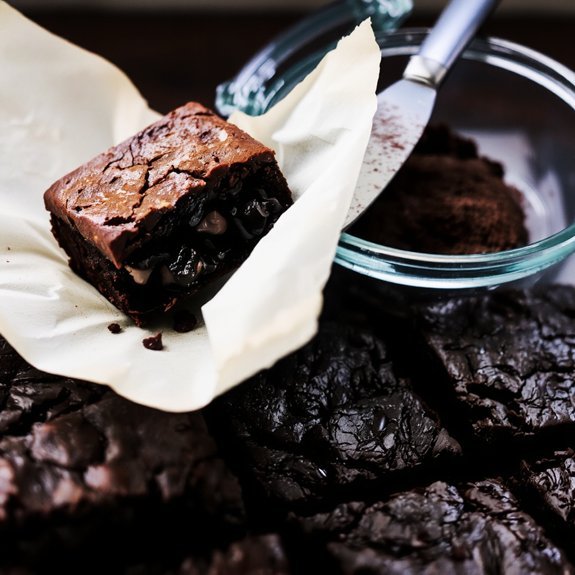
Proper storage techniques directly preserve your brownies’ fudgy texture by managing moisture retention and preventing crystallization.
Proper storage techniques preserve fudgy brownie texture by managing moisture retention and preventing crystallization.
You’ll want to maximize shelf life while maintaining that coveted dense crumb structure.
- Store cooled brownies in airtight storage containers at room temperature for up to five days
- Layer parchment paper between stacked brownies to prevent adherence and moisture migration
- Refrigerate for extended preservation, then bring to room temperature before serving for ideal texture
- Freeze individually wrapped portions up to three months for long-term storage without compromising fudginess
Consider strategic serving pairings to enhance your brownies’ appeal.
Pair them with cold milk, vanilla ice cream, or espresso for complementary flavor profiles.
You control how you enjoy your creation—whether straight from storage or elevated through thoughtful accompaniments.
Frequently Asked Questions
Can I Substitute Butter With Oil or Applesauce in Brownie Recipes?
You can substitute butter with oil using a 3:4 ratio—use three-quarters cup oil for every cup of butter. This maintains proper fat ratios for fudgy texture.
Applesauce won’t work; it lacks sufficient fat content, compromising brownie structure and flavor retention. Oil substitution works because it’s liquid fat, but applesauce creates dense, cake-like results.
For ideal outcomes, stick with oil if you’re avoiding butter, maintaining that essential fat balance your brownies demand.
Why Do My Brownies Come Out Cake-Like Instead of Fudgy and Dense?
You’re likely overmixing your batter, which incorporates excess air and develops gluten structure—creating cake-like crumb instead of that dense, fudgy texture you want.
Minimize mixing after combining wet and dry ingredients.
Additionally, check your leavening agents; excessive baking soda or powder causes unnecessary rise.
Use precise ratios: more chocolate and fat, less flour.
Underbake slightly—your brownies should jiggle subtly at center when removed from the oven.
How Do I Fix Brownies That Are Undercooked or Overcooked?
You’ll fix undercooked brownies by returning them to a 325°F oven for 2-3 minutes—don’t overbake.
For overcooked brownies, you’ve lost moisture; prevent this by using carryover cooking: remove them at 205°F internal temperature.
Tent with foil during final minutes to prevent over-browning.
Master the toothpick test—it should show fudgy crumbs, not batter.
Precise timing and temperature control determine your brownie’s density and texture outcome.
What Altitude Adjustments Are Necessary for Baking Brownies at High Elevations?
You’ll need to adjust your brownie recipe at high elevations due to increased evaporation rates and lower atmospheric pressure effects. Reduce baking soda by 25%, increase liquid by 2-4 tablespoons, and raise your oven temperature by 15-25°F.
These modifications compensate for rapid moisture loss and lower boiling points, preventing dry, crumbly results. Start checking brownies 5-10 minutes earlier than standard recipe times to guarantee ideal fudgy texture.
Can I Freeze Brownie Batter, and if So, for How Long?
You can absolutely freeze brownie batter for up to three months.
Use proper freezer packaging—airtight containers or freezer bags—to prevent freezer burn and maintain ingredient integrity.
When you’re ready to bake, employ gradual thawing techniques by transferring your batter to the refrigerator overnight. This controlled thawing preserves the emulsion between fats and liquids, ensuring ideal texture and rise.
Never bake from frozen; thawed batter yields superior crumb structure and browning.

Leave a Comment