
Key Takeaways
- Choose an egg substitute based on your recipe: applesauce, mashed banana, aquafaba, flaxseed, or commercial egg replacers work effectively.
- Use correct replacement ratios: 1 egg equals 1/4 cup applesauce, 1/4 cup mashed banana, or 3 tablespoons aquafaba.
- Reduce other liquid ingredients by 10–15% when substituting eggs to maintain proper dough consistency and prevent spreading.
- Chill dough 30–60 minutes after mixing to allow starch hydration and help compensate for missing egg protein structure.
- Lower oven temperature by 25°F and monitor baking time closely, as egg-free cookies often bake denser and require adjustments.
Why Eggs Matter in Baking

Eggs perform multiple critical functions in baking that you can’t overlook.
They’re essential binding agents that create structural integrity in your cookies by holding ingredients together cohesively. When you incorporate eggs, you’re enabling proteins to form networks that prevent your baked goods from crumbling apart.
Eggs are essential binding agents that create structural integrity by holding ingredients together cohesively and preventing baked goods from crumbling apart.
Eggs also provide vital leavening action through their protein content.
As you mix and bake, these proteins denature and create air pockets, giving your cookies desirable texture and rise. The yolk contributes fat and emulsifiers, which enhance moisture retention and improve flavor development.
Additionally, eggs serve as a liquid component that activates dry ingredients and promotes even browning through the Maillard reaction.
Understanding these functions empowers you to select appropriate substitutes that replicate these specific properties, ensuring your egg-free cookies maintain quality and performance.
Applesauce as an Egg Substitute

Substituting applesauce for eggs requires understanding how this ingredient compensates for the binding and moisture functions you’ve just explored.
You’ll replace one egg with ¼ cup unsweetened applesauce, maintaining your cookie’s structure while adding natural sweetness.
The moisture content in applesauce prevents excessive dryness, though you may need to reduce other liquids slightly.
Consider regional varieties—unsweetened applesauce from different producers varies in consistency and tartness, affecting your results.
Flavor pairings matter greatly.
Applesauce works exceptionally well with cinnamon, nutmeg, and vanilla-based cookies.
You’ll want to avoid chocolate-heavy recipes where applesauce’s subtle apple notes might conflict.
For best results, select high-quality applesauce without added sugars or preservatives.
This approach gives you complete control over your ingredients while achieving reliable, egg-free cookies.
Mashed Bananas and Other Fruit Options
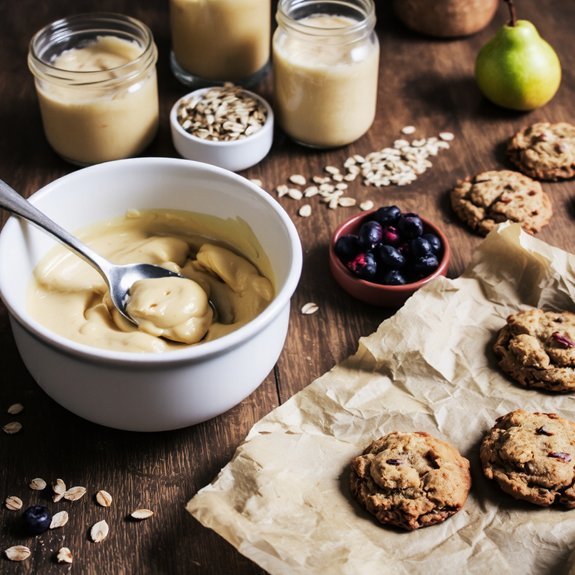
You can substitute mashed banana for eggs at a 1:4 ratio (¼ cup banana per egg) to add moisture and binding properties to your cookie dough.
Other fruit purees—such as applesauce, pumpkin, or avocado—work similarly, though they’ll each impart distinct flavors and affect your dough’s consistency differently.
You’ll need to adjust your dry ingredients and liquid ratios to compensate for the added moisture and achieve your desired cookie texture, as fruit purees typically contain more water than eggs.
Banana as Egg Replacer
When you’re seeking a natural binding agent for egg-free cookies, mashed banana offers a reliable alternative that provides moisture and structural support comparable to whole eggs. You’ll use approximately one-quarter cup of mashed banana per egg replacement, though this ratio depends on your recipe’s specific requirements.
| Banana Type | Ripeness | Moisture Content | Binding Strength |
|---|---|---|---|
| Yellow | Medium | Moderate | Good |
| Brown-spotted | High | High | Excellent |
| Green | Low | Low | Weak |
| Overripe | Very High | Very High | Strong |
| Frozen-thawed | Variable | Increased | Good |
You’ll appreciate banana’s sustainability benefits, as it requires minimal processing compared to commercial egg replacers. However, consider potential banana allergies when serving to guests. The fruit’s natural sugars enhance flavor while creating structure, though you may notice subtle taste differences in your final product. This approach grants you control over your ingredients while maintaining ethical baking standards.
Other Fruit Puree Options
Beyond banana, what other fruit purees can effectively replace eggs in cookie formulations?
You’ll find applesauce delivers superior moisture retention while maintaining neutral flavor profiles that won’t compromise your recipe.
Pumpkin puree offers structural stability and rich color retention, making it ideal for spiced cookies.
Avocado contributes density and binding properties without adding competing flavors.
When selecting fruit purees, consider your desired flavor pairings carefully.
Prune puree works exceptionally well with chocolate, while berry purees pair naturally with vanilla or almond extracts.
You can substitute one-quarter cup puree for each egg, though you may need to adjust liquid ratios slightly.
These alternatives give you creative freedom in your baking while delivering consistent results.
Experiment with different purees to discover which best suits your cookie preferences and desired texture outcomes.
Adjusting Moisture and Texture
Fruit purees’ moisture content directly influences your cookie’s final texture, requiring strategic adjustments to achieve ideal results.
You’ll need to reduce other liquids in your recipe proportionally—typically decreasing milk or water by 25-50% when substituting eggs with puree.
Fat selection becomes critical; incorporating extra butter or coconut oil compensates for lost binding properties while enhancing texture.
Dough chilling is essential after mixing.
Refrigerate your dough for 30-60 minutes, allowing starches to fully hydrate and flavors to develop.
This resting period prevents excessive spreading during baking.
Monitor baking time closely since fruit purees can create denser cookies.
You may need to reduce oven temperature by 25°F to prevent over-browning while ensuring adequate interior cooking.
Aquafaba: The Chickpea Liquid Game Changer

Discovering aquafaba—the starchy liquid drained from canned or cooked chickpeas—opens a reliable alternative for egg-free baking.
Aquafaba—the starchy liquid from canned chickpeas—unlocks a reliable, plant-based alternative for egg-free baking success.
You’ll find that three tablespoons of aquafaba replaces one egg effectively in most cookie recipes.
This versatile ingredient stabilizes and aerates your dough, creating structure without animal products.
You can whip aquafaba into stiff peaks for meringue-style cookies, much like professional bartenders use it for cocktail foams.
The starches and proteins in aquafaba provide binding power comparable to conventional eggs.
Beyond functionality, aquafaba delivers sustainability benefits.
You’re repurposing a byproduct typically discarded, reducing waste while supporting plant-based baking practices.
This approach aligns with your values of independence and resourcefulness.
Start with three tablespoons per egg and adjust liquid ratios accordingly.
You’ll achieve excellent texture and rise consistently.
Commercial Egg Replacers Explained
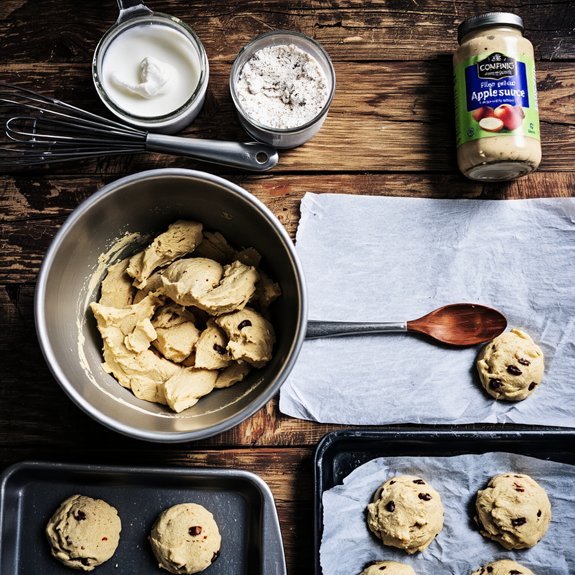
Convenience drives many bakers toward commercially formulated egg replacers, which you’ll find as powders or pre-mixed liquids specifically engineered to mimic eggs’ functional properties.
These products offer reliable results without animal products.
Understanding your egg replacer’s ingredient breakdown matters.
Most contain starches, leavening agents, and binding compounds that replicate eggs’ moisture and structure contributions.
You’re getting standardized formulations that eliminate guesswork.
Key advantages include:
- Shelf stability—powdered versions last months without refrigeration
- Precise measurements—consistent results across batches
- Allergen-free options—avoiding multiple dietary restrictions simultaneously
- Reduced mixing complexity—no separation or temperament issues
You’ll appreciate the straightforward substitution ratios these products provide.
Most require simple 1:1 water-to-powder ratios, streamlining your baking process.
Commercial egg replacers deliver freedom from dietary limitations while maintaining cookie quality and texture.
Adjusting Your Recipe for Success
You’ll need to adjust your binding agent ratios since egg replacers absorb and distribute moisture differently than whole eggs, affecting how your dough hydrates.
Your recipe’s moisture content requires modification—reduce liquid ingredients by 10-15% initially, then test your results to prevent overly dense or crumbly cookies.
Balancing texture and consistency demands attention to these variables simultaneously, as changes in binding ratios directly impact your final product’s structure and mouthfeel.
Understanding Binding Agent Ratios
How do you know when you’ve added enough binding agent to replace eggs in your cookie dough?
You’ll need to master starch ratios and binding chemistry to achieve your desired texture.
Each binding agent performs differently, so precise measurements matter.
Here’s what you need to know:
- Cornstarch and tapioca starch require 1 tablespoon per egg replaced
- Flaxseed and chia seeds need 3 tablespoons mixed with water per egg
- Applesauce demands ¼ cup per egg, reducing other liquids accordingly
- Aquafaba works at 3 tablespoons per egg for ideal structure
Your dough’s consistency should mirror traditional egg-based recipes.
Too little binding agent creates crumbly, disappointing results. Too much yields dense, gummy cookies.
Test small batches first, adjusting ratios based on your specific flour blend and desired crumb structure for consistent, reliable outcomes.
Moisture Content Modifications
Because binding agents absorb and retain moisture differently than eggs, you’ll need to recalibrate your recipe’s liquid ratios to prevent cookies that spread excessively or bake unevenly. Start by reducing your total liquid content by 10-15% when substituting eggs with alternatives like flax or aquafaba.
Monitor sugar hygroscopicity—the ingredient’s tendency to attract moisture—as it directly impacts your dough’s hydration level and final texture.
You’ll also want to account for oven humidity, which influences evaporation rates during baking. If you’re baking in humid conditions, further decrease liquids by 5%. Conversely, dry climates may require slight increases.
Test small batches first, documenting adjustments so you can refine your technique and achieve consistent, predictable results every time.
Texture and Consistency Balance
Once you’ve calibrated your liquid ratios, the next critical variable is achieving the proper dough consistency—the foundation for cookies that hold their shape while maintaining the desired crumb structure.
Your egg-free dough requires precise adjustments to match conventional formulations.
Here’s how you’ll optimize texture and mouthfeel contrast:
- Monitor dough firmness by adding binders incrementally—cornstarch, xanthan gum, or flax meal—until you achieve workable consistency
- Test spreadability by flattening a sample; it should hold edges without excessive flattening
- Adjust fat content if dough feels too dry or greasy, affecting both density and bite
- Chill dough appropriately; longer chilling compensates for missing egg proteins that normally set structure
You’re controlling variables that determine whether your cookies spread excessively or bake underbaked.
Precision here directly impacts your final product’s success.
Troubleshooting Common Baking Issues
Even when you’ve selected the right egg substitutes and followed your recipe precisely, egg-free cookies can still present challenges that differ from traditional baking. You’ll want to verify your oven calibration to achieve accurate temperatures, as egg-free batters behave differently during heat exposure. Pan choice matters notably—dark pans absorb more heat, potentially burning your cookies’ bottoms, while light-colored pans distribute heat more evenly.
| Issue | Cause | Solution |
|---|---|---|
| Spread too thin | Excess moisture | Reduce liquid binder by 15% |
| Too crumbly | Insufficient binding | Increase egg substitute ratio |
| Underbaked centers | Wrong oven temp | Recalibrate and verify thermometer |
| Cakey texture | Over-mixing | Mix until just combined |
| Burnt edges | Dark pan selection | Switch to aluminum pans |
You’re now equipped to troubleshoot confidently and achieve superior results.
Frequently Asked Questions
Can I Use Egg Substitutes in Recipes That Specifically Require Eggs for Structure?
Yes, you can use egg substitutes in structure-dependent recipes, but you’ll need careful selection.
Aquafaba and flax eggs provide binding properties, though they won’t replicate eggs’ full structural capabilities.
Test your substitutes’ heat stability by baking small batches first, conducting structural testing to verify proper rise and crumb formation.
Starches and gums enhance binding; experiment with ratios to achieve your desired texture and independence from conventional ingredients.
How Do Egg-Free Cookies Compare Nutritionally to Traditional Cookie Recipes?
You’ll find that egg-free cookies typically contain fewer calories per serving than traditional recipes, since eggs contribute roughly 70 calories each.
However, your protein levels drop substantially—you’re losing approximately 6 grams per egg. You’ll need to compensate by incorporating protein-rich substitutes like Greek yogurt or legume-based binders. This calorie comparison matters when you’re optimizing your nutritional intake while maintaining your dietary independence and baking preferences.
Which Egg Substitute Works Best for Crispy Versus Chewy Cookie Textures?
You’ll achieve crispy textures with cornstarch or aquafaqueous binders that limit moisture retention.
For chewy cookies, you’ll want applesauce or mashed banana—they’re superior for moisture balance.
Your spread control depends on the binder’s viscosity; flax eggs create firmer structures, while starches promote browning edges.
You’re free to experiment with combinations, adjusting ratios based on your desired texture outcome and ingredient availability.
Are There Any Allergens in Commercial Egg Replacers I Should Know About?
You’ll want to scrutinize commercial egg replacers carefully for potential allergens. Most contain soy content, which poses risks for those with soy sensitivities.
Additionally, many products face nut contamination during manufacturing, threatening individuals with nut allergies. You’re responsible for reading labels meticulously and selecting replacers certified allergen-free if you’ve got specific dietary restrictions.
Some brands offer soy-free and nut-safe options, giving you control over what enters your kitchen.
Can I Combine Multiple Egg Substitutes in a Single Cookie Recipe?
You can combine multiple egg substitutes, but you’ll need to understand swap ratios and monitor flavor interactions carefully. Mix complementary binders—applesauce with cornstarch, for instance—to achieve ideal texture and structure.
However, avoid pairing strong-flavored substitutes that’ll overpower your cookie’s intended taste. Start with conservative ratios, testing small batches first. This approach gives you full control over your final product’s consistency and taste profile.




Leave a Comment