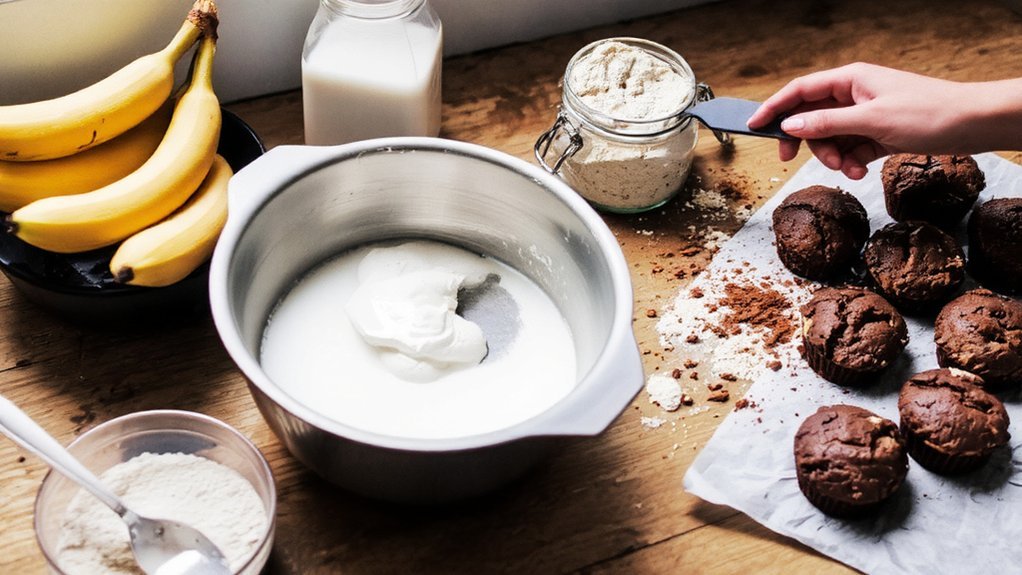

Key Takeaways
- Replace eggs with flax/chia eggs (1 tbsp ground + 3 tbsp water per egg) or aquafaba (3 tbsp per egg) for binding and leavening.
- Substitute butter 1:1 with coconut oil or vegan butter, adjusting liquid ratios to prevent dryness from plant-based fat behavior differences.
- Use plant milks at 1:1 ratio; choose soy for dense cakes, oat for subtle sweetness, or almond for delicate fruit desserts.
- Reduce oven temperature by 25°F and test conversions in smaller batches to prevent over-browning and document texture, rise, and browning effects.
- Stock essential ingredients: aquafaba, flaxseeds, chia seeds, tapioca starch, cornstarch, refined coconut oil, and vegan butter for consistent vegan baking success.
Understanding Egg Replacements
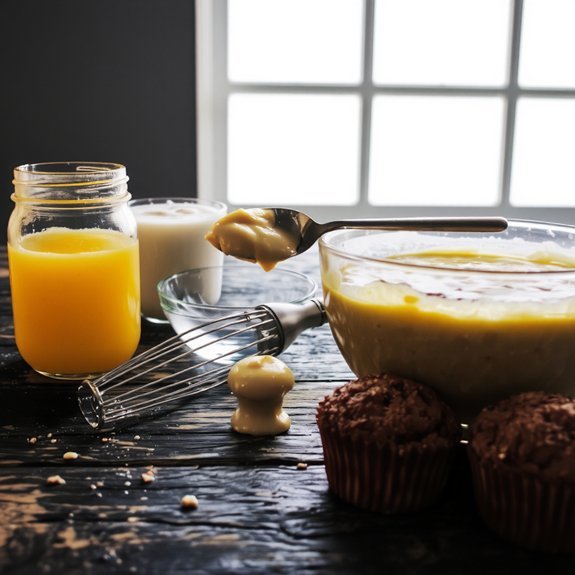
Why do eggs matter in vegan baking?
Eggs bind, leaven, and add moisture—functions you’ll replicate through strategic substitutions.
Eggs bind, leaven, and add moisture—functions you’ll master through strategic substitutions.
Your freedom from animal products doesn’t mean compromising results.
Flax and chia seeds create binding strength; mix one tablespoon ground with three tablespoons water per egg.
Applesauce adds moisture for dense cakes.
Aquafaba—that liquid from canned chickpeas—whips into meringues, delivering leavening power.
Each replacement offers distinct nutritional profiles.
Flax delivers omega-3s; applesauce provides fiber.
Consider allergen considerations carefully: some replacements may introduce concerns for sensitive individuals.
Match your substitute to your dessert’s demands.
Light cakes need aquafaba‘s aeration.
Dense brownies? Applesauce works perfectly.
You’re not sacrificing quality—you’re choosing liberation through informed ingredient substitution.
Dairy-Free Butter and Oil Alternatives
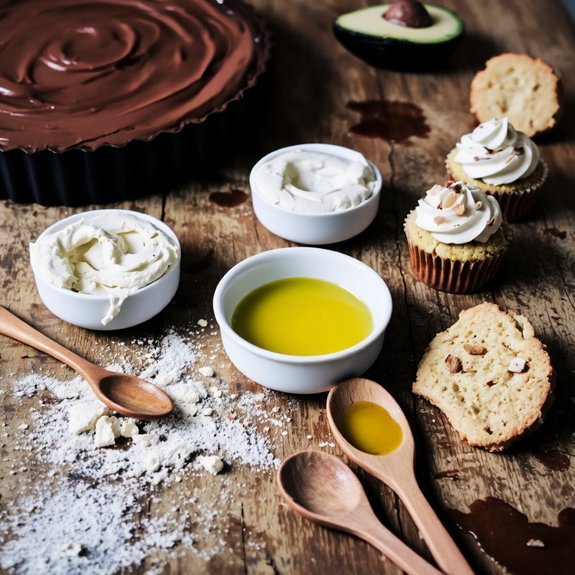
Just as you’ve mastered egg replacements through understanding their functional roles, you’ll approach dairy fats with the same strategic mindset.
Your freedom from conventional butter demands precision in selecting alternatives that deliver identical performance.
Coconut oil excels for laminated doughs, offering high smoke points and superior shelf stability.
Refined versions provide neutral flavor profiles without coconut’s assertiveness.
Vegan butter, engineered for direct substitution, mimics dairy butter’s creaming properties and moisture content.
Consider your dessert’s requirements strategically.
Palm oil alternatives provide structure in shortbreads.
Nut butters contribute richness and binding capacity.
Aquafaba-based options create lighter, airier textures.
Each substitute carries distinct functional properties—smoke points determine baking temperatures, while shelf stability affects ingredient sourcing and recipe longevity.
You’ll optimize results by matching fat selection to your specific application, ensuring your vegan desserts achieve structural integrity and flavor complexity without compromise.
Plant-Based Milk Options for Baking
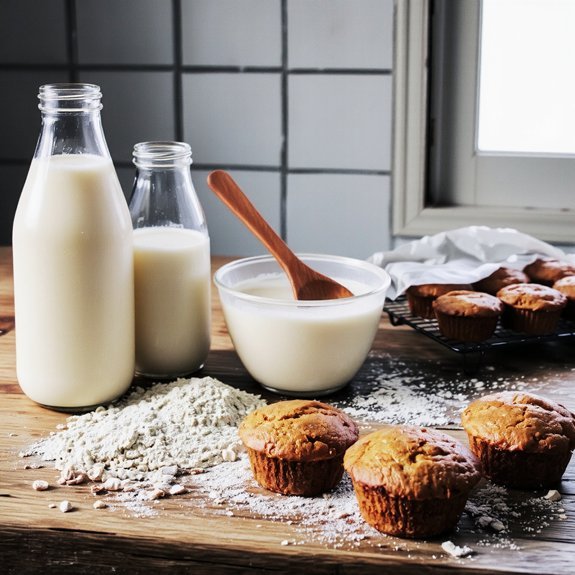
When you’re substituting plant-based milk in your vegan desserts, you’ll need to adjust ratios based on the milk’s fat content and viscosity—almond milk typically uses a 1:1 ratio, while coconut milk‘s richness may require a 3:4 reduction.
Each milk option imparts distinct flavor profiles: oat milk adds subtle sweetness, soy milk provides neutral backbone support, and coconut milk introduces assertive tropical notes that can either complement or overpower delicate dessert flavors.
You’ll achieve ideal results by matching milk characteristics to your dessert’s flavor composition, ensuring that your plant-based choice enhances rather than competes with primary ingredients.
Milk Substitutes and Ratios
Most plant-based milks’ll work in vegan baking, but you’ll need to match the right milk to your specific recipe since each option brings distinct fat content, protein levels, and flavor profiles that directly impact texture and rise.
You’ll want to understand viscosity ratios—thicker milks like oat require different measurements than watery almond varieties.
Protein variance matters substantially; soy milk’s higher protein content suits dense cakes, while coconut milk’s richness works best in chocolate desserts.
Use a 1:1 ratio as your baseline, then adjust based on your milk’s thickness. Cashew and macadamia milks offer superior richness for pastries.
You’re fundamentally engineering moisture balance and structural support, so selecting strategically guarantees your desserts achieve ideal crumb, rise, and moisture retention every time.
Flavor Impact on Desserts
Selecting your plant-based milk isn’t merely about hydration—you’re actively shaping your dessert’s final flavor profile and mouthfeel.
Each milk option delivers distinct characteristics:
- Oat milk provides subtle sweetness that softens spice layering in cakes and cookies
- Coconut milk introduces richness, enhancing chocolate and caramel notes
- Almond milk offers neutral base for delicate acid balance in fruit desserts
- Soy milk delivers protein structure, supporting dense brownie and pudding textures
You’ll notice that higher-fat plant milks create creamier results.
Thinner varieties require binding adjustments.
When layering spices, oat or coconut milk complements warm flavors beautifully.
For acid balance in lemon or berry recipes, soy and almond milks stabilize pH effectively, preventing unwanted bitterness.
Your choice determines whether your dessert achieves intended complexity or falls flat.
The Magic of Aquafaba
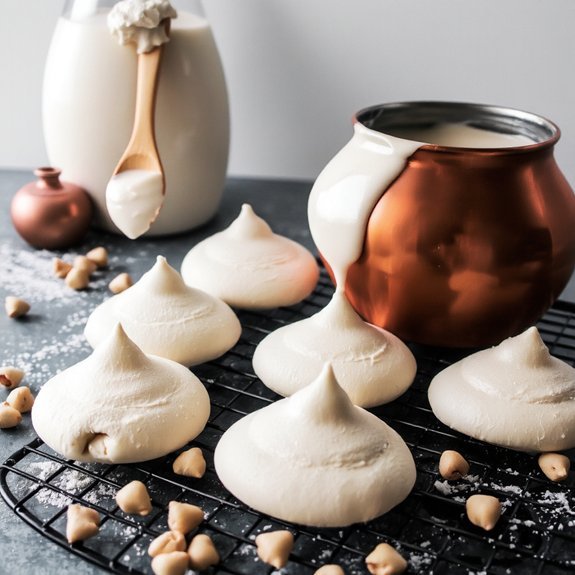
You’ll discover that aquafaba—the liquid from canned chickpeas—whips into stiff peaks that rival egg whites, making it your ideal replacement for meringues and mousses.
This versatile binder simultaneously provides moisture and structure to your vegan cakes, cookies, and brownies, eliminating the density issues you’d encounter with flour-only formulations.
Whipping Aquafaba Into Peaks
When you drain a can of chickpeas, you’re capturing a protein-rich liquid that rivals egg whites in its emulsifying and aerating properties.
You’ll achieve stable peaks by whipping aquafaba at room temperature—cold liquid resists proper aeration. Use an electric mixer for consistent results, typically 3-5 minutes to stiff peaks.
Here’s what you need to know:
- Room temperature accelerates protein denaturation and air incorporation
- Acidic ingredients (lemon juice, cream of tartar) stabilize foam structure
- Storage in airtight containers keeps whipped aquafaba fresh for 24 hours
- Copper bowls enhance peak formation through chemical interaction
Temperature effects directly impact your success rate.
Refrigerated aquafaba won’t whip properly.
For ideal storage methods, keep unused liquid sealed and refrigerated up to five days.
You’re now equipped to replace eggs confidently in meringues, mousses, and pavlovas without compromise.
Binding and Moisture Benefits
Beyond its impressive aerating capabilities, aquafaba’s molecular composition makes it an exceptional binding and moisture agent in vegan baking.
You’ll discover that its starches and proteins create structural integrity that rivals traditional eggs in custards and mousses.
When you combine aquafaba with fruit purees, you’re leveraging natural pectin and fiber to enhance texture while reducing processed additives.
Sugar syrups mixed with aquafaba establish stable emulsions, preventing separation in glazes and ganaches.
You’re also gaining hydration benefits—aquafaba retains moisture longer than egg-based formulations, keeping your cakes tender and preventing premature drying.
This dual functionality lets you eliminate multiple ingredients, streamlining your ingredient list while maintaining professional-quality results.
You’ve liberated yourself from egg dependency without sacrificing structural reliability or sensory experience.
Binding Agents and Thickeners
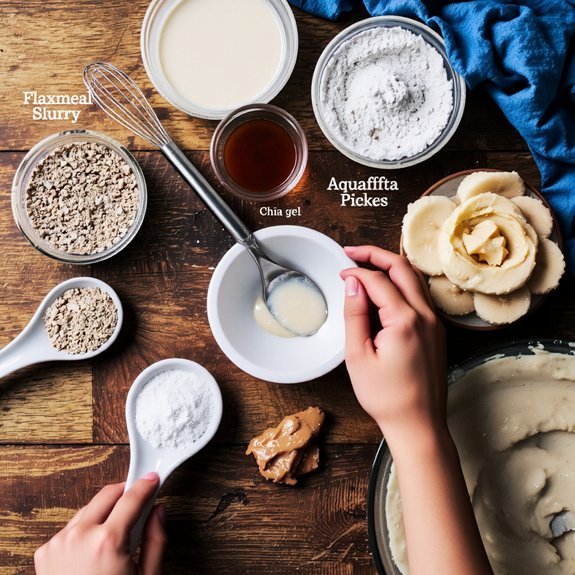
Replacing eggs’ binding and thickening properties requires understanding how plant-based alternatives function differently in vegan batters and fillings. You’ll find that mastering these substitutes gives you complete control over your dessert’s structure and texture.
Key binding agents you should explore:
- Flax and chia seeds: Create gel-like consistency when hydrated, perfect for brownies and cookies
- Hydrocolloid uses: Xanthan gum and guar gum stabilize batters with minimal quantities needed
- Nut gels: Nut butters or ground nuts provide natural binding while adding richness
- Starches: Cornstarch, tapioca, and arrowroot thicken fillings and crusts effectively
You’ll discover that combining multiple binders often yields superior results.
Experiment with ratios to find your ideal texture. Each option delivers distinct moisture characteristics, allowing you to craft desserts that match your exact specifications without compromise.
Adapting Your Favorite Recipes
Once you’ve mastered binding agents, you’ll convert traditional recipes by systematically replacing each animal-derived ingredient with its plant-based equivalent.
| Traditional Ingredient | Vegan Substitute | Ratio |
|---|---|---|
| Butter | Coconut oil or vegan butter | 1:1 |
| Eggs | Flax/chia eggs or appleseed | 1 egg = 3 tbsp aquafaba |
| Dairy milk | Oat or almond milk | 1:1 |
You’ll need temperature tweaks since plant-based fats behave differently than dairy. Reduce baking temperatures by 25°F to prevent over-browning. When recipe scaling, maintain precise ratios—vegan batters respond sensitively to measurement changes. Test your first adaptation in smaller batches to calibrate results. Document successful conversions, noting how each substitution affects texture, rise, and browning. This systematic approach guarantees consistent, liberated baking without compromise.
Troubleshooting Common Vegan Baking Issues
Even with careful ingredient substitution and precise measurements, you’ll encounter problems that don’t appear in traditional baking.
Your vegan desserts demand technical precision to achieve consistent results.
Key challenges you’ll face:
- Dense crumbs: Aquafaba overmixing or insufficient leavening agents compromise your structure
- Dry texture: Plant-based fats absorb differently; adjust liquid ratios accordingly
- Flat rises: Oven calibration errors prevent proper heat distribution
- Uneven baking: Altitude adjustments require modified baking times and temperatures
Master oven calibration by using a reliable thermometer—your vegan batters need exact temperatures.
Altitude adjustments become critical; reduce leavening agents and increase liquid at higher elevations.
Document your modifications meticulously.
Each adaptation builds your plant-based expertise, granting you independence from conventional baking constraints.
You’re not limited by traditional methods; you’re pioneering them.
Essential Tools and Pantry Staples
Your success in vegan baking hinges on assembling specialized tools and maintaining a curated pantry that accommodates plant-based chemistry. You’ll need precision scales, silicone spatulas, and offset spatulas—clean them immediately after use to prevent residue buildup. Invest in quality storage solutions: airtight containers preserve flax eggs, aquafaba, and plant milks at peak potency.
| Essential Item | Purpose |
|---|---|
| Digital scale | Accurate flour and liquid measurements |
| Aquafaba | Egg replacement for meringues |
| Tapioca starch | Binding agent substitute |
| Coconut oil | Fat replacement for richness |
| Tool maintenance kit | Extends equipment lifespan |
Stock flaxseeds, chia seeds, cornstarch, and non-dairy butter. You’ll gain freedom from conventional limitations by mastering these substitutions. Proper tool maintenance guarantees consistent results and reliability. Your pantry becomes your laboratory—organized, intentional, and liberated from animal dependencies.
Frequently Asked Questions
How Long Do Vegan Baked Goods Typically Stay Fresh Compared to Traditional Desserts?
You’ll find vegan baked goods typically stay fresh 3-5 days, matching traditional desserts’ shelf life.
However, your moisture retention differs noticeably due to egg replacements and oil ratios.
You’ll notice reduced microbial growth when you use plant-based ingredients like aquafaba or flax, which contain natural antimicrobial compounds.
You’re controlling freshness through proper ingredient substitution—storing your creations in airtight containers extends their viability considerably beyond standard timelines.
Can I Use Regular Recipes Without Modifications, or Must I Always Adapt Them?
You’ll need to adapt traditional recipes.
Egg substitutes like flaxseed, appleseed, or aquafaba won’t function identically to eggs—they’ve different binding and leavening properties.
Dairy replacements require precision too; coconut milk, oat milk, or vegan butter behave distinctly from their conventional counterparts.
You’re not simply swapping ingredients; you’re understanding plant-based chemistry.
Master these substitutions, and you’ll gain complete dessert freedom without compromise.
What Vegan Desserts Are Best for Beginners With No Prior Baking Experience?
You’ll find no bake bars your easiest entry point—they’re forgiving and require minimal technique.
One bowl cakes liberate you from complicated methods; you’re simply combining plant-based milk with flax eggs and vegan butter substitutes.
These desserts demand straightforward ingredient swaps: aquafaba replaces eggs, coconut oil substitutes dairy butter. You’re mastering basic ratios and texture, not wrestling with temperamental techniques. Start here, build confidence, then expand your vegan baking freedom.
Are Vegan Desserts More Expensive to Make Than Conventional Baked Goods?
You’ll find vegan desserts don’t necessarily cost more—it depends on your ingredient choices. While specialty vegan products inflate expenses, you’re free to use budget substitutions like applesauce for eggs or coconut oil for butter.
Purchasing plant-based staples in bulk dramatically reduces ingredient cost. You control your baking expenditure by strategically selecting alternatives rather than premium branded options, making vegan baking competitive with conventional baking financially.
Which Vegan Desserts Freeze Well for Long-Term Storage and Meal Prep?
You’ll find brownies, cookies, and cake layers freeze exceptionally well for up to three months when you’re using aquafaba or flax egg substitutions.
Store them in airtight storage containers, separating layers with parchment paper.
Your freezing techniques should include flash-freezing individual pieces before containerizing to prevent clumping.
Unbaked dough also maintains quality when frozen, giving you maximum flexibility for spontaneous baking sessions without sacrificing your plant-based ingredient integrity.

Leave a Comment