
Key Takeaways
- Divide every ingredient weight by two using a kitchen scale for maximum accuracy and consistency.
- Reduce dried spices by half, salt by one-third to one-half, and fresh herbs by one-quarter.
- Halve baking powder and baking soda proportionally; reduce yeast by only 25–33% to prevent over-proofing.
- Halve all liquids by weight; monitor evaporation and reduce cooking time by 25–30% for smaller portions.
- Keep oven temperature unchanged; verify scale calibration and measure ingredients on a level, stable surface.
Understanding Recipe Scaling Basics
How do you adjust ingredient quantities when you need fewer servings?
You’re controlling ingredient ratios—the mathematical relationships between components.
When you halve a recipe, you’re dividing each ingredient by two, maintaining the same proportions that create the dish’s intended flavor and texture.
Halving a recipe divides each ingredient by two, preserving the proportions that define flavor and texture.
This fundamental principle applies universally across recipes.
You’ll maintain consistency by reducing every component equally, whether you’re working with liquids, solids, or seasonings.
Batch planning determines your scaling strategy.
Consider your cooking equipment, available time, and storage capacity.
Halving recipes gives you flexibility to prepare exactly what you need without waste or excessive leftovers.
You’re not merely cutting quantities—you’re preserving the chemical and culinary balance that makes recipes work.
Understanding this relationship empowers you to modify any recipe confidently while protecting its integrity.
Halving Dry Ingredients Accurately
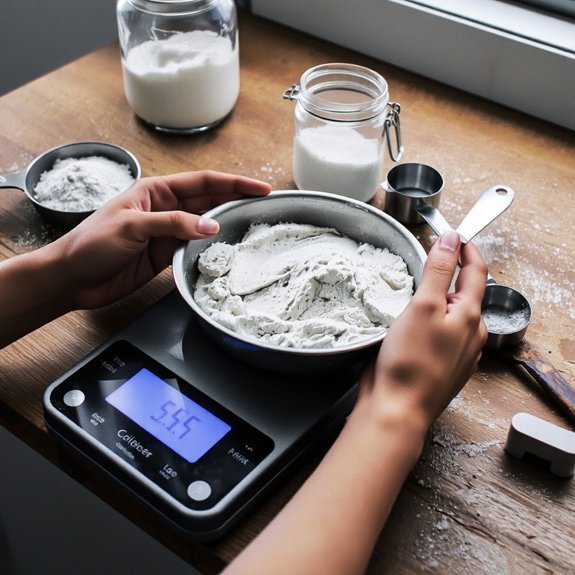
You’ll achieve the most accurate results when you use kitchen scales to measure your dry ingredients by weight rather than by volume.
If you don’t have scales available, you can rely on measuring cups, though you’ll need to account for settling and packing variations that affect accuracy.
Weight conversion charts provide a reliable reference when you’re converting between different measurement systems or scaling recipes down to half their original quantities.
Using Kitchen Scales
Because volume measurements like cups and tablespoons can vary considerably based on how densely you pack ingredients, kitchen scales offer the most reliable method for halving dry components.
You’ll achieve precision by following these steps:
- Calibrate scales before each use to eliminate accumulated errors and assure accuracy
- Place your scale on a level, stable surface away from air currents that might affect readings
- Tare the scale to zero, then add your ingredient until reaching exactly half the original weight
This approach eliminates guesswork.
You’re not dependent on technique or interpretation—just objective measurements.
When you weigh flour at 250 grams instead of estimating cups, you’re guaranteeing consistent results every time you halve that recipe.
Your freedom from failed batches comes through this straightforward, science-based method.
Measuring Cups Method
While kitchen scales provide unmatched precision, measuring cups remain the standard tool in most home kitchens and can deliver accurate results when you’re halving dry ingredients.
Understanding their historical origins helps you appreciate their standardization—US cup measurements evolved from imperial systems, establishing consistent volumes you can rely on.
You’ll find cultural variations matter here.
British cups differ from American cups, so verify which standard your recipe uses.
When halving, you’re not simply dividing by two; you’re accounting for how ingredients settle and pack differently at smaller quantities.
Spoon and level your dry ingredients before measuring.
Don’t tap or shake the cup—this compacts flour and throws off ratios.
For half-cup amounts, use quarter-cup measures for precision.
This methodical approach guarantees your halved recipes maintain structural integrity and flavor balance.
Weight Conversion Charts
How do weight measurements transform the precision of halved recipes?
You’ll discover that grams and ounces eliminate the guesswork inherent in volume measurements.
Weight conversion charts establish your foundation for accuracy.
You’re empowered to halve dry ingredients with confidence using these strategies:
- Locate original weights on ingredient labels or reliable conversion tables
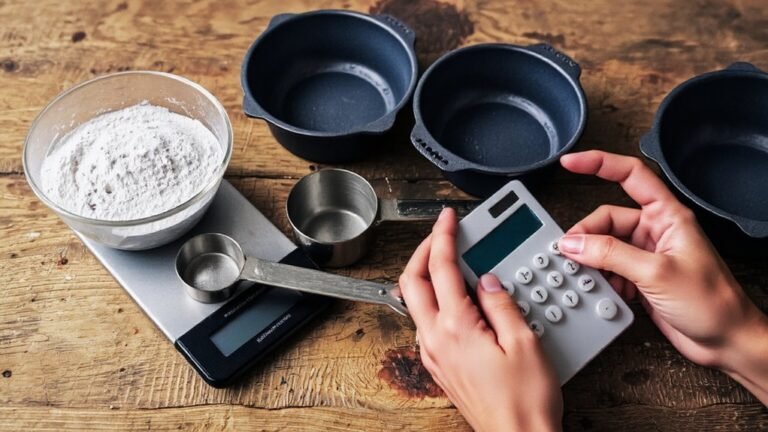
- Divide by two using a calculator for exact measurements
- Reference color-coded charts organized by ingredient category for quick visual hierarchy
You’ll find that professional bakers rely exclusively on weight-based measurements.
Your kitchen scale becomes indispensable—infinitely more reliable than cups or tablespoons.
Color coding systems in conversion charts guide you intuitively through conversions without mental calculation errors.
This technical approach liberates you from volumetric uncertainty, ensuring consistent results every time you halve recipes.
Adjusting Liquid Measurements
When you’re halving a recipe, you’ll need to recalculate your liquid ingredients with the same precision you’re applying to your dry components. Divide all liquids—water, oil, milk, broth—by two using weight measurements for accuracy.
However, viscosity adjustments require careful consideration. Thicker liquids like honey or molasses may need slightly less reduction since they’re more concentrated.
For emulsion stability in recipes containing both oil and water-based ingredients, maintain proper proportions to prevent separation. You’ll want to reduce seasonings and thickening agents proportionally as well.
Remember that cooking times may shift with smaller quantities, affecting evaporation rates. Use your judgment to verify consistency as you cook, adjusting incrementally rather than dramatically.
This methodical approach guarantees your halved recipe performs identically to the original.
Modifying Leavening Agents
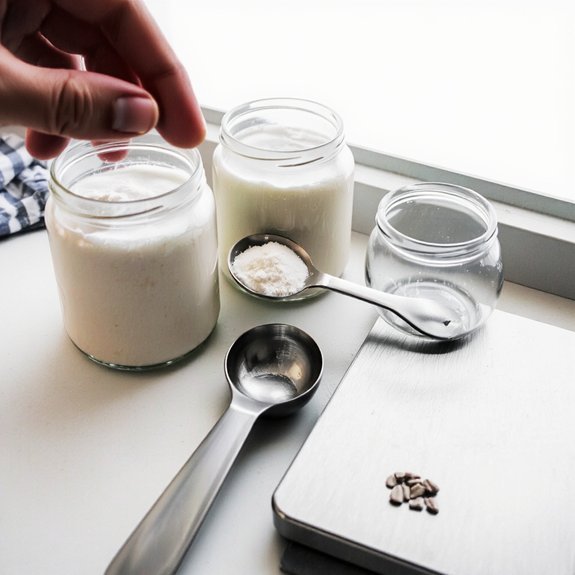
When you halve a recipe, you’ll need to carefully reduce leavening agents since they don’t scale proportionally with other ingredients.
Cutting baking soda in half requires precision to avoid flat or dense results.
You should adjust yeast proportions thoughtfully, as reducing it too much will compromise rising time and texture, while overdoing the reduction wastes the ingredient. Scaling baking powder down demands the same attention to measurement accuracy, ensuring your baked goods achieve proper lift and crumb structure at half the original volume.
Halving Baking Soda Carefully
Since leavening agents like baking soda directly control a recipe’s rise and texture, you’ll need to halve them with precision rather than rounding down casually.
When halving baking soda, follow this protocol:
- Measure the original amount precisely using a kitchen scale for accuracy
- Divide by two and label containers clearly to prevent cross-contamination during storage
- Implement strict hygiene protocol by using clean, dry measuring spoons each time
You can’t simply eyeball this reduction—baking soda’s chemical reaction is unforgiving.
Too little won’t activate properly, leaving your baked goods dense and flat.
Too much creates an unpleasant metallic taste.
Use a scale rather than volume measurements whenever possible, as density variations make cups unreliable.
Record your exact measurements so you maintain consistency across batches.
Adjusting Yeast Proportions Properly
Because yeast’s fermentation rate directly affects rise time and flavor development, you’ll need to adjust its proportions methodically when halving a recipe.
Simply dividing the yeast amount by two often yields disappointing results, as yeast doesn’t scale linearly with recipe size.
Start by reducing yeast by only one-quarter to one-third rather than half.
This maintains adequate fermentation activity in smaller batches.
Before using, perform freshness testing by proofing a small amount in warm water—it should foam vigorously within ten minutes.
Proper yeast storage extends viability.
Keep active dry yeast sealed in cool, dark conditions; refrigerate or freeze opened packages.
Instant yeast requires similar protection.
Monitor your dough’s rise time closely.
You’ll likely notice faster fermentation in halved recipes due to increased yeast concentration relative to dough volume.
Adjust timing accordingly to prevent over-proofing.
Scaling Baking Powder Down
Unlike yeast, which requires nuanced adjustment to maintain fermentation balance, baking powder and baking soda demand straightforward proportional reduction when halving recipes.
You’ll simply divide the original amount by two.
This direct approach works because these leavening agents don’t rely on living organisms or fermentation timing.
When sourcing your ingredients, verify they meet regulatory limits established by food safety authorities—this guarantees consistent rise and texture.
Consider these key points:
- Measure precisely using dry measuring cups and level off excess
- Check expiration dates, as potency diminishes over time
- Mix thoroughly into dry ingredients before combining wet components
You’re free to halve baking powder without the complexity yeast demands.
This straightforward scaling maintains your baked goods’ structural integrity and rise while giving you complete control over your recipe’s final outcome.
Seasoning a Halved Recipe
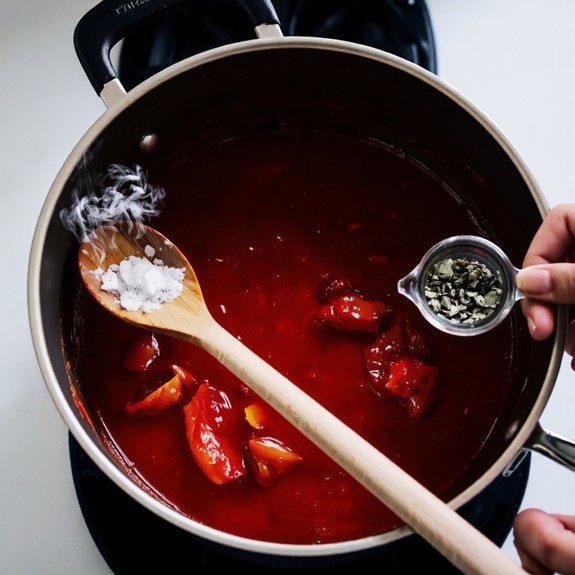
When you’re halving a recipe, you’ll need to reconsider your seasoning strategy, as spices and seasonings don’t always scale down proportionally with other ingredients. You have the freedom to adjust based on your palate rather than following rigid ratios.
| Seasoning Type | Halving Approach |
|---|---|
| Salt | Reduce by one-third to one-half; adjust during salt timing |
| Dried Spices | Cut by one-half; concentrated flavors intensify |
| Fresh Herbs | Reduce by one-quarter; preserve aromatic profile |
| Acid Finishing | Use half amount initially; taste and adjust final acid |
Start conservative with your reductions. You’ll discover that volatile compounds in dried spices remain potent, requiring less than proportional cuts. For acid finishing, add half the original amount, then taste. This approach grants you control over the final flavor profile without over-seasoning your scaled-down dish.
Managing Cooking Times and Temperatures
How do cooking times and temperatures shift when you’re working with half a recipe?
You’ll find that standard cooking temperatures remain unchanged—don’t alter your oven settings.
However, cooking times often decrease because smaller portions heat through faster.
Here’s what you need to know:
- Reduce cooking time by 25-30%, then check for doneness rather than relying solely on original instructions
- Verify oven calibration before starting, as temperature inaccuracies compound in smaller batches
- Account for carryover cooking, which continues after you remove food from heat—smaller items finish faster
Monitor your dish closely during the adjusted timeframe.
You’re gaining control over your cooking process, so trust your instincts.
Test for doneness using visual cues, temperature readings, or texture checks specific to your dish rather than blindly following scaled times.
Special Considerations for Specific Ingredients
Certain ingredients don’t scale proportionally, requiring you to adjust beyond simple division by two. You’ll encounter ingredients that demand special handling when halving recipes, particularly those affecting texture, rise, and flavor intensity.
| Ingredient | Halving Strategy | Rationale |
|---|---|---|
| Leavening agents | Reduce by slightly less than half | Prevents dense, flat results |
| Salt & spices | Cut by more than half | Flavor concentrates during cooking |
| Chocolate tempering | Maintain full amount or reduce minimally | Structural integrity depends on cocoa solids ratio |
| Egg alternatives | Adjust based on binding function | Varies by substitute type and recipe role |
You’ll maintain better control over your reduced batch by respecting these ingredient categories. Don’t mechanically divide everything—instead, evaluate each component’s functional role. This approach gives you the freedom to scale confidently while preserving your dish’s intended characteristics.
Measuring Fractions and Using Kitchen Tools
You’ll need precise measurement tools to successfully halve recipes, especially when working with fractional amounts that don’t divide evenly.
Precise measurement tools are essential for halving recipes, particularly when dealing with fractional amounts that don’t divide evenly.
Visual fractioning—estimating half-portions by sight—works for some ingredients but demands accuracy for baking.
Master these essential techniques:
- Invest in graduated measuring cups and spoons that display both standard and metric measurements, giving you flexibility and precision.
- Use a kitchen scale for ingredients like flour and butter, which provides exact weights when halving proves mathematically awkward.
- Practice visual fractioning with flexible ingredients like spices and liquids, though scales remain superior for consistency.
Maintain your tools properly—wash measuring equipment immediately after use and store them dry.
Damaged or warped measuring devices compromise accuracy, undermining your halving efforts entirely.
Frequently Asked Questions
Can I Halve a Recipe That’s Already Been Halved Before?
Yes, you can halve a recipe that’s already been halved.
However, you’ll face equipment limitations with extremely small measurements and potential texture changes from reduced ingredient ratios.
Precise scaling becomes critical—use weight measurements instead of volume for accuracy.
Be aware that some ingredients, particularly leavening agents and spices, don’t scale linearly.
You’re free to experiment, but expect unpredictable results with multiple halvings.
How Do I Halve a Recipe Designed for a Crowd?
You’ll divide all ingredient quantities by two, but exercise caution with scaling spices—reduce them by only one-quarter to one-third initially, then adjust to taste.
Make timing adjustments too; smaller batches cook faster, so cut baking and simmering times by ten to fifteen percent.
Test early to make sure you’re not sacrificing flavor or texture.
You maintain complete control over your results this way.
Should I Halve Recipes With Eggs Differently Than Other Ingredients?
Yes, you’ll handle eggs differently than other ingredients.
Since eggs provide critical egg binding properties in baked goods and custards, you can’t always halve them linearly. For cakes and cookies, use standard substitution ratios: half an egg equals two tablespoons of liquid mixed with one tablespoon of flour.
This maintains your recipe’s structural integrity without compromising texture or rise. You’ve got the flexibility to experiment once you understand these binding mechanics.
What if My Halved Recipe Uses Measurements I Can’t Measure?
You’ll convert unmeasurable fractions using volume conversions and fraction tips.
Half of 3/4 teaspoon becomes 3/8 teaspoon—scale down numerators while keeping denominators stable.
For odd measurements, you can round strategically without compromising results.
Convert tablespoons to teaspoons when necessary: half of 1 tablespoon equals 1.5 teaspoons.
You’ve got flexibility here.
Use kitchen scales for precision or estimate confidently based on your cooking experience and desired outcome.
Can I Freeze Halved Recipe Portions for Later Use?
You can absolutely freeze halved recipe portions.
Most prepared foods maintain quality for 2-3 months when properly stored in airtight containers.
Your storage lifespan depends on the dish type—soups and stews freeze better than dairy-based items.
For reheating tips, thaw overnight in your refrigerator, then reheat slowly on low heat or in your microwave at reduced power.
This approach preserves texture and flavor while maximizing your culinary independence.

Leave a Comment