
Key Takeaways
- All-purpose flour converts at 1 cup = 125 g; granulated sugar at 1 cup = 200 g; butter at 1 cup = 227 g.
- Ingredient density varies by type, requiring different cup-to-gram conversions; flour and sugar have distinctly different weights per cup.
- Volume and weight measurements are not interchangeable without accounting for ingredient density; grams measure mass while cups measure space.
- Kitchen scales provide accurate gram measurements when placed on stable surfaces and calibrated to zero before adding ingredients.
- Document personal conversion ratios based on your specific kitchen tools and techniques to maintain consistency across batches.
Why Accurate Measurements Matter in Baking
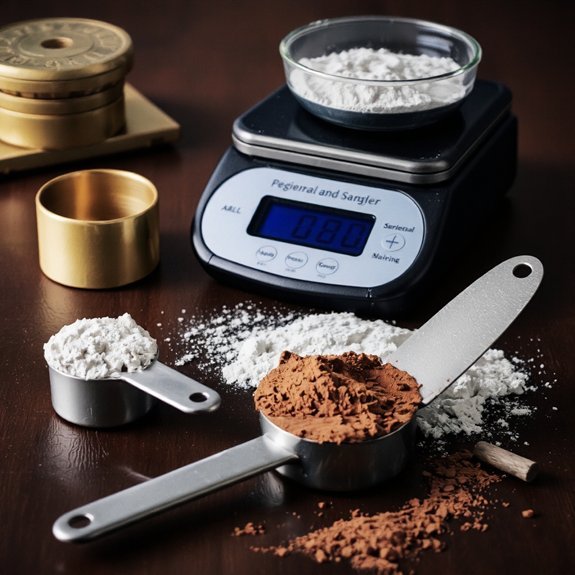
Because baking relies on precise chemical reactions between ingredients, you’ll find that even small measurement variations can dramatically alter your results. When you use grams instead of cups, you’re eliminating the guesswork that undermines consistency. Cups vary based on how densely you pack flour or sugar, but grams provide absolute accuracy every single time.
You’ll achieve better portion control when you measure by weight, ensuring uniform batches without waste. This precision directly supports cost management—you’re not buying excess ingredients or discarding failed batches due to measurement errors.
Your freedom to create reliable, reproducible baked goods depends on measurement accuracy. Whether you’re scaling recipes up or down, grams maintain proportional integrity that cups can’t guarantee. Embrace this technical advantage and transform your baking outcomes.
Understanding Ingredient Density and Weight Variations
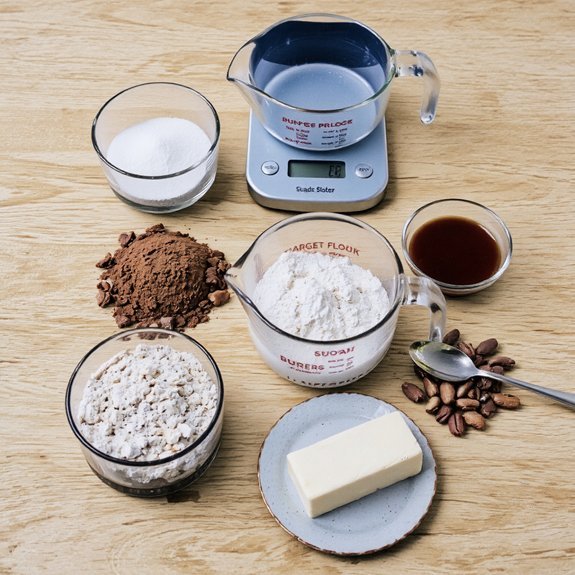
When you measure ingredients by volume rather than weight, you’re relying on density—a variable that shifts based on how tightly particles pack together in your cup.
You’ll notice that flour settles differently depending on storage conditions and handling, while sugar, salt, and other dry ingredients each possess unique densities that affect their gram equivalents.
Understanding this distinction between volume and weight measurements is essential because you can’t achieve consistent baking results without accounting for these density variations.
Density Affects Measurement Accuracy
Different ingredients pack into cups with varying density, which is why volume-based measurements don’t reliably translate to consistent gram weights across the board.
You’ll notice that porosity effects substantially impact your results.
Flour, for instance, contains air pockets that compress differently depending on how you scoop it.
When you measure by volume, you’re capturing both the ingredient and trapped air, making conversions unpredictable.
Thermal expansion complicates matters further.
Temperature changes alter ingredient density—warm ingredients occupy more space than cold ones.
You might measure identical gram amounts that occupy different cup volumes based solely on temperature variations.
You’re gaining accuracy by recognizing these variables.
Understanding density relationships empowers you to convert measurements reliably.
When precision matters, you’ll weigh ingredients rather than relying on cups, ensuring consistent results every time.
Volume vs. Weight Distinction
Volume and weight measurements operate on fundamentally different principles that you’ll need to distinguish to master conversions.
Volume measures space occupied, while weight measures gravitational force on mass.
You can’t freely interchange these units without understanding what you’re measuring.
- Legal definitions establish standardized cup volumes (236.6 mL in the US), but ingredient density determines actual gram weight
- Cultural practices vary globally—metric countries prioritize grams, while traditional recipes rely on volume measurements
- Water’s density (1 g/mL) serves as your baseline; denser ingredients like flour weigh more per cup
- Your conversion accuracy depends entirely on identifying specific ingredient density, not assuming uniform ratios
This distinction demands precision.
You’re converting between measurement systems with different physical foundations.
Recognizing this fundamental difference guarantees your baking succeeds and your recipes scale reliably across any culinary application.
Common Ingredient Conversions: Cups to Grams
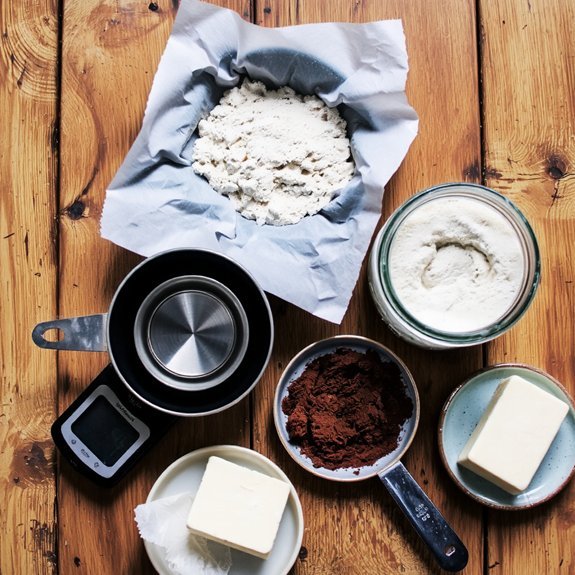
You’ll need to understand how dry and liquid ingredients convert differently when measuring by volume rather than weight.
Dry ingredients like flour and sugar vary in density based on how they’re packed, requiring specific gram conversions that differ from their liquid counterparts.
Liquid ingredients, conversely, maintain consistent density, making their cup-to-gram conversions more straightforward and reliable across applications.
Dry Ingredient Conversions
Why does converting dry ingredients from cups to grams matter?
You’ll find precision is essential when baking or cooking, especially when following recipes with historical origins rooted in various cultural practices.
Volume measurements like cups vary substantially depending on how you pack ingredients, leading to inconsistent results.
Accurate gram conversions give you:
- Consistent outcomes across different recipes and cooking methods
- Independence from subjective measuring techniques that compromise quality
- Direct alignment with professional culinary standards and international recipes
- Freedom to scale recipes confidently without calculation errors
Converting dry ingredients to grams eliminates guesswork.
You’re no longer dependent on eyeballing measurements or dealing with packed versus unpacked variations.
This technical approach guarantees you’ll achieve reliable, repeatable results every time you cook or bake.
Liquid Ingredient Conversions
Because liquids possess different densities than their dry counterparts, they’ll require a distinct conversion approach.
You’ll find that one cup of water weighs 236.588 grams, yet one cup of honey weighs approximately 339 grams—a substantial difference rooted in molecular density.
You must recognize this variance matters notably for culinary applications.
When you’re converting liquid measurements, you’re working with volume-to-weight ratios that demand precision.
The measurement history of cup-based cooking emerged from practical necessity, yet modern accuracy demands gravitational verification.
You can’t simply apply dry ingredient conversion formulas to liquids.
Instead, you’ll consult ingredient-specific gravity charts to guarantee your culinary results remain consistent.
This technical understanding grants you complete freedom from guesswork, delivering reproducible outcomes across your kitchen operations.
How to Use a Kitchen Scale for Precise Measurements
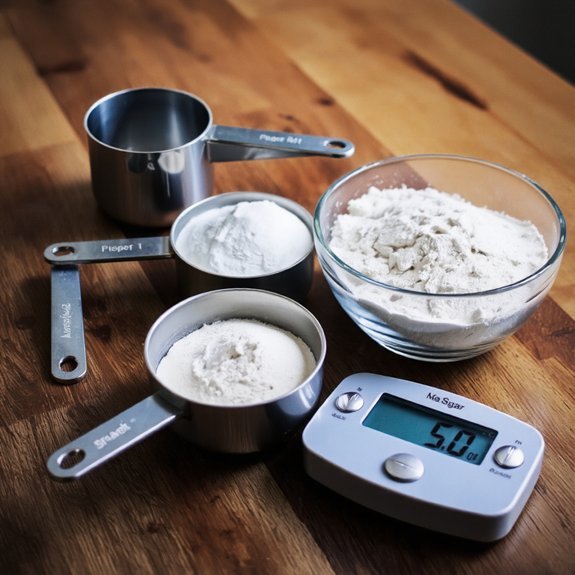
While cup measurements can vary based on packing and technique, a kitchen scale eliminates guesswork by providing exact weights in grams or ounces.
A digital kitchen scale eliminates guesswork by providing exact ingredient weights, freeing you from cup measurement inconsistencies.
You’ll gain complete control over your recipes when you master scale usage.
- Place your scale on a stable placement surface, away from edge proximity, ensuring level contact for accurate readings
- Calibrate before each use by pressing the tare button to reset to zero
- Add ingredients gradually, monitoring the display as weight accumulates in real-time
- Check battery care regularly, replacing batteries promptly to prevent measurement errors
Using a digital kitchen scale liberates you from measurement inconsistencies.
You’re no longer bound by approximate cup conversions or ambiguous instructions. This precision empowers you to replicate results consistently, experiment confidently, and achieve professional-quality outcomes in your cooking endeavors.
Converting Recipes From Cups to Metric Units
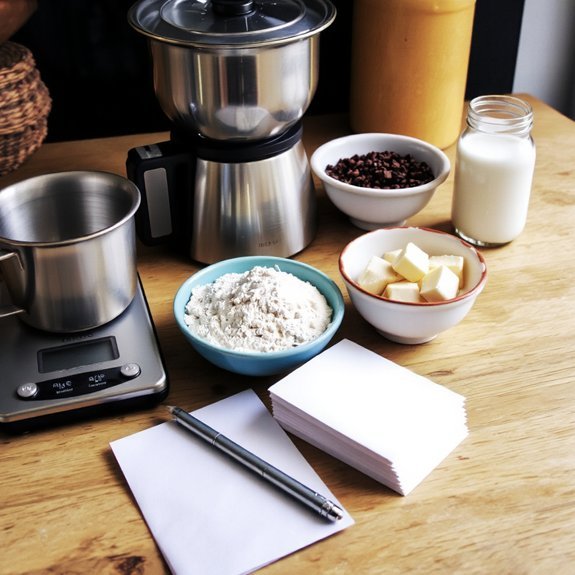
Now that you’ve mastered using a kitchen scale to measure ingredients accurately, you’re ready to convert your favorite recipes from cup measurements to metric units.
Converting recipes requires understanding conversion ratios. You’ll find that ingredient density varies considerably, affecting gram equivalents. Consider your kitchen ergonomics—a digital scale positioned at eye level reduces measurement errors and strain.
| Ingredient | Cups | Grams |
|---|---|---|
| All-Purpose Flour | 1 | 125 |
| Granulated Sugar | 1 | 200 |
| Butter | 1 | 227 |
When sourcing ingredients, verify their density specifications, as quality and moisture content impact conversions. Use metric measurements consistently throughout your recipe for reproducible results. This approach eliminates guesswork and guarantees precision every time you cook.
Tips for Consistent Results Across Different Measurement Systems
To guarantee your recipes perform identically whether you’re using cups or grams, you’ll need to establish a standardized conversion baseline for each ingredient you regularly cook with.
- Invest in quality digital scales and calibrate them regularly—tool maintenance guarantees accurate measurements every time.
- Master measurement education by understanding density variations; flour weighs differently than sugar.
- Document your personal conversion ratios based on your specific kitchen tools and techniques.
- Cross-reference multiple reliable sources before committing conversions to your recipe collection.
You’ll gain independence from recipe guessing games when you control your measurement standards.
Precise conversions eliminate variables that compromise results.
Your kitchen becomes a controlled environment where ingredient weights trump volume assumptions.
This freedom from conversion uncertainty transforms your cooking reliability across all measurement systems.
Frequently Asked Questions
What’s the Difference Between US Cups and Metric Cups in Grams?
You’ll find that US cups and metric cups differ in their volume standards, affecting measuring precision when you convert to grams.
A US cup equals 236.6 milliliters, while a metric cup measures 250 milliliters.
This 13.4-milliliter discrepancy means you’re working with distinct measurement systems.
When you’re converting ingredients to grams, you’ve got to know which cup standard you’re using, because the weight variations compound quickly across recipes, demanding accuracy for consistent results.
Can I Convert Recipes Using Volume Measurements Without a Kitchen Scale?
Yes, you can convert recipes using volume measurements without a scale.
You’ll rely on visual cues and equipment alternatives like measuring cups and spoons for accuracy. Pack flour lightly, level dry ingredients with a knife, and use standard measurements consistently.
Liquid ingredients are more forgiving. You’re not bound to scales—traditional volume measurements work perfectly when you’re precise with your technique and pay attention to visual consistency throughout your cooking process.
Why Do Similar Ingredients Have Different Gram Weights per Cup?
You’ll find similar ingredients weigh differently per cup due to particle size and packing density variations.
Flour particles pack tighter than sugar crystals, so you’re getting more flour by weight in that same cup volume.
Ingredients like cocoa powder or finely ground spices compress differently than coarser materials.
Understanding these density differences gives you the control to adapt recipes precisely without surrendering accuracy to volume measurements.
How Do Altitude and Humidity Affect Ingredient Measurements and Conversions?
You’ll find that altitude and humidity directly impact your ingredient measurements.
At higher elevations, you’re dealing with lower atmospheric pressure, requiring Leavening Adjustments to your baking ratios.
Humidity affects Flour Hydration levels—you’ll need to reduce liquid in moist conditions and increase it in dry climates.
You’re fundamentally compensating for environmental variables that alter how ingredients behave, demanding precise recalibration of your conversions for consistent results.
Are There Free Online Tools Available for Instant Cup-To-Gram Conversions?
You’ve got multiple options at your disposal.
Web-based converters like Convert Kitchen Units and Recipe Scaler function instantly in your browser.
You can install browser extensions that calculate conversions on-the-fly without leaving your recipe page.
Mobile apps like Kitchen Calculator and Ingredient Manager give you offline access, ensuring you’re never dependent on internet connectivity.
These tools eliminate proprietary systems, letting you work independently across any platform.
Leave a Comment