

Key Takeaways
- Use digital scales to measure ingredients by weight in grams for consistency and accuracy across all recipes.
- Convert volume to weight using standard equivalents: 1 cup flour = 120g, 1 cup sugar = 200g.
- Calculate scale factors by dividing desired yield by original yield, then multiply all ingredients accordingly.
- Replace butter with coconut or vegetable oil at a 1:1 weight ratio without affecting recipe outcomes.
- Adjust baking times when scaling recipes, as thinner batters cook faster and thicker layers need extended time.
Understanding Volume vs. Weight Measurements

When you’re baking, the measurement system you choose substantially impacts your results’ consistency and accuracy.
Volume measurements—cups and tablespoons—vary based on how you pack ingredients and air incorporation levels.
Weight measurements in grams eliminate these variables entirely, giving you precise control.
You’ll find that flour’s moisture content fluctuates seasonally and by storage conditions, affecting volume measurements unpredictably.
Scales bypass this problem.
Liquids behave more consistently in volume, yet weight remains superior for scaling recipes reliably.
Understanding this distinction grants you freedom from failed batches.
You’re not bound to recipes’ imprecise volume instructions.
By switching to weight measurements, you’ll achieve reproducible results regardless of environmental factors.
Your baking becomes systematic and dependable—controlled entirely by your choices, not chance variables.
Converting Between Metric and Imperial Units
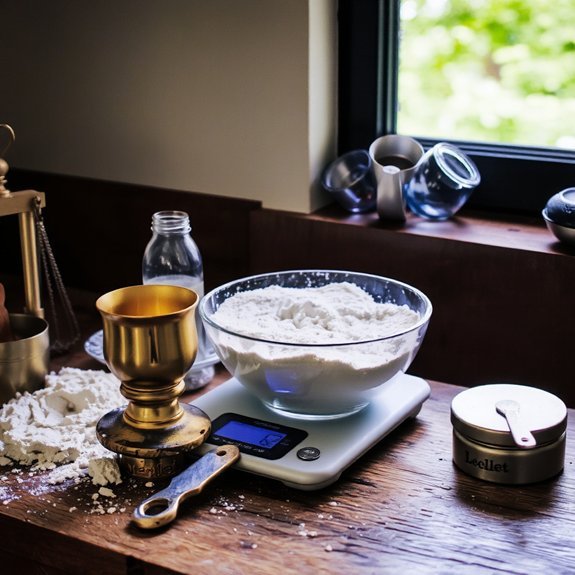
Since you’ve committed to weight measurements, you’ll need to convert between metric and imperial units to follow most baking recipes.
Converting between metric and imperial units unlocks flexibility in following baking recipes from any region or tradition.
Understanding unit history helps explain why these systems exist: the metric system emerged from 18th-century France as a standardized, decimal-based approach, while imperial measurements developed from traditional British standards.
Regional standards considerably impact recipe formats.
The United States primarily uses imperial units (ounces, pounds), whereas most other countries employ metric measurements (grams, kilograms).
You’ll find conversion factors essential: one ounce equals approximately 28.35 grams, and one pound equals roughly 453.6 grams.
Master these conversions to enable recipe flexibility.
You’re no longer confined to recipes written in your region’s preferred system—you can freely adapt any formula.
Precise conversions guarantee consistent results across culinary traditions.
Scaling Recipes Up and Down

Once you’ve mastered unit conversions, you’ll discover that scaling recipes requires the same mathematical precision.
You’re not limited by someone else’s proportions—you control the yield.
To scale up or down, divide your desired yield by the original yield, then multiply each ingredient by this factor.
This maintains flavor balance and texture integrity.
Pan size directly impacts your results.
Scaling a cake recipe up demands consideration of how batter depth affects baking time.
Thinner layers cook faster; thicker ones require extended heat exposure.
Batch timing becomes critical when you’re doubling or halving.
Oven capacity constrains simultaneous production.
You’ll need to stagger batches strategically to maintain consistent quality.
Leverage these scaling principles to customize recipes to your specifications, freeing yourself from rigid measurements.
Common Baking Ingredient Conversions
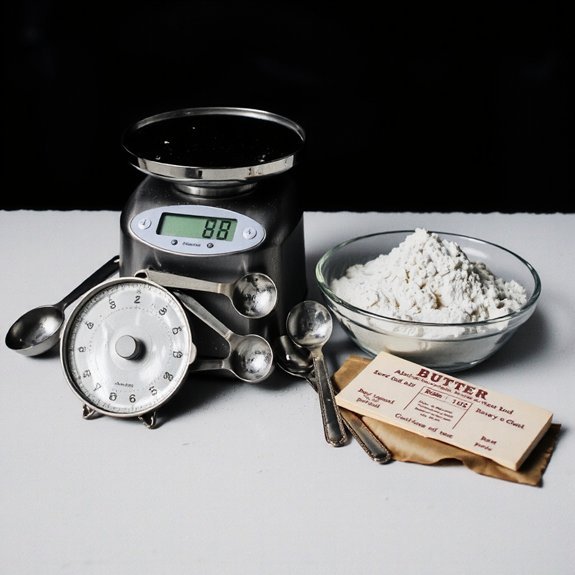
You’ll encounter three primary ingredient categories in baking conversions: dry goods, liquids, and fats.
Understanding these conversions gives you control over your baking outcomes.
- Dry goods: 1 cup flour equals 120 grams; 1 cup sugar equals 200 grams
- Liquids: 1 cup milk or water equals 240 milliliters; measurements remain consistent across volume and weight
- Fat substitutions: Replace butter with coconut oil or vegetable oil at a 1:1 ratio by weight
- Sweetener equivalents: Use 3/4 cup honey for 1 cup sugar; reduce other liquids by 1/4 cup
These conversions empower you to scale recipes confidently while maintaining structural integrity.
Weight measurements offer superior accuracy compared to volume, especially for precision-demanding applications.
Master these fundamental conversions, and you’ll achieve consistent results across all your baking projects.
Tools and Techniques for Accurate Conversions

Precision in baking conversions hinges on selecting the right measurement tools and applying systematic techniques.
Precision in baking conversions requires the right measurement tools and systematic, repeatable techniques.
You’ll want digital scales for accuracy, as they eliminate human error inherent in volume measurements.
Invest in calibration techniques to make sure your scales remain reliable—test them regularly with known weights to verify consistency.
Tool maintenance directly impacts your conversion accuracy.
Keep your measuring cups and spoons clean and dry, protecting them from warping or damage.
Store scales in stable environments away from moisture and extreme temperatures.
You’ll gain independence from guesswork by using weight-based measurements whenever possible.
Convert recipes to grams rather than cups, guaranteeing reproducible results across batches.
This systematic approach transforms baking from uncertainty to reliable, predictable outcomes you can control and replicate with confidence.
Frequently Asked Questions
Why Do Some Recipes Use Weight Measurements While Others Use Volume Measurements?
You’ll find recipes vary because weight measurements offer precision differences that volume can’t match.
Grams eliminate inconsistencies from packing and settling, giving you reliable results every time.
Volume measurements persist due to regional preferences—Americans favor cups while Europeans embrace kilograms.
You’re free to choose either method, but understanding that weight provides superior accuracy helps you decide which approach best suits your baking goals and kitchen setup.
Can I Substitute One Ingredient for Another and Adjust Measurements Accordingly?
You can substitute ingredients, but you’ll need to account for flavor swaps and texture balancing carefully.
Convert weights using ingredient-specific density ratios—don’t assume one-to-one conversions. You’re free to experiment, though you must adjust liquid ratios, binding agents, and leavening based on your substitute’s properties. Systematic testing makes certain you won’t compromise your final product’s structure and taste.
How Do Temperature Conversions Affect Baking Time and Final Results?
You’ll find that temperature conversions directly impact your baking outcomes. When you adjust oven temperatures, you’re altering heat distribution and baking duration. Higher temperatures accelerate crust formation, creating darker exteriors while potentially undercooking interiors.
Lower temperatures extend baking times, requiring oven calibration adjustments. You’ve got the freedom to modify temperatures—just expect corresponding timing changes. Precise calibration guarantees you maintain control over your final product’s texture, color, and doneness.
What’s the Difference Between Packed and Unpacked Measurements for Dry Ingredients?
You’ll find that packed measurements compress your ingredient density substantially higher than unpacked ones. Your packing technique directly affects volume—when you firmly press brown sugar or flour into a measuring cup, you’re fitting more substance into the same space.
Unpacked ingredients settle naturally, requiring less material to fill the cup. This distinction matters: packed brown sugar weighs roughly 1.5 times more than unpacked. You must follow your recipe’s specifications precisely to control your baking outcomes reliably.
How Do Altitude and Humidity Impact Baking Measurements and Recipe Adjustments?
You’ll need leavening adjustments at high altitudes where reduced air pressure causes batters to rise too quickly.
Increase baking soda or powder slightly and reduce sugar to prevent overflow.
For humidity compensation, you’ve got flexibility—add flour in damp climates or reduce it in dry conditions.
Monitor your dough’s consistency closely.
You’re controlling the outcome by adapting ratios systematically to your environment’s demands.

Leave a Comment