

Key Takeaways
- Cool frosted cakes completely, apply a crumbcoat, and insert dowel supports between tiers for structural stability.
- Select an airtight container with adequate depth to prevent frosting compression, ensuring 1/2 inch clearance minimum.
- Store cakes between 65–70°F and maintain 35–50% humidity to prevent frosting separation, cracking, and weeping.
- Refrigerate buttercream after 24 hours and cream cheese frosting immediately; keep fondant and ganache away from heat.
- Label cakes with creation date; dairy-based frostings last 3–5 days refrigerated, fondant cakes 1–2 weeks maximum.
Prepare Your Cake for Storage

Allowing your frosted cake to cool completely guarantees that condensation won’t form when you store it, which would compromise the frosting’s appearance and texture. Once cooled, you’re free to proceed with preparation.
Completely cool your frosted cake to prevent condensation and preserve frosting appearance and texture during storage.
Apply crumbcoat—a thin frosting layer that seals in crumbs—before your final frosting coat. This technique prevents loose crumbs from marring your finished surface and delivers a professional appearance.
For tiered cakes, insert supports strategically between layers. Dowels or bubble tea straws distribute weight evenly, preventing collapse during storage and transport. Cut supports flush with the cake’s top surface for seamless integration.
Place your prepared cake on a sturdy, level surface away from direct sunlight, heat sources, and strong odors. These environmental factors degrade frosting quality and flavor. Your cake’s stability and longevity depend on these preparatory steps.
Choose the Right Storage Container
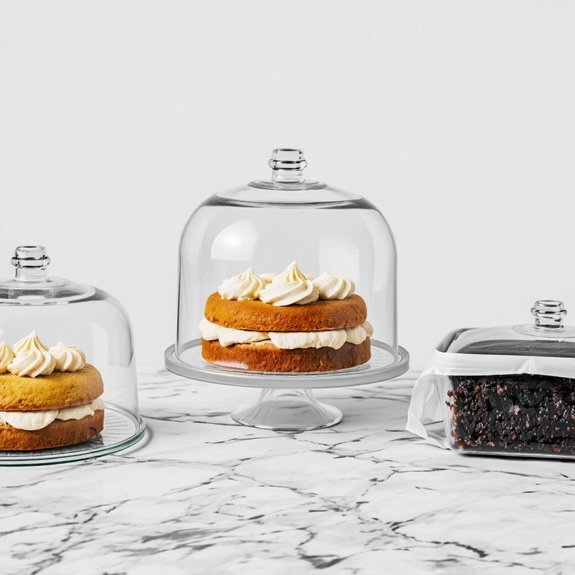
You’ll want to select an airtight container that seals completely to prevent moisture loss and contamination.
Make sure the container’s depth and dimensions accommodate your cake without compressing the frosting or forcing the lid against the surface.
Consider food-grade plastic or glass materials, as they maintain structural integrity and won’t interact with frosting components.
Airtight Container Benefits
Selecting an airtight container stands as one of the most critical decisions for preserving frosted cakes, as it directly prevents moisture loss and oxidation that compromise texture and flavor. You’ll experience significant waste reduction by maintaining ideal humidity levels, extending your cake’s shelf life considerably. Quality airtight containers enhance kitchen aesthetics while protecting your investment from environmental contaminants.
| Container Type | Seal Quality | Durability | Best Use |
|---|---|---|---|
| Glass with Rubber Gasket | Excellent | High | Long-term storage |
| Plastic Snap-Lock | Very Good | Medium | Short-term storage |
| Cake Carrier Dome | Good | Medium | Countertop display |
| Vacuum-Sealed Plastic | Excellent | High | Freezer storage |
| Stainless Steel | Very Good | Very High | Premium protection |
You’ll maximize freshness while minimizing spoilage when you select containers engineered for airtight performance.
Size and Depth Matters
While airtight quality forms the foundation of proper cake storage, the container’s internal dimensions prove equally important for maintaining frosting integrity and cake structure. You’ll want to measure your cake’s layer height before selecting a container, ensuring sufficient vertical clearance to prevent frosting smudging or compression.
A container that’s too shallow won’t accommodate multi-tiered cakes without damaging delicate decorations. Consider your slice yield requirements when choosing depth. Rectangular containers maximize space efficiency for sheet cakes, while round containers suit layered designs.
You shouldn’t force your cake into undersized storage—this compromises both appearance and taste. Calculate the necessary dimensions by accounting for cake height plus frosting thickness, then add half an inch for safety clearance. This precision prevents unnecessary deterioration and preserves your cake’s quality throughout storage.
Material Selection Guidelines
The container material directly impacts how well your frosted cake maintains its moisture and structural integrity during storage.
You’ll want to prioritize durability standards that withstand temperature fluctuations and protect against contamination.
Consider these options:
- Plastic containers: Lightweight, reusable, meet food-safety durability standards
- Glass: Superior moisture retention, recyclable, minimal environmental impact
- Cardboard cake boxes: Breathable, recyclable, reduce environmental impact
- Aluminum: Excellent insulation, durable, fully recyclable
- Cake carriers: Purpose-built design, stackable, long-term durability
Select materials that align with your storage duration and environmental values.
Glass and aluminum offer superior protection for extended storage, while recyclable options reduce your environmental footprint.
Make sure your chosen container provides an airtight seal to prevent moisture loss and preserve frosting quality.
You maintain control over both preservation effectiveness and ecological responsibility through smart material selection.
Control Temperature and Environment
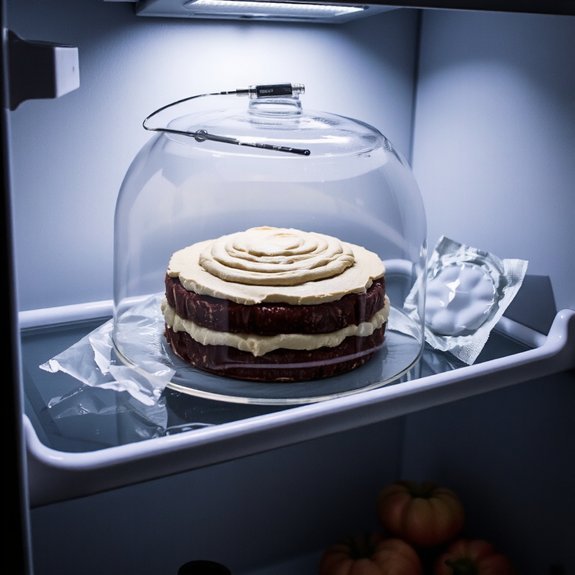
For ideal results, use a dedicated cake storage box or enclosed container that shields your creation from external atmospheric changes. This approach grants you complete control over the storage environment, ensuring your frosted cake maintains its quality and appearance throughout its shelf life.
Because frosting’s stability depends heavily on environmental conditions, you’ll need to maintain precise temperature and humidity levels to prevent degradation.
Keep your frosted cake between 65-70°F to avoid temperature gradients that cause frosting separation and cracking.
Monitor ambient conditions consistently, as fluctuations compromise structural integrity.
You should store cakes in dark spaces away from direct sunlight, which accelerates color fading and butter oxidation.
Maintain humidity between 35-50% to prevent moisture absorption or excessive drying.
Avoid positioning cakes near heat sources, air vents, or windows where environmental variables shift unpredictably.
Manage Humidity Levels

Stabilizing humidity levels directly impacts frosting texture, preventing both weeping and cracking that’ll compromise your cake’s appearance.
You’ll want to maintain 35-50% relative humidity for ideal storage conditions.
Consider these strategies:
- Install humidity monitors in your storage area to track moisture levels consistently
- Position dehumidifier placement strategically near cakes without direct airflow
- Use silica gel packets inside airtight containers for portable humidity control
- Avoid refrigerators with high moisture output; use dedicated cake boxes instead
- Seal storage containers completely to prevent external humidity infiltration
You control your cake’s fate by managing environmental moisture.
Excessive humidity causes frosting to weep and lose definition, while low humidity promotes cracking.
Regular monitoring guarantees you maintain precise conditions that preserve your frosted creation’s structural integrity and visual appeal throughout storage.
Position Your Cake Properly

Once you’ve established stable humidity levels, proper cake positioning becomes your next critical step in preserving frosting integrity. You’ll want to store your cake on a level surface away from direct heat sources and sunlight. Elevate your cake using rack elevation to promote air circulation underneath, preventing moisture accumulation that softens frosting. Avoid tilting or displaying your cake at an angle; maintain a perfectly level display angle to prevent frosting migration and collapse.
| Position Element | Ideal Setting | Result |
|---|---|---|
| Surface Level | Completely flat | Frosting stability |
| Rack Elevation | 2-3 inches minimum | Airflow circulation |
| Display Angle | 0 degrees | No frosting shift |
| Distance from walls | 4+ inches | Temperature stability |
| Container seal | Airtight | Moisture control |
You’ll protect your frosting from unnecessary stress by respecting these positioning fundamentals.
Understand Frosting-Specific Storage Needs
Different frosting types demand distinct storage conditions to maintain their structural integrity and visual appeal.
You’ll need to grasp frosting chemistry and ingredient sensitivity to preserve your cake’s quality.
- Buttercream: Store at room temperature for 24 hours; refrigerate beyond that to prevent oil separation
- Cream cheese frosting: Requires immediate refrigeration due to dairy’s instability and bacterial growth risk
- Fondant: Keep away from humidity; moisture causes dissolving and discoloration
- Ganache: Monitor temperature carefully; cocoa butter’s crystalline structure destabilizes above 70°F
- Royal icing: Store in airtight containers; egg white proteins deteriorate when exposed to air
Understanding these ingredient sensitivities prevents frosting breakdown, color fading, and texture degradation.
You’re empowered to make informed decisions about refrigeration duration and environmental controls, ensuring your frosted cake maintains professional appearance throughout storage.
Know Your Cake’s Shelf Life
How long can you realistically expect your frosted cake to maintain quality?
Your cake’s shelf life depends on several factors you’ll need to assess independently.
Ingredient impact plays a pivotal role—cakes made with dairy-based frostings (buttercream, cream cheese) last 3-5 days refrigerated, while fondant-covered cakes extend to 1-2 weeks.
Dairy-based frostings keep cakes fresh 3-5 days refrigerated, while fondant extends shelf life to 1-2 weeks.
Oil-based cakes outlast butter-based varieties.
Temperature control substantially affects longevity; room temperature storage limits cakes to 2-3 days maximum.
Check label dating on all ingredients, particularly eggs and dairy products, to establish your baseline freshness timeline.
Homemade cakes without preservatives won’t last as long as commercial varieties.
You’ll gain freedom in planning by understanding these variables upfront.
Document your cake’s creation date for reference, allowing you to make informed decisions about consumption windows and preventing waste.
Frequently Asked Questions
Can I Freeze a Frosted Cake, and How Long Will It Last?
Yes, you can freeze a frosted cake.
Frosting compatibility matters greatly—buttercream, cream cheese, and fondant freeze well for up to three months, while whipped cream frosting doesn’t hold up as effectively.
You’ll want to freeze your cake unwrapped for two hours first, then wrap it tightly in plastic wrap and aluminum foil.
Freezing duration depends on frosting type, but most frosted cakes maintain quality for eight to twelve weeks when properly stored at zero degrees Fahrenheit.
What’s the Best Way to Transport a Frosted Cake Without Damaging It?
You’ll want to secure your frosted cake on non-slip trays to prevent shifting during transport.
Install dowel supports vertically through the cake’s layers for structural reinforcement, especially with tiered designs.
Keep the cake in a temperature-controlled environment—never expose it to direct heat.
Drive carefully, avoiding sudden stops or sharp turns.
Place the cake on a flat vehicle surface, away from passengers.
You’ve got the autonomy to choose your route deliberately.
How Do I Remove Frosting Stains From Plastic Storage Containers?
You’ll effectively remove frosting stains by creating a vinegar soak—submerge your containers in equal parts white vinegar and water for thirty minutes.
For stubborn residue, you’ve got the freedom to apply baking soda directly onto damp surfaces, scrubbing gently in circular motions. This chemical reaction breaks down fatty frosting compounds without damaging plastic. Rinse thoroughly with hot water and air-dry completely to prevent bacterial growth and maintain container integrity.
Can I Store Different Cake Flavors Together in One Container?
You shouldn’t store different cake flavors together in one container.
Flavor transfer and aroma mixing will compromise each cake’s integrity, leaving you with muddled, undesirable tastes.
You’re better off using separate airtight containers for each variety.
This approach preserves the distinct characteristics you’ve worked to create, giving you complete control over your storage choices and ensuring you’ll enjoy each flavor exactly as intended without unwanted contamination or degradation.
What Should I Do if Frost Forms on My Stored Frosted Cake?
You’ll need to address frost removal and humidity control immediately. Gently brush off surface frost with a soft pastry brush—don’t wipe it. Move your cake to a warmer environment to prevent condensation buildup.
Maintain storage humidity between 35-50% using a dehumidifier if necessary. Store your cake away from temperature fluctuations and cold surfaces.
If frost persists, your cake’s been exposed to excessive moisture; transfer it to a properly controlled space immediately.
Leave a Comment