

Key Takeaways
- Use airtight containers with proper seals to minimize air exposure and prevent moisture absorption that causes staleness.
- Store cookies at 65–70°F away from direct sunlight and heat sources to slow chemical degradation.
- Separate strongly flavored and moisture-sensitive cookies into individual containers to prevent flavor and moisture transfer.
- Freeze cookies in airtight containers for 3–4 months of long-term preservation, or refrigerate for 1–2 weeks.
- Layer cookies with parchment paper and choose container sizes that minimize excess air space for optimal freshness.
Choose the Right Container

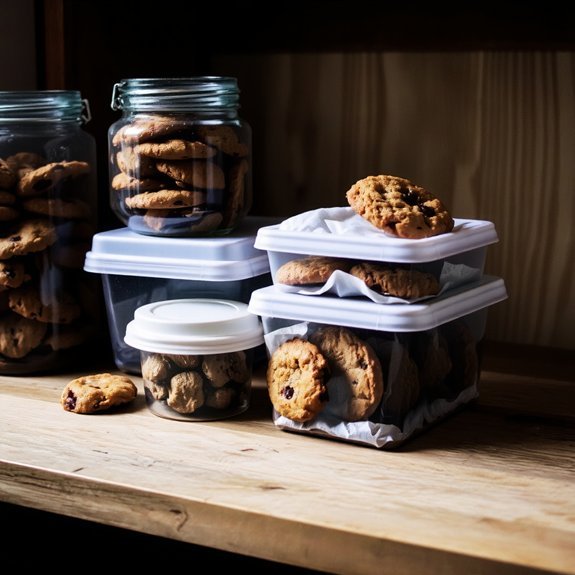
The container you select directly impacts your cookies’ shelf life and texture preservation. You’ll want airtight containers that seal properly—glass or food-grade plastic works best.
Airtight containers made of glass or food-grade plastic directly determine whether your cookies stay fresh or turn stale.
Metal tins offer excellent protection from moisture and light, making them ideal for long-term storage.
Consider childproof lids if you’re storing cookies around young kids, preventing unauthorized snacking. For gift presentation, decorative tins elevate your cookies while maintaining freshness.
Layer cookies with parchment paper to prevent sticking and breakage.
Avoid cardboard boxes; they’re porous and won’t protect against humidity.
Don’t use containers that previously held strong odors—cookies absorb flavors easily.
Size matters too—choose containers that minimize excess air space, reducing oxidation. Your container choice determines whether cookies stay crispy or turn stale within days.
Understanding Moisture and Staleness

Because cookies contain fats and starches that naturally absorb moisture from the air, you’ll need to understand how humidity directly affects their texture and longevity.
You’re fighting two primary enemies: excessive moisture and starch retrogradation, the process where starches crystallize and harden over time.
Water activity—the amount of moisture available for microbial growth—determines your cookie’s shelf life.
You’ll notice staleness manifests differently depending on your cookie type:
- Crispy cookies absorb humidity and lose their snap
- Chewy cookies dry out and become brittle
- Soft cookies develop hard edges while centers remain moist
You control staleness by managing your storage environment. Keep cookies in airtight containers away from heat and sunlight.
This minimizes water activity fluctuations and slows starch retrogradation, preserving texture and flavor longer.
The Best Storage Temperature

While temperature alone won’t prevent staleness, it’ll dramatically slow the chemical reactions that degrade your cookies.
Temperature alone won’t stop staleness, but it dramatically slows the chemical reactions that degrade your cookies.
You’ll want to maintain a consistent 65-70°F environment.
Higher temperatures accelerate oxidation and lipid breakdown, compromising texture and flavor.
Fluctuations are your enemy—they cause moisture migration and structural collapse.
For thermostat calibration, invest in an accurate thermometer.
Most household thermostats drift 2-3 degrees, throwing off your storage conditions.
Verify your actual temperature independently.
Seasonal adjustments matter considerably.
Winter’s dry heating systems demand vigilance; summer humidity requires counter-strategies.
You’re not bound by seasons, though—create your own ideal microclimate.
A cool closet, basement corner, or dedicated container works well.
Avoid refrigerators; they’ll dry cookies and absorb odors.
Room temperature storage with proper moisture control beats temperature extremes every time.
Separating Different Cookie Types
You’ll want to store moisture-sensitive cookies like biscotti and shortbread separately from crispy varieties such as tuiles and wafers, as they’ll absorb humidity from each other and compromise texture.
Keep flavored cookies—particularly those with strong spices, chocolate, or nuts—in their own containers to prevent aromatic compounds from migrating to your delicate or subtly flavored batches.
Airtight compartments or individual tins give you precise control over each cookie type’s microenvironment, ensuring you preserve the specific moisture content and flavor profile you’ve worked to achieve.
Moisture-Sensitive vs. Crispy
Different cookie structures demand different storage environments, and mixing them together’ll compromise both.
Your moisture-sensitive cookies—like shortbreads and delicate wafers—require airtight containers with desiccant packets to prevent texture contrast degradation.
Crispy varieties, conversely, need breathable storage to maintain their snap and crunch from high-temperature baking techniques.
Consider these storage distinctions:
- Soft cookies: sealed containers with bread slices to absorb excess moisture
- Crispy cookies: paper bags or loosely covered containers for air circulation
- Mixed batches: separate compartments to preserve individual textural integrity
Your baking techniques determine storage urgency.
High-fat, low-moisture formulas stay crisp longer in cool conditions.
Conversely, egg-forward recipes absorb ambient humidity quickly.
Monitor your storage environment’s temperature and humidity levels closely.
This precision-based approach guarantees each cookie type maintains its intended sensory experience without compromise or degradation.
Preventing Flavor Transfer
Because aromatic compounds migrate readily between cookies in shared storage spaces, you’ll need to segregate bold-flavored varieties from delicate ones to preserve their distinct taste profiles.
Strong spices like cinnamon, ginger, and cardamom will dominate neighboring cookies within hours, obliterating subtle vanilla or almond notes.
Store intensely flavored cookies separately in airtight containers.
You can’t rely on scent compatibility between chocolate-dipped varieties and fruit-filled options—they’ll cross-contaminate.
Use odor neutralizers like baking soda packets or crumpled parchment paper to absorb migrating aromas before they settle into your delicate batches.
Glass containers with proper seals outperform plastic, which absorbs and releases flavors over time.
Compartmentalized storage boxes work well when you’re managing multiple varieties simultaneously.
This precision approach guarantees each cookie retains its intended flavor profile.
Using Airtight Sealing Techniques

When moisture infiltrates your cookie container, it’s the primary culprit behind staleness and texture degradation.
You’ll need to master airtight sealing techniques to preserve your baked goods effectively.
Implement these proven methods:
- Vacuum sealing removes oxygen entirely, extending shelf life to three weeks while maintaining crispness
- Gasket maintenance guarantees your container’s rubber seal remains clean and pliable, preventing air leakage
- Glass jars with locking lids provide superior moisture barriers compared to plastic alternatives
You’re taking control of your storage by investing in quality equipment.
Check gaskets regularly for cracks or deterioration.
Wipe them clean before sealing to maximize effectiveness.
Vacuum sealing demands minimal effort yet delivers maximum protection—you’re eliminating variables that degrade cookies.
These techniques give you freedom from stale cookies while maintaining ideal texture and flavor integrity throughout storage.
How Long Cookies Actually Last
You’ll find that different cookie types maintain quality at distinct rates—butter cookies typically stay fresh for 5-7 days at room temperature, while chocolate chip varieties last 7-10 days due to fat content that slows staling.
Your storage method dramatically affects longevity: room temperature works for most cookies, but refrigeration extends shelf life by 1-2 weeks if you’re protecting against humidity, while freezing preserves them for 2-3 months by halting moisture migration and oxidation.
Understanding these variables lets you choose the right technique based on when you’ll actually consume your batch.
Shelf Life by Type
Different cookie compositions create vastly different storage timelines—a buttery shortbread’ll outlast a soft chocolate chip cookie by weeks.
Your ingredient impact directly determines longevity. High-fat cookies resist staleness longer; moisture-rich varieties deteriorate faster.
Preservative presence extends shelf life considerably—you’ll notice commercial cookies last substantially longer than homemade batches lacking additives.
- Shortbread & butter cookies: 2-3 weeks in airtight containers
- Chocolate chip & oatmeal varieties: 5-7 days before noticeable staleness
- Decorated/frosted cookies: 3-5 days due to moisture absorption from toppings
Fat content acts as your natural preservative. Oil-based cookies withstand time better than those relying on eggs for structure.
Hard, crunchy cookies maintain quality longer than chewy textures.
You’ll find that refrigeration extends most types by 50%, while freezing preserves them for months—just account for condensation when thawing.
Room Temperature Storage Duration
Most cookies won’t survive more than a few days at room temperature before they’ll start losing their signature texture—though the exact timeline depends on your storage method and cookie composition.
Butter-based cookies typically last 3-5 days, while sugar cookies can stretch to a week.
Oil-based varieties hold up longer due to their moisture content.
You’ll want to implement labeling dates on your containers so you’re not guessing about freshness.
Practice batch rotation by consuming older cookies first, preventing waste.
Hard cookies like biscotti outlast soft varieties markedly.
Store them in airtight containers away from direct sunlight and heat sources.
Check your cookies periodically—you’ll notice staleness before flavor deteriorates substantially, giving you control over your consumption timeline.
Refrigerator Vs Freezer Methods
While refrigeration slows staling by reducing moisture migration, it doesn’t actually extend shelf life as dramatically as freezing does.
You’ll find that refrigerated cookies last 1-2 weeks, whereas frozen ones remain fresh for 3-4 months.
The freezer’s low temperature halts bacterial growth and starch retrogradation—the primary culprits behind staleness.
This makes freezing your best option for gift freezing or travel packing without compromising quality.
Storage method advantages:
- Freezer preserves texture and flavor integrity through extended dormancy
- Refrigerator works best for cookies you’ll consume within days
- Room temperature suits immediate consumption only
Thaw frozen cookies at room temperature for 15-30 minutes before serving.
Your independence in meal planning expands when you’ve mastered freezer storage—bake batches ahead and enjoy fresh-tasting cookies whenever you choose, liberated from daily baking constraints.
Reviving Stale Cookies
You can restore moisture to stale cookies through controlled humidity exposure or brief heat treatment. A slice of bread in an airtight container overnight rehydrates hard cookies effectively. Alternatively, microwave individual cookies for 10-15 seconds, allowing steam to penetrate the crumb structure.
| Method | Time | Result |
|---|---|---|
| Bread method | 8-12 hours | Soft, chewy |
| Microwave | 10-15 seconds | Warm, pliable |
| Oven reheat | 5 minutes at 300°F | Crispy exterior |
| Steam tent | 3-5 minutes | Moist throughout |
| Crumb repurposing | Varies | Dessert transformations |
Don’t discard broken pieces—crush them for crumble toppings, cheesecake bases, or ice cream mix-ins. This approach maximizes your investment while minimizing waste. You’re controlling your cookie’s fate, not discarding perfectly good ingredients.
Frequently Asked Questions
Can I Store Cookies in the Refrigerator Instead of at Room Temperature?
You can refrigerate cookies, but you’re risking texture changes and moisture migration that’ll compromise your baked goods.
Cold temperatures accelerate staling as starches recrystallize faster.
Your cookies’ll dry out quicker and become brittle instead of maintaining their intended crumb structure.
Room temperature storage in airtight containers lets you preserve that fresh-baked quality longer.
If you’re pushing for extended shelf life, freezing works better than refrigerating—it halts degradation without the moisture complications.
Do Homemade Cookies Last Longer Than Store-Bought Cookies?
Your homemade cookies typically won’t last as long as store-bought varieties. That’s because you’re not using commercial preservatives and stabilizers.
However, your ingredient impact matters substantially—butter-based cookies deteriorate faster than shortening formulations. You’ll maximize freshness by controlling bake thickness; thicker cookies retain moisture longer than thin, crispy versions. Store yours airtight within 24-48 hours for ideal quality, whereas commercial products stay shelf-stable for weeks.
What Should I Do if Cookies Absorb Unwanted Odors During Storage?
You’ve got to act fast if your cookies absorb off-flavors. Place activated charcoal or baking soda in open containers near your stored batch—they’ll neutralize unwanted odors within hours.
You can also transfer cookies to airtight containers with crumpled parchment paper laced with baking soda.
For stubborn smells, swap out the absorbent materials every 12 hours. Your cookies deserve fresh air circulation, so don’t seal containers too tightly during odor removal.
Can I Freeze Cookies, and How Long Do They Stay Fresh?
You can absolutely freeze cookies—they’ll stay fresh for up to three months when you use proper freezer packaging.
Airtight containers or freezer bags prevent freezer burn and preserve your cookies’ texture and flavor integrity.
For thawing methods, let them reach room temperature in their sealed packaging; this prevents condensation that’d compromise crispness.
Your baked goods maintain ideal quality when you avoid temperature fluctuations during storage and thawing processes.
Is Parchment Paper Necessary Between Cookie Layers in Containers?
You don’t absolutely need parchment paper, but it’s your best bet for preventing sticking and moisture transfer.
Consider nonstick alternatives like wax paper or silicone liners if you’re out.
Your stacking techniques matter more—place delicate cookies flat, sturdy ones upright.
You’ve got freedom here: plastic wrap works, foil works, even paper towels separate layers adequately.
The real deal? Airtight containers with proper layering keep your cookies fresher longer, regardless of separator choice.



Leave a Comment