
Key Takeaways
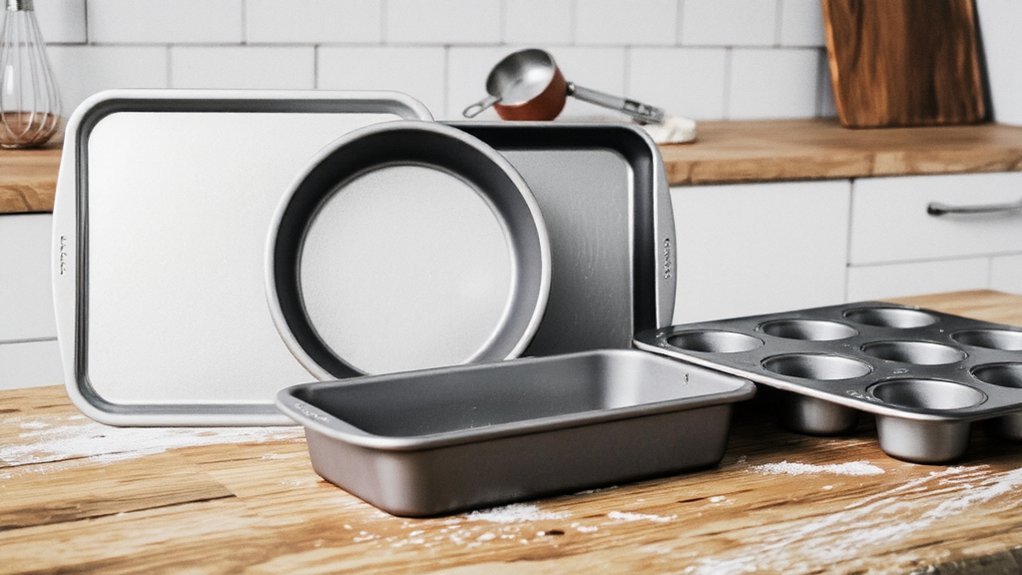
- Start with a 9×13-inch rectangular pan, two 8-inch round pans, and a muffin tin for versatility.
- Choose aluminum or steel pans with even thickness and reinforced rims to prevent warping during baking.
- Light-colored pans provide better browning control; dark pans require reducing oven temperature by 25°F.
- Ensure round cake pans have at least 1.5-inch wall height to properly contain rising batter.
- Use parchment paper liners for easy removal, cleaner edges, and simplified cleanup after baking.
Round Cake Pans: The Foundation of Your Collection

Before you invest in specialty molds or springform pans, you’ll want to stock your kitchen with round cake pans in two essential sizes: 8-inch and 9-inch diameters.
Stock your kitchen with 8-inch and 9-inch round cake pans before investing in specialty molds.
The 9-inch pan’s larger capacity accommodates most standard recipes, while the 8-inch option gives you flexibility for layer assembly without excess batter waste.
You’ll appreciate quality aluminum construction—it distributes heat evenly and prevents browning edges before your cake’s center sets.
Look for pans with at least 1.5-inch walls to contain rising batter safely.
For cake leveling, consider pans with dark, nonstick surfaces that promote even browning and easier release.
Invest in heavy-gauge pans; they’ll resist warping through countless bakes and maintain their precision shape, ensuring consistent results every time.
Rectangular Baking Pans for Brownies and Sheet Cakes

While round pans handle layer cakes, rectangular pans become your workhorse for dense batters and sheet-style desserts. You’ll appreciate their efficiency for brownies, sheet cakes, and bar cookies that demand even baking and straightforward portioning.
Standard 9×13-inch pans suit most recipes, though 8×8-inch options work for smaller batches. Consider these essentials:
- Material choice: Aluminum conducts heat efficiently; dark steel requires temperature reduction
- Cooling techniques: Place hot pans on wire racks for uniform cooling and prevent moisture buildup
- Presentation tricks: Line pans with parchment for easy removal and cleaner edges
- Durability: Reinforced corners resist warping through repeated use
You’ll gain freedom in your baking repertoire with quality rectangular pans. Their versatility justifies the minimal investment, delivering consistent results whether you’re crafting fudgy brownies or tender sheet cakes.
Choose commercial-grade options for longevity.
Muffin Tins: Perfect for Portion Control

You’ll find muffin tins in standard sizes—regular (2.5 oz), jumbo (4 oz), and mini (1.25 oz)—that let you control portion sizes precisely for consistent baking results.
Non-stick coatings save you cleanup time and prevent sticking, though you should still grease them lightly for ideal release.
Steel and aluminized steel materials offer superior heat distribution and longevity, with heavier-gauge pans resisting warping better than flimsy alternatives.
Standard Sizes and Capacities
Why do muffin tins matter for beginners?
You’ll find that understanding standard sizes and capacities empowers your baking independence.
Most retail SKUs feature these configurations:
- Standard muffin tins hold 12 cups at 1/3 cup capacity each
- Mini muffin tins contain 24 cups at roughly 1/8 cup capacity
- Jumbo muffin tins offer 6 cups exceeding 3/4 cup capacity
- Specialty tins provide 8-cup configurations for cupcakes
You’ll notice manufacturer tolerances vary between brands, typically ±5% in cup depth and diameter.
This precision matters when you’re scaling recipes or converting between tin sizes.
Check your pan’s specifications before you bake—mismatched capacities affect baking times and results.
Quality commercial-grade tins maintain consistent heat distribution and dimensional accuracy, giving you reliable outcomes every time you bake.
Non-Stick Coating Benefits
Non-stick coatings fundamentally transform muffin tin performance by eliminating the need for greasing and reducing cleanup time.
You’ll appreciate how this coating prevents batter from adhering to the pan’s surface, ensuring your muffins release cleanly every time.
The easy cleanup benefit can’t be overstated—you’re simply rinsing with warm soapy water rather than scrubbing stubborn residue.
This saves you valuable time after baking.
From a healthier cooking perspective, non-stick surfaces allow you to bake without added butter or oil for greasing.
You’re reducing unnecessary fat intake while maintaining perfect results.
Quality non-stick coatings withstand repeated use and moderate oven temperatures without degradation.
When selecting muffin tins, you’re choosing freedom from frustrating stick-and-tear disasters and tedious pan maintenance, making your baking experience genuinely enjoyable.
Material Durability Matters
Because muffin tins endure repeated heating cycles and temperature fluctuations, the material composition directly impacts longevity and performance consistency.
You’ll want durable construction that resists warping and maintains even heat distribution across baking sessions.
Consider these durability factors:
- Aluminized steel construction resists rust and provides superior heat conductivity
- Heavy-gauge thickness prevents warping at standard oven temperatures
- Non-stick coating durability withstands repeated washing without degradation
- Reinforced edges resist denting from stacking and handling
For maintenance tips, hand-wash your tins with soft sponges and avoid abrasive cleaners that compromise coatings.
Store them flat to prevent deformation.
When your pan finally fails, explore recycling options at local metal recycling facilities.
Quality material investment gives you reliable portion control for years of baking freedom.
Loaf Pans for Bread and Quick Breads

The foundation of successful bread baking rests on selecting the right loaf pan. You’ll want a standard 9×5-inch steel or aluminum pan for ideal heat distribution and crust development.
Dark nonstick surfaces bake faster, so reduce your oven temperature by 25°F to prevent over-browning.
For quick breads like banana or zucchini bread, lighter-colored pans give you superior control over browning. You’re free to choose either material, but steel offers superior durability and consistent results across batches.
Proper slicing techniques depend on cooling your loaf completely before cutting—this prevents crumbling and guarantees clean edges. Sharp serrated knives work best. For presentation tips, slice uniform pieces and arrange them face-up to showcase the crumb structure and appeal of your homemade creation.
Cookie Sheets and Baking Trays
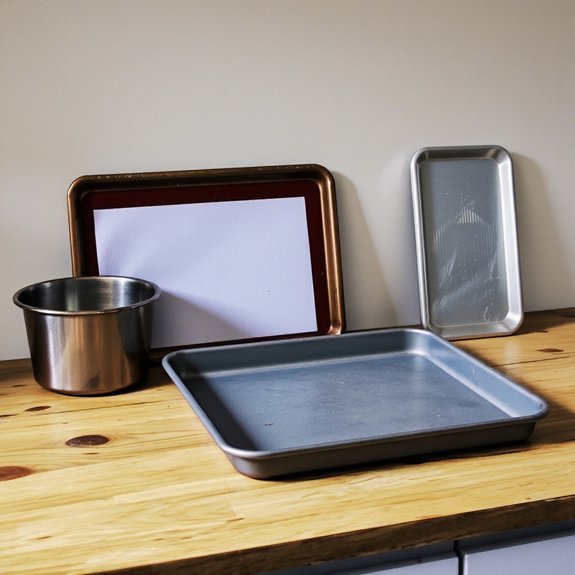
While loaf pans create the structure for yeasted and quick breads, cookie sheets and baking trays handle the demands of cookies, pastries, and roasted items that require different heat management.
You’ll want versatile options that give you complete control over your baking outcomes.
Consider these essentials:
- Rimmed half-sheet pans (13×18 inches) for even heat distribution and mess-free roasting
- Flat baking sheets for delicate cookies needing precise browning control
- Perforated trays for superior air circulation around pastries
- Insulated pans for consistent results without bottom burning
You’ll master storage solutions by stacking pans vertically in narrow spaces.
For cleaning hacks, line pans with parchment paper to eliminate scrubbing.
Invest in quality aluminum or steel construction—your baking freedom depends on reliable, responsive heat conduction that delivers reproducible results batch after batch.
Understanding Pan Materials: Steel vs. Ceramic vs. Glass
When you’re selecting baking pans, you’ll find that steel offers superior durability and heat distribution, making it the workhorse choice for consistent results across batches.
Glass and ceramic pans conduct heat differently than steel—they heat up faster and can cause over-browning on edges, so you’ll need to adjust your oven temperature down by 25°F when using them.
Understanding these material differences lets you choose the right pan for your specific baking needs and compensate for their distinct thermal properties.
Steel: Durability and Heat
Because steel conducts heat quickly and distributes it evenly across the pan’s surface, you’ll achieve consistent browning and more predictable baking results than with other materials.
Steel pans offer several advantages for your baking endeavors:
- Superior durability: Steel withstands repeated use, thermal shock, and metal utensils without warping or degrading
- Even heat distribution: You’ll get uniform browning on cookies, cakes, and pastries every time
- Magnet testing capability: You can verify steel composition and quality before purchasing
- Recycling impact: Steel pans remain fully recyclable at end-of-life, reducing environmental waste
Commercial bakeries rely on steel exclusively because it’s predictable and forgiving.
Its thermal properties prevent hot spots that ruin delicate baked goods.
You’ll notice superior results immediately when switching from inferior materials.
Steel pans demand minimal maintenance and deliver years of reliable performance without degradation.
Glass and Ceramic: Comparison
Glass and ceramic pans heat more slowly than steel but retain heat longer once they’ve reached temperature, which can affect your baking outcomes in distinct ways. You’ll notice these materials won’t brown edges as quickly, requiring adjusted oven times. Glass conducts heat more evenly, reducing hot spots that compromise cookies or brownies.
| Feature | Glass | Ceramic |
|---|---|---|
| Heat Retention | Excellent | Good |
| Browning Speed | Moderate | Slow |
| Durability | High | Moderate |
| Environmental Impact | Recyclable | Sustainable |
| Aesthetic Presentation | Clear visibility | Decorative options |
You’ll appreciate ceramic’s decorative versatility and glass’s transparency for monitoring baking progress. Both options minimize chemical leaching, supporting your health-conscious approach. Choose glass for precision baking; ceramic for aesthetic kitchen integration.
Size Matters: Choosing the Right Dimensions
Why does pan size matter so much?
You’ll find that selecting the correct dimensions directly impacts your baking success and kitchen efficiency.
Standard sizes dictate heat distribution, cooking times, and recipe outcomes.
Here’s what you need to keep in mind:
- Standard 9×13 inches: Versatile for most recipes; fits most ovens
- 8×8 inches: Compact option; requires less oven clearance
- Half-sheet pans (13×18 inches): Professional-grade; demands ample oven space
- Round 9-inch: Essential for cakes; maximizes countertop storage
You’ll want to verify your oven’s interior dimensions before purchasing.
Measure your available space—both oven clearance and countertop storage—to avoid purchasing pans you can’t accommodate.
This strategic approach gives you the freedom to bake without constraints or frustration.
Dark Pans vs. Light Pans: How Color Affects Baking
Once you’ve selected the right pan dimensions, you’ll discover that the material’s color plays an equally significant role in your baking outcomes. Dark pans absorb more heat, causing faster browning on your baked goods’ bottoms and edges. This accelerated heat absorption means you’ll often need to reduce your oven temperature by 25°F or shorten baking time by 5-10 minutes to prevent burning. Light-colored pans reflect heat more effectively, resulting in gentler, more even browning throughout your creation.
The browning differences between these options aren’t trivial—they directly impact your final product’s texture and appearance. For beginners seeking control over their baking results, understanding these color distinctions empowers you to make informed pan choices that match your specific recipe requirements and desired outcomes.
Budget-Friendly Options Without Sacrificing Quality
You don’t need to spend premium prices to get reliable baking pans that’ll deliver consistent results.
Quality baking pans don’t require premium pricing—smart shopping delivers professional-grade results on any budget.
Smart shopping strategies give you professional-grade equipment without breaking your budget.
Consider these cost-effective approaches:
- Clearance hunting at restaurant supply stores and seasonal sales nets you high-quality commercial pans at fraction retail prices
- Secondhand treasures from thrift shops and online marketplaces offer vintage steel pans that outperform many new alternatives
- Store brands from major retailers provide dependable aluminized steel construction meeting industry standards
- Bulk purchases reduce per-unit costs when buying multiple pan sizes
Focus on essential specifications: aluminum or steel construction, even heat distribution, and reinforced rims.
Avoid flimsy materials that warp under standard oven temperatures.
You’ll gain freedom from overpriced specialty brands while maintaining baking precision and reliability that serious bakers demand.
Building Your Starter Pan Collection: A Practical Guide
You’ll want to select essential pan types—at minimum, a 9×13-inch rectangular pan, an 8 or 9-inch round cake pan, and a muffin tin—that cover most basic baking projects.
Material quality directly impacts heat distribution and baking results, so you should prioritize aluminum or steel pans with even thickness over cheaper, thin alternatives.
Size and versatility matter equally; choosing pans with standard dimensions guarantees recipe compatibility and lets you expand your collection strategically without redundancy.
Essential Pan Types
Building a functional baking collection doesn’t require an overwhelming number of specialty items.
Instead, it’s about selecting versatile pieces that’ll handle the majority of recipes you’ll encounter.
You’ll want to invest in these foundational pans:
- Round cake pans (9-inch): Your workhorse for layer cakes and standard recipes
- Rectangular baking pan (9×13-inch): Essential for sheet cakes, brownies, and bars
- Bundt pans: Perfect for elegant ring-shaped cakes with minimal effort
- Springform pans: Ideal for cheesecakes and no-bake desserts requiring easy removal
These four types cover approximately 80% of home baking projects.
You’re not locked into expensive professional-grade equipment.
Quality mid-range options deliver consistent results without breaking your budget. Dark metal conducts heat faster than light aluminum, affecting bake times slightly. Choose what aligns with recipes you actually want to make, prioritizing versatility over novelty.
Material Quality Matters
Once you’ve settled on which pan types suit your baking ambitions, the material you choose becomes the deciding factor in how consistently those pans perform.
You’ll want aluminum or steel pans that meet strict manufacturing standards, ensuring even heat distribution and durability.
Dark nonstick surfaces absorb more heat, browning edges faster, while lighter pans offer more moderate heat absorption.
You’re responsible for verifying food safety certifications—look for products meeting FDA requirements.
Quality materials prevent warping, chemical leaching, and uneven baking results.
Invest in pans from reputable manufacturers who’ve optimized their formulations.
Your choice directly impacts whether you’ll achieve golden, evenly-baked results or frustrating inconsistencies. Premium materials cost more upfront but deliver superior performance across countless baking projects, giving you genuine control over your baking outcomes.
Size and Versatility
How do you maximize utility without cluttering your kitchen?
You’ll want starter pans that adapt across multiple recipes and baking techniques.
Consider these essentials:
- 9×13-inch rectangular pan—handles sheet cakes, brownies, and roasted vegetables
- 8-inch round cake pans (two)—essential for layer cakes and precise portioning
- Muffin tin—versatile for cupcakes, savory applications, and portion control
- Baking sheet—indispensable for cookies, roasted goods, and prep work
Each pan maximizes oven compatibility across standard residential ovens.
You’ll achieve freedom in your baking choices without excess equipment.
Dark nonstick finishes offer superior browning control for beginners.
Steel construction provides durability and heat distribution consistency.
Smart storage solutions—hanging racks or vertical dividers—keep your collection organized and accessible.
This focused approach gives you the flexibility to execute nearly any recipe while maintaining kitchen efficiency.
Frequently Asked Questions
How Do I Properly Season and Maintain My Baking Pans for Longevity?
You’ll maximize your pan’s lifespan by establishing a consistent maintenance schedule.
Hand wash immediately after use with warm soapy water and dry thoroughly.
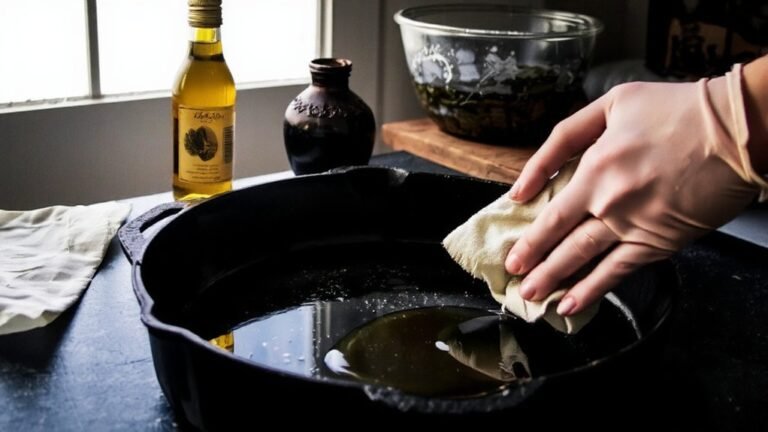
Apply your seasoning technique monthly: coat lightly with neutral oil, wipe excess, then bake at 350°F for 15 minutes.
Store in a dry location.
Avoid dishwashers and acidic foods that compromise the protective layer.
This regimen gives you years of reliable baking freedom.
What’s the Best Way to Clean and Store Baking Pans to Prevent Rust?
You’ll prevent rust by thoroughly drying your pans immediately after washing—don’t air dry. Wipe them completely with a clean cloth, then apply thin oil coating.
Store in a cool, dry location using desiccant storage methods; silica gel packets absorb moisture that triggers oxidation.
Stack pans with parchment paper between layers.
You’re free to choose your storage approach, but maintaining this discipline guarantees your equipment stays rust-free and performs at its best for years.
Can I Substitute One Pan Size for Another in Baking Recipes?
You can substitute pan sizes, but you’ll need to account for volume conversion carefully.
Smaller pans require higher temperatures and shorter baking times, while larger pans need adjustments for rise adjustment and even cooking.
Calculate your pan’s volume by multiplying length × width × height.
Match it to your original recipe’s capacity, then modify baking time and temperature accordingly.
This flexibility gives you control over your baking outcomes without sacrificing quality results.
Do Non-Stick Coatings Wear Off, and When Should I Replace Pans?
Yes, non-stick coatings deteriorate through repeated heating and cleaning.
You’ll want to inspect your pans regularly for peeling, flaking, or stuck-on residue that won’t release properly.
Replace them when you notice these inspection signs, typically every 3-5 years with proper care.
Your replacement timeline depends on usage frequency and maintenance—hand-washing extends longevity.
Don’t compromise your baking freedom by using damaged pans; they’ll underperform and potentially affect food safety.
Are Vintage or Secondhand Baking Pans Safe and Worth Purchasing?
You’ll want vintage pans tested for lead before use—older coatings sometimes contain harmful substances.
Check historical value through maker’s marks and production dates.
If you’re buying secondhand, inspect surfaces for damage that’ll compromise baking results.
Quality vintage steel pans often outperform modern equivalents, but you’re taking calculated risks.
Stick with trusted sellers offering transparency about pan origins and condition assessments.



Leave a Comment