

Key Takeaways
- Motor power of 300–500 watts handles home baking; commercial-grade 800+ watts suits demanding recipes and bulk batches.
- Five-quart bowl capacity suits most home bakers; eight-quart capacity better for larger batches and commercial applications.
- Variable speed control (6–12 speeds) enables delicate tasks like whipping and heavy dough kneading with precision.
- Stainless steel bowls offer superior thermal retention and durability for temperature-sensitive doughs and consistent mixing performance.
- Extended warranty coverage and established brand history indicate manufacturer confidence and long-term reliability for serious bakers.
What to Look for in a Stand Mixer
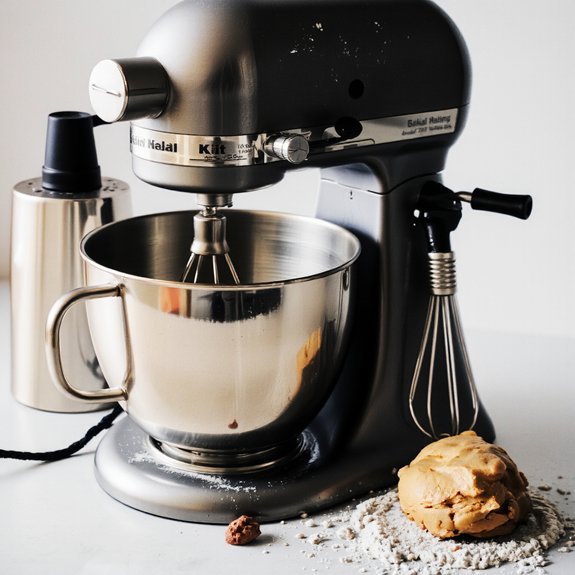
When you’re selecting a stand mixer for baking, you’ll want to prioritize motor power, bowl capacity, and attachment versatility. A robust motor—typically 300 watts or higher—handles dense doughs without strain.
Choose a bowl size matching your baking volume; 5-quart capacities suit most home bakers. Verify that the mixer includes dough hooks, whip attachments, and paddle beaters for complete functionality.
Consider warranty coverage as a critical factor. Extended warranties protect your investment and demonstrate manufacturer confidence.
Look for aesthetic options that complement your kitchen style without compromising performance specifications.
Examine speed settings carefully; variable speeds provide precision for delicate tasks like meringues and demanding jobs like kneading. Make sure the design allows easy bowl removal and attachment swapping. These specifications grant you the freedom to tackle any baking project confidently.
Bowl Capacity and Material Considerations

The bowl’s capacity and material directly impact your mixer’s performance and durability.
The bowl’s capacity and material are foundational to your mixer’s performance and longevity.
You’ll find stainless steel bowls offer superior thermal retention, keeping ingredients at stable temperatures during extended mixing sessions.
This stability matters when working with temperature-sensitive doughs and batters.
Ceramic and glass alternatives provide excellent chemical reactivity resistance, preventing unwanted interactions with acidic ingredients like buttermilk or lemon juice.
However, they’re heavier and more fragile than stainless steel.
Your capacity choice depends on your baking volume.
Five-quart bowls suit most home bakers, while eight-quart capacities accommodate larger batches and commercial applications.
Don’t sacrifice quality for size—a durable stainless steel bowl at five quarts outperforms a cheaply-made eight-quart alternative.
Verify your mixer’s bowl compatibility and material specifications before purchasing.
Your freedom to bake confidently starts with the right equipment foundation.
Motor Power and Speed Settings

Why does motor power matter more than you’d think?
A robust motor determines whether your mixer handles dense dough or delicate batters without stalling or overheating.
You’ll want adequate wattage—typically 300-500 watts—to manage heavy mixing tasks consistently.
Speed settings give you control over your baking outcomes.
Most quality mixers offer 6-12 speeds, allowing you to start slow and increase gradually.
This flexibility matters when creaming butter, whipping egg whites, or incorporating flour.
Look for torque control features that maintain consistent speed under load, preventing slowdowns when mixing thick batters.
A soft start function reduces initial shock to the motor and ingredients, protecting delicate mixtures from splattering.
These specifications guarantee your mixer performs reliably across diverse recipes without compromising quality or longevity.
Attachments and Versatility

Standard mixer attachments—the flat mixing paddle, dough hook, and wire whip—form your foundation for diverse baking applications. You’ll unleash expanded capabilities through the accessory ecosystem, transforming your mixer into a multipurpose kitchen powerhouse.
| Attachment | Primary Function | Creative Uses |
|---|---|---|
| Flat Paddle | Creaming butter and sugar | Mixing batters, emulsifying |
| Dough Hook | Kneading bread dough | Processing pie crusts |
| Wire Whip | Whipping egg whites | Aerating cake batters |
| Pasta Roller | Flattening dough sheets | Creating uniform thickness |
| Grinder Attachment | Processing ingredients | Nut butters, spice blends |
You’ll appreciate how versatility grants you independence from multiple single-purpose appliances. Premium models offer robust attachment options that enhance your baking freedom. This all-encompassing approach eliminates constraints, allowing you to experiment confidently across various baking projects without compromise.
Size and Kitchen Space Requirements

Before committing to a stand mixer purchase, you’ll need to honestly assess your available counter or storage space, as these machines demand considerable real estate.
Most stand mixers occupy a counter footprint ranging from 7 to 9 inches wide and 12 to 14 inches deep—dimensions that substantially impact your workflow and kitchen accessibility.
Measure your available workspace carefully, accounting for the mixer’s height when the bowl’s raised.
If counter space is limited, verify your cabinet clearance for vertical storage.
Compact models exist but sacrifice capacity and power.
Alternatively, you can position your mixer on a rolling cart, granting you flexibility to store it elsewhere when idle.
Choose based on your kitchen’s actual constraints, not aspirational cooking habits.
Your independence in baking depends on practical space management.
Noise Level and Durability
You’ll want to understand decibel levels to assess how much noise your mixer produces during operation, as most quality stand mixers range between 67 and 80 dB.
You should also evaluate the build quality by examining the motor’s construction, gear system durability, and warranty coverage, which directly indicate how long your mixer will perform reliably.
These two factors—noise output and structural integrity—significantly impact your long-term satisfaction and investment value.
Decibel Levels Explained
When operating a stand mixer, you’re exposing yourself to sound levels that warrant consideration—most models generate between 67 and 85 decibels depending on speed setting and motor design.
Understanding decibel mathematics helps you make informed decisions about your kitchen environment.
Here’s what you should know:
- Hearing thresholds: Normal conversation sits around 60 decibels, while prolonged exposure above 85 decibels risks hearing damage
- Motor efficiency: Quality mixers operate at lower decibel levels through superior engineering and insulation design
- Speed correlation: Higher speeds increase noise output proportionally, so you’re not powerless in controlling sound exposure
You’ll maintain greater control over your baking space by selecting mixers engineered for quieter operation.
Check manufacturer specifications before purchasing—they’re your key to understanding actual noise output.
This knowledge empowers you to protect your hearing while enjoying reliable mixing performance.
Build Quality Assessment
While decibel specifications tell you about immediate sound exposure, they’re only part of the durability picture—the materials and manufacturing tolerances that produce those noise levels directly determine how long your mixer will function reliably.
You’ll want to examine the gearbox construction, motor housing, and bowl coupling mechanisms closely. Premium models feature tighter manufacturing tolerances, reducing vibration and mechanical wear over years of use.
Check the fit finish of seams, fasteners, and component joints. Inferior construction allows micro-movements that accumulate damage and amplify noise over time.
You’re investing in a machine that’ll handle thousands of mixing cycles, so prioritize models with reinforced internal components and robust external construction that withstands rigorous, sustained performance demands.
Top Budget-Friendly Stand Mixer Options
Several excellent stand mixers deliver professional-grade performance without the premium price tag. You’ll find genuine value by strategically timing your purchases and exploring alternative purchasing channels.
Consider these proven strategies:
- Refurbished finds – Manufacturer-certified refurbished models offer full warranties at 20-30% discounts, delivering identical performance to new units without cosmetic imperfections.
- Seasonal sales – Black Friday, Cyber Monday, and post-holiday clearances typically feature 15-25% reductions on top-tier brands like KitchenAid and Cuisinart.
- Entry-level professional models – Budget brands now match mid-range specifications, offering 6-quart capacities and variable speeds at competitive pricing.
You’ll maximize your freedom to bake ambitious projects without financial constraint.
These mixers handle dough development, whipping, and mixing with reliable durability.
Research warranty coverage and return policies before committing to make sure your investment aligns with your baking ambitions.
Premium Stand Mixers for Serious Bakers
For bakers who’ve moved beyond casual home baking, premium stand mixers deliver the performance and durability that justify their higher investment.
| Feature | Commercial-Grade | Artisan Models |
|---|---|---|
| Motor Power | 800+ watts | 1000+ watts |
| Capacity | 8-14 quarts | 20+ quarts |
| Build Quality | Cast iron | Reinforced steel |
You’ll find premium models offering variable speed controls, multiple attachment systems, and commercial-grade construction that withstands rigorous daily use. Brands release limited editions featuring artisan collaborations, combining engineering excellence with aesthetic refinement.
These mixers handle demanding recipes—laminated doughs, high-hydration starters, bulk batches—without performance degradation. You’re investing in equipment that’ll outlast cheaper alternatives by decades. The robust warranty coverage and superior component quality provide the reliability serious bakers demand.
Brand Comparisons and Reliability
When you’re committing to a premium stand mixer, brand reliability becomes your primary concern—it’s what separates equipment that performs consistently for decades from machines that deteriorate after months of intense use.
You’ll want to examine three critical factors:
- Brand history – Established manufacturers with decades of production demonstrate proven engineering and quality control standards that newer competitors haven’t yet established.
- Customer satisfaction ratings – Real user feedback reveals long-term durability patterns and service responsiveness that marketing claims can’t replicate.
- Warranty coverage – Robust warranties reflect manufacturer confidence in their product longevity and provide you financial protection against premature failure.
You’re investing in freedom from kitchen limitations.
Choose brands that back their mixers with substantive warranties and documented track records of reliability, ensuring your equipment serves you reliably for years.
Maintenance Tips and Longevity
You’ll extend your stand mixer’s lifespan by establishing regular cleaning practices immediately after each use, wiping down the bowl, beaters, and motor housing to prevent batter buildup and corrosion.
You must also follow proper storage and care guidelines—keep your mixer in a dry location away from humidity, store attachments in their designated slots, and cover the unit when not in use.
These preventive measures substantially reduce wear on internal components and maintain your mixer’s performance consistency over years of baking.
Regular Cleaning Practices
Consistent maintenance through proper cleaning directly extends your stand mixer’s operational lifespan and guarantees peak performance.
You’ll maintain your mixer’s integrity by following these essential practices:
- Disassemble removable components after each use—bowl, beaters, and whip attachments—then hand wash with warm soapy water to prevent buildup and allergen control
- Wipe the motor housing with a damp cloth, avoiding water entry into electrical components that could compromise functionality
- Check child safety locks and seals regularly, ensuring protective mechanisms remain secure and functional
Don’t use abrasive scrubbers on stainless steel surfaces; they’ll damage the finish.
You’re responsible for preventing food particles from accumulating in crevices where bacteria thrives.
Store attachments separately in a dry location.
This disciplined approach preserves your investment while ensuring your mixer operates reliably for years.
Storage and Care Guidelines
Because proper storage directly impacts your mixer’s longevity and performance, establishing dedicated care protocols is essential. Store your mixer in a cool, dry location away from moisture and temperature fluctuations. During seasonal storage, wrap the unit in a protective dust cover and disconnect the power cord completely.
Keep the bowl, whip, dough hook, and paddle attachments organized in designated containers. Safeguard child safety by storing these components in an elevated cabinet or locked drawer, away from curious hands.
Document maintenance intervals and replacement part schedules. Inspect the power cord regularly for damage. Tighten any loose fasteners before extended storage periods.
These deliberate practices preserve your mixer’s mechanical integrity, eliminate costly repairs, and maximize your investment’s operational lifespan while maintaining complete control over your equipment’s condition.
Frequently Asked Questions
Can a Stand Mixer Replace Hand Mixing for All Baking Recipes?
No, you can’t universally replace hand mixing with a stand mixer. You’ll encounter texture differences when mechanically mixing delicate batters—stand mixers overwork certain doughs, compromising your final product.
Ingredient handling matters too; you’ve got more control manually when folding fragile components or incorporating add-ins.
For dense batters and doughs, your mixer excels.
However, you’ll retain superior results with hand techniques for specific applications, giving you the flexibility to choose your method based on your recipe’s demands.
What Is the Warranty Coverage for Stand Mixers and What Does It Include?
You’ll typically find standard warranty coverage spanning one to three years, protecting against defects in materials and workmanship.
Most manufacturers cover motor failure, transmission issues, and electrical components.
However, you’ll encounter Service Exclusions for normal wear, user misuse, and unauthorized repairs.
Extended Warranty options let you increase protection beyond the baseline period, safeguarding your investment.
Review your specific model’s documentation carefully—coverage details vary substantially between brands and retailer offerings.
Are Stand Mixer Bowls and Attachments Compatible Across Different Brands?
Stand mixer bowls and attachments aren’t universally compatible across brands.
You’ll find significant differences in mounting mechanisms that prevent cross-brand use.
Electrical compatibility varies too—voltage requirements and motor specifications differ between manufacturers.
Your mixer’s proprietary design safeguards performance and safety.
You’re locked into the manufacturer’s ecosystem, so you can’t freely mix components from competing brands.
This limitation protects your investment but restricts your customization options.
How Much Counter Space Do You Need for Safe Stand Mixer Operation?
You’ll need approximately 24-30 inches of clearance dimensions on either side of your mixer for safe operation and bowl access.
The stability footprint requires a solid, level surface measuring at least 18 inches deep and 16 inches wide—don’t compromise here.
You’re maintaining your independence in the kitchen, so guarantee adequate ventilation space above the unit.
This setup prevents accidents, maximizes your operational freedom, and protects your investment from unnecessary damage or mishaps during vigorous mixing tasks.
What Is the Average Lifespan of a Quality Stand Mixer With Proper Care?
You’ll get 15-20 years from a quality stand mixer when you maintain it properly.
Premium models demonstrate superior motor longevity, resisting wear that cheaper units can’t withstand.
You’re investing in equipment that’ll retain strong resale value—a significant advantage for independent bakers.
Routine cleaning, timely belt replacements, and avoiding overloading preserve performance across decades.
Your freedom to bake extensively without equipment failure justifies choosing robust construction and reputable brands.






Leave a Comment