
Key Takeaways
- Brush warm cake with simple syrup (equal parts sugar and water) to rehydrate the crumb from within.
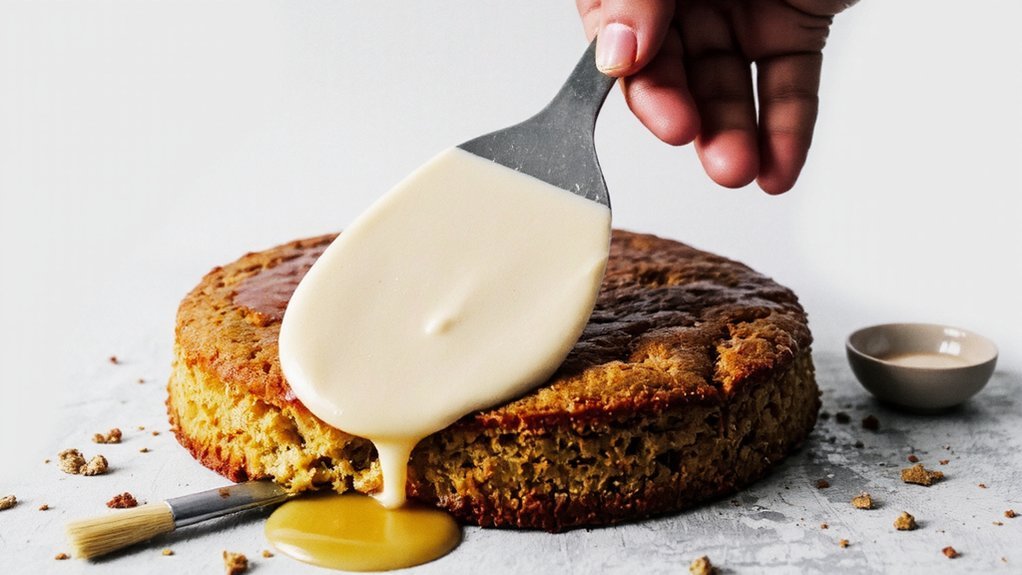
- Apply moisture-rich frostings like mascarpone, cream cheese, or ganache glaze to seal in hydration after syrup.
- Transform dry cake into trifle or pudding by layering crumbled cake with custard, whipped cream, or fruit.
- Form cake balls by crumbling cake with frosting binder, adding flavor mix-ins, then dipping in chocolate coating.
- Prevent future dryness by measuring ingredients by weight, avoiding overbaking, and storing cake in airtight containers.
Brush Your Cake With Simple Syrup
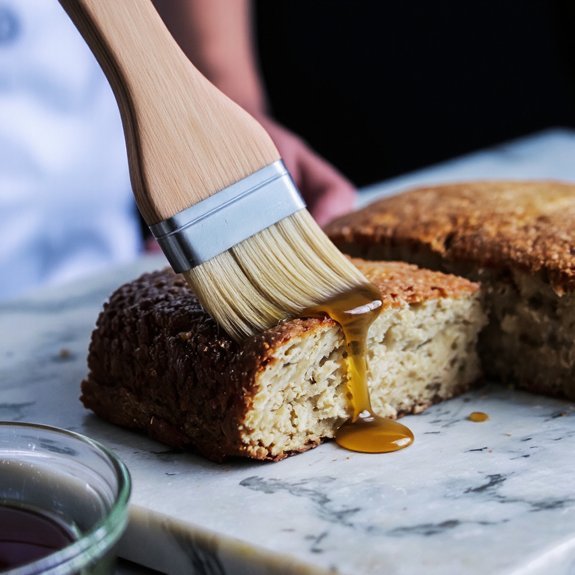
Brushing your cake with simple syrup is one of the most effective methods for restoring moisture to a dry crumb.
Simple syrup brushing stands as one of the most effective methods for restoring moisture to dry cake crumbs.
You’ll create simple syrup by dissolving equal parts sugar and water through heating, then cooling it completely before application.
Timing matters critically—apply the brushing technique while your cake’s still warm but not hot.
This allows the syrup to absorb thoroughly into the sponge without damaging the crumb structure.
Use a pastry brush to distribute the syrup evenly across the entire cake surface, working methodically in sections.
The sugar solution penetrates deep into dry layers, rehydrating them from within.
You’re effectively replacing lost moisture with a flavorless vehicle that carries sweetness and texture restoration.
Adjust your syrup’s concentration based on your cake’s dryness level—drier cakes benefit from slightly heavier syrups.
Add a Moisture-Rich Frosting or Glaze
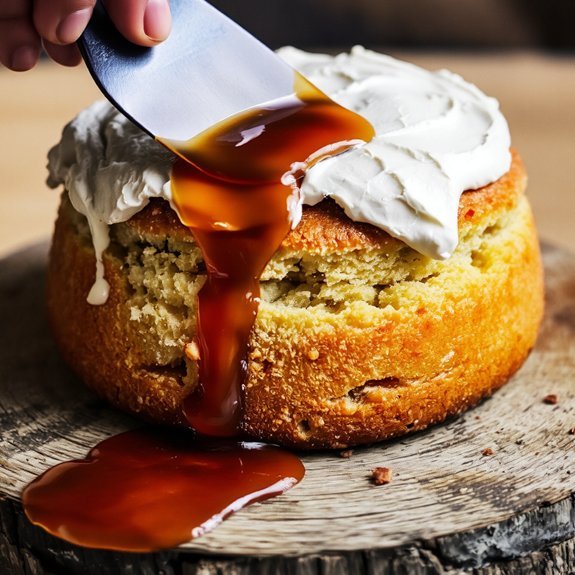
After you’ve applied simple syrup, you’ll want to seal in that moisture with a frosting or glaze that adds both hydration and flavor.
Your frosting choice directly impacts your cake’s final texture and taste profile.
Consider these options:
- Mascarpone Frosting – Combines tangy mascarpone cheese with butter and powdered sugar, creating a rich, creamy layer that won’t dry out your cake
- Swiss Meringue – Offers stable, silky coverage with minimal grittiness from sugar crystals
- Cream cheese frosting – Delivers moisture through its dairy content while adding subtle tartness
- Ganache glaze – Uses chocolate and cream, penetrating the cake’s crumb structure for deep hydration
Each option locks moisture effectively.
Apply your chosen frosting generously, ensuring complete coverage between layers and across all surfaces.
This final step guarantees your dry cake transformation into something moist and delicious.
Layer It Into a Trifle
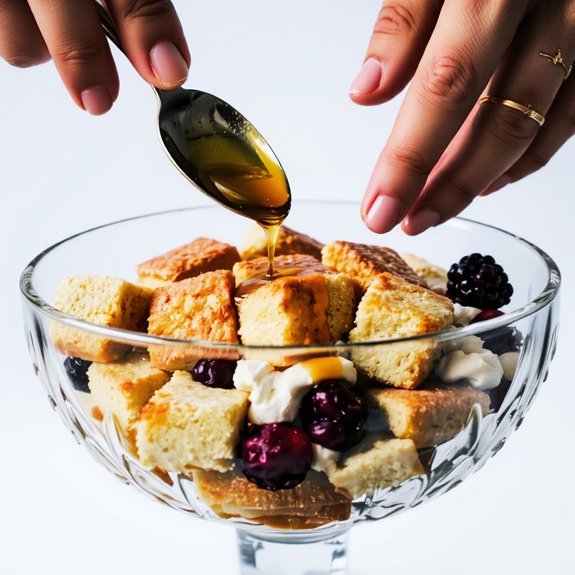
Converting your dry cake into a trifle represents one of the most effective rescue methods because you’re distributing moisture throughout multiple layers rather than relying solely on surface treatments. Start by crumbling your cake into bite-sized pieces.
Layer them with custard, whipped cream, or pudding—these moisture-rich components penetrate the cake thoroughly. Incorporate fruit layering using fresh berries, compote, or syrup-soaked fruit to add hydration and flavor complexity.
Create texture contrast by alternating soft cake pieces with crunchy elements like granola or toasted nuts. This strategic layering approach allows you to control moisture distribution precisely. The trifle’s assembled nature means you’re not committing to a single presentation; you’re transforming a baking mishap into an intentional, sophisticated dessert that showcases your problem-solving skills and culinary resourcefulness.
Transform It Into Cake Pudding
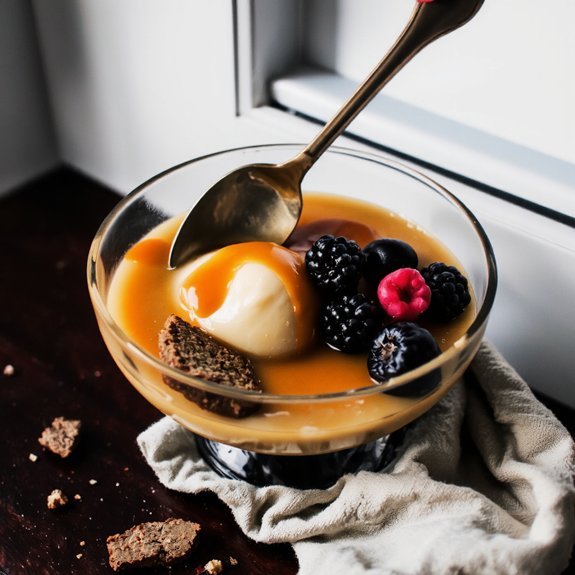
Creating a cake pudding offers you a straightforward method to salvage dry cake by submerging it in a rich, custardy base.
You’ll transform your dried-out cake into a decadent dessert by following these steps:
- Crumble your dry cake into bite-sized pieces and layer them in a baking dish
- Prepare a stovetop custard using eggs, milk, sugar, and vanilla extract
- Pour the warm custard over the cake pieces, allowing complete absorption
- Bake until the mixture sets into a steamed pudding with a custard-like consistency
The stovetop custard method gives you precise control over temperature and texture.
This approach doesn’t mask your cake’s shortcomings—it redefines them as intentional components.
You’re not hiding failure; you’re exercising culinary freedom to create something entirely new and satisfying.
Soak It in Flavored Liquid
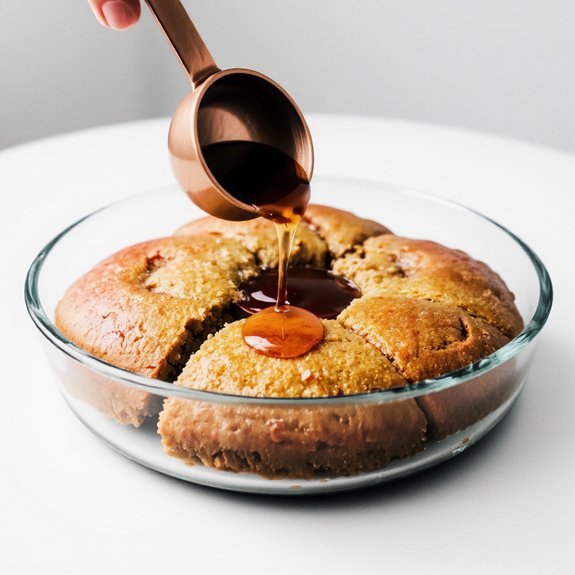
You can revive your dry cake by soaking it in simple syrup, which you’ll make by dissolving equal parts sugar and water, then cooling before application.
Alcohol-based liquids like bourbon, rum, or liqueurs add depth and moisture simultaneously, with the alcohol evaporating during absorption.
Alternatively, you can use flavored broths—such as chicken or vegetable—to introduce savory notes while restoring the cake’s moisture content.
Simple Syrup Solutions
If your cake’s crumb structure’s already set, soaking it in simple syrup is one of the most effective restoration methods available.
You’ll create a custom syrup tailored to your cake’s flavor profile using these straightforward steps:
- Combine equal parts water and sugar, heating until dissolved completely
- Add invert sugar or corn syrup to prevent crystallization and enhance moisture retention
- Incorporate your chosen flavoring—vanilla extract, liqueur, or fruit juice—while the mixture cools slightly
- Brush the cooled syrup generously over your cake layers, allowing absorption before frosting
This method bypasses traditional constraints, giving you complete control over moisture content and taste.
The invert sugar guarantees your syrup won’t recrystallize, maintaining consistent texture.
You’re not masking problems; you’re actively restoring your cake to its intended quality with precision and intention.
Alcohol-Based Liquid Options
While simple syrup works excellently for moisture restoration, alcohol-based liquids offer distinct advantages: they’ll evaporate more slowly, won’t crystallize, and won’t dilute your frosting’s consistency the way water-based syrups can.
You’ll choose your alcohol based on proof adjustments and liqueur pairings that complement your cake’s flavor profile. Higher proof spirits dry faster; lower proof options provide extended moisture penetration. Apply sparingly using a pastry brush—alcohol penetrates cake structure differently than water, demanding restraint.
| Alcohol | Proof | Ideal Cake Pairing |
|---|---|---|
| Bourbon | 80-100 | Chocolate, vanilla |
| Rum | 80-151 | Spice, tropical |
| Cointreau | 80 | Citrus, white cake |
| Kahlúa | 53 | Mocha, dark chocolate |
You’ll notice improved texture retention and enhanced flavor complexity without compromising structural integrity.
Flavored Broth Techniques
Infusing savory broths into dry cake represents an unconventional yet highly effective moisture restoration method that works particularly well for dense, crumb-structured cakes.
You’ll enhance your cake’s texture while introducing sophisticated flavor dimensions through strategic liquid application.
Consider these proven techniques:
- Chicken or vegetable broth – delivers umami enhancement while maintaining cake structure
- Herb infusion – steep rosemary, thyme, or sage in warm broth before application
- Gradual saturation – brush thin layers across cake surface, allowing absorption between applications
- Temperature control – use room-temperature broth to prevent thermal shock to your cake
You’ll achieve ideal results by applying broth systematically rather than flooding the cake immediately.
This methodical approach guarantees even moisture distribution without compromising structural integrity.
The umami-rich components penetrate the crumb matrix, restoring palatability while respecting your cake’s foundational architecture.
Crumble and Repurpose Into Cake Balls
Transforming dry cake into cake balls requires crumbling your baked good into fine, uniform pieces—roughly the consistency of breadcrumbs—then combining it with a binding agent like frosting, cream cheese, or simple syrup in a 2:1 cake-to-binder ratio.
This mixture becomes moldable and loses its original dryness through moisture reabsorption.
Once combined, you’ll roll portions into uniform spheres and refrigerate them until firm. This method opens creative possibilities: incorporate flavor mix-ins like cocoa powder, espresso, or extracts to mask any stale notes and elevate the final product. Dip your finished balls in chocolate, candy coating, or sprinkles for professional appearance.
Cake balls function excellently as party favors—individually packaged and personalized with custom coatings or toppings, they’re both impressive and practical.
Common Causes of Dry Cake
Overbaking stands as the primary culprit behind dry cake, occurring when your oven’s heat draws excessive moisture from the batter during baking.
Overbaking remains the primary culprit behind dry cake, as excessive oven heat draws critical moisture from your batter during the baking process.
Understanding these causes empowers you to reclaim control over your baking outcomes.
Several factors contribute to dry cake:
- Overbaking – Extended baking times evaporate critical moisture
- Excess Flour – Too much flour absorbs liquid, creating a dense crumb structure
- Overmixing Batter – Excessive mixing develops gluten, toughening the cake and trapping air
- Insufficient Wet Ingredients – Inadequate butter, eggs, or milk produces insufficient moisture
You’ll prevent dry cake by measuring flour accurately, mixing only until ingredients combine, setting precise oven timers, and using proper ingredient ratios.
These deliberate adjustments guarantee a moist, tender crumb that respects your baking freedom and delivers consistent results.
Prevention Tips for Future Bakes
You’ll prevent dry cakes by measuring your ingredients with precision—use a kitchen scale for flour and liquids rather than relying on volume measurements.
Maintain your oven’s temperature accuracy by using an oven thermometer, since even small fluctuations can over-bake your cake and strip away moisture.
You should also store your finished cake in an airtight container at room temperature, which locks in humidity and keeps the crumb tender.
Measure Ingredients Accurately
Since dry cake often stems from ingredient imbalances, precise measurement is your most effective preventative tool.
You’ll master accuracy through these methods:
- Invest in scale calibration – Digital scales eliminate guesswork; zero them before each ingredient for exact weights
- Use spoon leveling – Fill measuring cups, then level off with a straight edge rather than packing flour down
- Weigh flour by grams – Volume measurements vary; 1 cup flour weighs differently based on how densely it’s packed
- Measure liquids at eye level – Position your measuring cup on a flat surface to catch the meniscus accurately
You’re empowered when you take control of your ingredient ratios.
This methodical approach prevents moisture loss and guarantees consistent, tender results every single time you bake.
Monitor Baking Temperature
While precise ingredient measurement prevents dry cake at the mixing stage, oven temperature control determines whether that batter bakes evenly or overdries.
You’ll want to invest in oven calibration by using an independent thermometer to verify your oven’s actual temperature—most home ovens run 25 degrees off from their display.
Place this thermometer on the center rack where your cake sits, ensuring accurate probe placement away from heating elements. Check the reading after preheating for 15 minutes.
If your oven runs hot, you’re baking faster than intended, extracting moisture prematurely. Conversely, if it runs cool, your cake’ll stay in longer, drying out gradually.
Proper calibration and strategic probe placement guarantee you’re baking at the temperature you believe you are, protecting your cake’s moisture content throughout the process.
Store Cake Properly
Once your cake’s baked and cooled completely, proper storage becomes your defense against moisture loss that’d otherwise harden the crumb over days. You’ll maintain ideal texture by following these fundamental strategies:
- Use airtight containers to seal your cake, preventing evaporation that causes dryness
- Apply plastic wrap directly against cut surfaces, blocking air exposure
- Store in fridge storage for cakes with perishable fillings or frostings, extending shelf life
- Keep room-temperature cakes in cool, dark cupboards away from heat sources
Temperature consistency matters markedly. Fluctuating conditions accelerate moisture migration and staleness.
For sheet cakes, leave them in their pans when possible—this minimizes surface area exposure.
Layered cakes need individual wrapping between layers. You’re fundamentally creating a moisture-controlled environment that preserves your cake’s tender crumb structure and prevents the hardening that frustrates bakers.
Frequently Asked Questions
Can I Fix Dry Cake That’s Already Been Frozen or Stored for Weeks?
You’ve got options for reviving your frozen cake.
Start with safe thawing at room temperature for gradual moisture reabsorption.
Once thawed, you’re not locked into disappointment—brush simple syrup or fruit juice onto each layer to restore moisture.
Layer it with frosting or ganache to seal in hydration.
Alternatively, crumble the cake and transform it into cake pops or trifle, giving you complete control over the final texture and taste outcome.
What’s the Best Way to Salvage Dry Cake Without Adding Extra Sugar?
You’ll want to employ a milk soak method—pierce your cake layers and brush them generously with whole milk or cream.
This restores moisture without unnecessary sweetness.
Layer on unsweetened mascarpone spread between cake sections for richness and structural support.
The mascarpone’s tangy notes complement most cake varieties while adding fat content that combats dryness.
This approach gives you complete control over sweetness levels while salvaging your cake efficiently.
How Do I Know if My Cake Is Dry Before Serving Guests?
You’ll perform the Toothpick test by inserting a toothpick into your cake’s center—it should emerge with moist crumbs, not completely dry.
For the Crumb test, you’ll break off a piece and examine its texture; it should feel tender and slightly springy, not crumbly or dense.
Check your cake’s surface too—it shouldn’t look shrunken or pull away from pan edges.
These ingredient-responsive indicators reveal moisture levels before your guests arrive.
Can Different Cake Types Be Fixed Using the Same Dryness Remedies?
You can’t apply identical remedies across all cake types—batter composition fundamentally determines which fixes work.
Dense cakes like pound cakes absorb syrups differently than airy sponges.
Your moisture sources must match the cake’s structure: oil-based batters respond better to butter glazes, while egg-forward cakes need lighter syrups.
Adjust your approach based on the specific cake’s ingredients and crumb density for best results.
Is There a Quick Fix for Dry Cake With Less Than 30 Minutes?
Yes, you’ve got quick options.
Try the Microwave Revive method: wrap your cake slice in a damp paper towel, microwave for 10-15 seconds.
For the Steam Refresh technique, place your cake over a bowl of hot water for 5 minutes, letting steam penetrate the crumb structure.
Both methods rehydrate the cake’s interior without compromising texture.
You’ll restore moisture and reclaim your dessert’s integrity fast.
Leave a Comment