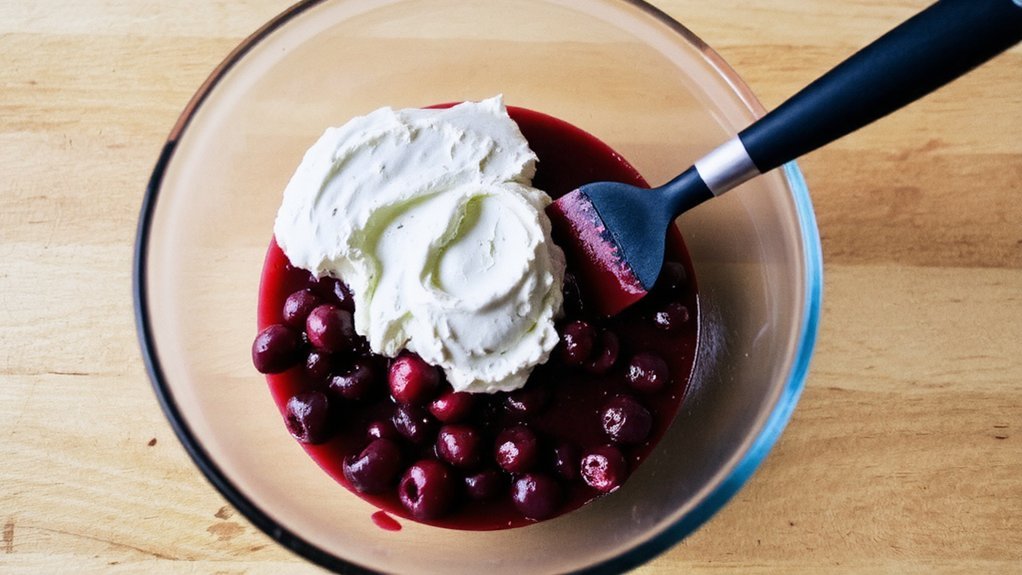

Key Takeaways
- Insert spatula vertically through the center, scrape the bottom, and fold the mixture upward while rotating the bowl.
- Use a gentle, deliberate folding motion at approximately one second per fold to preserve air pockets and volume.
- Continue folding until streaks disappear and ingredients integrate, but stop before the mixture loses visible air and lightness.
- Maintain an ideal spatula angle with consistent, controlled movements to protect the delicate structure and prevent deflation.
- Avoid vigorous stirring, rushing motions, or overworking the mixture, which collapses aeration and creates dense, flat baked goods.
Why Folding Technique Matters in Baking
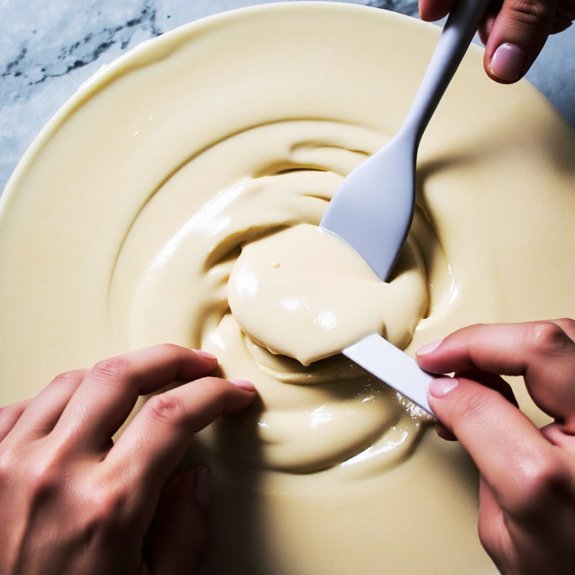
When you’re working with delicate batters or whipped egg whites, the folding technique you choose will directly impact your final product’s texture and rise.
Improper folding deflates air pockets you’ve carefully incorporated, resulting in dense, flat baked goods.
You’ll compromise the aesthetic finish and create an undesirable crumb structure.
Correct folding preserves volume while combining ingredients uniformly.
This matters because you control moisture distribution and gluten development, which directly affect your bake’s final quality.
A properly folded batter yields light, airy cakes and pastries with superior texture.
Additionally, proper technique influences the staling rate of your finished product.
Well-folded batters produce baked goods that maintain their moisture and freshness longer, giving you greater freedom to bake ahead without sacrificing quality.
Essential Tools You’ll Need for Folding
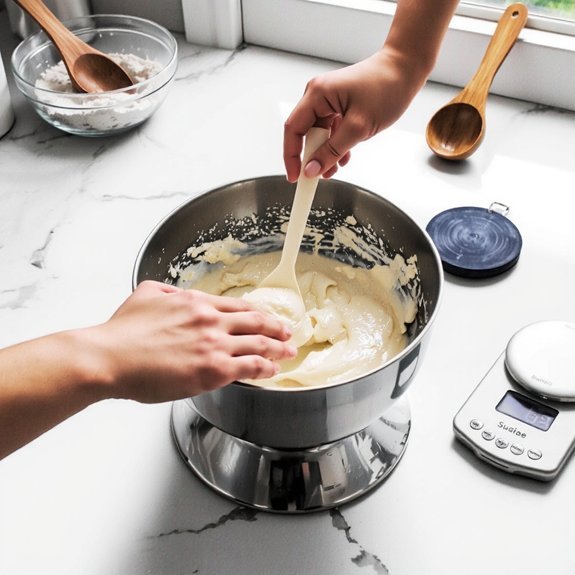
The right equipment makes folding easier and more effective.
You’ll want a silicone spatula as your primary tool—its flexibility allows you to cut through mixtures without deflating them while its heat resistance handles warm ingredients.
Choose one with a sturdy handle for better control.
A bench scraper serves as your secondary option, particularly useful for scraping bowl edges and incorporating stubborn pockets of unmixed ingredients.
Its rigid design excels at reaching corners where spatulas struggle.
You’ll also need a mixing bowl large enough to give you maneuvering space without crowding.
Avoid metal bowls; glass or ceramic provides better visibility of your folding progress.
These three essentials—silicone spatula, bench scraper, and appropriate bowl—form your complete folding toolkit.
Quality matters here; invest in durable, professional-grade tools that’ll serve you reliably through countless batches.
Understanding the Difference Between Folding and Mixing
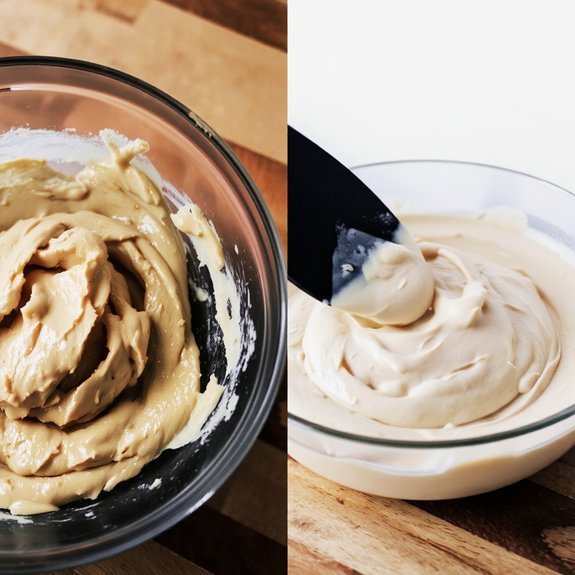
When you fold ingredients, you’re preserving air pockets and maintaining a delicate texture by gently combining components with minimal stirring motion.
Mixing, by contrast, thoroughly combines ingredients through vigorous stirring or blending, which breaks down air bubbles and fully incorporates all components.
You’ll choose folding when you need to retain lift and structure—such as with whipped egg whites or whipped cream—and mixing when you want complete, uniform incorporation.
Folding Preserves Air and Texture
Distinguishing folding from mixing is essential because these techniques produce fundamentally different results in your batter or mixture.
When you fold, you’re preserving the air you’ve worked to incorporate, maintaining bubble integrity throughout your preparation.
Here’s what happens when you fold correctly:
- You protect existing air pockets from deflating, which directly affects your final crumb structure
- You gently combine ingredients without aggressive stirring that’d collapse bubbles and compromise texture
- You achieve lighter, airier results in cakes, soufflés, and mousses that’d otherwise become dense
Folding respects the work you’ve already done.
Mixing, conversely, breaks down that structure through vigorous action.
Your choice between these techniques determines whether you’ll get delicate, tender results or denser outcomes.
Master folding, and you’ll control your texture destiny.
Mixing Combines Ingredients Thoroughly
Mixing combines ingredients through vigorous, continuous action that thoroughly distributes components and creates a homogeneous blend.
You’ll employ this technique when you need complete integration rather than texture preservation.
When you’re working with emulsion science—like combining oil and water-based ingredients—mixing breaks down large particles into smaller ones, facilitating molecular bonding.
You’re applying consistent mechanical force that overrides natural separation tendencies.
Viscosity control becomes critical during mixing.
You’ll adjust your mixing speed and duration based on ingredient thickness and desired consistency.
Thicker mixtures require more aggressive action, while delicate components might need moderate speeds.
You’ll recognize successful mixing when you can’t distinguish individual ingredients visually.
This contrasts sharply with folding, which you’ll use when preserving air incorporation and texture takes priority over thorough blending.
Step-by-Step Folding Method
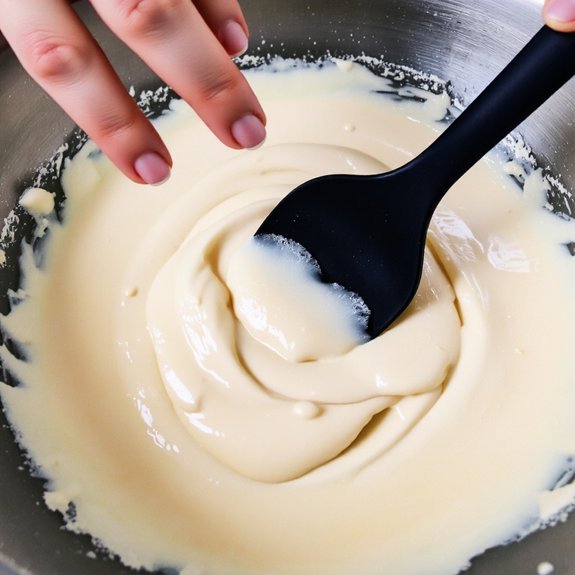
To fold ingredients effectively, you’ll need to master a simple three-motion technique.
Unlike mixing, folding preserves airiness and structure in your mixture.
- Hand placement: Position your spatula vertically through the mixture’s center, scraping the bottom and folding upward. Rotate the bowl a quarter turn with your other hand.
- Motion rhythm: Establish a consistent, deliberate pace—not rushed, not sluggish. Each fold should take about one second, maintaining steady control throughout the process.
- Repetition: Continue folding until ingredients integrate without overmixing. You’re aiming for visible streaks to disappear while preserving volume and texture.
Your freedom lies in knowing when to stop.
Overzealous folding destroys the delicate structure you’ve worked to build.
Trust your instincts and keep movements controlled.
Common Folding Mistakes to Avoid
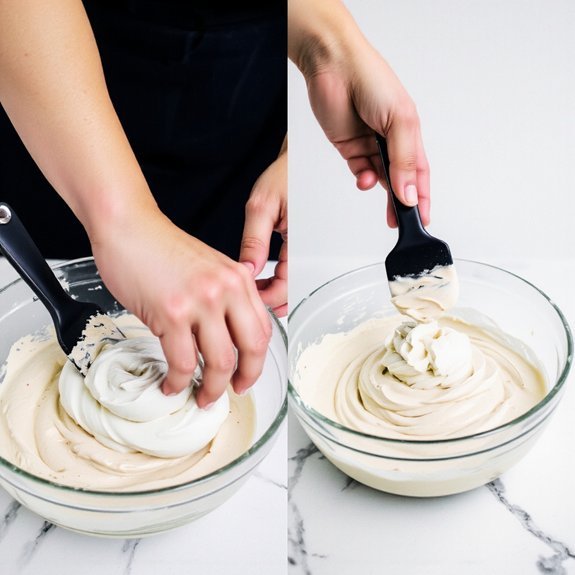
Even though you’ve mastered the basic folding technique, several common errors can sabotage your results. Ignoring sifting before folding introduces lumps that resist incorporation, creating uneven texture in your final product.
Many home cooks commit the wrong motion mistake—using vigorous stirring instead of gentle sweeping strokes. This aggressive approach deflates whipped eggs or cream, compromising your dish’s structure and rise.
Folding too quickly prevents proper ingredient distribution. You’ll end up with pockets of unmixed components rather than a cohesive batter.
Conversely, overfolding defeats your purpose entirely by breaking down aerated mixtures you worked to incorporate.
Temperature mismatches also sabotage success. Cold ingredients resist folding; bring them to room temperature first.
Finally, don’t fold in a shallow bowl—you need adequate depth and space for proper technique execution.
Folding Different Ingredients Successfully
Why do whipped egg whites require different folding techniques than chocolate ganache?
Each ingredient’s density demands precise handling to maintain structure and volume.
When you’re folding delicate components, you’ll want to control your technique based on what you’re combining:
- Whipped egg whites: Use a spatula to cut down the center, sweep across the bottom, and fold upward in one continuous motion—this preserves air pockets essential for leavening.
- Frozen berries and citrus zest: Fold these gently at the final stage to prevent crushing and color bleeding; incorporate them last to maintain integrity.
- Chocolate ganache: This denser mixture tolerates more vigorous folding, allowing you to combine it with other components without risk of deflation.
Matching your folding method to each ingredient’s properties guarantees ideal results.
Practice Tips for Mastering the Technique
Consistent practice with controlled repetition will sharpen your folding skills faster than occasional attempts.
Consistent practice with controlled repetition sharpens folding skills far more effectively than occasional attempts.
You’ll develop muscle memory through timed repetitions, gradually improving your speed and finesse.
Start by practicing with low-stakes ingredients like whipped cream or beaten eggs, then progress to delicate batters and folded meringues.
Video review proves invaluable for identifying your technique’s weaknesses.
Record yourself folding, then analyze your movements critically.
Are you overworking the mixture? Is your spatula angle ideal? This self-assessment accelerates your learning.
Set specific practice goals—perhaps folding ten batches with decreasing times.
Challenge yourself to maintain consistency while increasing efficiency.
Work with a partner who can provide objective feedback on your form and results.
Master this fundamental technique, and you’ll command greater control over your baking outcomes.
Frequently Asked Questions
How Long Can Folded Batter Sit Before Baking Without Losing Volume?
You’ve got approximately 15-20 minutes before your folded batter loses significant volume.
Don’t waste time—get it into the oven immediately after folding.
Refrigeration effects’ll slow decomposition of leavening agents, extending your leavening lifespan to roughly 30 minutes if you’re desperate.
However, you’re sacrificing ideal rise and texture.
Temperature fluctuations accelerate gas escape, so you’re better off baking fresh.
Keep your batter at room temperature and work efficiently for best results.
Can I Fold Ingredients by Hand Instead of Using a Spatula?
Yes, you can fold by hand, though it’s riskier than using a spatula.
Your hand technique won’t match a tool’s precision—you’ll deflate your mixture faster with excessive pressure.
A spatula gives you better control and consistent results.
If you’re committed to hand folding, use a light touch, work deliberately, and minimize strokes.
The tool comparison’s clear: spatulas preserve volume better, giving you the freedom to achieve reliable, professional outcomes.
What’s the Best Temperature for Ingredients Before Folding Them Together?
You’ll achieve ideal folding results when you’re working with room temperature ingredients, as they blend smoothly without resistance.
Chilled ingredients can create lumps and uneven incorporation since they don’t combine as readily.
If you’re folding delicate mixtures like whipped egg whites into batter, guarantee both components reach similar temperatures first.
This approach gives you maximum control over your final texture and consistency, delivering the freedom to execute professional-quality results every time.
How Do I Know When I’ve Folded Enough Without Overdoing It?
You’ll know you’ve folded enough when you’ve reached the ribbon stage—where your mixture flows in smooth, continuous ribbons from your spatula.
Stop folding once you’ve eliminated most visible streaks, but don’t chase perfection.
A few faint streaks won’t compromise your results.
Over-folding deflates your carefully incorporated air, ruining your texture.
Trust your instincts; you’ve got this.
Can Folding Techniques Be Applied to Non-Baking Recipes or Dishes?
You can absolutely apply folding techniques beyond baking.
When you’re preparing salad folding, you’ll gently combine delicate greens with dressing, preserving texture and preventing bruising.
For pasta coating, you’ll fold sauce into noodles using the same deliberate motion—cutting down the center, sweeping across the bottom, and turning the bowl.
This hands-on approach gives you complete control over your dish’s final consistency and presentation, ensuring every component integrates perfectly without compromising quality.



Leave a Comment